




Abstract
Hormesis is a common phenomenon in a number of biomedical areas. However, the basic nature of this phenomenon remains largely unknown. Therefore, significant uncertainty is inevitable in attempts to apply hormesis as a pro-health and anti-aging tool. Evidence supporting that hormetic-like effects may be the result of a generalized whole-organism adaptive epigenetic response is reviewed. Specific hormesis-inducing interventions during development would allow to achieve an optimal balance between activation and repression of various genes and thus to prevent age-related degenerative diseases and slow aging. The reasons that oscillating temperature mild stress could potentially be used for human application are discussed.
INTRODUCTION
Hormesis (the shape of the dose–response patterns when low doses elicit an adaptive response of the cell/organism) is a common phenomenon in a number of biomedical areas (Calabrese et al 2007; Hoffmann 2009). The basic nature of this phenomenon remains largely unknown. Therefore, significant uncertainty is inevitable in attempts to apply hormesis as a pro-health and anti-aging tool.
HORMESIS: A KIND OF ADAPTIVE EPIGENETIC RESPONSE?
A number of recent findings are consistent with hypothesis that epigenetic alterations early in life can have a life-long lasting impact on gene expression and thus on the phenotype (Delcuve et al., 2009; Waterland 2009). These alterations affect the gene expression by influencing DNA methylation, chromatin remodeling and microRNA-regulated transcriptional silencing without changes in DNA sequence. The idea that epigenetic modifications could be adaptive is very controversial. Nevertheless, convincing data were obtained showing that environmental stress can induce specific and predictable epigenetic changes that eventually result in an adaptive response to the stimulus (Jablonka and Lamb 1989). Most of these stress-induced modifications are reset to the basal level once the stress is relieved, while some of the modifications may be stable.
It seems likely that mild stress-induced hormetic response involves mechanisms similar to those that underlie developmental epigenetic adaptations. The whole-organism epigenetic transcriptional reorganization appears to be a common mechanism underlying all hormetic and lifespan-extending effects. Large-scale changes in gene expression were repeatedly found in a number of hormetic interventions including irradiation, both heat and cold shocks, repeated mild heat stress, dietary restriction, hypergravity (for review see Vaiserman, 2008), and antioxidant supplementation (Brack et al., 1997). Scott et al (2009) suggested that the hormetic effect may be attributed to induction of the adaptive-response genes due to a long-lasting epigenetic memory: once threatening damage of the nuclear DNA occurs, it is quickly recognized with subsequent, rapid up-regulation of the adaptive-response genes.
EARLY-LIFE-INDUCED HORMETIC EFFECTS IN HUMAN POPULATIONS
The dysregulations in epigenetic control appear to have a profound impact on both aging and age-related diseases including atherosclerosis, cancer, neurodegenerative diseases, and type 2 diabetes (Budovsky et al. 2006; Wolfson et al. 2008; Waterland 2009). Prenatal stress and early post-natal influences have well established long-term consequences and there are some indications that the impact of early environmental stress is observable until senescence (Pardon and Rattray 2008). Mild stress could have beneficial effects on the ageing process; the mechanisms underlying such benefits may be associated with an increased ability to adapt to stress (Frolkis 1993). Remarkably, both hormetic and lifespan-extending interventions seem to be more efficient if they are applied earlier in life (Burger et al., 2007; Mangel 2008).
The early-life stressful environments may cause hormetic effects in human populations. In particular, the early-childhood microbial exposures can be protective against subsequent allergy (Bukowski and Lewis 2003) and even cancer. For example, children who attend daycare in their first few months are much less likely to develop leukemia than those who stay at home (Marshall 2008). Yashin et al. (2001) raised the possibility that at least part of today's centenarians paradoxically originated from an initially frail part of the cohort. The authors suggested that an originally more vulnerable (and primarily more labile) organism may improve the quality of its own response to stress compared with an originally more robust (and primarily more stable) organism, because of a better-trained vascular and other systems. This may result in a survival advantage at older ages to the originally more vulnerable organisms. The ‘epigenetic explanation’ was proposed by Arking and Giroux (2001) for the phenomenon of late-life mortality-rate plateau (paradoxical slowing of mortality rate at older ages). The authors suggested that this could be attributed to epigenetic response to a wide variety of environmental stressors with subsequent transient increase in the basal level of expression of the antioxidant and heat shock protein genes in the long-lived subset of the population. As a result, the hormetically-induced subpopulation exhibits a reduced late-life mortality rate.
Long-term epigenetic adaptations to an actual environment occur mainly during critical (sensitive) developmental phases (Tzschentke 2007). However, later stages of life also seem to be ‘epigenetically plastic'. For example, epigenetic differences can arise during the lifetime in monozygotic twins (Fraga et al. 2005).
Taken together, the above findings suggest that longevity hormesis may be the result of a generalized whole-organism adaptive epigenetic response and therefore can be considered as a kind of adaptive life-history strategy (fig. 1). From this point of view, some diseases, e.g., cancer, could be a by-product of epigenetic adaptation (Blagosklonny 2002).
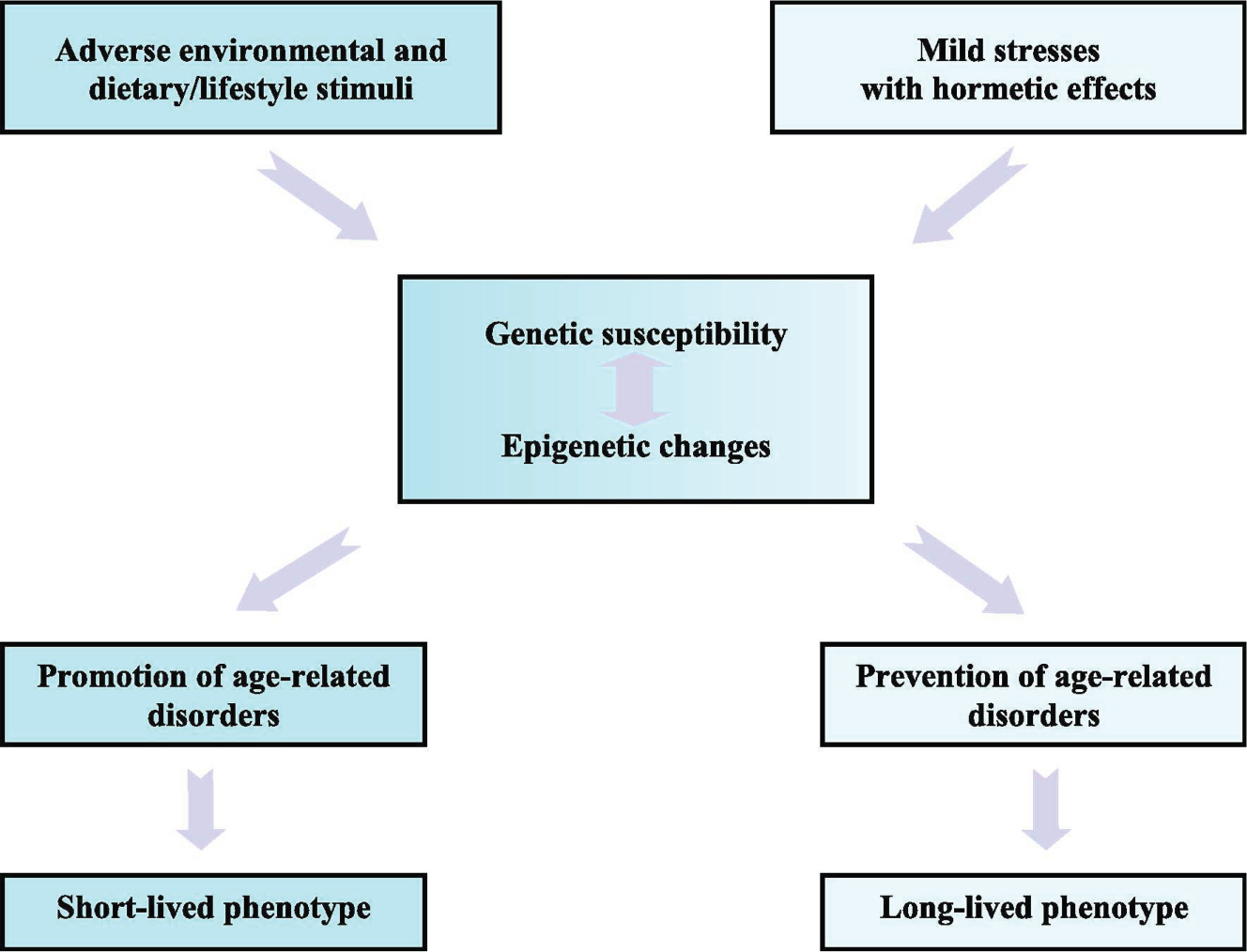
The figure illustrates the involvement of hormesis in the epigenetic processes determining age-related disorders and longevity.
IMPLICATIONS FOR HUMAN HEALTH AND LONGEVITY
Aging is associated with a decrease in adaptive abilities and the increased vulnerability to stress. On the other hand, aging is a complex process involving a persistent activation of some stress responsive systems, which can be consider a ‘geroprotective’ adaptation (Frolkis 1993). The hormetins [agents that induce hormesis (Hoffmann 2009)] can stimulate the self-maintenance and repair pathways, which increase adaptive abilities and thus delay senescence. Aging, rather than changes in individual cells, tissues, or organs, may be more a consequence of the deterioration of integrative mechanisms (Shock 1977). The hormetic response also suggested to be regulated by integrative mechanisms (Neafsey 1990). Therefore, search for anti-aging treatments will likely be more effective by utilizing the hormetic response. For the promotion of health, hormetins can induce the body's capabilities in good balance with numerous interacting metabolic processes to combat more severe stresses (Goto 2004) and to protect against age-related chronic disorders including metabolic and cardiovascular diseases, cancer and neurodegeneration (Mattson, 2008).
A question arises: what kind of mild stress would be most useful for human health improvement? There is considerable body of evidence that therapeutic doses of low-level ionizing radiation could be beneficial (Cameron 2005). However, there is widespread public and medical professionals alarm about radiation health hazards, especially those that cause cancer. Therefore, the low-level radiation does not seem to be suitable for practical use at present. Alternatively, another kind of mild stress, e.g., repeated mild heat stress, seems to be appropriate for application in humans (Rattan et al., 2009). Oscillating temperature seems to be even more appropriate. Convincing evidence was obtained in experimental studies demonstrating that developmental oscillating temperature can be an effective tool for lifespan extension (Soliman and Lints 1982; Economos and Lints 1986). Drosophila melanogaster males tended to live longer when larvae were reared under oscillating 21/25°C (mean lifespan = 67.8 ± 12.6 days) than when they were reared at a constant 23°C (mean lifespan = 59.0 ± 14.3 days) (Economos and Lints 1986). The authors concluded that such results are in agreement with the hypothesis of epigenetic influence on life span by alternating developmental temperature. The alternating temperature resulted in increase in not only lifespan but also male and female reproductive potential in fruit fly Anastrepha fraterculus (Cardoso et al. 2002). Incubation of Caenorhabditis elegans at the repeated temperature fluctuations between 12 and 25°C induced stress-responsive gene expression that led to significant lifespan extension (Galbadage and Hartman 2008).
This could also be applicable for the people. Sharp temperature alteration such as ice-hole swimming after the sauna is important component of the Russian traditional healthy life-style. Certainly, it is necessary to begin such training under the control of the physician and the highest effect could be expected when it starts in early childhood. Because heat shock protein response is a common feature of various stresses, adaptation to extreme temperatures could be translated into adaptation to other stresses, especially in human populations where modern cultural processes tend to minimize exposure to abiotic stressful conditions (Parsons 2000).
If induction of transcriptional reprogramming really is a key mechanism of early-life programming of health and longevity, then specific interventions during development would allow to achieve an optimal balance between activation and repression of various genes and thus prevent age-related degenerative diseases and slow aging. Future studies could provide the basis for identifying therapeutic targets focusing on epigenetic prevention of age-related diseases and human lifespan extension.
Footnotes
ACKNOWLEDGEMENT
I would like to thank Dr Kh. K. Muradian for helpful discussions and comments on the manuscript.