




Abstract
Digital avulsions and amputations are not uncommon in outdoor activities. Rope entanglement is often the cause, though specific descriptions of the mechanism of injury have not been reported. We report a common scenario where entanglement during a fall resulted in an amputation injury. Although any roping activity may cause a loop formation leading to digital entrapment and subsequent amputation injury, activities involving soft and loose ropes may increase the chances of injury. Rope slack is to be avoided to minimize the likelihood of entanglement. This case report describes a digital amputation during an indoor climbing incident and also describes a possible mechanism for such injuries.
Introduction
Avulsions and amputations of digits are common. 1 Digital-entanglement injuries involving ropes have been reported in rodeos 1 –3 and waterskiing and during use of animal leads or reins. 4 –6 In all these activities, great force may avulse entrapped body parts caught in ropes. We report a case of a young rock climber who sustained a near-complete amputation of his dominant index finger when his hand was entangled in a rope during a fall.
Case report
An 18-year-old otherwise healthy, right-hand dominant, experienced rock climber was climbing at an indoor climbing wall. After leading a 12-m long climbing route, he attempted to use his left hand to clip the rope into the anchor carabiner at the end of the route, 2 m above the last protection. During this maneuver, he lost balance and fell approximately 5 m before he was caught by the dynamic climbing rope. During falls, experienced climbers are taught to grab the rope approximately 50 cm away from their harness to stabilize their body during the deceleration phase. While attempting this maneuver, the climber's right index and middle fingers became entangled in a loop of the rope. The full force of the fall was thus transferred to his middle and index fingers before being distributed by the harness. This caused a near-complete amputation of the index finger at the distal interphalangeal joint level. Only the flexor digitorum profundus tendon was in continuity, whereas all vessels, nerves, and soft tissue were completely avulsed. A minor soft tissue injury occurred at the middle finger. Because of the mechanism of injury with severely compromised soft tissue as well as delays during transfer resulting in a presentation 12 hours after the injury, a replantation was not attempted and a completion amputation was performed at the distal interphalangeal level. The distal articular surface of the middle phalanx was removed and the soft tissue envelope was closed over the defect. The postoperative course was uneventful.
Discussion
Hand injuries are common in rock climbers. 7 Tenosynovitis, pulley injuries, fractures, joint capsule injuries, and tendon ruptures have all been described. 7 –9 Roping injuries to the digits are also common. 1 –3 This case illustrates how a loop formation that cannot uncoil itself may cause digital entanglement and injury. Although amputations may be caused by different mechanisms of injury, avulsions represent a cause of amputations due to the severe crushing of soft tissues.
Grabbing the rope during a fall is an essential skill that is especially important for climbers in pendulum and long falls to stabilize the body. 10 Mountaineering often requires ascending and descending on fixed ropes, sometimes without special devices. Reduction of the rope slack by the belayer may decrease the likelihood of loop formation. Exactly how an entanglement may cause a complete avulsion has not been fully investigated. Some reports mention inappropriate grip or unspecified entanglement as possible reasons for injury.3,5
We reconstructed the event with a cadaver hand and a dynamic climbing rope, which was wrapped around the index and middle finger in different loops. We could observe 2 different loop formations. A longitudinal force was then exerted on the rope with a 10-kg weight, which was dropped from 50 cm height. Only the down-sided loop remained in place and transferred the energy completely to the digit, whereas the simple loop self-released. We found that a single, down-sided loop without the ability to uncoil when the rope is tightened is capable of entrapping the finger (Figure). This causes a locking-type mechanism. As the rope is tightened further, a bending effect eventually releases the entrapped body parts. During this unwinding, additional shearing forces further damage the fingers. Because the twisting point was confirmed to be at the index finger, we believe that this shearing motion was responsible for the amputation, whereas the initial crushing mechanism might have only fractured the digit. In our evaluation, no other type of loop was capable of irreversibly entrapping a digit. A simple wrapping around of the rope seems inadequate to transfer sufficient energy loads to cause an amputation. We believe that most entanglement injuries are caused by loops that will not automatically unwrap when the rope is tightened.
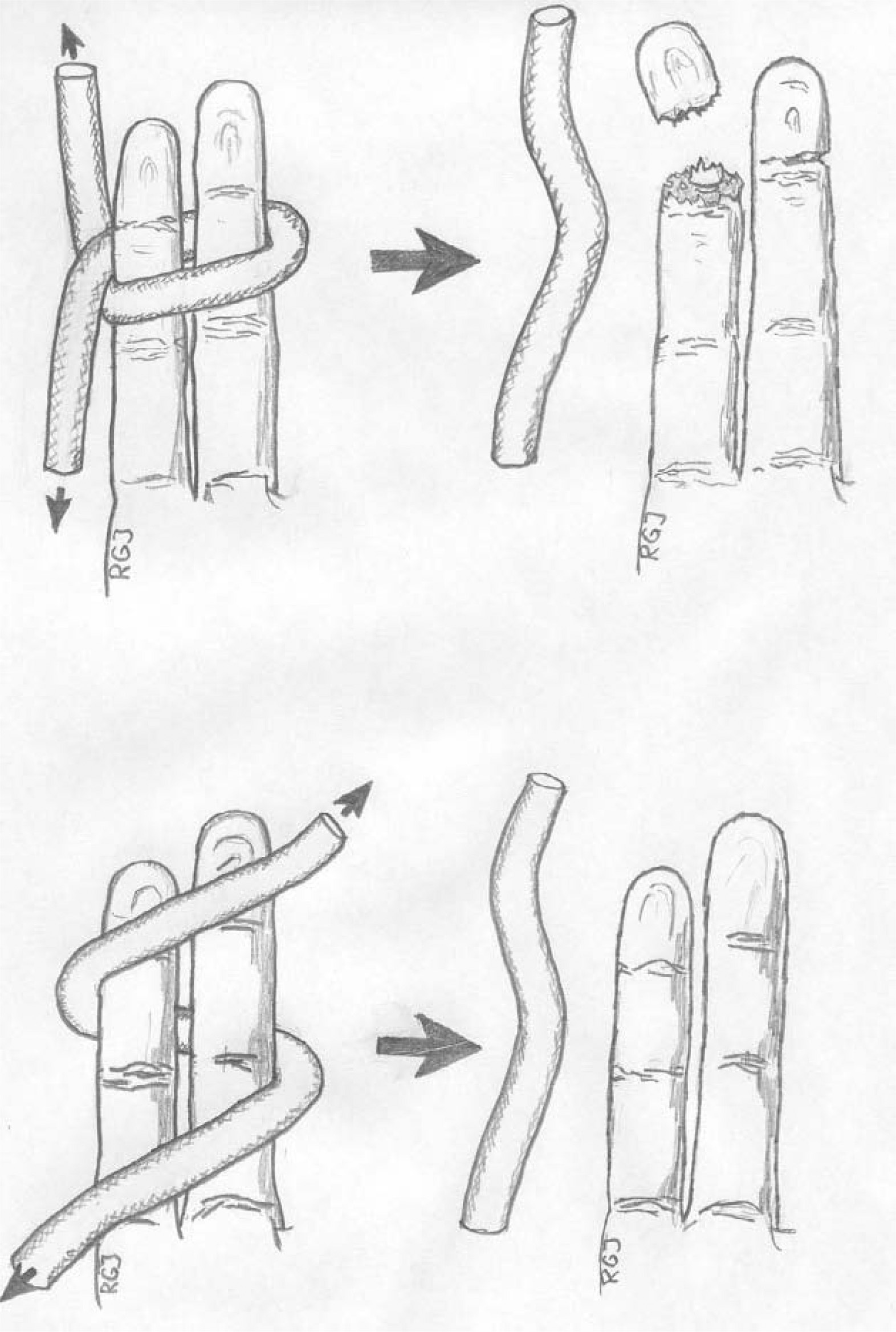
Mechanism of injury. While the second loop formation will uncoil when tightened, the first one will cause a severe crushing injury
Conclusion
The most important prevention of rope-related digital injuries during a fall might be the use of stiffer ropes, which are less likely to form loops when slack. Old ropes, which can be found in commercial indoor gyms, are often coiled as a result of heavy use and thus pose a possible increased threat to the climber. Climbers should grab the rope during a fall in a controlled manner. Reducing rope slack as well as using new ropes that are less likely to coil up will additionally decrease the likelihood of major finger injuries. As the popularity of rock climbing increases, the potential for serious rope-related hand injuries may also increase.