






Abstract
We report a case of a bather injured by a swordfish in shallow water off the coast of southern Brazil. The victim suffered multiple injuries from the fish's bill, including a puncture wound of his left knee and the tip of the bill remaining as a foreign body. The victim made a full recovery after field management and conservative care. The potential factors leading to this most unusual attack are discussed.
Introduction
Billfish are large pelagic fish with a sword-like structure to their snout. They include the Xiphiidae and Istiophoridae families and are migratory species. They live in deep waters and are prized by sport fishermen. The billfish Xiphias gladius (swordfish) belongs to the Xiiphidae family. The other billfish (marlin, sailfish, and spearfish) belong to the Istiophoridae family. 1 , 2 There are only a few recorded cases of human injury or death caused by billfish. 1 – 3 One of the cited references reports that “a swordfish fatally wounded an angler off the waters of Kudat (Malaysia) in 2004 when it suddenly leapt out the water and struck the victim in the chest.” 1
We report an usual case of a bather injured by a swordfish in shallow water off the coast of Brazil.
Case Report
A 44-year-old man was injured while swimming in approximately 1-m deep water near the beach in Matinhos, a town in Paraná state, Brazil. He was swimming with his children, when he saw a “big fin” approaching in waist-deep water. The fish leaped approximately 1 m out of the water and swam between the man and his children.
When approaching the fish, which he thought to be a shark, to protect his children, the man was attacked 3 times by the fish's bill and suffered, in sequence, a puncture in the right thigh, a perforation in the left calf, and transfixion in the left knee, where the bill broke, leaving in place an approximately 10-cm fragment. Other bathers helped bring him and the animal, still stuck to the victim's knee by its bill, from the water (Figures 1 and 2). While the patient was removed from the water, the bill was broken, with retention of a fragment in the knee of the victim.
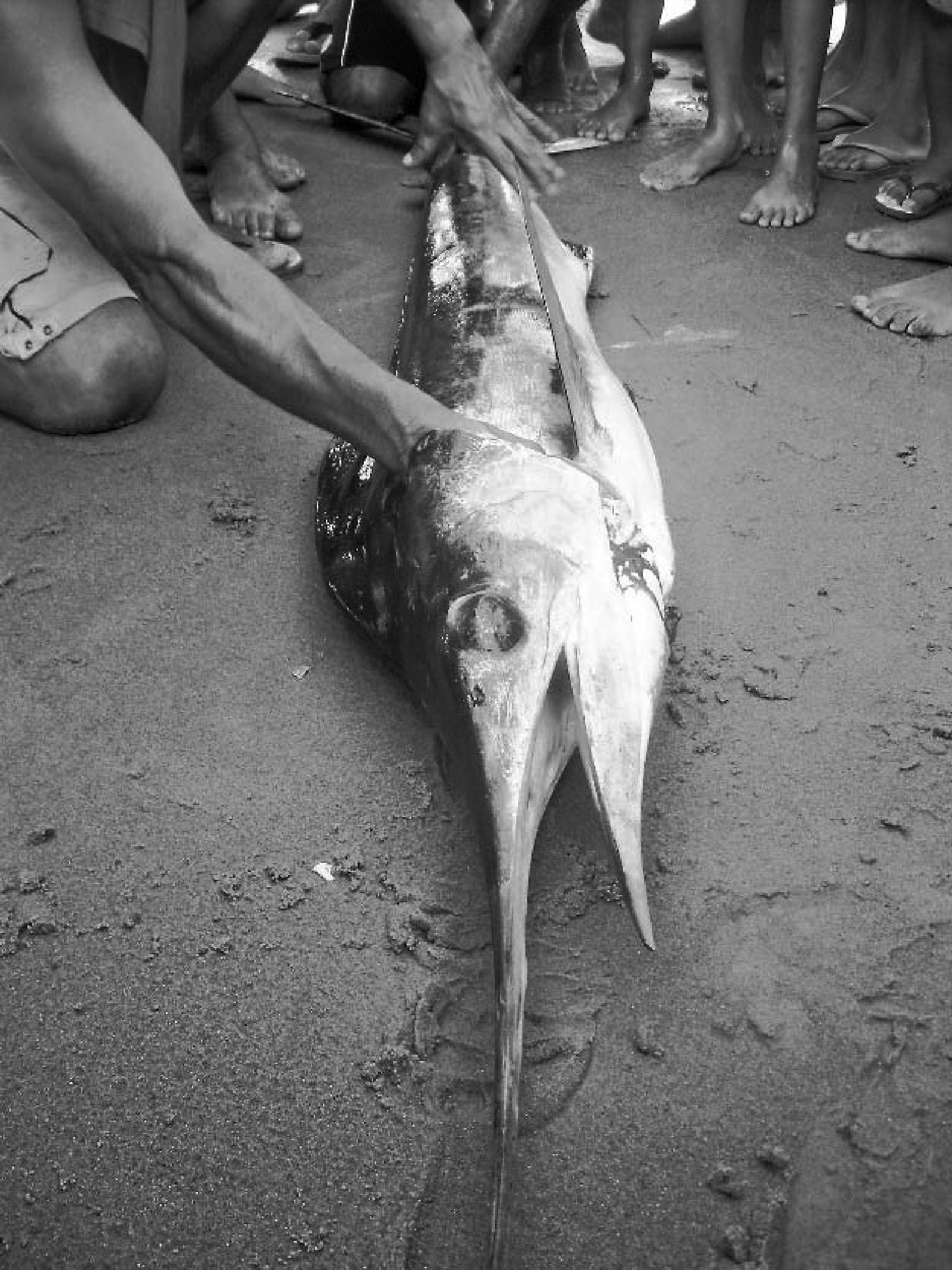
Swordfish (Xiphias gladius) that attacked the bather.
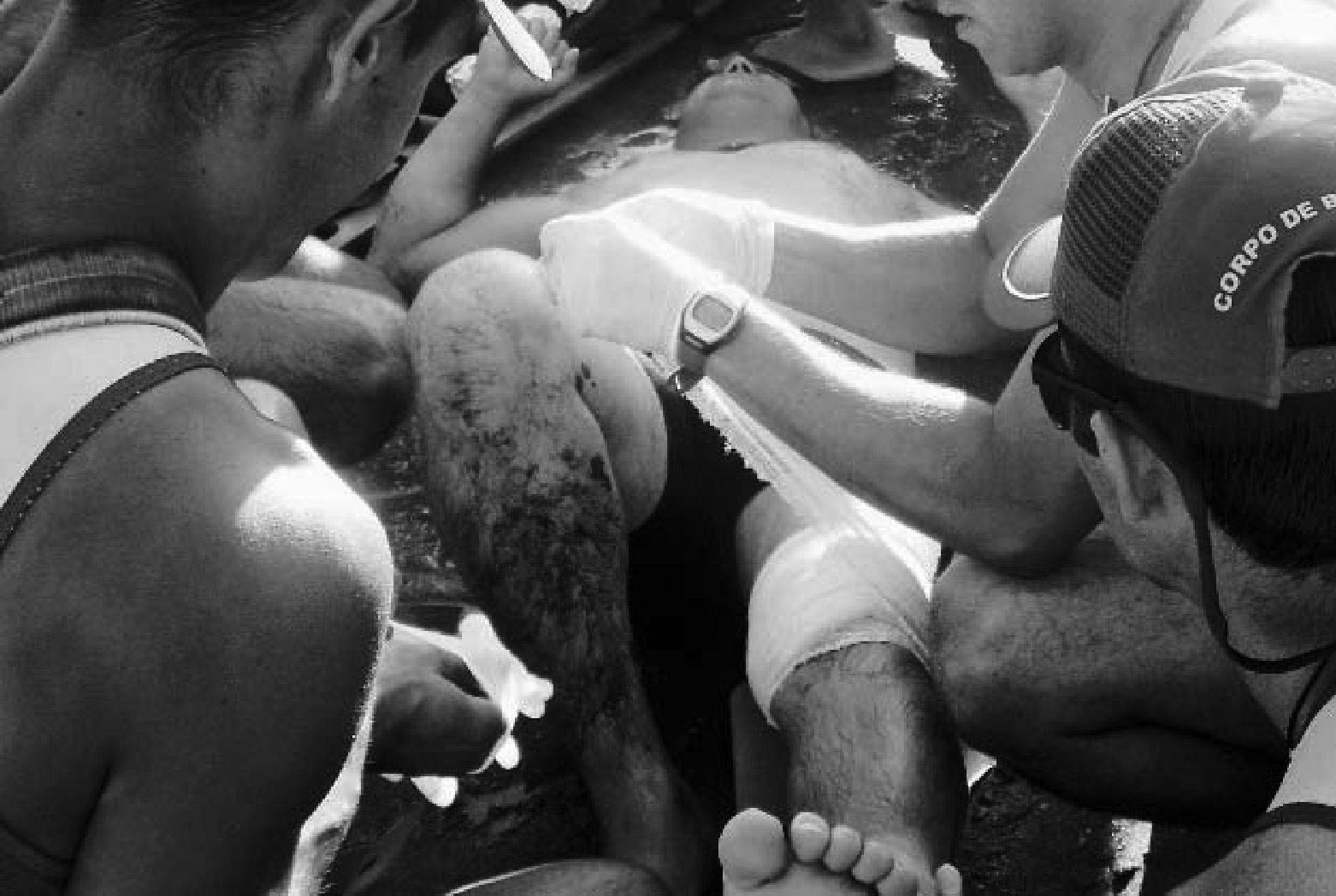
. Bather receiving first aid care on the beach.
The fish was identified as X gladius (swordfish), measuring 1.9 m in length and weighing approximately 40 kg (estimated by the sea lifeguard professionals and supported by the images of the fish). The patient received first aid from the local lifeguard (control of local bleeding, measurement of vital signs, and wound dressings) and was referred to a hospital (Hospital do Trabalhador of Curitiba) specializing in trauma for additional emergency treatment. His vital signs were normal on arrival. Radiographs of his knee confirmed the position of the retained bill fragment (Figure 3) in a superficial, lateral position external to the knee capsule.
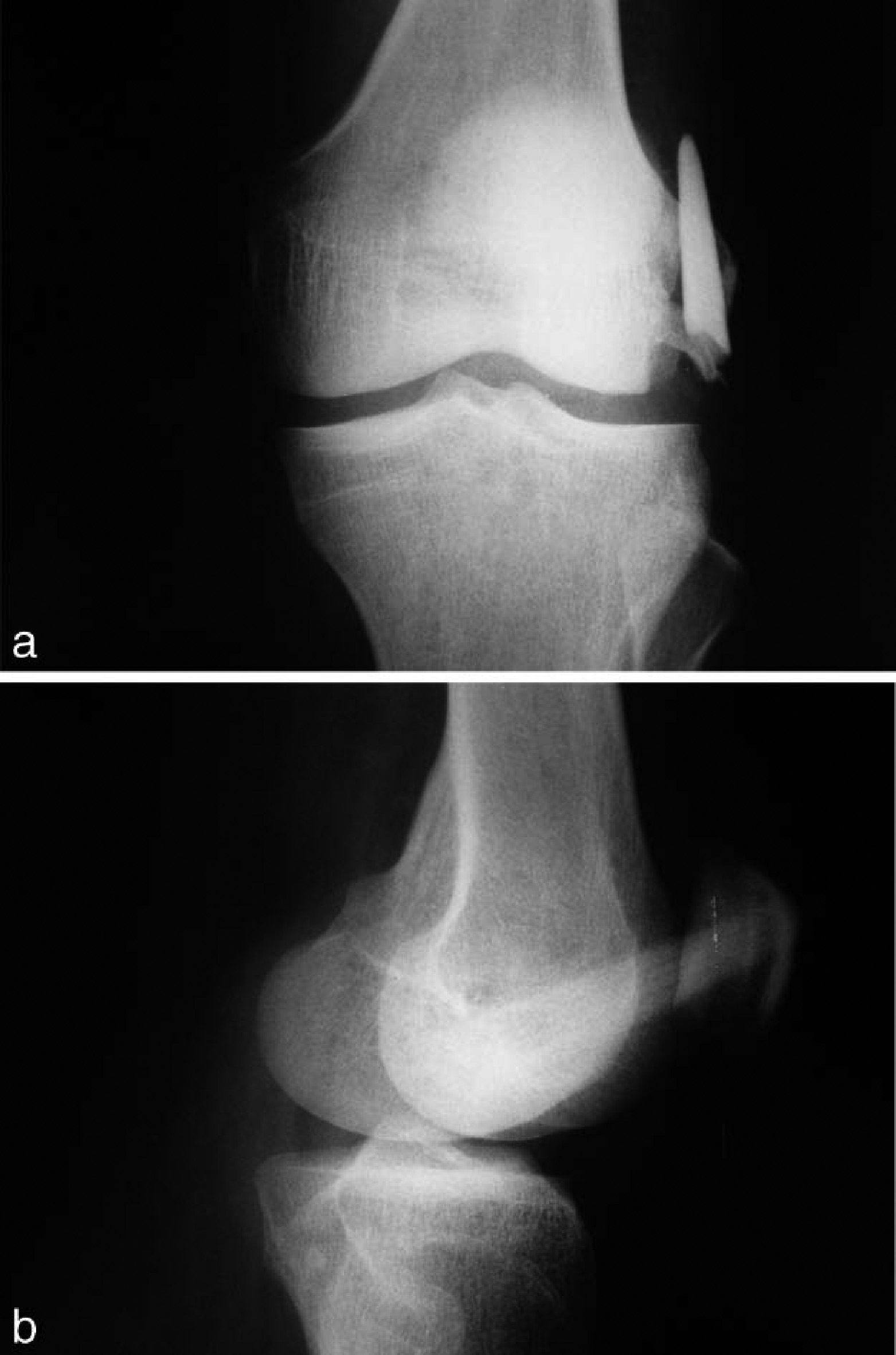
Radiographs of the patient's left knee demonstrating the retained fish's bill fragment (
Management involved cleaning the injuries, irrigating the wounds with clean water, extracting the retained fragment from the left knee, and suturing all wounds. Prophylactic antibiotics were withheld at the discretion of the attending physician. The patient had an uncomplicated course, with complete recovery after approximately 1 month.
Discussion
Although human injuries caused by the bills of fish belonging to the Xiphiidae and Istiophoridae families have been described, only a handful of reports exist, 1 and the author could not find similar published reports in the peer-reviewed medical literature. Swordfish reach a maximum size of 177 in. (455 cm) total length and a maximum weight of 1400 lb. (650 kg). 2 The great member of the family, the blue marlin, can reach 2600 lb, according to the Smithsonian Institute. 2 The bill is an extension of the snout, and it is used to kill prey (other fish and mollusks) and occasionally for defense. 4 This case demonstrates a proven accident, precipitated by the following factors: the proximity of the fish to the beach (it tends to be in depths ≥70 m); the stress to which the fish was submitted when “stranded” in shallow waters; and the victim's attempt to get closer to the animal to protect his children, who were also in the water near the fish.
Sport fishermen who intentionally interact with these fish are likely at some risk for injury from hooked or boated catches, but attacks to bathers must be exceedingly rare, only occurring under very unusual circumstances, such as those in this case.
Footnotes
Acknowledgments
The author would like to thank Lieutenant Rafael Lorenzetto and other members of the Lifeguard Troops of Matinhos (Paraná state, Brazil) for providing information about the accident and photographic records, without which this report would not have been possible. Radiologic examination records were provided by Hospital do Trabalhador of Curitiba City, Paraná state.