






Abstract
Objective
To describe the relative frequency and types of injury and illness in the Newport-Bermuda off-shore yachting race.
Methods
At the end of each race held in even numbered years from 1998–2006, the captain of each boat was asked to complete a survey detailing any injury or illness among his/her crew.
Results
There was an overall 87% response rate to the survey. During the study period, 38 injuries and 57 illnesses were reported for an estimated 8105 sailors, yielding rate of injury or illness of 12 per 1000 races per sailor. Most common were injuries to the upper extremity (47%), and lacerations were the most common type of injury (45%). Sea sickness was the most common illness, and the rate of illness and injury increased in races that took place in heavy weather. Radio consultations were used 4 times, and 3 sailors required transport to a hospital.
Conclusions
The rate of injury and illness was relatively low in the Newport-Bermuda race. Injuries to the upper extremities and lacerations were most common, and sea sickness was the most common illness. The majority of illness and injury can be initially managed onboard.
Keywords
Introduction
First held in 1906, the biennial Newport to Bermuda race is one of the oldest and most challenging yacht races in the world. The 635 nautical mile course crosses the Gulf Stream where temperature gradients between the powerful warm water current and cooler surrounding waters often generate squalls with strong winds and high seas. Though participation varies, nearly 2000 sailors have entered each of the last 5 races, with roughly 90% of the competitors being experienced amateurs and 10% being professional sailors. While numerous deaths have been documented in other ocean races, there has been only 1 life lost in the 100-year history of this race, which was in 1932 when the last crew member failed to jump successfully from the burning yacht Adriana. 1
The safety requirements for yachts and crew are stringent. There are detailed structural specifications for the boats, life rafts, safety harnesses, personal flotation devices (life jackets), emergency position transponders, radio communications equipment, and medical kits. Thirty percent of each yacht's crew must attend a safety seminar before the race. 2
An “Accident, Gear Failure, Injury and Illness” survey was begun by the Newport-Bermuda Race Committee in 1998. Since the year 2000, the results of this survey have been presented in each safety seminar to encourage risk aversive behavior and to help competitors prepare for expected medical problems. Cumulative injury and illness data from the survey, presented here, may help other offshore racers and regatta organizers by describing the mechanisms, patterns, and incidence rates of injury and illness encountered during the last 5 Newport-Bermuda Races.
Materials and methods
This was a prospective observational study of injuries and illnesses sustained during the Newport to Bermuda yacht race. The study was presented to the Institutional Review Board at Rhode Island Hospital and exempted from review. In the races of 1998, 2000, 2002, 2004, and 2006, the captain of each competing yacht was asked to complete a confidential, multiple-choice questionnaire regarding injuries and illnesses reported by his/ her crew during the race. The questionnaires were collected by the race duty officer in Bermuda as part of the postrace checkout process from race finishers and those who withdrew from the race and crossed the finish line under engine power. Questionnaires were not collected from boats that withdrew but did not proceed to Bermuda.
Medical conditions were denoted according to type and anatomic location and classified according to 3 categories of medical care: (1) first aid on board, (2) medical assistance by radio, and (3) evacuated to a medical facility. One question asked about factors contributing to each injury, and provision was made for a free-text description of each incident. The responses were manually entered into an Excel spreadsheet (Microsoft Corp., Redmond, WA).
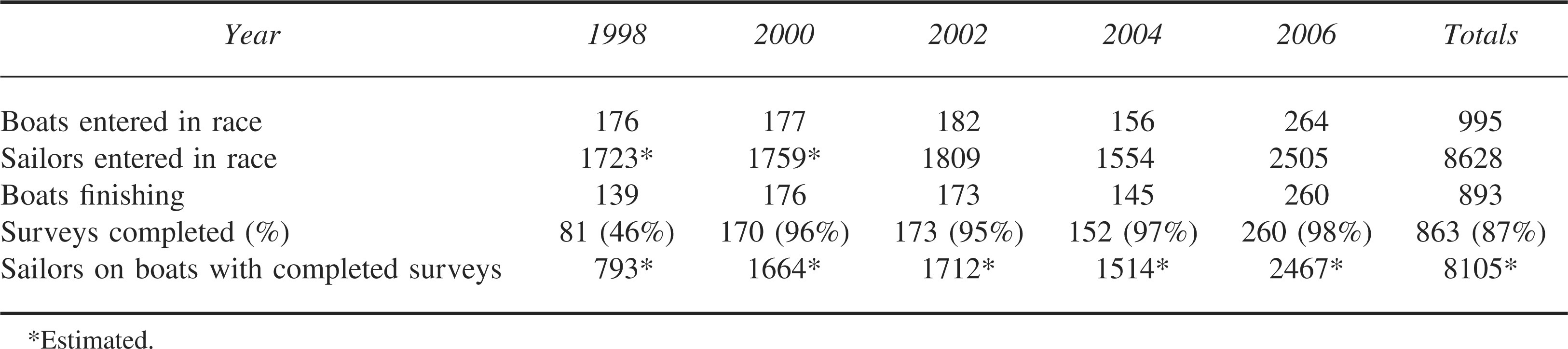
The numbers of yachts and competitors in each race were determined from the Newport-Bermuda Race records kept by the chairmen of each race and deposited in the Cruising Club of America Archives in Mystic Seaport, The Museum of America and the Sea, Mystic, Connecticutt. While the number of boats entered in the 1998 and 2000 races is known, the actual number of sailors for the years 1998 and 2000 was not available. An estimate of the number of sailors for 1998 and 2000 was calculated by determining the average number of sailors per boat between 2002 and 2006 (9.79 sailors/boat) and multiplying that average by the number of boats that entered the race in 1998 and 2000.
While the number of boats whose captain returned a survey is known for each year, the exact number of sailors on those boats is not known. The number of sailors on boats for which a survey was completed was estimated by multiplying the average number of sailors per boat for a given year by the number of boats for which a survey was completed that year (Table 1).
Boats and crew in the 1998–2006 Bermuda races
Results
During the study period, 955 boats entered the race, 893 boats completed the race, and 863 “Accident, Gear Failure, Injury and Illness” surveys were completed (response rate 87%). During this period, 38 injuries and 57 illnesses were reported from among an estimated 8105 sailors. The overall rate of injury or illness was 12 per 1000 races per sailor, with a range from 3 per 1000 in 2004 to 23 per 1000 in 2002.
Injuries
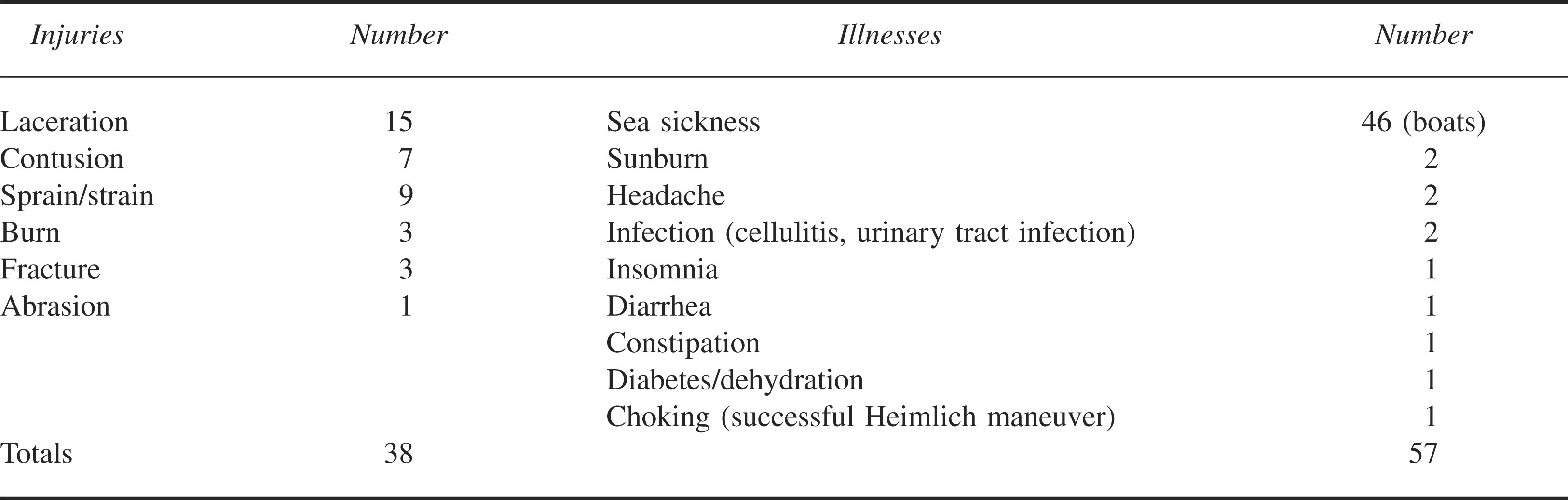
The most frequent injury location was the upper extremity, with 14 of the 38 injuries occurring to the fingers and 4 to the hand. The lower extremity, the head and face, and the spine had 8, 6, and 5 injuries, respectively, and 1 injury occurred to the abdomen.
Cuts and scrapes accounted for half of the injuries, a cut on the finger being the most common injury. The 6 spine injuries (neck and back) were categorized as “strains.” Injuries to the face and head were cuts, scrapes, and bruises. There were 3 fractures: 2 to the fingers and 1 to the foot. There were also 3 burns: 2 at the galley stove and 1 rope burn (Table 2).
Types of injuries and illnesses reported in the Newport-Bermuda races, 1998–2006
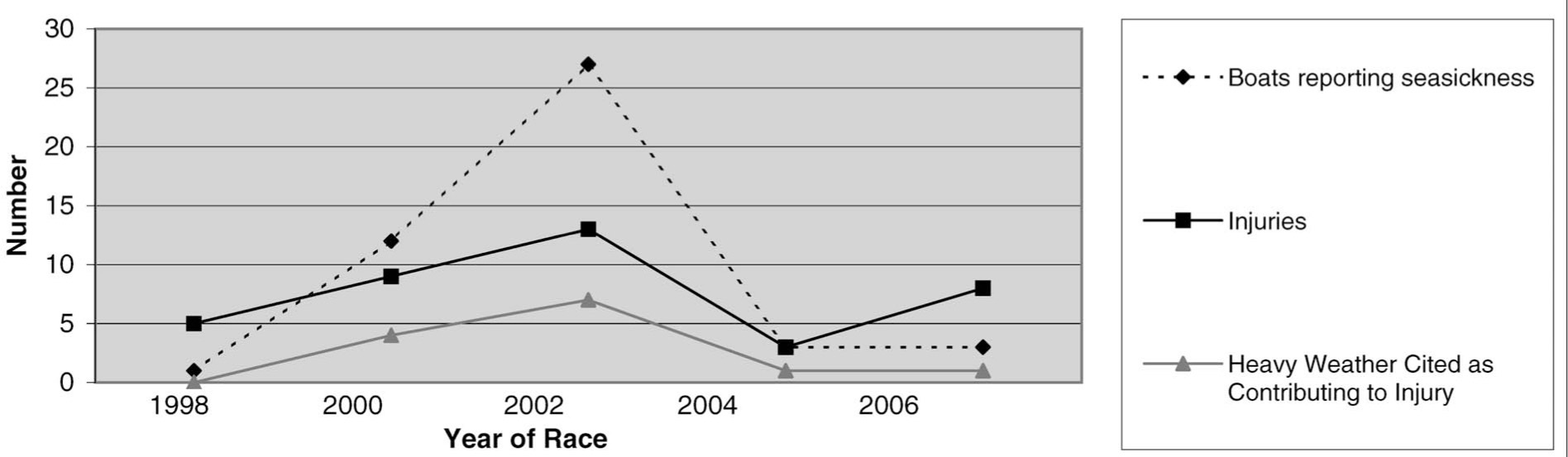
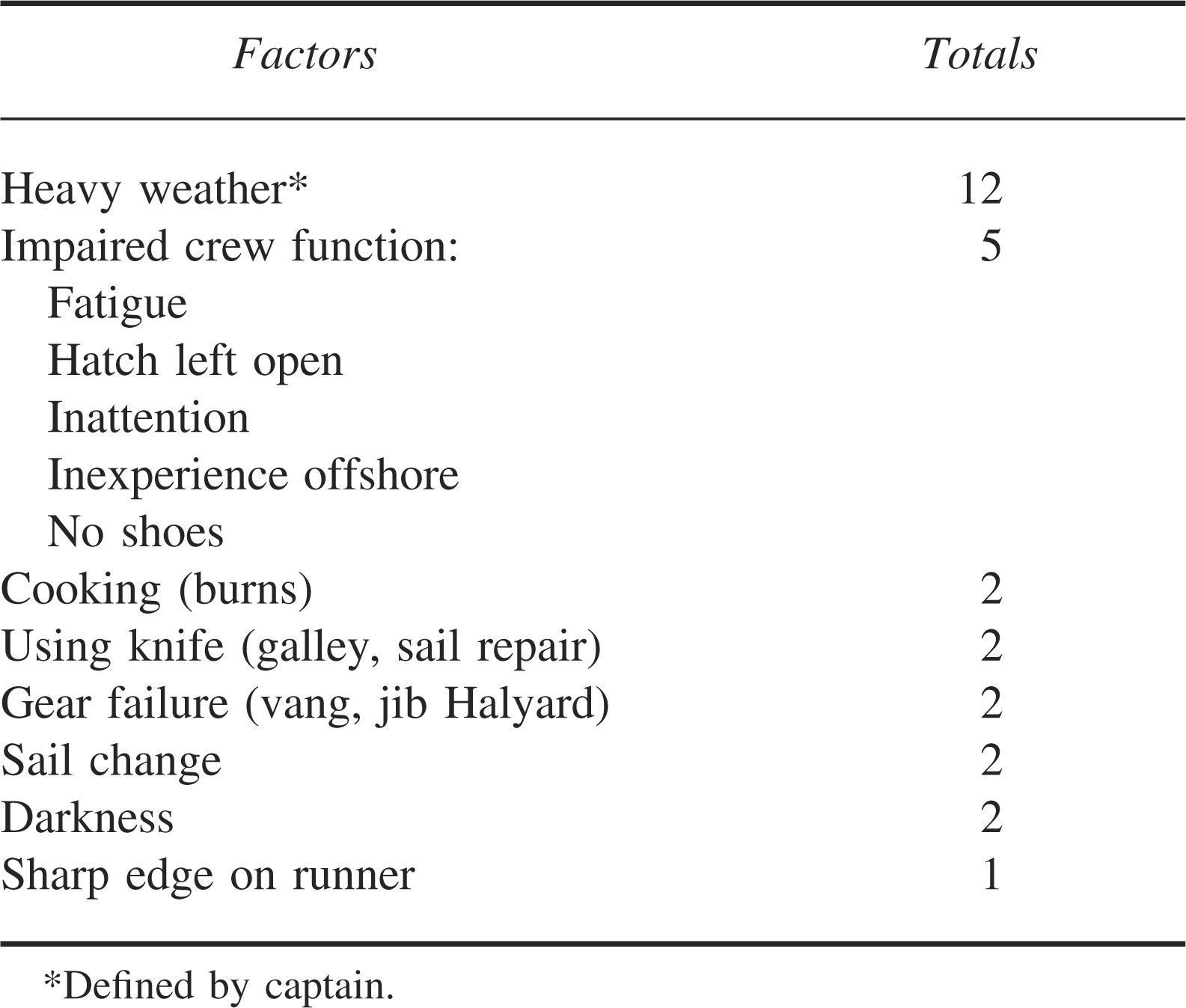
Heavy weather (as defined by each captain), most notable in 2000 and 2002, was the factor most frequently cited as contributing to injury, and correlated with both frequency of injury and sea sickness (Figure). Impaired crew function was the next most likely factor contributing to injury, followed by specific activities such as changing sails, jibing, using a knife, or working in the galley. There were also injuries related to failure of boat gear and darkness (Table 3).
Factors contributing to injury
Radio consultation with a physician was obtained for 2 injuries. In 1998, 2 injured sailors, one with a back injury, the other with a severe finger laceration, were sent to the hospital upon arrival in Bermuda.
Illnesses
Sea sickness (defined/identified by each boat's captain), the most common illness, was reported among 46 boats. Other illnesses are listed in Table 2. There were 2 radio calls for medical consultation: a urinary tract infection and a diabetic with sea sickness and dehydration. The diabetic patient was transported to a hospital upon arrival to Bermuda.
Discussion
Medical care aboard a sailboat at sea presents a number of unique challenges: definitive medical care is often days away; medical supplies are limited; space below deck is cramped and poorly lit; and the motion of the boat may be violent and unpredictable. Furthermore, injuries are most likely to occur during rough weather when members of the crew may be fatigued or seasick. 3 Given the constraints of providing medical care on board, planning and provisioning a vessel for the most likely medical emergencies is of utmost importance.
The results of this survey suggest that the rate of injury and illness in the Newport-Bermuda race is quite low, approximately 12 per 1000 races per sailor. None of the injuries and only 2 of the illnesses (diabetic/dehydration, choking) were potentially life threatening. Out of a total of more than 8000 sailors in 5 races, there were only 4 calls for radio-medical assistance, and only 3 patients requiring transport to a hospital. There were no medical evacuations at sea. While catastrophic injury and death were not reported in our survey, they remain a risk in this sport, particularly when falling overboard or during an accidental jibe, when the boom sweeps rapidly across the cockpit, which can cause severe or fatal head injuries.4,5
The excellent safety record observed during the study period may be due to the culture of safety promoted by the race committee that requires a high level of boat preparation as well as mandatory attendance at safety seminars. While the response rate of the survey was good (87%), it is possible that underreporting from boats failing to complete the survey or failing to complete the race also contributed to the low rate of medical problems observed. Sea sickness was reported per boat, as opposed to per crewmember, so it is likely that this potentially disabling malady was underreported in this study. More research is required to determine which components of an offshore yacht racing safety program are most effective.
The most common anatomic location of injury was the upper extremity, especially the fingers, followed by the head and spine, findings similar to studies of beginning dinghy sailors, America's Cup competitors, and round-the-world amateur yacht racing. 6 –8 Rates of injury and illness (predominantly sea sickness) increased during heavy weather races, and heavy weather was the most commonly cited factor contributing to injury and illness. Severe weather certainly played a role in numerous deaths and injuries noted in other offshore races swept by storms, such as the 1998 Sydney-Hobart race and the 1979 Fastnet race.9,10
Conclusions
The risk of injury or illness in the Newport-Bermuda Race is low, and most medical conditions can be initially managed onboard. Most frequently reported were upper extremity injuries, particularly lacerations and fractures of the hand. Medical preparation of the yacht, competent communications systems, astute assessment of weather systems, and the conscientious use of safety equipment may minimize the risk of injury or illness in offshore racing.
Footnotes
Acknowledgment
The authors would like to thank the Bonnell Cove Foundation for its generous support of sailing injury research, without which this publication would not have been possible.