




Abstract
Modelling the reliability information in decision making process is an important issue to inclusively reflect the thoughts of decision makers. The Evaluation Based on Distance from Average Solution (EDAS) and Analytic Hierarchy Process (AHP) are frequently used MCDM methods, yet their fuzzy extensions in the literature are incapable of representing the reliability of experts’ fuzzy preferences, which may have important effects on the results. The first goal of this study is to extend the EDAS method by using Z-fuzzy numbers to reinforce its representation ability of fuzzy linguistic expressions. The second goal is to propose a decision making methodology for the solution of fuzzy MCDM problems by using Z-fuzzy AHP method for determining the criteria weights and Z-fuzzy EDAS method for the selection of the best alternative. The contribution of the study is to present an MCDM based decision support tool for the managers under vague and imprecise data, which also considers the reliability of these data. The applicability of the proposed model is presented with an application to wind energy investment problem aiming at the selection of the best wind turbine. Finally, the effectiveness and competitiveness of the proposed methodology is demonstrated by making a comparative analysis with the Z-fuzzy TOPSIS method. The results show that the proposed methodology can not only represent experts’ evaluation information extensively, but also reveal a logical and consistent sequence related to wind turbine alternatives using reliability information.
Introduction
We face decision-making processes at every moment of our lives. In the decision-making process, people express their knowledge and thoughts via their personal opinions and comments. Decision makers (DMs) often use expressions containing doubt and uncertainty in their judgments. Expressions such as “not very clear”, “likely”, etc., show the uncertainty of human thought and are frequently used in daily or business life. Zadeh (1965) introduced fuzzy set theory in order to model this ambiguity and subjectivity of human judgments and to use linguistic terms in the decision-making process. Thus, fuzzy set theory enables DMs to incorporate their uncertain information in the decision model.
DMs who have knowledge and experience are often not exactly sure of their assessments when they are making a decision. The probability of correct diagnosis of even a doctor is not one hundred percent (Xian et al., 2019). For example, one doctor can say “you likely have anemia”. In the medical world, tests and investigations can be performed to confirm this diagnosis. However, in many fields that need decision-making, subjective judgments cannot be confirmed in that way. Moreover, when quantitative data are used in decision making, they are treated to be exactly accurate since the sources’ reliability level is not questioned. However, it would not be correct to assume the numerical data with 100% certainty due to factors such as the concept of time and measurement accuracy. The possible variations that may occur in numerical data can be modelled with different extensions of fuzzy set theory. However, when qualitative data consisting of uncertain judgments is used in decision making, it would be most logical to explicitly ask people about their confidence level in their judgments. In these cases, the reliability of the experts’ fuzzy judgments must be considered and incorporated to the decision model. As a result, it is clear that restrictive information must be integrated with reliability information especially when linguistic expressions, which represent subjective judgments, are employed in the decision model.
After the introduction of fuzzy set theory, fuzzy versions of classical multi criteria decision making (MCDM) methods have emerged to capture the DMs’ uncertain expressions (Chatterjee et al., 2018a). These methods have been expanded by ordinary fuzzy sets and their several extensions, such as type-2 fuzzy sets, intuitionistic fuzzy sets, hesitant fuzzy sets, Pythagorean fuzzy sets, and neutrosophic sets, to find the best representation of human thinking structure. Although the extensions of fuzzy sets are highly beneficial and suited to deal with vague information, their capabilities are limited to represent the reliability of the assigned fuzzy data. In order to overcome this limitation and to reach more accurate and effective results, reliability information must be incorporated into the decision processes.
Z-fuzzy numbers have been proposed by Zadeh (2011) in order to deal with the vagueness and impreciseness of membership functions by incorporating a reliability function to the evaluation system as a complementary element. This can be commented as a similar effort by Zadeh to his type-2 fuzzy sets for preventing the criticisms that membership functions themselves are not fuzzy. Thus, the requirement of reliability information in the decision-making can be satisfied by the use of Z-fuzzy numbers. Z-fuzzy numbers reflect the uncertainty in DMs’ mind through a reliability function, which express how confident they are about their evaluations. In the doctor example, whereas the word “anemia” represents restrictive information, the word “likely” represents reliability information.
Evaluation Based on Distance from Average Solution (EDAS) is one of the recently developed MCDM methods. The EDAS method has been integrated with various fuzzy set extensions to better define the DMs’ uncertain judgments. However, these versions of the EDAS method such as intuitionistic fuzzy EDAS or picture fuzzy EDAS do not fully include the reliability information. To the best knowledge of the authors, the EDAS method has not been extended with Z-fuzzy numbers by any researcher. In the literature, there is only one paper trying to use linguistic Z-numbers in EDAS method, different from our study, for quality function deployment (Mao et al., 2021). In this study, EDAS method is extended to Z-fuzzy EDAS method using ordinary Z-fuzzy numbers to strengthen the reliability degree of the given decisions.
Main objectives of the study are as follows:
The first aim of the study is to extend the traditional EDAS method to Z-fuzzy EDAS for the solution of MCDM problems under vagueness and impreciseness, which takes the reliability of the experts’ data into account.
The second aim of this study is to integrate Z-fuzzy AHP method with Z-fuzzy EDAS method in order to use the criteria weights obtained from AHP in the Z-fuzzy EDAS method for ranking the alternatives.
The proposed methodology is applied to a wind turbine technology selection problem to present its practicality and efficiency. A comparative analysis is performed by using the same data with the Z-fuzzy TOPSIS method.
This study contributes to the literature in four aspects:
First, a novel Z-fuzzy EDAS has been developed for the first time by formulating it step by step using Z-fuzzy numbers. Thus, the literature gap on Z-fuzzy MCDM methods will be filled.
Second, to the best of our knowledge, a methodology integrating Z-fuzzy numbers and AHP & EDAS methods has not been developed.
Third, all steps of the Z-fuzzy EDAS method have been performed by Z-fuzzy numbers which prevents the loss of information existing in the fuzzy data.
Finally, the proposed approach has been applied to a renewable energy problem in the literature illustrating how to use the proposed methodology step by step.
The rest of the paper is organized as follows. Section 2 presents a literature review on EDAS and Z-fuzzy MCDM. Section 3 includes the preliminaries of Z-fuzzy numbers. Section 4 presents the proposed Z-fuzzy AHP method and Section 5 gives the steps of the proposed Z-fuzzy EDAS method. Section 6 presents the application on wind turbine technology selection. Section 7 gives a comparative analysis using Z-fuzzy AHP&TOPSIS methodology. The last section presents the conclusions and future research directions.
Decision making problems arise when there is a need for comparison or selection from a set of alternatives, taking into account the impact of multiple conflicting criteria. For this purpose, various multiple criteria decision making (MCDM) methods are constructed to determine the best alternative with respect to all relevant criteria (Chatterjee et al., 2018b). Decisions taken in daily life or business life may have different degrees of difficulty due to the factors such as the considered criteria, the relationship between them and the number of alternatives. However, when DMs need to evaluate the alternatives by considering many criteria; many factors such as the number of criteria and alternatives, criteria weights and conflicts between criteria further complicate the problem and need to be evaluated with more comprehensive methods. Therefore, multi-criteria decision making (MCDM) methods are used in order to get more accurate decisions in solving more complex decision problems.
EDAS method has been introduced to the literature by Keshavarz Ghorabaee et al. (2015) as a MCDM method. It is based on the measurement of the positive and negative distances from the average solution rather than calculating the negative ideal solution (NIS) and positive ideal solution (PIS) as in TOPSIS (Technique for Order Preference by Similarity to an Ideal Solution) (Chatterjee and Kar, 2016) and VIKOR (Vise Kriterijumska Optimizacija I Kompromisno Resenje) methods. Thus, unlike the TOPSIS and VIKOR methods, EDAS offers a solution based on how far the alternatives are from the average solution instead of PIS and NIS.
After the introduction of EDAS method to the literature, it has been used in many application areas such as supplier selection, project selection, personnel selection, material selection and drug selection. Due to the fact that fuzzy set theory in decision making better defines human thoughts, various fuzzy extensions of EDAS method have been used more frequently than classical EDAS method in the literature. Table 1 presents the classical, stochastic, neutrosophic, and fuzzy EDAS papers published in the literature and their application areas in historical order.
Papers in the literature on EDAS method.
Papers in the literature on EDAS method.
A literature review on MCDM studies using Z-fuzzy numbers.
Table 1 shows that the classical EDAS method has been developed by many extensions of ordinary fuzzy sets such as type-2 fuzzy sets, intuitionistic fuzzy sets and hesitant fuzzy sets. However, since it was only put forward in 2015, there is still a gap in the literature about the method and its usage areas.
Since the fuzzy versions of the EDAS method proposed so far do not fully reflect the reliability information, another possible extension of the classical EDAS method is realized in this study through Z-fuzzy numbers, which represent the natural language with better descriptive ability. Thus, apart from the fuzzy extensions in Table 1, the EDAS method has been extended with Z-fuzzy numbers, which are composed of trapezoidal restriction function and triangular fuzzy reliability function.
After Z-fuzzy numbers were introduced to the literature, they have been integrated with several MCDM methods such as AHP (Azadeh et al., 2013; Sergi and Sari, 2021; Tüysüz and Kahraman, 2020a; Kahraman and Otay, 2018), TOPSIS (Krohling et al., 2019), VIKOR (Shen and Wang, 2018), and WASPAS (Sergi and Sari, 2021). Table 2 presents the Z-fuzzy number integrated MCDM methods based on their publication years.
As can be seen in Table 2, Z-fuzzy numbers are integrated with different MCDM methods, and they are used in different application areas. However, there is still a significant literature gap regarding the combined use of Z-fuzzy numbers and MCDM methods. This study contributes to fill this literature gap by integrating the EDAS method with Z-fuzzy numbers.
DMs are often not 100% confident in their assignments for membership degrees. Hence, in addition to assigning a membership degree/function
A Z-fuzzy number is an ordered pair of fuzzy numbers
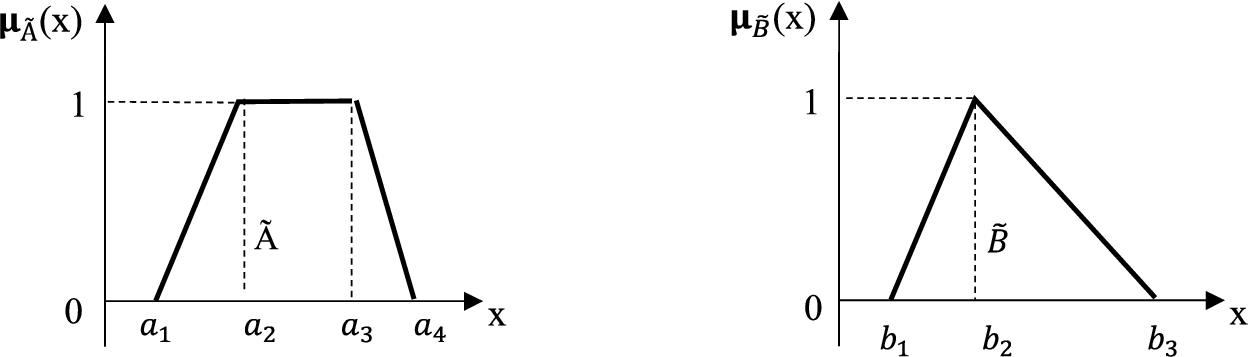
A simple Z-fuzzy number,
The concept of a Z-fuzzy number is intended to provide a basis for computation with ordinary fuzzy numbers which are not reliable.
Let a fuzzy set
Consider a Z-fuzzy number
(1) Convert the reliability function into a crisp number using Eq. (2):
Alternatively, the defuzzification equation (
(2) Weigh the restriction function with the crisp value of the reliability function (α). The weighted restriction number is denoted in Eq. (3).
(3) Convert the weighted restriction number to ordinary fuzzy number using Eq. (4):
Ordinary fuzzy number converted from Z-fuzzy number.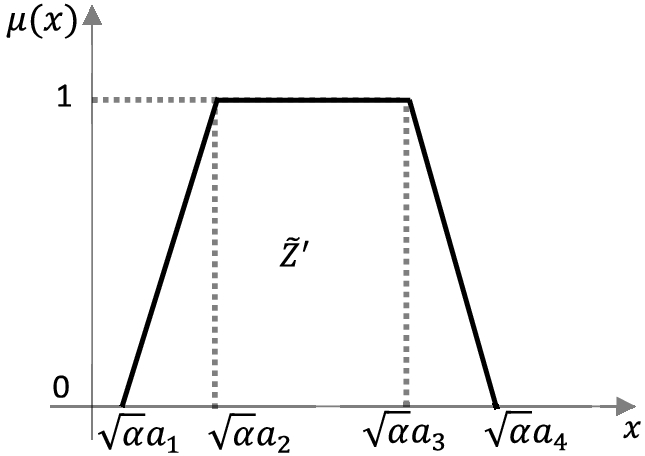
(4) If the restriction function and reliability function are defined as in Fig. 3, the calculations are modified as follows:
Let
A simple 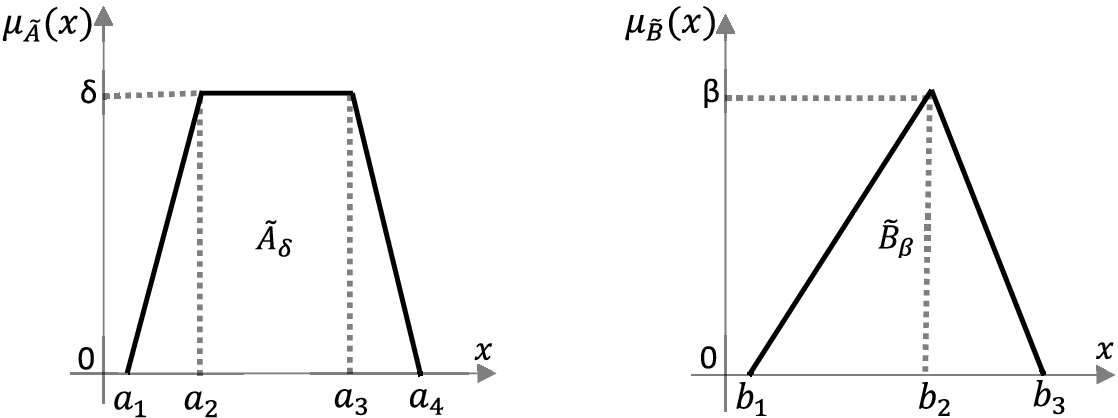
In this case, restriction and reliability functions are given in Eqs. (5)–(6), respectively. The reliability membership function in Eq. (6) is substituted into the defuzzification formula Eq. (2); so that, Eq. (7) is obtained.
The AHP method is one of the most widely used MCDM methods to calculate the criteria weights and there are several versions of it (Chatterjee and Kar, 2017). Due to the nature, it is usual for DMs to have hesitation while making pairwise comparisons, and in these situations, it is expected that they will not be absolutely sure about their evaluations. These preferences can be included in the decision methods by modelling the DMs’ thinking structure under the concept of Z-fuzzy numbers. Therefore, in this study, to obtain criteria weights, it is suggested to collect DMs’ judgments using Z-fuzzy numbers integrated AHP method rather than commonly used fuzzy versions of AHP method.
To calculate criteria weights, the steps of the Z-fuzzy AHP method are presented in the following:
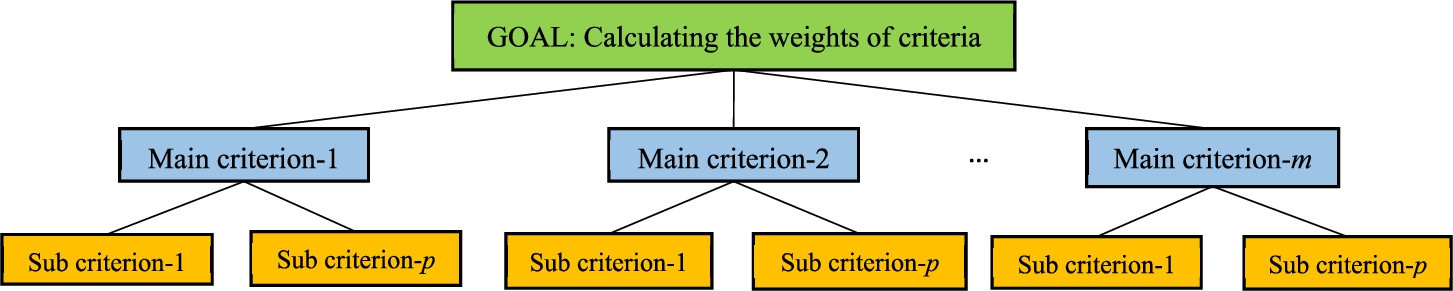
Hierarchical structure for criteria.
Let each decision maker (
Triangular restriction scale for pairwise comparisons of criteria.
Triangular reliability scale.
Assume three DMs assign the following terms:
The first fuzzy EDAS method is introduced by Keshavarz Ghorabaee et al. (2016) for the solution of MCDM problems under uncertainty. It is integrated with various fuzzy set extensions to model the vagueness and impreciseness. In this study, due to the fact that these extensions cannot completely combine the reliability information with the EDAS method, it is extended to Z-fuzzy EDAS method by using ordinary Z-fuzzy numbers. This method allows to define the DMs’ preferences over the alternatives with their degree of confidence, which creates a more comprehensive and flexible decision-making environment. Z-Fuzzy EDAS method is presented as follows:
Z-fuzzy restriction scale for evaluation of alternatives.
To determine
For restriction function:
For restriction function
Fig. 5 shows the flowchart of the methodology which integrates Z-fuzzy AHP and Z-fuzzy EDAS methods. The proposed methodology aims at finding the weights of the criteria to be used in wind turbine selection (Z-fuzzy AHP) and also ranking the alternatives (Z-fuzzy EDAS) according to these criteria.
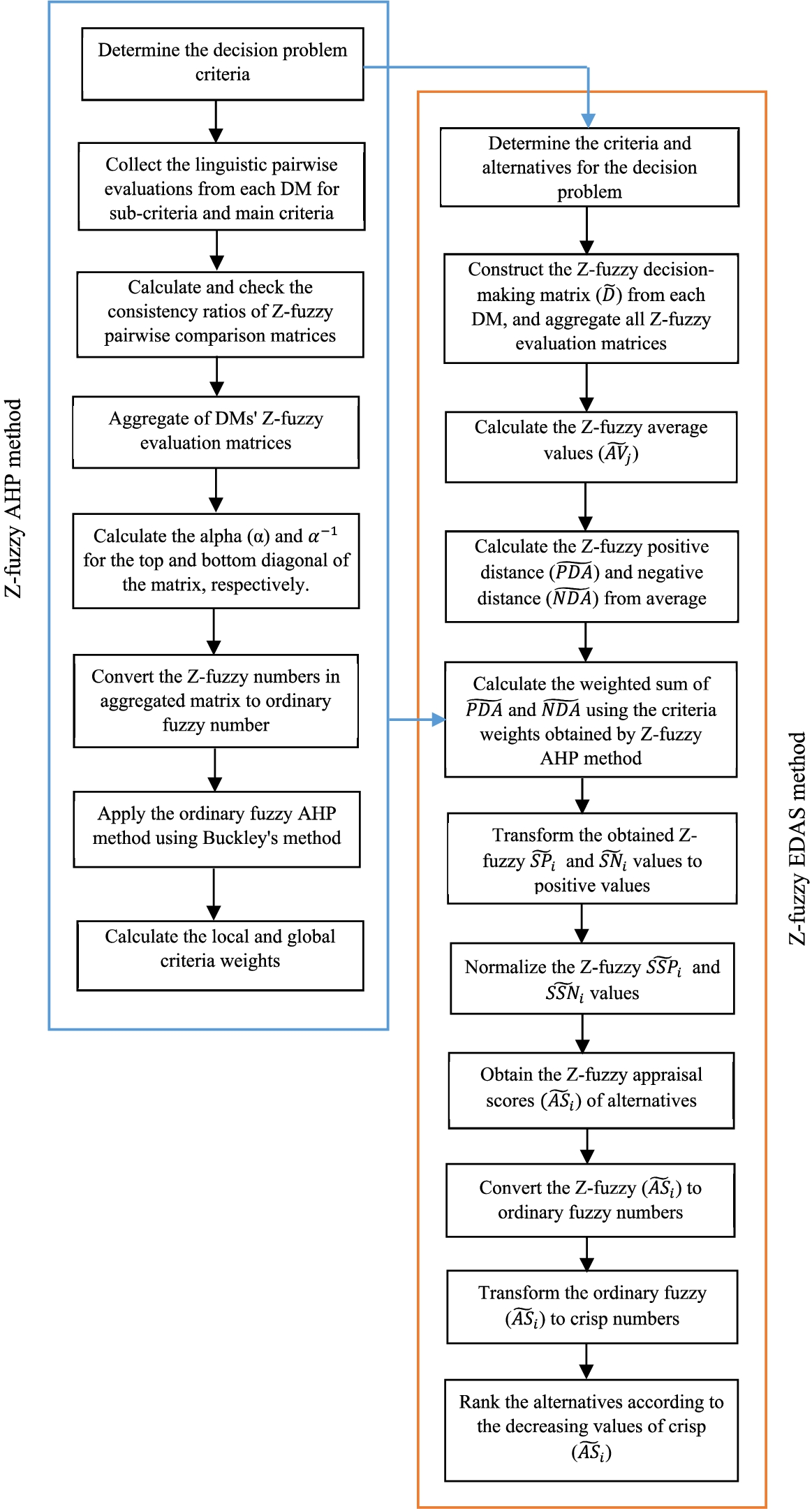
Proposed Z-fuzzy AHP&EDAS methodology.
Wind power is one of the fastest growing renewable energy alternatives. Due to the increasing energy demand, investments toward renewable energy sources are getting more importance day by day. Wind energy is the most widely used renewable energy source in Turkey (Kahraman and Kaya, 2010). According to the March 2022 TEİAŞ (Turkish Electricity Transmission Corporation) report, there are 355 wind power plants, and approximately 10861 megawatts of energy are produced from the wind in Turkey (TEİAŞ, 2022). In order to produce energy efficiently from the wind, the turbine characteristics of the power plant to be established have great importance. Therefore, the selection of wind turbines in a wind energy investment is extremely important for investors. There are many types of wind turbines according to their characteristics. In order to produce energy efficiently from the wind, the right wind turbine should be selected by the DMs according to the wind characteristics of the region to be established. In addition, the problem should be considered as a MCDM problem since many factors should be evaluated together in wind turbine selection. The MCDM studies of wind turbine selection in the literature are quite limited (Supciller and Toprak, 2020). Studies related to wind turbine selection can be found in Supciller and Toprak (2020) and Pang et al. (2021).
The proposed Z-fuzzy AHP&EDAS methodology is applied for the selection of the best alternative among wind turbines in the Aegean region of Turkey. For this purpose, in Step 1, the alternatives and criteria have been determined. There are five wind turbine alternatives represented by A1, A2, A3, A4 and A5 and six criteria which are reliability (C1), technical characteristics (C2), performance (C3), cost factors (C4), availability (C5) and maintenance (C6) (Cevik Onar et al., 2015). In Step 2, decision matrices have been constructed by three DMs using the linguistic terms given in Tables 4 and 5. Three DMs’ pairwise comparison matrices for the criteria are presented in Tables 6–8.
Pairwise comparisons of the criteria by DM1.
Pairwise comparisons of the criteria by DM1.
Pairwise comparisons of the criteria by DM2.
Pairwise comparisons of the criteria by DM3.
Applying the Z-fuzzy AHP method in Section 4 the criteria weights have been obtained as in Table 9.
Criteria weights obtained by Z-fuzzy AHP method.
After the DMs have compared the criteria, the evaluations of the alternatives according to the criteria have been collected. Tables 10–12 show the Z-fuzzy decision matrices including the linguistic evaluations of three DMs.
Z-fuzzy decision matrix of DM1.
Z-fuzzy decision matrix of DM2.
Z-fuzzy decision matrix of DM3.
In Step 3, the individual evaluations of DMs are aggregated by using geometric mean method given by Eqs. (25)–(26). The obtained aggregated matrix is presented in Table 13.
Aggregated evaluations of wind turbines.
Z-fuzzy average values.
Z-fuzzy
In Step 4, using the aggregated evaluations and Eqs. (27)–(28), the Z-fuzzy average values are calculated for both the restriction and reliability functions separately, and the resulting values are shown in Table 14.
In Step 5, Z-fuzzy
Z-fuzzy
In Step 6, the criteria weights obtained in Section 4 by using Z-fuzzy AHP method are employed to find
In Step 7,
In Step 8, Z-fuzzy
In Step 9, Z-fuzzy
In Step 10, Z-fuzzy
Trapezoidal fuzzy
In Step 11, trapezoidal fuzzy
Crisp
In order to investigate the importance of reliability information, the reliability judgments regarding all DMs’ evaluations have been accepted as “certainly reliable” when applying the Z-fuzzy EDAS method without changing the criteria weights. Then, Z-fuzzy EDAS method has been re-applied. The obtained
Crisp
According to these results, when the reliability information is neglected (accepted as
Similarly, while the Z-fuzzy AHP method has been applied to find the criteria weights, the reliability information has been accepted as “certainly reliable”, and the criteria weights have been recalculated. The obtained criteria weights are presented in Table 27.
Criteria weights obtained by Z-fuzzy AHP method (DMs’ reliability judgements accepted as
Table 27 shows that the ranking of cost factor and reliability factor, which are in the first two rankings, have changed when compared to previous results (Table 9). Among the six criteria, only the rankings of the performance and availability factors have not changed. These results support the obtained result regarding the importance of reliability information as in the EDAS method.
To compare the results, the Z-fuzzy TOPSIS methodology proposed by Yaakob and Gegov (2016) is used. Z-fuzzy TOPSIS is one of the first fuzzy extensions which is performed by Z-fuzzy numbers in MCDM methodology. TOPSIS method was developed by Yoon and Hwang (1981). It is one of the most commonly used MCDM methodology by researchers in the literature. TOPSIS method allows to reach the solution by using the distances of the alternatives from the positive and negative ideal solutions.
Z-fuzzy TOPSIS methodology consists of the following steps; (i) construction of Z-fuzzy decision matrix, (ii) conversion of Z-fuzzy numbers to ordinary fuzzy numbers, (iii) normalization procedure, (iv) weighing the normalized decision matrix, (v) calculation of distances from positive and negative ideal solutions, and (vi) calculation of closeness coefficients (Yaakob and Gegov, 2016).
Table 28 presents the results of Z-fuzzy AHP&TOPSIS methodology and it shows the distances from positive and negative ideal solutions (
Results of Z-fuzzy TOPSIS methodology.
Results of Z-fuzzy TOPSIS methodology.
According to the results obtained by the Z-fuzzy TOPSIS method, the ranking of the alternatives, except alternatives 3 and 5, is the same as the methodology proposed in this study. The comparison of the rankings can be seen in Table 29.
Comparison of Z-fuzzy EDAS and Z-fuzzy TOPSIS.
EDAS method considers the positive and negative distances from the average solution rather than calculating the negative and positive ideal solutions as in TOPSIS method. According to the results of both methods, the closeness coefficients in Z-fuzzy TOPSIS are composed of quite closer values whereas appraisal scores in Z-fuzzy EDAS indicate larger differences between alternatives. In general, it can be concluded that the proposed method is consistent since the rankings of two methods are quite similar. The only difference is between alternatives A3 and A5. The first three best alternatives are the same in both methods.
As a result of the comparative analysis, obtaining similar results with the Z-fuzzy TOPSIS method shows the consistency and competitiveness of the proposed method.
Extensions of ordinary fuzzy sets are quite successful in modelling the uncertainty in the decision-making process. However, they do not exactly represent the reliability information inherent in the solutions. The reliability information of the evaluations is very important as it can have significant impacts on the obtained results. The Z-fuzzy numbers introduced by Zadeh (2011) allow the reliability of the DMs’ judgments to be included in the decision models. In this study, a novel Z-fuzzy EDAS method is introduced to the literature. Then, an integrated usage of Z-fuzzy AHP and Z-fuzzy EDAS method is proposed to the field for the first time to deal with uncertain expressions of DMs in real life decision making problems. The inclusion of the reliability information of the DMs in the decision model makes the decision making process more realistic in both daily and business decisions as in the case of renewable energy investment decisions.
The importance of renewable energy sources has increased considerably with the concern of leaving a sustainable world to future generations in recent years. In this study, the selection of a suitable wind turbine problem has been handled by considering the multiple factors affecting the decision. Criteria weights to be used in alternative selection have been calculated by using Z-fuzzy AHP method which has also been integrated to Z-fuzzy EDAS method. Z-fuzzy numbers integrated AHP method offers a more realistic solution by reflecting the DMs’ hesitancy in pairwise comparisons to the proposed Z-fuzzy AHP&EDAS methodology. After defining the criteria weights, three DMs have evaluated the five alternatives using Z-fuzzy EDAS method. All the DMs’ evaluations have been expressed by Z-fuzzy numbers in both methods, and all steps of the Z-fuzzy EDAS method have been performed by Z-fuzzy numbers. The proposed methodology allows DMs to express both restriction and reliability information about criteria and alternatives. In order to show the effects of reliability component on the decision system, the reliability information of all evaluations have been made “certainly reliable” and the calculations have been re-performed, then the results were compared with the proposed method. It is concluded from this analysis that the difference in the ranking results displays the importance of consideration of the reliability information. Therefore, the proposed methodology offers a more reliable evaluation system to DMs, including their degree of confidence to their assessments.
In order to show the robustness and stability of the proposed method, the obtained results have been compared with the results of the Z-Fuzzy AHP&TOPSIS methodology. It can be stated that the suggested methodology is an effective and useful method for researchers who want to make decisions based on distances from average solution rather than the distance from positive and negative ideal solutions. For further research, other MCDM approaches integrated with Z-fuzzy numbers can be used and compared with the results of this paper.
Although there are many fuzzy versions of the AHP method in the literature, its integration with Z-fuzzy numbers is limited. This research gap in the literature can be filled with increased application of Z-fuzzy AHP method, then importance and advantages of Z-fuzzy numbers can be further analysed. In addition, other fuzzy set extensions such as fermatean fuzzy sets or picture fuzzy sets can be used in the improvement of Z-fuzzy numbers. Then, in future research, it can be suggested to combine these extensions of Z-fuzzy numbers with different MCDM methods to expand the related literature.