




Abstract
Policy-makers are often hesitant to invest in unproven solutions because of a lack of the decision-making framework for managing innovations as a portfolio of investments that balances risk and return, especially in the field of developing new technologies. This study provides a new portfolio matrix for decision making of policy-makers to identify IoT applications in the agriculture sector for future investment based on two dimensions of sustainable development as a return and IoT challenge as a risk using a novel MADM approach. To this end, the identified applications of IoT in the agriculture sector fall into eight areas using the meta-synthesis method. The authors extracted a set of criteria from the literature. Later, the fuzzy Delphi method helped finalise it. The authors extended the SWARA method with interval-valued triangular fuzzy numbers (IVTFN SWARA) and used it to the weighting of the characteristics. Then, the alternatives were rated using the Additive Ratio Assessment (ARAS) method based on interval-valued triangular fuzzy numbers (IVTFN ARAS). Finally, decision-makers evaluated the results of ratings based on two dimensions of sustainability and IoT challenge by developing a framework for decision-making. Results of this paper show that policy-makers can manage IOT innovations in a disciplined way that balances risk and return by a portfolio approach, simultaneously the proposed framework can be used to determine and prioritise the areas of IoT application in the agriculture sector.
Introduction
The IoT in the agricultural sector aims to empower farmers through automation technologies and decision-making tools that lead to the integration of products, knowledge and services for higher productivity, better quality (Elijah et al., 2018), and sustainability (Sundmaeker et al., 2016). Despite the many different innovative applications of IoT in the agricultural sector, policy-makers (PMs) only recently began to consider the risk and return of using this technology. Therefore, to establish policies for the development of this technology there is a need for a framework to ensure the realisation of sustainable development (SD) goals in the agricultural sector and consider the smallest challenges for IoT implementation. Due to complex and multi-dimensional nature of sustainability issues (Shen and Tzeng, 2018) and the evolutionary nature of the IoT (Kim and Kim, 2016), decision-making faces problems such as lack of complete information and the need to use experts’ opinions for decision-making. Given the capability of multiple-attribute decision-making (MADM) techniques to meet similar conditions (Kim and Kim, 2016; Luthra et al., 2018; Mohammadzadeh et al., 2018; Quaddus and Siddique, 2001; Vinodh et al., 2013; Zarei et al., 2016), it seems that the use of these techniques can be useful in establishing the intended policy-making framework.
In many situations, candidates’ information for decision-making is usually uncertain and incomplete. Therefore, using MADM techniques that consider input parameters accurately and certainly is an inefficient approach (Turskis and Zavadskas, 2010a). Decision-makers use fuzzy number sets when solving complicated problems to overcome this limitation (Lima Junior et al., 2014). Although the use of fuzzy numbers has enabled many real-world decision-making problems to be solved (Turskis et al., 2019b), it cannot adequately meet all the requirements of such problems due to uncertainty (Dahooie et al., 2018; Stanujkic, 2015). Therefore, Atanassov (1986) generalised the fuzzy numbers and introduced intuitive fuzzy numbers (Ye, 2010). Intuitive fuzzy numbers allow better visualisation of ambiguity and environmental uncertainty (Dahooie et al., 2018).
On the other hand, Iran, as a country transitioning from a factor-driven economy to an efficiency-driven economy, seeks to deploy IoT in various industries and use its benefits to achieve the economic 1404 outlook (Iran’s 2025 outlook) and SD goals (Zarei et al., 2016). Despite the many different applications of IoT in the agricultural sector, PMs only recently began to consider the possibilities and benefits of using this technology in Iran. The purpose of this study is to present a MADM framework for policy-making in implementing IoT applications in the agriculture sector. The literature review helps to identify a list of sustainability attractiveness criteria, and IoT challenges to prioritise IoT applications in the agriculture sector to achieve more SD goals and face the least challenges. The PMs, due to research limitations in this field, used the fuzzy Delphi method (FDM) and expert opinions to create a useful list of criteria. Experts weighted the identified criteria based on the IVTFN SWARA method in the next step. Due to the aim of the study, the authors extend the SWARA method to utilise IVTFN. In the next step, the PMs calculated performance scores of each of the identified applications using the IVTFN ARAS. Finally, the proposed framework assists PMs in selecting appropriate IoT applications based on the two criteria of achieving more sustainability and facing fewer challenges for implementing IoT in the agricultural sector in Iran.
The existing literature on using IoT in the field of agriculture usually focus on topics such as IOT architectures and network layers from a technical point of view (Villa-Henriksen et al., 2020) and less systematically investigate the IoT applications from the perspective of national policymakers, so the main advantages of this research are:
Introducing a new classification for different IoT applications in agriculture.
Identify and categorize both the challenges of the Internet of Things and its benefits from a sustainable development perspective on a national level.
Extend SWARA based on IVTFN to calculate the weight of criteria.
Provide a new decision-making matrix for selecting high-priority IoT applications in the agriculture sector using interval-valued triangular fuzzy sets.
Assist national policy makers to better understand, and thus implement the applications of IoT in the field of agriculture.
This paper is organized as follows. Section 3.1 reviews the literature and discusses the need to establish a decision-making framework for the selection of appropriate IoT applications that encounter fewer challenges and more sustainability. Section 3.2 describes the research method. Section 4 illustrates the case study and presents the results. Finally, Section 4 concludes the research.
Literature Review
Modern policy-makers must effectively manage projects (Yazdani et al., 2019a), choose to implement the best possible solutions based on many factors affecting the environment and economic expediency (Zemlickienė and Turskis, 2020) and technology (Bagočius et al., 2014; Ruzgys et al., 2014). Significant political requirements change aspects of the rationality presumption of management at local and international levels (Hashemkhani Zolfani et al., 2013; Erdogan et al., 2017). Policy-makers must take into account the social well-being of people (Zagorskas and Turskis, 2020a, 2020b). The rapid development of the world and the growth of the population require the emergence of new technologies (Zavadskas et al., 2013) and raise the need to develop decision-making theories and methodologies to justify the rational use of them (Yazdani et al., 2019b). There seems to be no limit to the improvement and refinement of multi-criteria decision-making algorithms. The IoT paradigm referred to as one of the drivers of the Industry 4.0 revolution (Geng, 2017) has been able to transform the society dramatically and achieve the goals of SD (Benkhelifa et al., 2014; Biggs et al., 2016; Hopwood et al., 2005). Therefore, it is useful to empower sustainable agriculture (it is a concept stemming from the idea of SD published in the 1987 Brundtland Committee Report). In order for the decision-makers to achieve SD goals, they need a balance of economic, social, environmental, and technical issues (Merad et al., 2013) and face a variety of IoT applications in the agriculture sector (Elijah et al., 2018; Ray, 2017; Verdouw et al., 2016). Therefore, the MADM techniques can support the decision-makers in this field (Quaddus and Siddique, 2001). In the following, the authors discuss the background of the research on the importance of sustainable agriculture, the concept of IoT, the applications of IoT in the agriculture sector, and the necessity of establishing a decision-making framework to reduce IoT challenges and achieve SD goals.
The concept of sustainable agriculture has emerged and has been considered by national PMs. The Food and Agriculture Organization (FAO) defines sustainable agriculture as the management and conservation of critical natural resources and the direction of technological change in a way that will continually satisfy human needs for present and future generations. Various papers have set out different criteria for measuring the extent to which SD goals are being met in the agricultural sector. PMs categorise them into four types: environmental, economic, social, and technical. Table 1 presents a list of criteria extracted from the literature.
A literature review on sustainable development (criteria and methods).
A literature review on sustainable development (criteria and methods).
Note: FAHP = fuzzy Analytic Hierarchy Process; VIKOR = Vlsekriterijumska Optimizacija I Kompromisno Resenje; AHP = Analytic Hierarchy Process; MAVT = Multiple Attribute Value Theory; CRITIC = CRiteria Importance Through Inter-Criteria Correlation; PROMETHEE = Preference Ranking Organization Method for Enrichment Evaluations; FTOPSIS = Fuzzy Technique for Order Preference by Similarity to Ideal Solution; HFLTS = Hesitant Fuzzy Linguistic Term Set; MAMCO = Multi Actor Multi-Criteria Outranking; L = literature; L* = literature and Delphi; IDEA = indicateurs de durabilité des exploitations agricoles or farm sustainability indicators.
A literature review on the challenges of IoT development (criteria and methods).
A literature review on the challenges of IoT development (criteria and methods).
Note: FANP = fuzzy Analytic Network Process; L = literature.
The traditional concept of the internet as an infrastructure network seeks to diminish end-user terminals and move to the idea of “smart” interconnected objects to shape pervasive computing environments. A new paradigm called “Internet of Things” (Atzori et al., 2010; Noje et al., 2020; Perera et al., 2014) has been formed to refer to:
The global network of intelligent objects interconnected by advanced internet technologies;
The process of identifying IoT applications in different areas.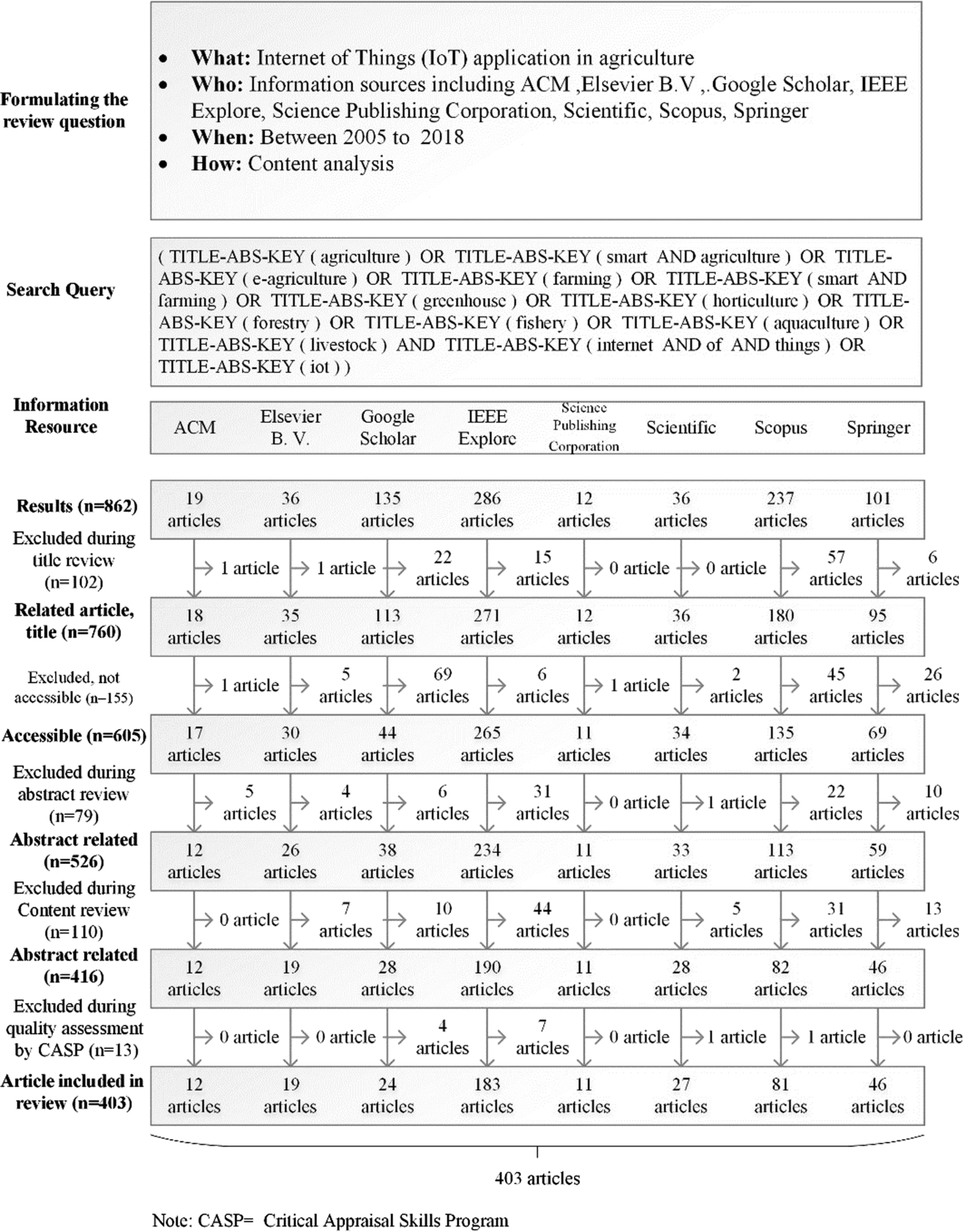
A set of support technologies needed to achieve the desired vision (including RDFs, sensors/actuators, Machine-to-Machine communication devices, and others);
Group of applications and services that leverage these technologies to establish new businesses and maximise market opportunities (Miorandi et al., 2012).
Identifying the challenges to the implementation of IoT can help researchers and PMs in planning to develop its applications. Table 2 highlights the most critical challenges facing the development of IoT from the technological, security, business, legal, and cultural aspects.
Since IoT applications are widespread and evolving (Kim and Kim, 2016) and have a variety of applications in the agricultural sector (Elijah et al., 2018), the Sandelowski and Barroso’s Meta-Synthesis Method is used to identify applications of the IoT in the agriculture sector (Sandelowski and Barroso, 2006). Figure 1 summarises the research process, including the criteria for accepting and rejecting articles, keywords used in searching for research articles, research timeframe, and the search of databases, journals, and various search engines. In the final step, policy-makers out of 862 items were identified, and 403 articles were analysed.
The identified IoT applications fall into eight areas: open-field agriculture, greenhouses, hydroponics and aquaponics, open-air horticulture, livestock farming, fishery and aquaculture, forestry, and distribution and supply networks. Table 3 presents the IoT applications identified based on different agriculture areas.
On the one hand, the applications of IoT in various agricultural areas are ubiquitous. On the other hand, the implementation of IoT has many challenges due to its evolutionary nature. However, no framework has been provided to assist PMs in making decisions regarding implementing IoT in different agriculture areas. To be transparent, a framework for selecting the agriculture areas that are more appropriate for implementing IoT that must be considered both SD goals and IoT challenges simultaneously is necessary. Of course, as previously shown in Tables 1 and 2, measuring each of these two objectives need to take into account several criteria that are sometimes inconsistent. MADM approaches offer a variety of methods for obtaining expert opinions and making the right decisions on a particular issue by considering multiple criteria (Shen and Tzeng, 2018). A review of applications of MADM methods in similar domains (Kim and Kim, 2016; Luthra et al., 2018; Quaddus and Siddique, 2001; Vinodh et al., 2013; Zarei et al., 2016) indicates the potential of these methods in establishing decision-making frameworks in the field of study.
Applications of IoT in different agricultural areas
Applications of IoT in different agricultural areas
Note: A1 = open-field agriculture; A2 = greenhouses; A3 = hydroponics and aquaponics; A4 = open-air horticulture; A5 = livestock farming; A6 = fishery and aquaculture; A7 = forestry; A8 = distribution and supply networks; RFID = Radio-frequency identification; NFC = Near-field communication.
The authors aim to provide a decision-making framework for PMs regarding the implementation of IoT in the agricultural sector under the conditions of Iran. In establishing this framework, achieving SD goals by the identified IoT applications and facing the least challenges for IoT implementation in the agricultural sector should be considered. The necessity of simultaneous attention to these two issues is similar to the idea of choosing an IT investment portfolio (Peppard and Ward, 2012; Ramakrishnan, 2008; Silvius, 2010) or technology portfolio management (Jolly, 2003).
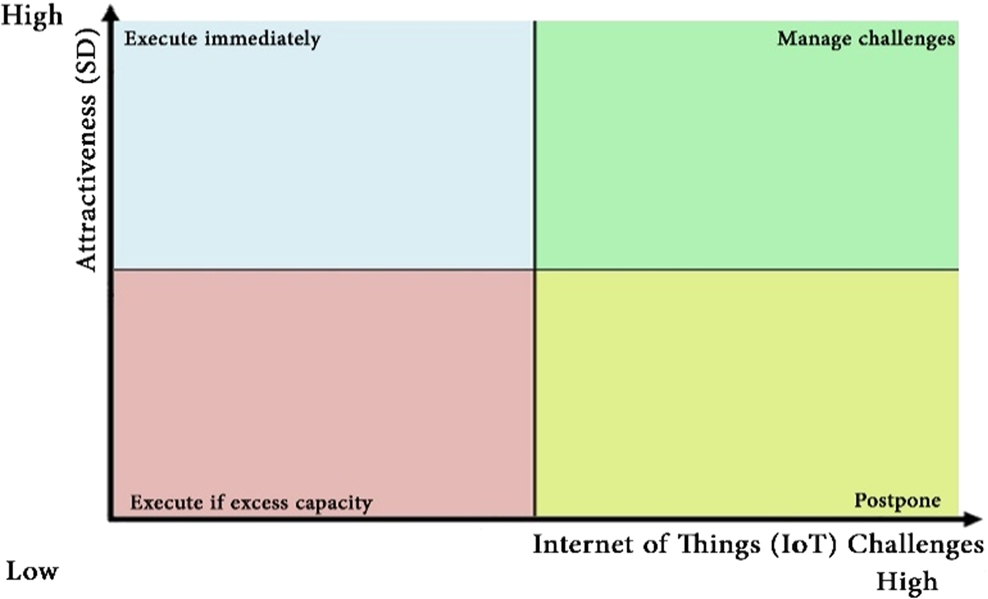
Portfolio view based on risk and attractiveness Adapted from Silvius (2010).
The primary purpose of information technology investments is to identify aspects related to the value (attractiveness) and the risk of projects individually as well as project portfolios. The term IT portfolio management, which is derived from the financial portfolio investment model, represents the process of evaluating projects before investment (Ramakrishnan, 2008). The most important advantage of this approach is to understand the value of an investment that is affected by other investments or assets in the portfolio. In other words, investment decisions are not taken individually, and this method examines investments concerning other investments and assets (Silvius, 2010). It enables management to visualise the pattern of investments and enhance the project-level debate to the entire portfolio (Peppard and Ward, 2012). The idea of portfolio matrix formation, in addition to commercial areas, has been used in many areas such as IT infrastructure investment assessment (Peppard and Ward, 2012; Ramakrishnan, 2008; Silvius, 2010), technology portfolio management (Jolly, 2003), transportation project evaluation (Reza Ghaeli et al., 2003), and others. Figure 2 represents the portfolio matrix consisting of two dimensions of attractiveness and challenges.
With this in mind, to build a decision-making framework based on sustainability indicators (Attractions) as well as the challenges of IoT development, initially, the IoT applications in the agriculture sector were identified and categorised into eight main areas. The criteria existed in the literature were selected, and the final list of criteria then was determined using a fuzzy Delphi process with the help of experts in the field in the form of a working group (consisting of representatives from the Agricultural Research, Education and Development Organization and Iran Telecommunication Research Center). The IVTFN SWARA method weights the criteria. Later, the IVTFN ARAS method rates the IoT applications based on different areas identified in the agriculture sector. To this end, the team members evaluated each identified application according to the final list of criteria. Finally, the ratings were assessed based on two dimensions of SD and the challenges of IoT development, and a suitable framework for policy-making in this area was proposed. Figure 3 presents the details of each of these steps.
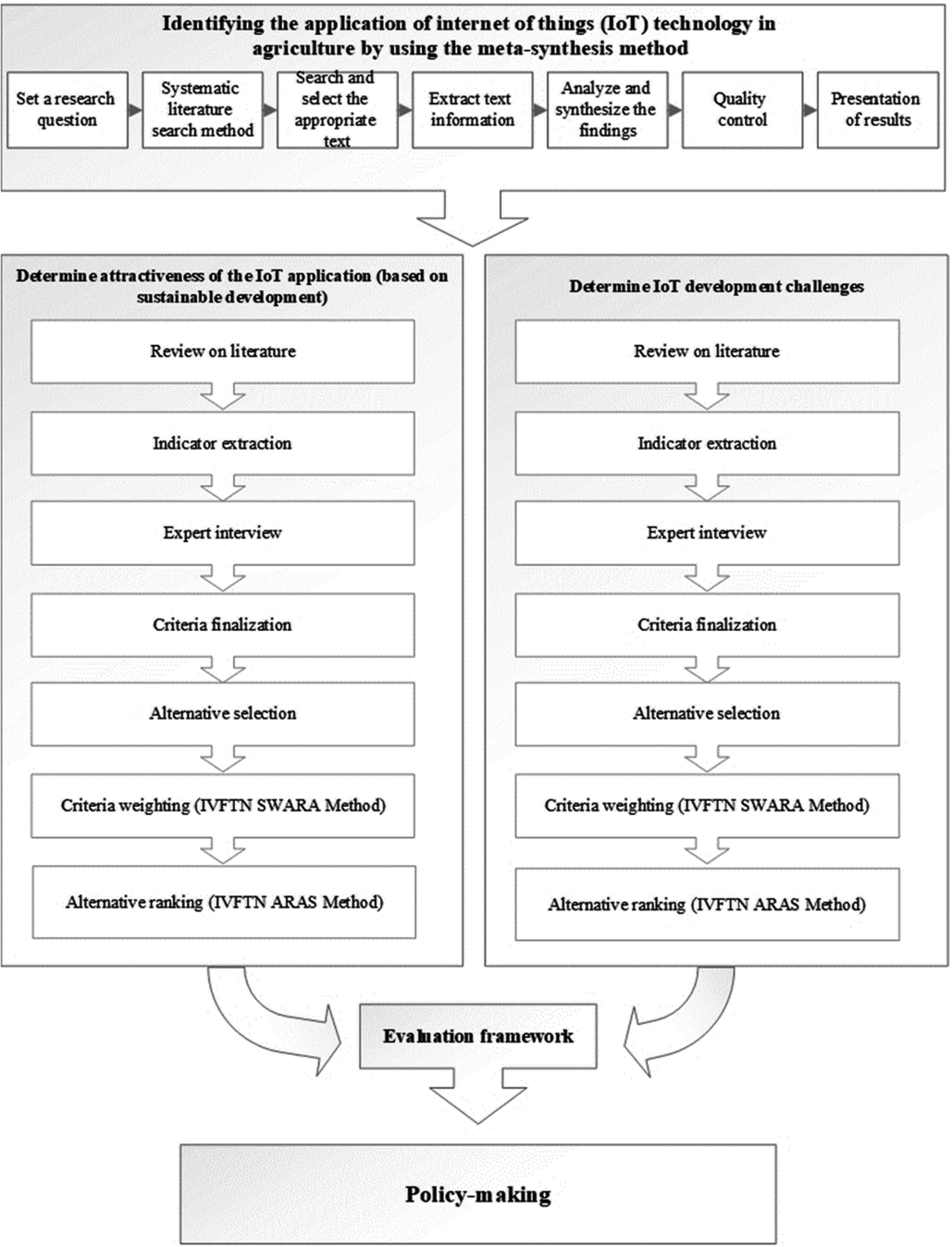
The executive process of the research.
In this study, the fuzzy Delphi method (FDM) is used to adapt the experts’ views on the determination of essential criteria (Lin, 2013) in evaluating IoT applications in the agriculture sector. The Delphi method, first used in technology prediction in 1950, was rapidly developed in various fields (Mullen, 2003). Then, in 1985, Murray et al. improved its ambiguity and uncertainty by applying fuzzy theory (Dahooie et al., 2018; Kuo and Chen, 2008). Since various techniques have been proposed for FDM calculations, this study uses the approach proposed Kuo and Chen (2008). Each fuzzy number (
The last step is to set a threshold to accept or reject the criteria (Dahooie et al., 2018). For this purpose, according to experts’ opinions, the value 4 and 3.5 was set as the threshold for the SD criteria and IoT challenge criteria, respectively. Finally, the criteria with the values lower than the threshold were removed from the list, and the final list of measures necessary for evaluation was created (Tables 3 and 4).
One of the applications of the fuzzy number set theory proposed by Zadeh (1965, 1975) is to use it in the process of making decisions based on ambiguous and uncertain information like decision-makers’ opinions (Lima Junior et al., 2014). In this theory, the membership of an element in the fuzzy number can only have a definite value between zero and one. However, in reality, the degree of non-membership of an element in the fuzzy number is not equal to one minus the degree of membership. It means that there may be some degree of hesitance. Thus, Atanassov introduced intuitive fuzzy sets by generalising the fuzzy number set (Atanassov, 1986; Zeng et al., 2019). The intuitive fuzzy number has the features of membership degree, non-membership degree, and degree of hesitance. Atanassov and Gargov (1989) presented the interval-valued intuitive fuzzy numbers set by generalising the fuzzy number (Wang et al., 2019b; Ye, 2010). As with generalised fuzzy numbers, the interval-valued fuzzy numbers can be trapezoidal (interval-valued trapezoidal fuzzy numbers) or triangular (IVTFN). As shown in Fig. 4, Yao and Lin (2002) presented an IVTFN as follows Stanujkic (2015):
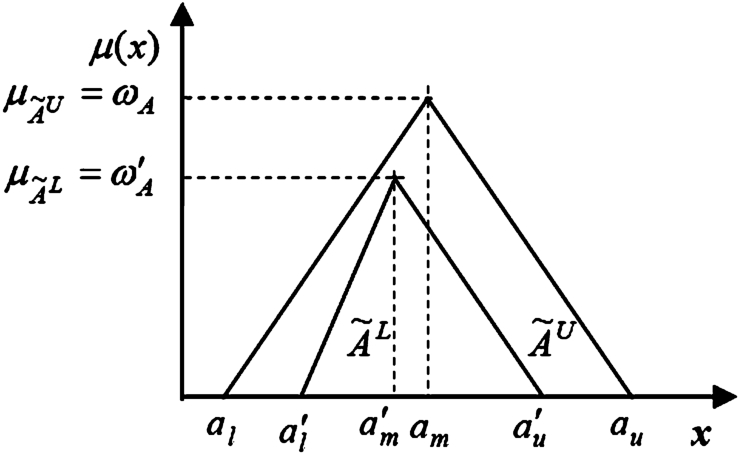
IVTFN.
Besides, a particular case of IVTFN is the normalised IVTFN in which
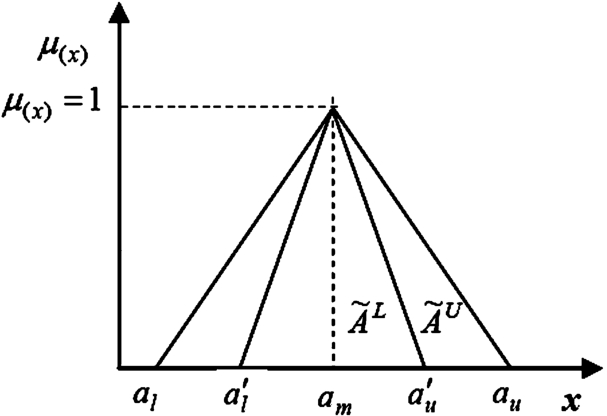
Normalised IVTFN.
If
Decision-makers cannot quantitatively evaluate many aspects of various activities in the real world but can qualitatively evaluate, i.e. by ambiguous or inaccurate knowledge. In this case, using linguistic variables instead of numerical values could be a better approach (Keršulienė and Turskis, 2014). Therefore, the variables used in such problems are evaluated through linguistic terms (Herrera and Martínez, 2000). In the researches done by several authors, different linguistic variables based on triangular or trapezoidal fuzzy numbers have been proposed (Stanujkic et al., 2015). Table 4 presents linguistic variables for weighting criteria and ranking alternatives based on IVTFN (Stanujkic et al., 2015).
Linguistic variables for weighting criteria and ranking alternatives adapted from Stanujkic et al. (2015).
Linguistic variables for weighting criteria and ranking alternatives adapted from Stanujkic et al. (2015).
There are a variety of methods for assessing the importance of criteria that researchers have used or modified when solving complex problems, e.g. eigenvector method, SWARA (Keršuliene et al., 2010), expert judgement method, Eckenrode’s rating technique (Turskis et al., 2019a), Analytic Hierarchy Process (AHP) (Saaty, 1977, 1980; Turskis et al., 2012; Zavadskas et al., 2020) and Entropy method. Keršuliene et al. (2010) developed the Step-wise Weight Assessment Ratio Analysis (SWARA) method to weight the criteria based on the opinions and judgments of decision-makers and experts (Keršuliene et al., 2010; Keršulienė and Turskis, 2011). This method is a subjective method with low complexity, low time, and the ability to estimate the opinions of experts or stakeholders on the importance of criteria in the weighting process (Karabasevic et al., 2016; Stanujkic et al., 2017). On the other hand, the inaccuracy and inadequacy of candidates’ information in many situations lead to the inefficiency of using methods that consider input parameters accurately and conclusively (Ye, 2010). Among sets that consider uncertainty in decision-making, interval-valued fuzzy numbers have received special attention from researchers. However, despite numerous developments of the SWARA method, this method has not yet been developed to take advantage of these numbers. Therefore, the authors develop an IVTFN SWARA extension and present it below. Prioritise the criteria: At this stage, the final criteria for evaluating the alternatives are sorted based on their importance in a descending order. The most important and the least essential criteria are ranked highest and lowest in the ranking process, respectively. Determine the relative importance of the criteria ( Calculate the coefficient Calculate the initial weight of the criteria: At this stage, the initial importance of each measure is calculated using equation (11) Calculate the final normalised weight: Finally, the final normalised weights are obtained by equation (12)
The ARAS method is one of the newest MADM approaches introduced by Zavadskas and Turskis in 2010 (Zavadskas and Turskis, 2010). This method is useful to solve various decision-making problems. According to the literature, the fuzzy (Turskis and Zavadskas, 2010a), grey (Turskis and Zavadskas, 2010b; Mardani et al., 2018), and IVTFN (Dahooie et al., 2018) extensions of this method are proposed. The steps of the IVTFN ARAS are as follows (Dahooie et al., 2018).
1. Formulate the decision matrix and determine the optimal performance rating for each criterion
The optimal performance rank for each criterion with the interval values is calculated using equation (15).
2. Equation (22) helps to normalise the values
3. Calculation of weighted normalized decision matrix with interval values
At this stage, using the normalized weights obtained by the IVTFN SWARA method and the normalized decision matrix, the weighted normalized decision matrix
4. Calculate the overall performance index for each alternative
The overall performance index for each alternative is calculated by equation (25)
5. Calculate the degree of utility for each alternative
The fuzzy decision result for each alternative is in the form of IVTFN. There exist different defuzzification processes. They may affect the problem solution results. The defuzzification of
Equation (27) represents the utility degree of alternative
6. Alternative ranking and choosing the most effective alternative
At this point, the decision-makers ranked the alternatives based on
IoT development in Iran is in its infancy. Besides, IoT related technologies and enablers have not yet evolved and are facing many challenges. Therefore, the scores associated with each of the two dimensions of Sustainability and Challenges of IoT Development were first calculated using a combination of IVTFN SWARA and IVTFN ARAS methods. Then, the scores are normalised into the interval
Iran aims to leverage IoT opportunities in all sectors, including agriculture, to achieve SD goals. Therefore, in November 2016, the Ministry of Agriculture Jihad, in collaboration with Ministry of Communication & Information Technology, formed joint working groups under the titles of Infrastructure, Remote Sensing, IoT, and Basic Resources, Business Development and Improvement, Training Development and Empowerment, and Governance Platform to implement this technology. As a result, policy-makers formed a team of experts from among the members of these working groups. The applications of IoT in various agricultural areas were identified through reviewing the literature and categorised in eight fields of open-field agriculture (A1), greenhouses (A2), hydroponics and aquaponics (A3), open-air horticulture (A4), livestock farming (A5), fishery and aquaculture (A6), forestry (A7) and distribution and supply networks (A8). The results of each of the steps taken for evaluation are described below.
Fuzzy Delphi Results
To prioritise the identified agriculture areas for implementing IoT applications based on the two dimensions of SD and the challenges of IoT development, the extracted criteria, which present Tables 1 and 2, were distributed among the experts in Agricultural Research, Education, and development Organization and Research Institute for Information and Communication Technology in the form of a questionnaire to identify the critical criteria. The questionnaire consisted of two sections. The first section evaluated the importance of the requirements extracted from the previous studies. In the second section, experts were asked to suggest other measures that may be effective in evaluation. As shown in Tables 5 and 6, using the FDM, 14 and 22 criteria, respectively, were selected as the final criteria for evaluating the IoT applications based on the experts’ opinions.
Final and localised criteria to prioritise alternatives based on SD indicators.
Final and localised criteria to prioritise alternatives based on SD indicators.
Final and localised criteria to prioritise alternatives based on the challenges of IoT development.
In this section, decision-makers used the developed IVTFN SWARA method to determine the weights of the criteria and relevant sub-criteria based on experts’ opinions. Tables 7 and 8 present the results.
As shown in the third column of Table 7, experts ranked the criteria based on their importance in a descending order. Also, the results of the second, third (equation (10)), fourth (equation (11)), and fifth (equation (12)) steps of the IVTFN SWARA method are presented in columns 4, 5, 6 and 7 of Table 7, respectively. Besides, the final weights of the criteria were normalised after the integration steps using the geometric mean, and are shown in Table 8.
Calculating the weight of the first expert’s criteria.
Calculating the weight of the first expert’s criteria.
Final Normalised weights.
Table 9 presents the weights of criteria after the defuzzification process, which is based on equation (13). As shown in Table 9, economic (C1) and business (I3) were determined as the most important main criteria for the SD and IoT development challenges criteria, respectively. In addition, the most important sub-criteria can be considered, respectively, as follows: Financial measures and profitability (C21), productivity (C23), and contribution to regional development (C33) for SD criteria and trust (I53), transparency (I21), and education and training (I51) for IoT development challenges criteria.
The final weights of SD and IoT development challenges criteria based on experts’ opinion.
In this section, the final weight obtained from the SWARA method (Table 8) are used as inputs to the IVTFN ARAS technique. The results of the IVTFN ARAS method to rate the alternatives based on the two dimensions of SD and the challenges of IoT development. The following describes the calculation details of each step.
The decision matrix and the optimal performance rating of each criterion are calculated based on the equation (14) and using the final weights of the two dimensions of SD and IoT development challenges and the expert opinions (see Appendix A). Decision-makers after creating the integrated decision matrix for the two dimensions of SD and the challenges of IoT development calculated the normalised decision matrix and the weighted normalised decision matrix using equations (22) and (23) (see Appendix A).
After calculating the overall performance index for each alternative (
Final ranking for different values of y (SD criteria).
Final ranking for different values of y (SD criteria).
Final ranking for different values of y (IoT development challenges criteria).
Given the underdeveloped nature of IoT and its challenges and the necessity of choosing solutions that are more attractive from an SD perspective, in this study, a framework based on MADM methods is presented to select the best areas for implementing IoT solutions in the agriculture sector taking into account the two dimensions of SD goals and the challenges of IoT development. Figure 6 outlines this conceptual framework used to analyse better the different areas of the agriculture sector based on a portfolio approach. Table 12 shows the results of ratings based on the two dimensions of SD and IoT challenges that are as inputs to the evaluation framework. Figure 6 illustrates the results of the implementation of the evaluation framework inspired by the portfolio management approach after normalising the ratings. As this figure shows; A8 and A1 areas, respectively, play an essential role in achieving SD goals. Distribution and supply networks (A8) play a crucial role in efficiently managing agricultural products so that farmers can gain profit (Elijah et al., 2018; Nukala et al., 2016). Since Iran today faces pressing problems such as water crisis and soil poverty, the implementation and development of IoT solutions in A8 and A1 can largely overcome issues in the agriculture sector. According to experts, these areas also face fewer challenges in terms of implementing IoT applications. Therefore, policy-makers should consider these areas as top priorities in implementing IoT-based solutions.
Like the A2, A4 and A7 areas face more challenges, with appropriate risk management; these areas could be considered as other priorities in implementing IoT solutions.
Finally, A3, A5 and A6 should be considered as the areas with the least priority for implementing IoT solutions.
Calculations related to the normalisation of ratings into the interval
.
Calculations related to the normalisation of ratings into the interval
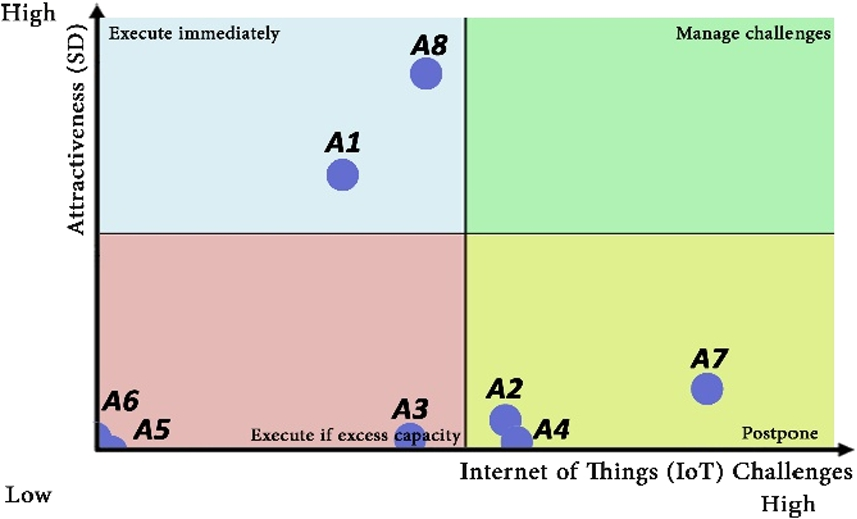
Rating agricultural areas for implementation of IoT applications based on the evaluation framework.
Today, the IoT is capable of empowering the agriculture sector to overcome challenges such as food security, food safety, overuse of the environment and its detrimental effects, supply chain inefficiency, and the loss of agricultural products during transport by providing solutions consistent with the goals of SD. Policy-makers always need to pay attention to various factors and criteria when selecting to implement the right decision. Some of the elements are inconsistent, so decision-makers evaluating them face inherent uncertainties, and in most cases, due to the lack of sufficient information, rely on expert opinions. In this context, policy-making, especially for new technologies, requires a coherent and scientific framework. Therefore, in this research, to support PMs for the implementation of IoT applications to achieve sustainable agriculture, the MADM framework is proposed to rate the IoT application in each agricultural areas based on two dimensions of SD and the challenges of implementing IoT. Besides, an evaluation framework finalises the evaluation of alternatives based on these two dimensions. For this purpose, the criteria and sub-criteria were extracted from the literature and experts selected them to solve FDM problem. In the next step, the developed IVTFN SWARA method and IVTFN ARAS method weighted the criteria and rated the alternatives. Later, the rating results based on two dimensions of SD (attractiveness) and challenges of IoT development were as inputs of a portfolio approach. Finally, PMs prioritised the alternatives.
Furthermore, an empirical case elicited from the agriculture sector in Iran is used to demonstrate the procedures of this framework. According to the experts, in terms of SD, economic criteria, and profitability criteria were selected as the most important criteria and sub-criteria, respectively. In terms of IoT development challenges, the business model and transparency criteria were chosen as the most important criteria and sub-criteria, respectively. Finally, according to the evaluation framework, the areas of forestry, greenhouse, open-air horticulture, hydroponics and aquaponics, supply and distribution networks, open-field agriculture, livestock farming, and fishery and aquaculture were respectively rated. Based on the results of the evaluation, distribution and supply networks and open-field agriculture are the most critical areas for the IoT challenges, followed by greenhouses, open-air horticulture and forestry. Accordingly, hydroponics and aquaponics, livestock farming and fishery and aquaculture areas have the lowest priority, respectively.
The proposed framework has several innovations. First, using Meta-Synthesis Method, new classifications for different IoT applications in agriculture are introduced. Second, using literature review, challenges of the Internet of Things and its benefits from a sustainable development perspective are identified and categorized. Third, the proposed framework uses the new extension IVTFN SWARA method to obtain the weight of criteria. Fourth, using proposed decision-making matrix, decision-makers will be able to select high-priority IoT applications in agriculture. Finally, the proposed framework can be useful for national policy-makers to raise awareness and, therefore, implement the applications of IoT in the field of agriculture.
One of the limitations of this study was the overlap of different agricultural areas, which prevented the accurate evaluation of the IoT solutions. Besides, due to the specialised nature of IoT applications in the agricultural sector, some experts are not able to evaluate all alternatives accurately and, therefore, were excluded from the evaluation process. However, the use of hesitant sets could be considered by researchers in future research to overcome the uncertainty of decisions. Besides, due to the multitude of criteria and sub-criteria related to the two dimensions of SD and the challenges of IoT development, it was not possible to examine the relationships between the criteria and sub-criteria. In future research, the authors suggest to consider the interactions between criteria and weight the criteria using methods such as ANP, DANP, or ISM. The proposed framework also has the potential for other sectors.
Footnotes
Initial Data for Evaluation and Selection of IoT Applications
Weighted normalised decision matrix based on IoT development challenges criteria.
| Code | I11 | I12 | I13 | I14 | I15 | I51 | I52 | I53 | |
| Sign | + | + | + | + | + | + | + | + | |
| [(0.09, 0.11), 0.15, (0.22, 0.26)] |
|
[(0.06, 0.07), 0.11, (0.16, 0.2)] | |||||||
|
|
|
|
|
|
|
|
|
|
|
|
|
|
|
|
|
|
|
|
|
|
|
|
|
|
|
|
|
|
|
|
|
| ⋮ | ⋮ | ⋮ | ⋮ | ⋮ | ⋮ | ⋮ | ⋮ | ⋮ | ⋮ |
|
|
|
|
|
|
|
|
|
|
|
|
|
|
|
|
|
|
|
|
|
|