






Abstract
To optimize the use of compression clothing to alleviate sports fatigue, this review discusses the current research status on clothing pressure and fatigue relief, and the principle of clothing pressure to relieve fatigue. In addition, research developments on the application of electroencephalography (EEG) in clothing pressure and sports fatigue are discussed and the relationship between the clothing pressure, EEG, and sports fatigue is analyzed. The mechanism of sports fatigue can be understood more comprehensively via EEG. Building a garment pressure evaluation system provides avenues for the research and development of apparel to relieve fatigue.
Introduction
Clothing involves several aspects of comfort, including heat and humidity, contact, and pressure. With the improvement of clothing performance requirements, people have begun to pay attention to the positive effects of clothing pressure and have focused on improving the ergonomics of clothing through appropriate clothing pressure. Current research shows that suitable clothing pressure reduces muscle energy loss, improves athletic performance, and relieves fatigue.
Presently, researchers are conducting research on clothing pressure using objective physical experiments and subjective evaluation methods. The objective physical experiments mainly include pressure testing devices to measure the pressure value of a certain pressure-sensitive part, and a finite element or BP neural network to build a human clothing model for predicting pressure distribution. 1 In the subjective evaluation methods of clothing pressure, a psychological scale is used to express the feeling of dressing; however, only the wearer can provide a score for the evaluation, which is highly subjective and easily affected by the physiological and psychological conditions of the user being tested. Consequently, the accuracy and repeatability of the experimental results are low. Thus, researchers have begun to introduce related technologies such as electromyography (EMG) and electroencephalography (EEG), which have been widely used in other fields, for the study of clothing pressure. EEG technology can record potential changes in the human brain in the state of dressing. Based on this, researchers can analyze the physiological and psychological changes of the wearer to better understand the impact of clothing pressure on the alleviation of fatigue and athletic performance and arrive at scientific and accurate experimental conclusions.
EEG and its Application
EEG Principle and Characteristics
Presently, EEG technology is widely used in various fields. For example, in perceptual engineering, EEG is connected with the subjective emotions of users to make product evaluation more scientific and enhance the understanding of user use demands.2,3 In addition, in the field of industrial design, designers use EEG to develop products with a high-quality user experience.4,5
EEG is a crucial physiological signal of the human body, which incorporates the external stimuli and human activity state information. EEG signals originate from the ion concentration difference inside and outside the cells owing to the form of the potential difference and current; it is the principle of electrical technology. EEG signals are the synthesis of electrical signals produced by countless stimulated neurons. They have the characteristics of weak signals, obvious individual differences, and complex compositions. EEG technology records and analyzes the spontaneous, rhythmic potential activity in the cerebral cortex following the time sequence. The characteristics of EEG include amplitude, frequency, and phase, in which the amplitude and frequency represent the physiological and psychological performance of people, whereas the phase represents the possible location of the impulse. 6 Researchers defined similar patterns and periods of the EEG signals as rhythms and divided them into five main frequency bands: α,β,δ,θ, and γ. Presently, digital EEG technology and ERP technology are widely used. Digital EEG technology possesses the characteristics of low cost and less pollution. 7 ERP technology is an effective cognitive process of certain experimental conditions with the characteristics of high time resolution and is non-invasive.
EEG Data Processing and Analysis
EEG signals are very weak and susceptible to external noise interference during collection. Consequently, data pre-processing must be conducted before data analysis; the method includes filtering, de-noising, artificial rejecting, and artifact removal. In recent years, separation methods with high removal accuracy, such as independent component analysis (ICA) and principal component analysis (PCA), have been applied to EEG related studies. 8 Fig. 1 shows the EEG acquisition process.
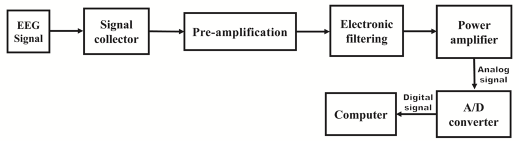
shows the EEG acquisition process.
The application of computer technology in EEG enables the quantitative expression of EEG data. To analyze EEG data, researchers have introduced many methods, the main ones including time-domain analysis, frequency-domain analysis, time-frequency analysis, EEG topography, and nonlinear analysis. Among these methods, the time-domain analysis is the earliest developed EEG analysis method, which mainly directly extracts and analyzes the waveform characteristics of EEG signals and has strong intuitiveness. Frequency-domain analysis is used to extract EEG signals from the frequency domain for feature analysis. In this method, the power spectrum estimation is an important means of frequency domain analysis and a more widely used method, whose principle is to change the amplitude of the EEG signal in the time domain to the frequency domain, to analyze the changes in the EEG signal. Because of the instability of EEG, it may contain several different rhythms simultaneously, and the EEG data cannot be accurately analyzed by unilateral analysis in the time or frequency domains. Researchers usually combine the time and frequency domains to process the signal.9,10 The EEG topographic map is the most widely used quantitative analysis method of EEG, which visually expresses EEG data graphics and color differences. 11 Because EEG is a nonlinear neural electrical signal, the spectrum analysis has certain limitations. Brain scientists have introduced nonlinear analysis methods to study the complexity of EEG signals and the relationship between the signals, which is based on nonlinear dynamic principles such as the chaotic and typing theory 12
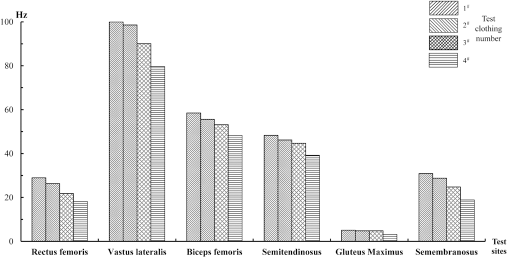
MF average of test position. 17
Influence of Garment Pressure on Fatigue
When the body is fatigued, the nerve responses and movement slow down. Researchers generally believe that clothing pressure can relieve sports fatigue. Experiments in clinical medicine have demonstrated that good blood microcirculation promotes fatigue relief. Based on the findings of this research, the microcirculation is influenced by clothing pressure, accelerating the exchange of substances between blood and tissues, increasing the oxygen and energy supply of muscles during exercise, which indirectly relieves fatigue.
Scientists have drawn conclusions by testing the blood samples of laboratory personnel in research on compression clothing. Relatively high clothing pressure has a good effect on the recovery of sports performance, and fatigue recovery is particularly obvious in the later period of exercise. 13 , 14 However, the detection of biochemical indicators is difficult. Surface electromyography (sEMG), as a technical way to refect changes in muscle activity, is widely used in kinematics and other related studies because of its noninvasive and easy operation. Some studies have shown that the occurrence of fatigue in EMG is mainly manifested as an increase in amplitude and a decrease in frequency 15 Many scholars have introduced it into clothing research to explore the relationship between pressure clothing and muscle fatigue. Time-domain indicators such as the root mean square amplitude (RMS) and frequency domain indicators such as the median frequency (MF) in EMG are used as the main evaluation indicators. 16 Chinese researchers that have conducted research on the development of sports protective clothing have reached conclusions similar to those of other researchers through relevant analysis of the subjective and objective indicators. In particular, clothing pressure can reduce the energy loss of muscles and alleviate sports fatigue, especially in the mid-late sports period. 17 - 19
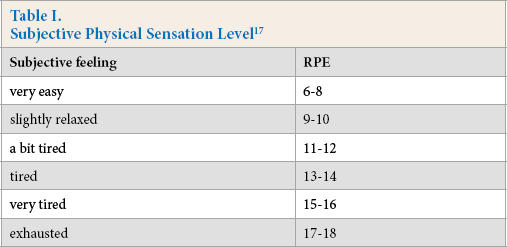
Surface EMG technology provided a new method and new ideas for the study of clothing ergonomics. The researchers also demonstrated the correlation between EMG indicators and fatigue through experiments. However, during the experiments, the researchers found that there was no universality of the indicators in the EMG signal owing to differences in the muscle size and location. For example, in the study of cycling clothing to alleviate fatigue, researchers found that because the gluteus maximus supported the seat throughout the cycling, the MF value in the myoelectric was almost unchanged (the results are shown in Fig. 2) and cannot be used as an indicator of fatigue in this case. Moreover, the EMG sensor has a certain size, which affects the results of the clothing pressure on the measured part. There are still some limitations on the current technology in the measurement range of the sensor. Furthermore, as presented in Table I, although the subjective scoring table currently used in the experiment has carried out a more detailed grading, it is affected by a certain deviation of the personal factors on the textual description in the score, which causes experimental errors.
Subjective Physical Sensation Level 17
Application of EEG Analysis in the Study of Clothing Pressure on Fatigue
Research on the Influence of Clothing Pressure on Physiology
The human body's response to clothing can be evaluated to some extent through the study of physiological indicators. This indirectly refects the intensity of external stimuli, which can characterize the wearing comfort. The effect of the dressing pressure on the digestive system is mainly characterized by the rate of saliva secretion. Studies have revealed that higher clothing pressure reduces the rate of saliva secretion. 20 Researchers have found that the clothing pressure of the waistband can significantly hinder the secretion of saliva and prolong the digestion time of the wearer, which can lead to constipation. 21 Using indicators such as the heart rate, skin blood flow, and blood pressure to characterize the influence of the dressing pressure on the blood circulatory system, the researchers concluded that clothing pressure affects heart rate and wearing pressure under differ-ent activities. The heart rate of subjects in clothing changed significantly during a series of dressing experiments. In addition, there were significant changes in the heart rate of subjects wearing pressure clothing under different activity states.22-24 By exploring the relationship between blood flow and compression, it is concluded that the blood flow increases significantly when appropriate mechanical compression is applied to the human body, and excessive pressure reduces the blood flow. Particularly, clothing pressures less than 1.0 kPa help improve varicose veins. 24 The change in blood flow becomes more obvious when external pressure acts on the surface of the human body.25,26
Generally, scientists have evaluated the qualitative relationship between the clothing pressure and physiology through physiological indicators. In research on the effect of clothing pressure on blood circulation, the majority of experts are more inclined to study the effect of high-intensity clothing pressure rather than the effect of low-intensity clothing pressure on blood flow. The experiments were conducted using instruments to simulate pressure instead of wearing compressing garments. However, there are some distinctions between the force areas of the actual dressing, which affect the blood flow. The brain nervous system regulates changes in these indicators. In other words, these will eventually be refected by changes in the EEG signals. Furthermore, the influence of the dressing pressure on the human body is not only refected in changes in the physiological indicators but is also affected by psychological factors. The current methods are aimed at one of the links in the evaluation of clothing pressure comfort. However, EEG as a physical and psychological research technique has the ability to integrate the physiological and psychological indicators of stress comfort, improving the evaluation system from physiology and psychology to comprehensive perception.
Study of Clothing Pressure Comfort and EEG Analysis
Using EEG technology to study the effect of clothing pressure on the human body can enhance the understanding of the impact of external stimuli on the body. Currently, the application principle of EEG in the comfort of clothing pressure is that clothing pressure affects blood circulation related to changes in the alpha waves. Based on this conclusion, scholars have begun to apply EEG technology when studying stress comfort. Among these, Japanese researchers chose the alpha wave as an object in the study of beam pants and found that the alpha wave can be recognized as one of the indexes used to judge the comfort of clothing pressure.27,28 Subsequently, many scholars deduced that the alpha wave is positively correlated with the pressure comfort by monitoring the time ratio of different dominant waves devoted to studying the pressure comfort of shaped abdominal girdles. They also demonstrated that the alpha wave can be used as a judgment indicator.29-34 When Zheng Cui carried out an ERP experiment for underwear pressure, she concluded that excessive underwear pressure could cause some components in ERPs to change significantly, which could cause women to have reduced attention. 35 Yun Sun used EEG as a physiological index to study the pressure comfort of women's high-heeled shoes. 36 The study found a positive correlation between the alpha wave and subjective comfort evaluation.
α and β Wave Characteristics
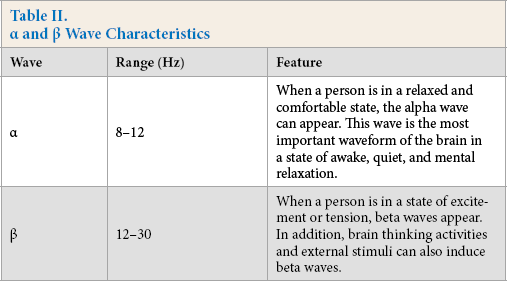
The researchers focused on studying alpha and beta waves because of their characteristics (Table II).
In the current clothing pressure research based on EEG analysis, most researchers focus on the amplitude and frequency of the EEG signals as key research objects. This is because they represent the intensity of nerve impulses to a certain extent, and scientists hope that they can build a more scientific and accurate evaluation system for evaluating the clothing pressure comfort by exploring a qualitative relationship between the EEG indicators and clothing pressure comfort, combined with subjective evaluation; most of the current EEG experiments are carried out in a static state. This is to avoid the interference of EMG as much as possible because current research has not completely confirmed that there is consistency between the two signals. The other reason why the current relationship between the EEG indicators and clothing pressure values cannot be quantified, according to previous works, is that the irregularity of the human body surface causes a difference in pressure on each part, making it difficult to control this objective physical quantity. For instance, when studying clothing pressure on the waist and abdomen, there are problems with large force areas and inconsistent forces.
Application of EEG Analysis in the Study of Sports Fatigue
Fatigue is a complex physical and psychological process, including muscle, nerve, and perceived fatigue. 3 Sports fatigue is one of the most studied fields in sports and medicine. Initially, researchers conducted tests using biochemical and behavior indicators; however, the results were not ideal enough to accurately detect sports fatigue. Researchers then turned their focus to physiological indicators that more accurately refect changes in human function and carried out fatigue testing using EEG, EMG, ECG, etc. Consequently, the work showed that sports fatigue is not only expressed in muscles but also refected in the central nervous system. Consequently, EEG can provide fatigue detection more objectively and refect the mechanism of fatigue more deeply.
Using EEG to monitor electrical signals in different regions of the cerebral cortex when the human body is fatigued, scholars have demonstrated the relationship between human fatigue and changes in EEG components, 37 which has provided a reference for the evaluation of human fatigue based on EEG signals. Some scholars have found that the degree of sports fatigue is negatively correlated with the degree of information interaction in the brain motor function area. 3 Several researchers have compared the changes in EEG before and after exercise to show that exercise affects the potential activity of the cerebral cortex. 38 , 39 Other scholars have studied brain fatigue using the characteristics of the EEG power spectrum and found that the EEG power spectrum has a strong correlation with fatigue. 40 In summary, researchers judged the recovery of fatigue by observing the EEG indicators, proved the feasibility of using EEG signals as a single physiological indicator to detect sports fatigue, and revealed that sports fatigue was closely related to the brain motor function area.
Study on the Effect of EEG Applied to Clothing Pressure on Sports Fatigue
It is not comprehensive enough to evaluate the effect of clothing pressure on fatigue relief by EMG alone. This is because sports fatigue occurs under the combined action of the peripheral and central factors of muscles. The brain is the ultimate control center of movement, and the EMG signals are also generated from the potential activity of neurons in the cerebral cortex. Moreover, central fatigue is the dominant factor under moderate exercise intensity. The central nervous system plays a leading role in the development of sports fatigue and prevents muscle failure by controlling motor units to reduce muscle contraction. Therefore, in recent years, some scholars have begun to combine EEG, clothing pressure, and sports fatigue. From the above, it can be deduced that brain waves are related to blood circulation, and some parameters in the brain electricity are strongly correlated with physiological fatigue. This shows that changes in human psychological perception also contribute to sports fatigue. These changes cannot be detected through EMG; however, they can be detected by EEG technology. This technology converts this part of the psychological change into changes in the EEG indicators. 36 Fig. 3 presents the connections among the brain electricity, clothing pressure, and sports fatigue.
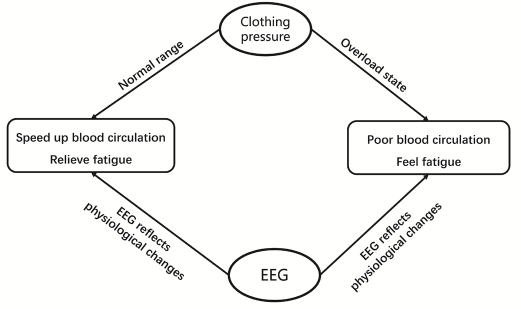
Relationships among clothing pressure, EEG, and sports fatigue.
As mentioned above, researchers have found that the relationship between α and β rhythm and sports fatigue is the closest. In the EEG study of clothing pressure comfort, the researchers also found that the α and β waves have a high correlation with pressure comfort. When studying the influence of stress clothing on fatigue relief using EEG, the physiological indicators of key detection are consistent. In addition, some researchers found that there is a certain consistency between inferior EMG and EEG in the study of low-intensity exercise fatigue,41,42 which also provided the basis for constructing a model to evaluate the fatigue relief effect of pressure clothing based on a single index of the EEG signal. The current research demonstrates that the pressure stimulation of different parts activates the brain area differently. The EEG signal is relatively weak and easily influenced by external conditions. The key to applying it in clothing pressure evaluation is to eliminate the interference of the human body state and other external factors in the experiments. Furthermore, it is difficult for researchers in the field of clothing to effectively summarize and analyze experimental data. According to current literature works, there is still an adherence to the qualitative relationship between EEG indicators and clothing pressure, and a comprehensive analysis of EEG indicators has not yet been conducted. Therefore, current research methods and content have provided results that are insufficient and lack details. The relationship between the stressed parts and different brain regions is the focus of the next study. However, it is not in line with the daily wearing pattern for which a large part of experiments based on EEG are performed in the short term. Thus, the design of long-period pressure clothing wearing experiments should be considered. In future research, clothing stress experiments for the limbs should be highlighted. This is because the limbs are more extensive and prone to sports fatigue. In addition, the surfaces of the limbs are relatively more regular, and the resulting deformation is not as significant as that of the other parts, and the force area is smaller than that of other parts. Exploring the brain wave changes caused by the pressure stimulation of the limbs will be more instructive in the study of the effect of clothing pressure on fatigue based on EEG.
Conclusion
In this study, changes in an EEG generated by human subjective feelings when clothing pressure is applied to the body were analyzed. This kind of change is objective and quantitative so that researchers can avoid the ambiguity of description and the inaccuracy of judgment in a single subjective evaluation. Combined with the current need for the development of sports protective clothing, we reviewed the research status of domestic and foreign scholars in EEG analysis to study clothing pressure that can relieve fatigue, improve sports performance, and explore the feasibility and effectiveness of EEG for evaluating the effect of clothing pressure on sports fatigue. This will lay the foundation for further application and research of EEG in pressure clothing.
Finally, the deeper application of EEG in the field of clothing also depends on the development of EEG technology. Because of the sensitivity of EEG signals, they are extremely susceptible to interference from the external environment and the current technology cannot completely remove artifacts. Therefore, it is necessary to develop more efficient tools. With the continuous development of brain science, there will be an increase in new technologies and the application of EEG in other research fields will keep growing. This will make the application of EEG technology in the field of clothing more extensive, which will improve the evaluation system of clothing comfort.