






Abstract
In this study, polypropylene (PP) fibrous mats are modified by plasma treatment, following by chemical grafting. Initially, the as-prepared PP fibrous mats are treated by plasma at different oxygen (O2) and argon (Ar) ratios. Then, the PP fibrous mats are modified by grafting dopamine onto polar groups for in situ polymerizations, resulting in a polydopamine (PDA) coating on the substrate's surface. Time-sensitive wettability is thereby converted into permanent wettability in PP fibers. The morphology, chemical performance, and relative wettability of the modified PP fibers are then characterized. The experimental results show, using an O2/Ar ratio of 3:7 during plasma treatment, that the water contact angle was decreased from 114.2° to 0°, and the maximum grafting degree was 0.79%.
Introduction
Polypropylene (PP) is widely used in many fields. However, owing to the lack of polar groups in the molecular structure, its widespread use in applications is restricted.1–3 A considerable number of approaches have been explored to modify PP and improve its wettability. Sheng et al. 4 reported modification based on a polydopamine (PDA) adhered layer for further surface-initiated photopolymerization under irradiation. Yang et al. 5 modified PP microfiltration membranes using a facile method of PDA and polyethyleneimine (PEI) co-deposition. Compared to use of only PDA, the treatment time was shortened, while the resulting hydrophilicity was improved. Zhang et al. 6 reported a strategy for rapid deposition of PDA using CuSO4/H2O2. This advanced method gave a fast deposition rate. However, PP's surface is smooth, therefore the hydrophilic coating does not easily adhere to the PP and can fall of. Compared to direct coating, it is more efficient and stable to graft active groups onto the surface before coating. The active groups can be introduced by the interaction of inorganic plasma with the polymer surface. 7 Although these active groups are time-sensitive, they can still be used as “bridges” to the polymer surface and some polar groups. Therefore, by adjusting the number of active groups during plasma treatment and then grafting permanent polar groups on the active groups, it is an effective method to perform controlled wetting modification on PP's surface. Herein, a controllable method for wetting modification of the PP fibrous mat has been proposed. PP fibrous membranes are treated with plasma at different O2 and Ar ratios to generate different amounts of oxygen-containing functional groups on its surface for grafting PDA, thus achieving controlled wetting modification of the PP fiber membrane.
Experimental
Material and Equipment
The as-prepared PP fibrous mat was prepared by melt-electrospinning. Dopamine hydrochloride (Da-HCl,) and aminomethane (Tris) are from Shanghai Aladdin Biochemical Technology Co. The heal-force water purification system (Shanghai Hetai Instruments Co.) supplied the distilled water used in this work. All analytical grade chemicals were used with no further purification. The plasma physical deposition equipment is from Beijing Chuangshiweina Technology Ltd.
Wetting Modification
The as-prepared PP fibrous mats were treated with a composite plasma containing Ar and O2 in certain ratios for 400 s, and the purity of gases used was more than 99.99%. Moreover, the treatment was carried out at a radio frequency (RF) power of 100 W. All samples were named as TPP in this process. Dopamine (2 g/L) was dissolved in Tris-HCl buffer solution (1.2 g/L, pH = 8.5). The TPP samples were immersed into the prepared solution for 30 min at 37 °C, then dopamine was grafted onto the active groups on the surface of the TPP layer, and in situ polymerization was carried out to form a thin polydopamine (PDA) coating. Finally, the modified fibrous mats were washed three times and vacuumed at 60 °C. The prepared substances were named as DPP fibrous mats.
Characterization
The morphology of PP, TPP, and DPP fibrous mats was characterized by scanning electron microscopy (SEM, S-3400N, Hitachi Inc., Japan). Surface chemical elements of initial PP, TPP, and DPP fibrous mats were detected by an X-ray Photoelectron Spectroscopy (XPS, Thermo Scientific K-Alpha+). Apparent water contact angles were measured by a contact angle tester (Beijing Jinshengxintesting Instrument Ltd., China). The PDA coating degrees of fibrous mats were determined gravimetrically using Eq. 1.
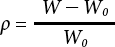
W and W0 are the weights of DPP and PP, respectively. Using dripping diffusion, a certain amount (200 μL) of ink-water was dropped on fibrous mats, and a digital camera recorded the diffusion process of water droplets on the surface.
Results and Discussion
Design and Morphology of Fibrous Mats
Fig. 1 shows the mechanism of wetting modification to the PP fibrous mat. The entire wetting modification was comprised of two steps: composite plasma treatment and dopamine grafting, and in situ polymerization. Initially, a certain number of active groups were generated on the PP surface by adjusting the ratio of O2 and Ar in the plasma. Subsequently, dopamine was grafted onto the time-sensitive active groups and underwent in situ polymerization to form the permanent hydrophilic coating.
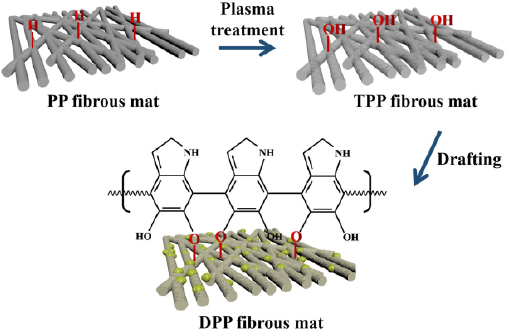
Schematic of the mechanism of wetting modification.
Figs. 2A–C demonstrate the morphology of PP, TPP, and DPP fibrous membranes, respectively. Individual curly fibers in the fibrous mat are distributed in a random direction. The results show that the pristine PP fibers were relatively fat and smooth without obvious wrinkles. After composite plasma treatment, the surfaces of fibers were etched. The surfaces of TPP fibers exhibited some distinct grooves and redeposited particles. A rough layer consisting of minute particles was formed on the DPP fibers, indicating that a thin PDA coating formed on the fiber surfaces after grafting and in situ polymerization. As shown in Figs. 2D–F, the average diameters of PP, TPP, and DPP fibers were 24.94, 24.33, and 25.98 μm, respectively, indicating that surface modification did not significantly change the size of the fibers.
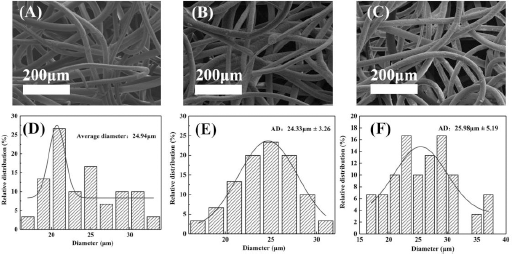
Morphology of (A) PP, (B) TPP, and (C) DPP, and the distribution of (D) PP, (E) TPP, and (F) DPP fibers diameters.
Chemical Performance of the Fibrous Mat
Surface chemical performance of PP, TPP, and DPP fibers were analyzed by X-ray photoelectron spectroscopy (XPS, Fig. 3A). Compared with PP fiber, TPP and DPP fibers presented peaks at 531.6 eV,8,9 indicating that there was a considerable number of oxygen-containing functional groups on the treated fibers. Moreover, peaks indicative of nitrogen at 392.5 eV were observed in the DPP fibers,10,11 confirming the successful adhesion of a thin PDA coating on the fiber surface. The quantified surface element analysis is shown in Fig. 3B. Compared with the PP fibrous mat, the oxygen content in TPP and DPP reached 23.05% and 22.42%, respectively, due to the large number of oxygen-containing functional groups present on these fibers. Trough plasma treatment, polar oxygen-containing functional groups were successfully created on the TPP surfaces, and a three-step strategy was used to prepare the stable hydrophilic PDA coating.
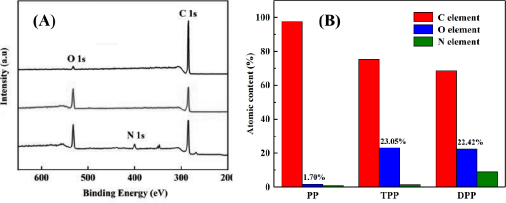
(A) X-ray photoelectron spectroscopy and (B) surface element analy-sis of PP, TPP, and DPP, respectively.
Wettability of Fibrous Mats
Fig. 4A shows the dynamic water contact angles (WCAs) of the PP fibrous mats after plasma treatment at various ratios of Ar/O2. Fibrous mat WCA values decreased from 112° to 0° with the increase in oxygen content. When the composite plasma bombards the polymer surface, the macromolecular chains of the polymer are broken, and some active sites are formed at the break, while the use of oxygen in the plasma can create polar groups at the active sites.10,12 Wettability of the polymer is improved in TPP, but this hydrophilicity is diminished after a fortnight. This hydrophilicity is time-sensitive due to the fact that polar groups flip to the inside of the macromolecule for the energy balance. 13
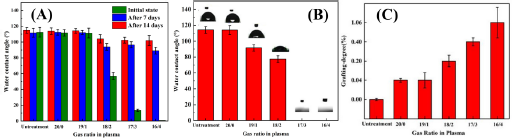
(A) Dynamic WCA values of fibrous mats after plasma treatment with various ratios of Ar/O2, (B) dynamic WCA values of DPP mats after plasma treatment with various ratios of Ar/O2, and (C) graft-degree of hydrophilic coating on the TPP surface.
Fig. 4B shows the dynamic WCA values of the DPP mats after plasma treatment at various ratios of Ar/O2. WCA values of 114.2°, 113.9°, 91.6°, 77.34°, 0°, and 0°, respectively, were obtained. At an Ar/O2 ratio of 20:0, the wetting behavior of the DPP fibrous mat showed no significant change due to the predominance of inert argon gas. As a result, the plasma treated DPP fiber surface did not contain active groups that can be grafted with dopamine. The WCA values of the DPP fibrous mats decreased with increased O2 in the ratio, and the WCA value reached 0° at an Ar /O2 ratio of 17:3. Due the large number of polar groups generated by O2 plasma treatment, the dopamine monomer can be easily grafted onto the fiber surface, forming an ultra-thin hydro-philic coating by the subsequent in situ polymerization of dopamine.
The grafting-degree of hydrophilic coating on the TPP surface also increased during plasma treatment with the increased amount of oxygen used in the Ar/O2 ratio (Fig. 4C). When the Ar/O2 ratio was 17:3, the corresponding grafting-degree reached 0.79%, in which case, water droplets can completely wet the surface of the TPP fibrous mat. For plasma treated TPP with an Ar/O2 ratio of 16:4, the grafting-degree increased to 1.05%. Consequently, it was possible to adjust the wettability of the TPP fibrous mats by controlling the oxygen in the Ar/O2 ration during plasma treatment.
Fig. 5 shows the diagram of droplet movement in the fibrous mat, where hydrophilic filter paper prepared from cellulose was placed under the DPP fibrous mats for comparing the wettability of the fibrous mat. Water can be transported from an area with low surface energy to high surface energy under the action of a surface free energy gradient. 14 Therefore, the mat wettability can be determined by observing the water transport between the fibrous mat and filter paper layers having the exact same wettability. The diffusion areas of ink droplets were enlarged on the DPP fibrous surface treated at an Ar/O2 ratio of 17:3; the droplets penetrated through the DPP layer and diffused on the filter paper. Meanwhile, when an Ar/O2 ratio of 16:4 was used, many droplets were absorbed in the DPP layer without moving toward the underlying filter paper, which was attributed to increased DPP hydrophilicity. Although the WCA values of DPP17:3 (DPP treated with a 17:3 Ar/O2 plasma) and DPP16:4 were both 0°, DPP16:4 was more hydrophilic.
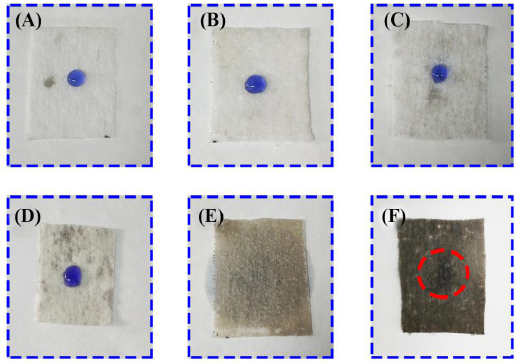
Schematic of droplet movements in (A) PP and DPP fibrous mats treated with different ratios of Ar/O2: (B) 20:0, (C) 19:1, (D) 18:2, (E) 17:3, and (F) 16:4.
Conclusion
In summary, polypropylene (PP) fibrous mats surface can be successfully modified to improve wettability by the two-step plasma treatment strategy used in this study, and the resulting degree of wettability was controllable. The results showed that the water contact angles (WCAs) of the DPP fibrous mats decreased with increased oxygen content during plasma treatment and reach 0° when the Ar/O2 ratio was 17:3. The surface wetting modification used in this study can help to expand the number of useful PP applications.