






Abstract
The purpose of this study was to determine the influence of the compression on muscle recovery after sports. Four kinds of gradient pressure socks were randomly ordered into 24 groups. Each subject needed to complete six experiments of all. The experiment was divided into two parts including a fatigue induced experiment and an intermittent fatigue induced experiment. The vertical jump height, blood oxygen saturation, local hemoglobin, blood flow, and Visual Analogue Score (VAS) were tested in each experiment. It was found that high pressure level has a significant effect on the vertical height after intermittent induced fatigue; however, the analysis showed no difference among sock pressure levels on blood oxygen saturation, local hemoglobin, blood flow, or VAS subjective feeling evaluation. The effect of compression socks was better than that of non-pressure socks. If the exercise intensity is strong, high-pressure socks can make contributions on recovery. If the exercise intensity is low, low-pressure socks contribute to greater comfort. This study concluded that different exercise intensities required different sock pressures to promote the muscle recovery after sports.
Introduction
Compression socks have been widely applied for medical therapy and sports events. It seems that compression socks can bring a lot of benefits to people who wear them. Compression socks can dramatically restrain edema compared with non-compression socks. In addition, high-pressure socks offer better performance than those with low pres-sure. 1 It has been found that compression stockings can counteract the gravity that limits the venous return from the distal leg. 2 Research suggests compression socks may help relieve muscle soreness, 3 improve lactic acid scavenging capacity, and promote cell repair. 4
The recovery period is complex and cannot be evaluated based on subjective feelings alone, so experts use a variety of objective indices to detect the body recovery condition. Sperlich used blood lactate concentration, blood pH value, serum creatine kinase concentration, and blood flow to evaluate the effect of the compression garment. 5 Tough it shows no difference to sports performance, it reduces the blood flow of the thigh muscle tissue in the recovery period. Some scholars report that wearing compression garment can reduce lactate dehydrogenase, creatine kinase, and plasma concentrations after sports. Mizuno found that wearing medium-pressure garments is most influential on the change in counter movement jump (CMJ) height compared with high-pressure and low-pressure garments. 6 The CMJ height with high-pressure garments is actually smaller than that with low-pressure garments. Some indices may show no difference when comparing compression and non-compression garments; such factors include plasma myoglobin and c-reactive protein. Even the same index may show different results in different sports experiments. There is no consensus on the physical effect during the fatigue recovery period; however, several studies have estimated the effect of compression socks after sports. The aim of this study was to test the muscle strength, blood oxygen saturation, and blood flow. It also used the VAS evaluation to describe the subjective feeling. The objective indexes with the VAS analysis formed a comprehensive evaluation system to quantify the effect of compression socks.
Methods
Participants
Ten healthy women who often exercise three times a week (mean ± standard deviation: age 22.8 ± 1.4 years, height 160.8 ± 2.2 cm, weight 49.8 ± 5 kg) volunteered to participate in the test. According to a medical interview, all were healthy with no history of cardiovascular or metabolic diseases. They were asked to avoid taking caffeine or alcohol for at least 24 h before the test. Subjects were required to provide informed consent. The study was approved by the institutional Human Research Ethics Committee.
Test Design
Socks of four gradient pressure levels could be tested in 24 different sequences. Six sequences were randomly selected and assigned to six subjects. All tests were conducted in the same environmental conditions (temperature: 25 °C, hygrometry: 60%). Every subject completed six experiments. Each experiment was divided into two parts including a fatigue induced experiment and an intermittent fatigue induced experiment.
First, fatigue was determined using heart rate combined with iEMG. When the two indices are unified, the muscle is fatigued. In the subsequent tests, heart rate was used to judge whether the subject was really fatigued.
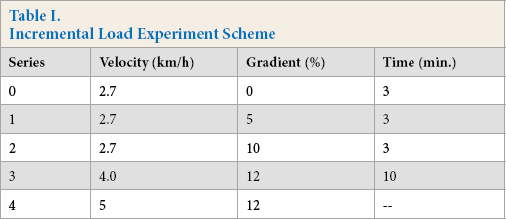
The next step was the fatigue induced experiment. The subject was asked to walk under increasing load (Table I). Firstly, they walked for 3 min at the speed of 2.7 km/h on 0 gradient. Ten they followed the experimental plan in Table I in turn until fatigued, and unable to walk any longer. Then, the subject was required to take a rest. Indexes (vertical jump height, blood oxygen saturation, local hemoglobin, blood flow, and VAS subjective feeling evaluation) were tested five times, for example, before the experiment, immediately after the experiment, 15 min. after the experiment, 45 min. after the experiment, and 1 h after the experiment. The intermittent fatigue induced experiment was conducted at 24-h intervals. Processes were the same as for the fatigue induced experiment.
Incremental Load Experiment Scheme
Statistical Analysis
Data were reported as mean plus or minus standard deviation. Mauchly inspection was used to test the assumption of sphericity. When it didn't meet the requirement of the assumption of sphericity, “correction for greenhouse efect” was used to adjust the degree of freedom of the mean test of significance. A paired t-test was used to explore whether differences existed between indexes tested before and after the experiment in the condition of socks with various pressure. Two-factor repeated measures of variance was used to confirm the effect of pressure level to each index. Statistical significance was set at p < 0.05.
Results
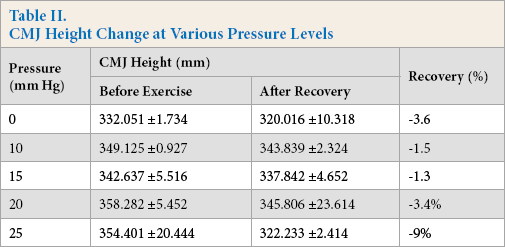
In one fatigue induced experiment, vertical jump height showed the same pattern, regardless of pressure. Height increased, then went down, and finally, increased again. This agreed with the character of the muscle soreness delay. At first, the muscle cells were activated because of the previous experiment; however, the third time showed the lowest height owing to fatigue and it confirmed the fact that the experiment induced fatigue. At the last point of detection, height was close to the height before the experiment. In contrast, Table II shows that the recovery rate of the compression socks with ankle pressure about 25 mm Hg is -9%, it showed a decrease compared with the non-socks conditions whose recovery rate is -3.6%. When the pressure is over one point, it no longer has any significant benefit and may even impede the recovery process, acting as a tourniquet. Analysis of variance between groups showed wearing various pressure socks had no influence on the vertical jump height.
CMJ Height Change at Various Pressure Levels
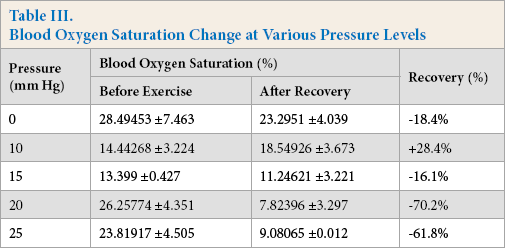
Regardless of the various pressure, changes in blood oxygen saturation also showed the same pattern. The oxyhemo-globin decreased after the experiment because the oxygen was consumed during the activity. When the subject takes a rest, the index increases again. Wearing compression socks makes the recovery process quicker. Table III showed that the 10 mm Hg sample allowed the subject to fully recover, its recovery rate is +28.4%. Other samples showed some recovery; however, the 20 mm Hg and 25 mm Hg samples showed an obvious decrease. The recovery rates are respectively -70.2% and -61.8%. This showed that too much pressure may restrain the blood oxygen saturation recovery. Analysis of variance between groups showed that there is no influence to blood oxygen saturation regardless of wearing various pressure socks.
Blood Oxygen Saturation Change at Various Pressure Levels
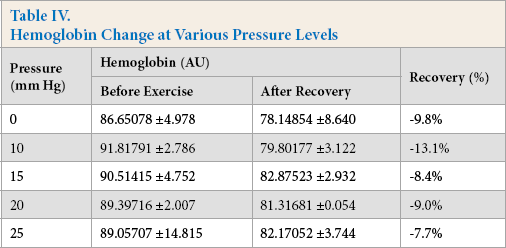
Changes in region hemoglobin showed the same trend for all pressures. Region hemoglobin decreased, then rose during the recovery period. Table IV shows that 10 mm Hg socks whose recovery rate is -13.1% are worse than non-pressure socks while the other experimental groups showed a great improvement. Other high pressure conditions recovery rates are -8.4%, -9.0%, and -7.7% respectively. It seemed high pressure is more helpful to the recovery of region hemoglobin, but the effect is not very great. In fact, analysis of variance between groups showed that there is no influence to region hemoglobin regardless of wearing various pressure socks.
Hemoglobin Change at Various Pressure Levels
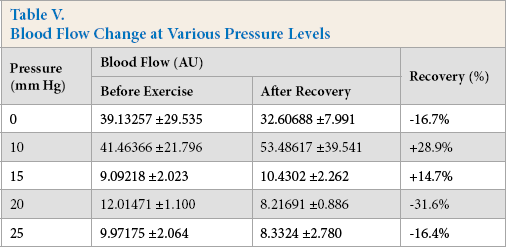
When the subjects participated in the experiment, blood flow increased; however, after sports, blood flow decreased first, then rose during the recovery period. Non-pressure and 25 mm Hg socks did not rise in the period. Too much pressure can restrain the blood flow, providing the same net effect as no pressure. Low pressure socks can help the recovery of blood flow. 10 mm Hg and 15 mm Hg samples made the blood flow recover to about the same level as before the experiment. Table V shows that the recovery rate is 28.9% and 14.7%, respectively. The high pressure sample did not recover to this level. Analysis of variance between groups showed that there is no influence to blood flow regardless of wearing various pressure socks.
Blood Flow Change at Various Pressure Levels
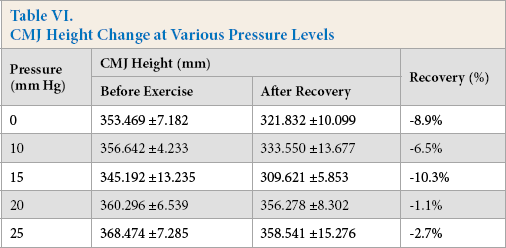
The fatigue feeling increased when the subject did not wear compression socks after 15 min. Subjects wearing the experimental socks did not report this increase. It seemed wearing pressure socks can reduce fatigue. Variance analysis results showed that the pressure socks have no significant effect on the vertical jump height; however, it showed a great differ-ence after the intermittent fatigue induced experiment. Table VI shows that the recovery rates after wearing 20 mm Hg and 25 mm Hg pressure socks are -1.1% and -2.7%. They recover better when they wore 20 mm Hg and 25 mm Hg than they wore 10 mm Hg and 15 mm Hg socks. The blood indexes and subjective fatigue feeling index still showed no influence.
CMJ Height Change at Various Pressure Levels
Discussion
This study confirmed the effect of the compression socks, especially that different degrees of sports injury should be matched with suitable pressure to help people recover. Tough different pressure levels didn't make any difference in one fatigue induced experiment, the experimental socks showed signs of leading to recovery. Also, the intermittent fatigue induced experiment indicated that high pressure socks can be better in recovery because they provided an improvement of the vertical jump height. Choosing the correct index is important. Counter movement jump has been considered as the benchmark to evaluate muscular strength and has been widely used in some explosive movement. 7 Biochemical substances in the blood can also be detected by laser light, infrared ray, and piercing test to judge the condition of the muscle injury. 8 These indexes are consistent with the subjective fatigue evaluation, so they can be used to characterize muscular fatigue.
The results of the current study do not support those described in work by Oficial-Casado, who did not report any increase in the volume of venous blood return via the popliteal vein in trained athletes after running for 30 min; 9 however, the data obtained in this study did show that the volume of venous flow was greater after running. As in the research of Armstrong, it has found that wearing compression socks for 48 h after marathon running can improve functional recovery. 10 Similarly, Halson found that wearing compression socks between repeated running bouts can aid recovery and subsequent performance. Furthermore, subsequent exercise may be even further enhanced when athletes believe in the efficacy of compression socks to assist in recovery between exercise bouts. 11 The current research, along with previous work supports the use of compression socks after sports.
Conclusion
This study suggested low pressure socks can help people recover after low exercise intensity based on subjective comfort. Athletes may need high pressure socks for recovery after high exercise intensity. Manufacturers should develop and label products based on sports intensity so that consumers can make the best choice for their needs.
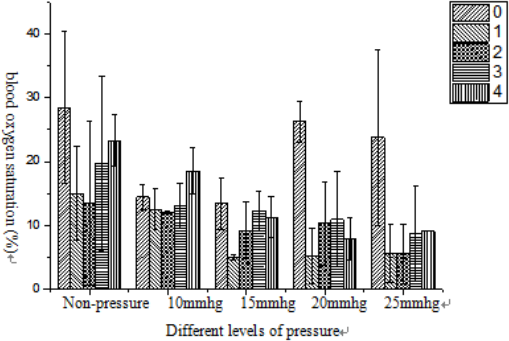
Blood oxygen saturation at various pressure levels and timepoints. 0 = baseline before experiment, 1 = end of experiment, 2 = after subject rested 15 min., 3 = 45 min., 4 = 1 h rest.
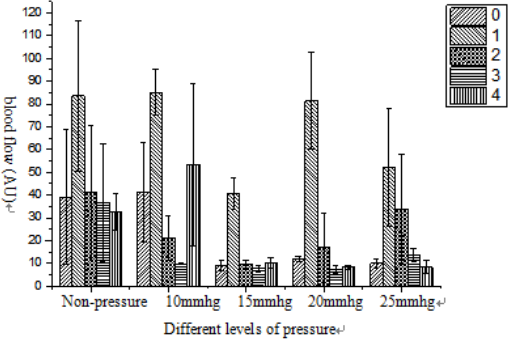
Blood flow at various pressure levels and timepoints. 0 = baseline before experiment, 1 = end of experiment, 2 = after subject rested 15 min., 3 = 45 min., 4 = 1 h rest.
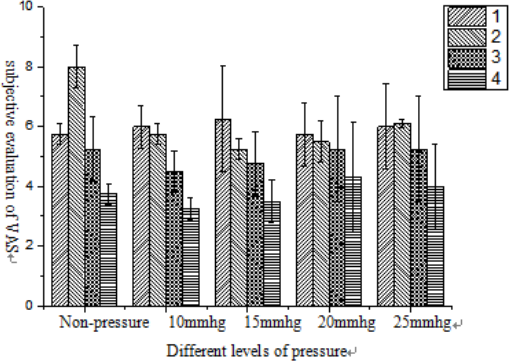
Subjective evaluation of VAS at various pressure levels and time-points. 1 = end of experiment, 2 = after subject rested 15 min., 3 = 45 min., 4 = 1 h rest.
Footnotes
Acknowledgements
This paper is supported by Key Projects of Ministry of Science and Technology (2018YFC2000900) (Sports and health continuous monitoring technology and weaving molding products research and development) and by the Science and Technology Innovation Action Plan of Shanghai Science and Technology Commission (18030501400). The authors would like to thank the subjects who participated in the experiments.