






Abstract
Thermal shrinkage of flame resistant fabrics can greatly affect the thermal protection of firefighters’ clothing. In this study, four boundary conditions were designed to simulate garment aperture structures. Thermal shrinkage was measured with and without an air gap under three heat-flux levels. The shrinkage ratio was measured and calculated using digital image technology. Results showed that an air gap between the fabric and sensors was the main factor in thermal shrinkage. The presence of an air gap aggravates thermal shrinkage at the garment apertures, especially under the open boundary condition with incomplete fixation. The ease required for human movement and thermal shrinkage should be taken into consideration when designing thermal protective clothing. This study provides a quantitative method for determining the thermal shrinkage of fabrics.
Introduction
The primary role of thermal protective clothing is to act as a barrier between wearers and hazardous environments.1,2 The thermal environments faced by firefighters is classified into three categories: routine, hazardous, and emergency, in which the temperature falls in the range of 20 °C to 1200 °C. Firefighters have to work for several minutes in these thermal environments.3-6 It is of great importance that clothing worn by people in such environments is fame resistant and maintains its integrity during the exposure.7-9 Flame resistant fabrics used as the outer layer of thermal protective clothing are mainly composed of polymer fibers such as aramid, polyimide, and polysulfonamide (PSA), which have high performance in fire-retardancy,10,11 but tend to shrink at high temperatures. 12 Specifically, a widely used aramid fabric shrinks seriously when the fabric temperature reaches 400°C.9,13 The shrinkage of fabric not only destroys the integrity of the clothing, but reduces the air gap size and increases the contact area of the fabric with body skin, accelerating the heat transfer rate and increasing the possibility of burn injury.14,15 Therefore, capturing and measuring the effect of thermal shrinkage of fame resistant fabrics is important for evaluating the thermal protective performance accurately.
A bench-scale test is used to evaluate the thermal protective performance of fabrics, which is more convenient and efficient compared with full-scale manikin tests. However, the effect of thermal shrinkage is not included in the method because of the planar geometry of the test device,9,16 For this reason, an improved device using a cylindrical configuration to simulate human body shape has been designed.9,16,17 Results measured by the cylindrical geometry test device refected the negative effect of thermal shrinkage on the thermal protective performance of fabrics. 9 Furthermore, previous studies have also developed quantitative methods to characterize the thermal shrinkage of fabrics and clothing. Measuring the positions of markers before and after exposure 15 can fully described the dimensional changes in four directions. Li, et al. focused on details of the fabric deformation and defined surface roughness ratio to evaluating shrinkage by digital image technology. 18 Wang, et al. carried out a quantitative evaluation of the overall shrinkage of clothing in combination with 3D image scanning technol-ogy. 19 Moreover, the reduction of air gap width caused by thermal shrinkage of fabrics has been shown to significantly affect the heat transfer after exposure ceases. Clothing with greater thermal shrinkage generally developed a larger percentage of burn injury. 20
Bench scale studies are limited to static conditions in which the fabric evenly covers the surface of human skin. The effect of thermal shrinkage of fabrics and the change in relative position of clothing by the wearer adjusting posture or movement was ignored. It is worth noting that this effect is more severe at garment apertures due to the spatial relationship between the garment apertures and human body. The human skin at garment apertures risks exposure to the thermal environment and burns due to thermal shrinkage of clothing in the warp direction. Furthermore, the shrinkage in the weft direction may close the heat exchange channel between the microclimate under the clothing and the external environment.
In this study, the marking method and digital image technique were used to quantify the garment apertures effect on thermal shrinkage of the flame resistant fabrics under fire exposure. The average shrinkage ratio was determined by measuring the shrinkage in four directions. Area retention ratio was defined in image analysis based on the function library of OpenCV (version 3.30).
Methodology
Materials
Two flame resistant fabrics, Kevlar/PBI and Nomex IIIA, used as the outer layers of firefighter protective clothing were selected. The details of these two fabrics are shown in Table I.
Basic Physical Parameters of the Fabric Specimens

Thermal Protective Performance (TPP) Test
The TPP tester (CSI-206, Custom Scientific Instrument Corp, USA) served as the heat source for inducing thermal shrinkage of the fabrics. The TPP tester consists of two meker burners and nine heated quartz tubes, which can produce a 50% convective and 50% radiant heat flux. The fabric specimens were cut to 15 × 15 cm and mounted in standard cases with a heat exposure area of 10 × 10 cm. To maintain the structural integrity of the specimens, the heat exposure time was limited to 17 s based on preliminary experiments and the specimens were rapidly removed from the heat source at the end of the exposure. The influences of boundary conditions, heat flux levels, and air gap have been investigated in this study.
The coverage of skin by thermal protective clothing at garment apertures changes with posture and movement of the wearers, as well as the thermal shrinkage of clothing. The coverage at apertures such as cuffs and collar can be divided into categories of complete cover, enough cover, and partial exposure. Accordingly, three boundary conditions of confined, semi-confined, and open boundary were designed, and the standard boundary condition is set as a control group, as shown in Fig. 1.
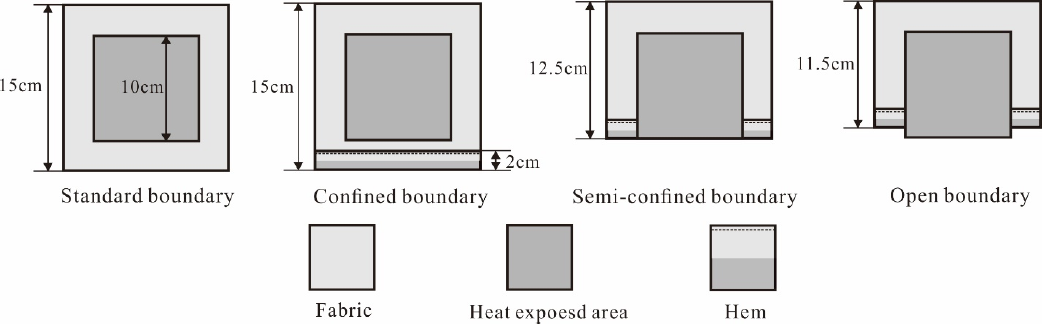
Diagram of boundary conditions.
To represent the diversity of emergency thermal conditions, three levels of heat flux (30 kW/m2, 40 kW/m2, and 50 kW/ m2) were selected. These levels did not cause rapid thermal aging of the tested fabric samples in preliminary experiments. In addition, air gaps of 0 mm (without air gap) and 6.4 mm (with air gap) were designed to simulate the differ-ent contact conditions between clothing and skin. The effects of each boundary conditions, heat flux, and air layer on the thermal shrinkage for two tested fabrics were investigated. A total of 48 groups of experiments were each repeated three times.
The fabric specimens were cut and sewn according to the boundary conditions. The specimens of standard boundary were cut to 15 × 15 cm and were not folded. The length of confined, semi-confined, and open boundary specimens was 15 cm, 12.5 cm, and 11.5 cm respectively. A 2 cm wide hem was sewn at the bottom, in which the raw edge width was 1 cm. The hem was sewn with flame-retardant sewing thread matching the color of fabrics, and the stitch density was no less than 9 stitches per 3 cm.
Measurement of Thermal Shrinkage Deformation
Stamp markers were sealed on the back side of the fabric before exposure, and the thermal shrinkage was measured based on the position of the markers before and after exposure. The positions of the markers were coincident with the sensor location. The marker was a circle with diameter of 4 cm. Four inner lines, namely the vertical, horizontal, left oblique, and right oblique line, were marked in the circle as the reference directions. The vertical line was in coincidence with the warp direction, and the horizontal line was in the weft direction. The left oblique line was rotated 45° counterclockwise from the vertical line, and the right oblique line was rotated 45° clockwise from the vertical line. The thermal shrinkage of the fabrics was determined using Eq. 1.
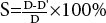
where, D is the diameter of the circle before exposure and D’ is the average of the lengths of the four lines after exposure.
Digital image technology based on the function library of OpenCV was used to measure the area retention of fabrics. Two-dimensional images were taken by a high-performance scanner (Fujitsu SV600) before and after thermal exposure. The images were taken directly above the fabric and kept at the same height, then converted to black and white by the image processing program to extract the fabric image more accurately. The area retention ratio was calculated by Eq. 2.

Average thermal shrinkage ratio (a) and average area retention (b) of two fabrics under 50 kW/m heat flux.
where, R is the retention ratio, A is the surface area of the fabric before exposure and A’ is the surface area of the fabric after exposure.
Statistical Analysis
The Statistical Package for the Social Sciences (SPSS) 24.0 was applied for statistical analysis at a significance level of 0.05. The shrinkage of the two fabrics was compared by the mean value analysis. One-way ANOVA analysis and Kruskal–Wallis nonparametric H test were used to compare the shrinkage ratio and area retention ratio of the Nomex specimens under different test conditions.
Results and Discussion
Thermal Shrinkage Deformation
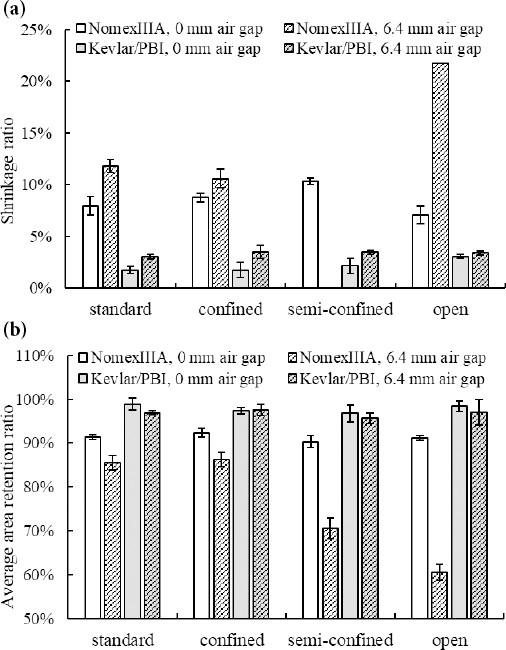
Fig. 2 presents the average shrinkage ratio and area retention ratio of two fabrics under the heat flux of 50 kW/m2, respectively. The average shrinkage ratio of Nomex IIIA specimens was 7.1%-21.7% (the data of semi-boundary specimens with 6.4 mm air gap was lost due to marker fading) and the average shrinkage ratio of Kevlar/PBI was 1.8%-3.5%. The area retention ratio of Nomex IIIA was 60.6%-92.3% and Kevlar/ PBI was 95.7%-98.8%.
The two methods measured the thermal shrinkage of fabrics from one-dimensional and two-dimensional perspectives respectively, and presented relatively consistent results. The thermal shrinkage deformation of Kevlar/PBI was signifi-cantly lower than Nomex IIIA. The shrinkage was intensified when there was an air gap and Nomex IIIA was more affected by the air gap. Nomex IIIA was selected to analyze the influence of various factors on thermal shrinkage deformation since it exhibited more severe shrinkage.
Shrinkage Ratio
The effects of boundary conditions, heat flux levels, and air gap on the average shrinkage of Nomex IIIA were examined based on the characteristics of normal distribution of data. The result of one-way ANOVA analysis indicated the boundary conditions had no signiaf)c ant effect on the average shrinkage ratio (p = 0.502) and there was no significant difference among the selected four boundary conditions. The Kruskal-Wallis H test showed that the presence of an air gap had a significant effect on average shrinkage ratio (p < 0.001), while the heat flux levels did not (p = 0.672).
Therefore, considering the significant effect of air gap, the 0 mm and 6.4 mm air gap were analyzed separately. The average shrinkage data of each heat flux level and bound-ary condition are normally distributegd. for the condition of 0 mm air gap. One-way ANOVA results indicated that heat flux levels had no significant effect on average shrinkage ratio (p = 0.808). LSD method was selected for intra-group comparison since the variance was homogeneous according to the Levene test, and the results showed there was no significant difference in each level of heat flux. No significant effect of boundary conditions on average shrinkage ratio was found (p = 0.250). For the 6.4 mm air gap, the results of one-way ANOVA showed that the heat flux levels (p = 0.652) and boundary conditions (p = 0.091) had no significant influence on the average shrinkage ratio. The Tamhane T2 multiple comparison test was selected because the variances for several of the boundary conditions were heterogeneous and the results showed there was no significant difference for each boundary condition.
Area Retention Ratio
One-way ANOVA was conducted on the effects of boundary conditions and air gap on the area retention ratio, and the results indicated that the boundary conditions had no significant effect (p = 0.254), while the air gap did have a significant effect (p < 0.001). The Kruskal-Wallis H test was used for exploring the influence of heat flux levels, and no significant effect was found. This result was in good agreement with the analysis of average shrinkage ratio that indicated the presence of an air gap is the most important factor affecting the thermal shrinkage of fabrics.
The effects of boundary conditions and heat flux levels on the area retention ratio of fabrics under the different conditions of air gap were also discussed separately. The area retention ratio data of heat flux levels and boundary conditions are normally distributed when there was no air gap between fabric and sensor. The result of one-way ANOVA showed that heat flux levels had a significant influence (p < 0.001). Multiple comparison results of LSD method indicated that the area retention ratio under the heat flux of 30 kW/m2, 40 kW/m2, and 50 kW/m2 had significant differences (p = 0.001; p < 0.001). There was no significant difference between the heat flux of 40 kW/m2 and 50 kW/m2 (p = 0.160). Boundary conditions had no significant effect on the area retention ratio for 0 mm air gap conditions (p = 0.811). In the case of 6.4 mm air gap, one-way ANOVA analysis showed that both heat flux levels (p = 0.214) and boundary conditions (p = 0.057) had no significant influence on the area retention ratio. Multiple comparison results showed that the area retention ratio. under standard, confined, and open boundary conditions had significant difference (p = 0.029).
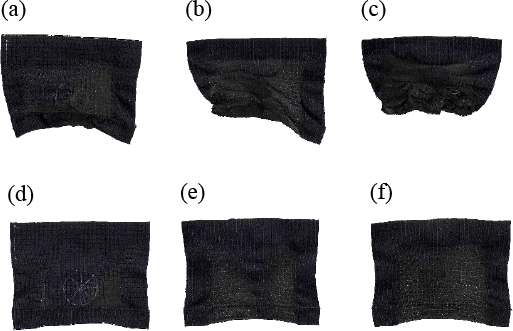
The above results indicated that in the absence of an air gap, the heat flux level has a significant effect on thermal shrinkage of Nomex IIIA fabric, and an increase in heat flux decreases the area retention ratio. When there was a 6.4 mm air gap, although the heat flux levels and boundary conditions did not significantly affect the thermal shrinkage of Nomex IIIA, the shrinkage of the fabric under the open boundary condition was significantly greater than that of the other three conditions. This may be because the lower edge of the specimen under the open boundary condition were not fixed, and the space provided by the air gap made it shrink, as shown in Fig. 3.
Nomex IIIA after fire exposure, with 6.4-mm air gap and heat flux of 30 (a), 40 (b) and 50 (c) kW/m2; and without air gap under heat flux of 30 (d), 40 (e) an d 50 (f) kW/m2.
Conclusions
The effects of air gap, boundary conditions, and heat flux levels on the thermal shrinkage of flame resistant fabrics were analyzed considering the structure of garment apertures. The shrinkage ratio obtained by the marking method and the area retention ratio obtained by digital image technology were determined. Results showed that Kevlar/ PBI has better thermal shrinkage resistant performance than Nomex IIIA. The area retention ratio was in good agreement with the average shrinkage ratio, both indicating that the presence of an air gap is the most important factor affecting the thermal shrinkage of fabrics. In addition, the area retention ratio refected the effect of various factors on the thermal shrinkage of the fabric more comprehensively than the average shrinkage ratio because the sample was taken in the form of area and had a larger sampling range. The analysis of area retention ratio indicated that the effect of the boundary conditions on the thermal shrinkage is different when there is an air gap between the fabric and the sensor. The space provided by the air gap exacerbates the thermal shrinkage of the Nomex IIIA, especially under the open boundary condition with incomplete fixation. The findings will provide a guideline for the specification of thermal protective clothing design.
Footnotes
Acknowledgements
The authors would like to acknowledge the financial support from the Chenguang Program supported by Shanghai Education Development Foundation and Shanghai Municipal Education Commission (Grant No. 18CG76), the Fundamental Research Funds for the Central University (Grant No. 2232020G-08) and Shanghai Summit Discipline in Design (Grant No. DA19202).