






Abstract
This paper presents an effective method to simulate the dynamic deformation of the breasts when a sports bra is worn during physical activity. A subject-specific finite element (FE) model of a female subject is established, and the accuracy of the material coefficients of the model is analyzed. An FE model of the sports bra is also built based on a commercially-available compression sports bra with a vest style. Then, an FE contact model between the body and bra is developed and validated, and the results applied to train a neural network model for predicting breast displacement based on bra straps with different tensile moduli. In this study, a four-layer neural network with a backpropagation algorithm (a Levenberg-Marquardt learning algorithm) is used. A comparison of the FE and machine learning results shows that machine learning can well predict the dynamic displacement of the breasts in a more time-efficient and convenient manner.
Introduction
The breasts are an important part of the female anatomy as they are designed to produce and secrete milk. However, breasts have no muscles; instead they are comprised of skin and subcutaneous tissues. Therefore, breasts have limited anatomical support, and any excessive movement of the body during physical activity or even daily activities can cause embarrassment, discomfort, pain, or even injury and sagging. 1 To solve this problem, a well-designed sports bra can provide adequate contact pressure to restrict breast movement without causing discomfort to the wearer. 2
It is important to determine the optimum contact pressure to restrict breast movement. Recently, machine learning (ML), which has been applied in many fields such as economics, engineering, and statistics,3-5 was used to build a mathematical function with given data to make predictions without background knowledge of the problem. In the past, the finite element method (FEM) has been used for simulations to predict various phenomena and has shown good accuracy and robustness, but the method is also computationally expensive and time consuming in most cases. Therefore, ML is now being increasingly used, and its efficiency and accuracy are popular in investigating the human body, especially tissues.6,7 As such, the aim of this study is to first build and analyze an FE contact model of the female body and sports bra. Then, ML algorithms called neural networks (NNs) are used to establish a model that would predict the dynamic displacement of the breasts while wearing a sports bra with different bra strap materials during running. Using NNs involves three sets of sample data: training, validation, and testing sets. The former two are used during training while the latter is used after training is completed to assess the performance of the selected network.
The study contributes to the current literature by offering a system of experiments to analyze the effect of sports bras, and numerical simulation of the mechanical behaviors of the breasts when a sports bra is worn during running.
After a brief introduction of the study, the related works in the literature are first discussed, followed by a description of the study methods, including experiments, and the FE and ML models. Next, the verification work of the models is presented and the predicted displacement of the breasts. Finally, the conclusions and future research recommendations are given.
Related Work
FEM is one of the most common numerical methods that can be applied to simulate the dynamic deformation of human soft tissues. Many studies have already used FEM to predict the deformation of female breasts under compression with great accuracy.8-10 The interaction between female bodies and sports bras were also analyzed by FEM previously.11,12 A serious limitation of FEM is its long computation time, especially when it involves contact problems. Therefore, ML techniques were used to greatly reduce the computation time and enhance efficiency.
ML is increasingly used as an approach to predict the biomechanical behaviors of breasts in the current literature. However, the focus has been mainly on diagnosing breast cancer. Kharya, Dubey, and Soni 13 summarized a number of papers in the literature on the diagnosis and prognosis of breast cancer with the use of ML techniques. They provided the benefits and limitations of four ML approaches: decision trees, artificial neural networks (ANNs), support vector machines (SVMs), and Bayesian networks. ANNs are mostly used as a predictive technique which replicates human thinking and is often used in medical predictions as compared to decision trees, which resemble a flowchart to make decisions and visualize all of the possible outcomes. SVMs are mainly used in computational biology, such as microarray data analysis, to transform data and categorize new examples. Finally, Bayesian networks are suitable for carrying out predictions under uncertain situations with incomplete data. Dubey, Gupta, and Jain 14 analyzed algorithms that have been used to predict the early stages of breast cancer, such as ANNs and SVMs, and found that the accuracy rate is higher than 90% in most research studies. Shan et al. 15 also used four ML approaches which include decision trees, ANNs, SVMs, and random forests to develop a computer-aided diagnosis system for 283 ultrasound images of the breasts. They compared the results and found that the SVM has the best performance. However, ML techniques have not been clinically applied, even though the techniques have developed rapidly in recent years. This is mainly due to the lack of standardization and the need for large datasets. 16
While ML techniques have been used to assist with decision making and optimizing the apparel industry processes, such as manufacturing plant processes, production planning, and order planning and scheduling, 17 no studies have focused on the application of ML directly to sports bra designs. Hence, this study addresses this research gap by examining the dynamic behavior of breasts when a sports bra is worn. Since the focus is on a sports bra, this can also be considered an intimate apparel study.
The combination of FEM and ML has been successfully used to predict deformation of human organs.6,7,18 The ML models were trained by the results of FEM in these studies. Then, real-time deformation with limited mean errors were predicted. For instance, the FEM based-ML models in the study of Martínez-Martínez et al. 7 were able to simulate the biomechanical behaviors of female breasts under compression and they only took less than 0.2 s. Importantly, the mean error was under 0.2 mm and 2 mm for the hold-out and leave-one-deformation-out experiments, respectively.
Methodology
A flow chart of the study method is shown in Fig. 1. The basis of building an ML model is accurate FE results. To build a robust FE model, several experiments were first conducted. Then, an FE model was built and validated based on the experimental results. After analyzing the FE results, a prediction model was established by using NNs.
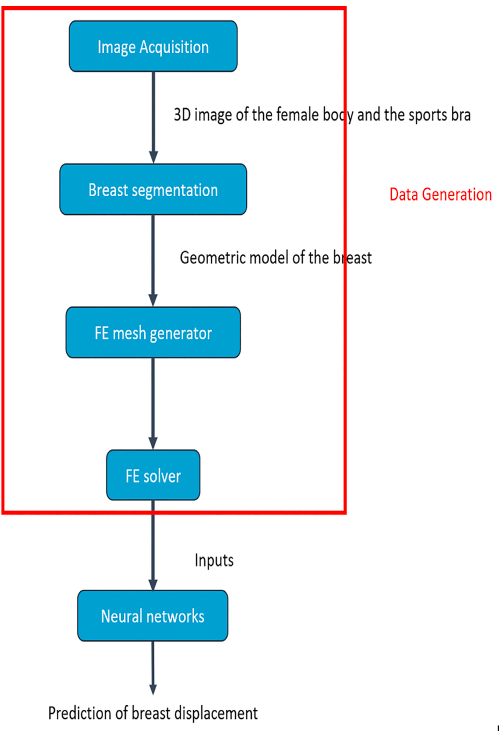
Flow chart of study method.
Subject
A 33-year-old healthy female subject with a bra cup size of 75C (metric sizing system) was recruited to voluntarily take part in the experiment. She had not undergone any treatment for any medical conditions and was not pregnant or lactating. The subject provided informed consent before she took part in the experiment, which was approved by the Human Subjects Ethics Sub-committee of The Hong Kong Polytechnic University (Approval No.: HSEARS20151207004).
Experiments
The body of the subject was first scanned with a 3D laser body scanner (Vitus, Human Solutions, Germany). The 3D point cloud data were used to construct geometric models of her body (rigid component) and breasts (soft component) by using reverse engineering software (Geomagic Studio 12, USA). As this study was focused on the upper body of the subject, the non-relevant parts (e.g., legs and feet) of the body were removed to save computation time. The final geometric model is shown in Fig. 2.
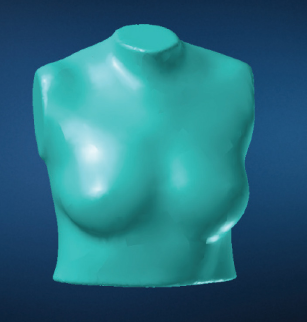
Geometric model of the subject.
The dynamic displacement of the breasts during running was captured by using 12 digital cameras (Eagle Motion Analysis Corporation, USA). Spherical retro-reflective markers were attached to the surface of her upper body to reflect infrared light, which would record the coordinates with time. One marker was placed on the nipple of the right breast, while another marker was placed on the torso to record the upper body movement. The first step of the motion capturing experiment was calibrating the cameras. The positioning of a T-shaped wand with several retro-reflective markers allows the direction of possible subject movement to be specified by the retro-reflective markers in three directions: left and right (x-coordinate plane), up forward and backward (y-coordinate plane), and up and down (z-coordinate plane), which was then calibrated in EVaRT (version 5) software (Motion Analysis Corporation, USA). After that, the subject was asked to stand still initially for each cycle of activity. Then, she was instructed to run on the treadmill until she reached a steady speed. The experimental setup is shown in Fig. 3. The values of the y-coordinate for each retro-reflective marker were recorded with time.
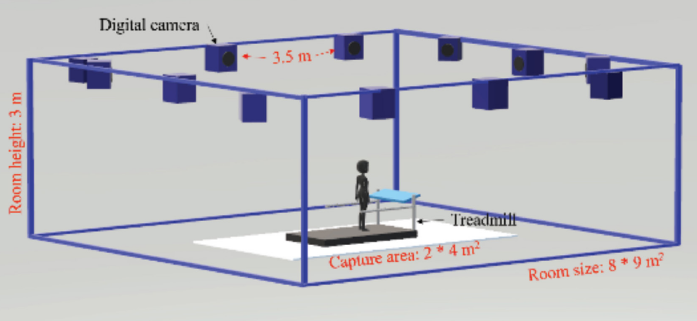
Setup of motion capture experiment.
The contact pressure between the subject and sports bra was measured by using a pressure sensor system (Novel Pliance-X) on five locations of the body: the left and right shoulders, left and right underarms, and bottom of the left bra cup. A single sensor was used to test the contact pressure in the shoulder and underarm areas, and a 2*2 sensor was used to test the contact pressure at the bottom of the bra cup because of its relatively larger area (Fig. 4). The contact pressure easily changed with each breath taken by the subject and each small movement that she made. In this study, the pressure value was calculated by averaging the values during the stationary phase.
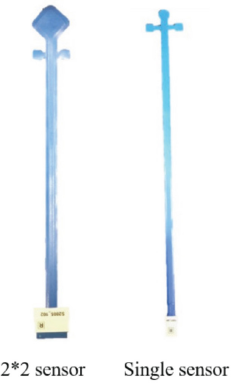
Pressure sensors.
Bra Sample
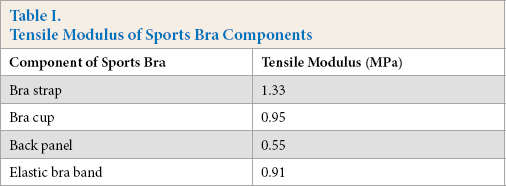
A compression sports bra with a simple vest-style was worn by the subject in the experiment, as shown in Fig. 5. The mechanical properties of four components of the bra were tested by using a constant-rate-of-extension tester (Instron 4411). The tensile modulus of each bra component is listed in Table I.
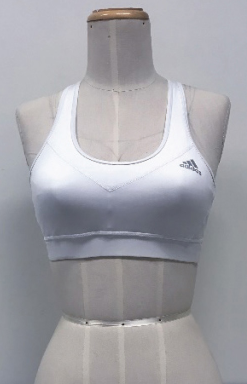
Sports bra sample.
Tensile Modulus of Sports Bra Components
Finite Element Model
A mesh sensitivity study was first conducted. Different mesh element sizes have been used to build FE models of the breasts in other studies. Sun et al. 19 used a mesh element size of 5 mm, while Martínez-Martínez et al. 7 used 2 mm. Hence, five FE models with different mesh element sizes (2, 4, 6, 8, and 10 mm) were built to determine the influence of the mesh density and determine the optimum mesh element size for this study. It was observed that there was only a 0.28% variation in the dynamic breast displacement between the results with the use of the 4-mm and 6-mm element sizes. However, the number of elements for the model with a 4-mm element size was 3 times greater than that with a 6-mm element size. Therefore, the calculation time was also three times longer. As a result, the 6-mm element size was used due to both efficiency and accuracy.
The geometric model of the body was based on the 3D scanned images of the subject, and then meshed with 6-mm, 10-node tetrahedral elements. The entire model of the body contained 152,811 elements, in which the breast had 50,679 elements. The geometric model of the sports bra was extracted from a gravity-free model of the body. It was meshed using 6-mm quadrangular shell elements and the number of elements was 29,227. Tree-dimensional (3D) FE contact models between the body and sports bra were built to simulate the running activity of the subject by using FE software (MSC Marc 2014) as shown in Fig. 6.
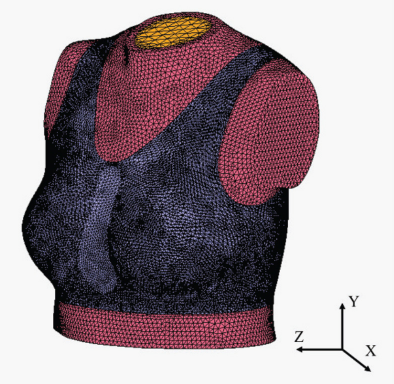
FE contact model.
Previous studies19,20 have shown that five Mooney-Rivlin coefficients (C01, C02, C10, C11, and C20) are useful for describing the biomechanical behavior of the breasts. They were determined by minimizing the differences between the experimental displacement of the bare breasts and FE model derived displacement using a series of simulations. Tat is, the experimental results were obtained from data based on a motion capture experiment in the bare-breast condition, while the FE results were obtained from simulation of running without wearing a sports bra. The criterion of the differences is the root mean square error (RMSE) given in Eq. 1.19,21,22

ΔYexp is the rate of change in the y-direction of the nipple obtained experimentally; ΔYFEM is the rate of change in the y-direction of the nipple from the FE analysis results; and n is the number of sample data points.
There were smaller displacements in the x- and z-directions versus the predominant displacement in the y-direction during treadmill running. Also, there were relatively more errors in the x- and z-directions due to shoulder rotation and body movement. Hence, this study focused on the breast displacement in the y-direction. The coordinate system is shown in Fig. 6.
Neural Networks
In this study, the data used to train the NN model were the results of the FEM simulations. The FE model of the body was based on the single subject in this study and the sports bra was a compression bra with a vest-style.
NN models require a training set, a validation set, and a testing set of data. The training set is used to ft every parameter of the NN model. The validation set is used to evaluate the model and stops the prediction if there are too many errors. The testing set is used to evaluate the final model. To generate the three sets of data, the sample data were split into the three sets of data at a ratio of 70:15:15. All sample data were obtained from the FE simulation results. MSC Marc solved the problems after several load steps and obtained a deformation result at each step. The load steps were automatically chosen by the software for convergence in this study. After simulation, a total of 380 deformations were obtained, which constituted the dataset for the NN model.
A four-layer NN that used a backpropagation algorithm was chosen, and the structure is shown in Fig. 7. The Levenberg-Marquardt learning algorithm, which is one of the fastest and most mature backpropagation algorithms, was used to establish the prediction model. The Levenberg-Marquardt algorithm combines the advantages of a Gaussian-Newton algorithm and gradient descent to find the local minimum. This algorithm was first proposed by an American statistician, Kenneth Levenberg, and then rediscovered by another American statistician, Donald Marquardt. In this algorithm, the Hessian matrix is approximated by using Eq. 2.


NN structure.
Then, the gradient can be calculated using Eq. 3.

J is the Jacobian matrix that contains the first derivatives of the network errors with respect to the weights and biases, and e is the vector of the network errors.
Trough this approximation, the Levenberg-Marquardt algorithm can be written as Eq. 4.

where μ is a scalar. This scalar will decrease after a successful step; 23 that is, there is a reduction in performance function. Therefore, this algorithm is very efficient.
The input parameter of this model is the tensile modulus of the shoulder strap fabric. The output is the time vs. displacement of the breast during running. The structure of this NN model is shown in Fig. 7. Therefore, the movement of the breast during running can be directly and easily shown after inputting the material parameter of the shoulder strap. The FE models with five different tensile moduli of shoulder strap (2, 4, 6, 8, and 10 MPa) were conducted to obtain the data set. The results of FE analysis, which were the values of the y-coordinates, were recorded every 0.02s. Then, the inputs (tensile moduli) and outputs (dynamic displacements) of the ANN's training set were obtained.
Results and Discussion
Accordingly, the RMSE was calculated by using the displacement in the y-direction. After eight cycles of FE simulations, the optimum material coefficients of the breast model were C01 = 0 082 kPa C02 = 118 kPa C10 = 0 064 kPa C11 = 0.82 kPa, and C20 = 0.82 kPa. This set of coefficients provided the lowest RMSE, which was 0.1303%.
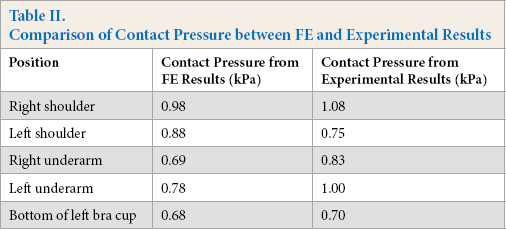
The FE contact model between the body and sports bra was then built to simulate the contact pressure exerted by the bra when the subject was running on a treadmill. To validate the FE contact model, a comparison between the FE and experimental results of the contact pressure was made, which is shown in Table II. This table shows that there was no obvious Eq. 4 difference between the FE and experimental results. However, the simulated contact pressure at the underarm was slightly lower than the tested pressure. This might be due to the simplification of the FE bra model to a one-layer model. However, the sports bra in this study had a thick elastic bra band to control riding up, which exerted a relatively higher contact pressure on the body. In order to simplify the NN model, one single variable was considered. Since bra straps are essential for a sports bra and greatly influence comfort and function, 24 the chosen variable was the tensile modulus of the bra straps. After validation, five more cycles of simulations were conducted with different tensile moduli of the bra straps.
Comparison of Contact Pressure between FE and Experimental Results
With the NN prediction model established, obtaining the breast displacement caused by any part of the bra strap with a different tensile modulus was not time consuming. To validate this prediction model, the breast displacement was calculated with the same tensile modulus of the actual bra strap (1.33 MPa). The plotted breast displacement time with the sports bra based on the FE and NN results are shown in Fig. 8. To visually understand the function of the sports bra, the plotted experimental results of the bare-breast condition are also shown in Fig. 8.
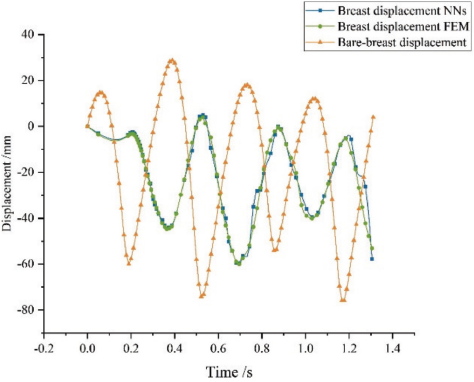
Breast displacement under different conditions.
Conclusions
This study presents an FE-based ML approach to predict dynamic breast movement when a compression sports bra is donned. A comparison of the experimental, FEM, and NN results shows that the NN model was accurate and reliable. This result can be used as a reference in the sports bra industry. This method can also potentially constitute the basis for future research work on intimate apparel and sports garments. Improvements to sports bra designs from the study findings also contributes to the wellbeing of the female population globally.
However, this study has some limitations, including the lack of generalizability. Therefore, more experiments and numerical modelling of different women of different ages and bra cup sizes are needed. Different sports bra designs, such as bras with different shoulder strap widths and wire bras, should also be considered in future studies.
Footnotes
Acknowledgements
This work was supported by the RGC General Research Fund [PolyU 152510/16E] titled “Optimization of the Comfort of Compression Sports Bras” and a research studentship granted to Ms. Liang Ruixin (RH09) from The Hong Kong Polytechnic University.