






Abstract
The textile and apparel industry is characterized by fast changes in customer demand and large seasonal impacts on products, which makes supplier selection more difficult. Textile and apparel enterprises should not only maximize their own economic interests, but also pay attention to humanistic care and ecological concepts due to the pressure from the public and the ecological environment. This study addresses the problem of sustainable development in textile and garment industry. A sustainable supplier selection research system, including quality, cost, flexibility, delivery, corporate social responsibility (CSR), and environmental management, was developed. A fashion apparel company was used as a specific case to support the study. The multi-attribute decision method PROMETHEE is used to evaluate supplier performance. The proposed sustainable framework can deal with the problem of supplier selection in textile and apparel industry effectively.
Introduction
Under the background of global informatization, it is very necessary for an enterprise to be in a complete, harmonious, and competitive supply chain. To this end, supplier selection has become a top priority task. At present, how to select and evaluate suppliers appropriately has become a big problem that troubles enterprise supply chain management. Especially for textile and apparel enterprises, supplier selection and evaluation are more complicated. With the characteristics of unpredictable customer demands, fast replacement of products, and large seasonal impact on products, it is necessary to provide a high level of product service to ensure the efficient operation of the supply chain. Therefore, it can be seen that the flexibility of enterprises in selecting apparel and textile suppliers becomes an important evaluation factor. With the increase of social exposure, new requirements have been put forward for corporate social responsibility. In addition, the annual consumption of the global textile industry exceeds 30 million tons, causing great pressure on the environment. 1 Some brands have been accused by the public of developing their supply chains without going green, which has had a negative impact on the brand. 2 Therefore, for the textile and apparel industry, the sustainability index of the supply chain is indispensable.
Based on the above significance, this study has the following purposes:
According to the characteristics of the textile and apparel industry and the environment of the supply chain, to formulate the evaluation standard of supplier selection.
According to the supplier selection system, select the most profitable suppliers in the textile and apparel industry from a group of alternative schemes in the supply chain.
To achieve these two goals, enhance overall competitiveness, and implement supply chain planning, the textile and apparel industry should develop principles, including economic, social, and environmental factors, in a supplier selection index evaluation system. The PROMETHEE method was used to select the optimal supplier of the textile and apparel industry under the evaluation system. 2 PROMETHEE is a kind of multi-attribute decision making method, which uses the set preference function to determine the difference of each supplier's behavior under different criteria of the same research system. Finally, the best textile and apparel supplier in this research system is selected by comparing their advantages and disadvantages. 3
To enhance the practical application of this study, the case of company A apparel enterprise selecting suppliers is discussed. A, a multinational fashion company, has more than 5000 stores worldwide. In 2018, A was listed in the world top 500 brands. 1 As an apparel retailer, company A plays a leading role in the fast fashion apparel industry. Nevertheless, company A is still exposed to some problems in supply chain management. For example, customers report that brand A has difficulty returning goods. Some social observers put forward that company A makes use of the relatively loose environmental regulatory system in developing countries to carry out chemical production, and so on. As a representative of the fashion apparel industry, company A reflects the common problems of the fast fashion industry. This study aims to help companies develop a supplier selection system and select the best suppliers by using PROMETHEE, providing guidance for other fast fashion apparel enterprises in the fashion industry.
The organization of the rest of this study is given as follows. The second section simply sorts out the previous literature studies on the supplier selection of textile and apparel industry. The third section establishes a supplier selection index system suitable for the economic, social, and environmental conditions of the A fashion apparel enterprise. The fourth section introduces the research methods. The fifth section uses the fuzzy language PROMETHEE to select the optimal suppliers and obtain the results. The sixth section summarizes the study.
Literature Review
The problem of supplier selection in textile and apparel industry has attracted many scholars’ attention for a long time. If apparel enterprises want to establish a good brand reputation in the industry, the task of supplier selection should be more scientific and reasonable.
Supplier Selection Index for the Apparel Industry
With the continuous development of the apparel supply chain and the deepening research of scholars, the traditional criteria of only requiring the delivery quantity from suppliers and considering the delivery cost of suppliers are no longer applicable. According to the viewpoint of the society foundation for sustainable development (SSI), and combining the characteristics of the apparel supply chain, a sustainable supply chain can be constructed from economic, social, and environmental levels. 4 The economic aspect refers to matters related to economic welfare in preparation for the future development of apparel enterprises. The social aspect refers to the performance of enterprises to the society, including the social needs of enterprises, the development needs of enterprises and employees, and their contributions to the society. In terms of environment, apparel enterprises should operate in a healthy ecological environment, including the impact of their production and operation on natural resources and climate. Research is continuing on traditional indicators such as cost and price, as well as the three aspects comprising sustainability.
Economic Indicators
The fluctuation of market demand will directly affect the sales of apparel products, and then affect the economic benefits of enterprises, which becomes a key factor in supplier selection of the textile and apparel industry. Margaret and Lucy hold that textile and apparel products have some specific market characteristics, which are largely affected by seasonal factors and generally have a short life cycle. They believe that fashion products are influenced by popular trends, with high volatility and low predictability of demand. In addition to the characteristics of fast fashion, consumers are used to purchasing products on impulse, so the impulse purchase level is relatively high. 5
Social Indicators
Quality directly affects consumers’ first impression of apparel brands. From the perspective of supply chain management (SCM), Romano and Vinelli studied the impact of quality management on enterprises and the whole supply network. 6 By comparing the “traditional” measures for the management of suppliers and the wider “coordination” of the supply chain perspective way, they concluded that cooperative enterprises in the supply chain can use a coordination mechanism, and share the philosophy of quality management, to achieve the overall innovation in the supply chain as well as the effect of customer satisfaction.
The convenience of the information age constantly exposes some social problems of apparel enterprises. This has also become a major obstacle to the development of the brand. Globalization promotes the widespread outsourcing of the textile and apparel supply chain. In order to maximize profits, some enterprises make use of imperfect regulatory systems in developing countries to allow workers to work in a low-security environment. Huq et al. studied four Bangladesh apparel suppliers and two Bangladesh purchasing companies of large British retailers, and found that when the suppliers select low social standards, employees will be transferred to factories with poor working environments, which brings a substantial negative impact on the reputation of enterprises. 7
For the textile and apparel industry, the fair payment of wages is one of the important factors in the evaluation of supplier selection at the social level. Jiang et al. studied Xintang international jeans, China's largest jeans maker, and found that sweatshops in developing countries could put them under increasing moral pressure from the West. Although such sweatshops save financial resources by offering low wages and poor working conditions to workers, they have a negative impact on enterprise performance and productivity, and have a negative impact on the future development of the overall supply chain. 8
Environmental Indicators
The textile and garment industry consume a large amount of ecological resources every year, and its environmental problems are of increasing concern to the public. Jiyun Kang and others studied the environmental consumption attitudes of young consumers in the textile and apparel industry. They collected 701 questionnaires on the views of students from China, South Korea, and the United States. They found product knowledge, awareness of consumers’ perceptions, and personal relevance would significantly affect young consumers’ attitude, subjective norm, and perceived behavioral control efficiency. This influence will further change their consumption attitude towards sustainable textiles and apparel, thus bringing good or bad effects to the clothing industry. 9
The impact of environmental indicators of green sustain-ability on financial performance has also aroused some scholars’ interest. By using the event study method, Li et al. studied the changes in corporate performance in terms of financial profitability, market sales, and internal operations after companies in China's textile and apparel industry adopted environmental management systems (EMS). Te results showed that return on assets (ROA) declined significantly after the company adopted EMS, indicating that the profitability and sales of textile and apparel companies were declining. In addition, they also observed that after the use of EMS, the inventory turnover rate of the company significantly decreased, thus bringing losses to operating efficiency in the process of enterprise transformation. 10
Application of PROMETHEE Methods in Supplier Selection
Selecting the best supplier is a difficult task, and it is necessary to select the right method. F. T. S. Chan has used the analytic hierarchy process (AHP) to develop a set of supplier selection criteria considering the supply chain strategy. He selected suppliers from China, Mexico, South America, and Vietnam for research, and concluded that suppliers would have more advantages in supplier selection if they paid attention to the rapid response strategy. 11 However, AHP is a qualitative method with a strong subjective opinion of decision makers, although the calculation is simple. LiXin Shen et al. used the technique for order of preference by similarity to ideal solution (TOPSIS) method to score each supplier's performance at the environmental level with language variables, so as to select the best green supplier with the highest score. 12 Compared with AHP, TOPSIS is a quantitative method, which reflects the results more objectively. However, the calculation is too complicated, which brings inconvenience to the research process. Hsu and Hu used the analytic network process (ANP) method to consider hazardous substances management (HSM) in supplier selection and built a multi-standard decision model. They applied the model to the problem of supplier selection based on the relevant requirements of environmental laws and regulations of electronics companies. 13 The ANP method can be used to describe the structure of complex systems, but it is difficult to study because of the large amount of computation and complicated operation. Mahdiloo et al. selected the best supplier with ecological efficiency by using the Data Envelope-Analysis (DEA) model to evaluate green suppliers, combined with the commercial cases of real steel companies. 14 The DEA method is a quantitative research method, which requires a large amount of data, and the calculation is complicated. Low availability of data about the textile and apparel industry is not conducive to research. Sarkis and Dhavale use Markov chains (MCMC) to obtain performance information about suppliers in a sustainable environment. 15 Although the quantitative Markov chain can construct a set of index systems, the time effciency is short. This is unreasonable for the construction of a sustainable indicator system. As an advanced computing method, the approximate low-rank projection learning (ALPL) improved by Fang et al. and the low-rank preserving projection via graph regularized reconstruction (LRPP-GRR) improved by Han et al. play a good role in selecting key factors.16,17 However, the uncertainty of the actual application program makes this method less used in the study of supplier selection. Faced with many factors in the process of supplier selection, flexible affinity matrix learning (FAML) and non-negative low-rank representation (NNLRR) have good clustering effects. However, due to the complexity of calculation, this method is seldom used to solve the supplier selection problem.18,19
Compared with the above methods, the PROMETHEE method is the preferred solution to solve the problems of supplier selection in the textile and apparel industry. PRO-METHEE is a sorting method proposed by Brans and Vincke and further improved by Brans. 20 PROMETHEE can be of great use when faced with multiple complex standards and sorting through limited alternatives. PROMETHEE is a qualitative and quantitative method, which is suitable for the textile and apparel industry with difficult data acquisition. The PROMETHEE method has great flexibility and can integrate qualitative and quantitative indexes well when there is no standard for the indexes of apparel suppliers. Tan et al. adopted the improved method of introducing the theory of uncertain fuzzy sets into PROMETHEE, which can easily deal with the selection and evaluation of complex information environments by converting the evaluation language of decision makers into quantifiable evaluation values. 21
Many scholars have used the PROMETHEE method to study the problem of supplier selection. Using the PROMETHEE method, Yilmaz and Dagdeviren solved the problem of making efficient equipment decisions in production systems that need to consider multiple standards. 3 Chen et al. designed seven standards including experience, reputation, and quality, and used the fuzzy PROMETHEE method to select suppliers of information system outsourcing in an attempt to improve the company's core competitiveness. 22 Duvivier et al. successfully solved industrial scheduling problems by using the PROMETHEE method and concluded that PRO-METHEE is an effective means to solve problems of multiple standards and prioritized schemes. 23
Research Gaps
The review of literature revealed the following:
Many researchers pay attention to the problem of supplier selection and put forward their own evaluation criteria. But they seldom comb through the evaluation criteria according to the systematic framework. Today, consumers have a multi-dimensional perspective when choosing products and no longer take economic indicators as the only principle. The research on supplier selection needs to combine with consumer demand, and it is necessary to develop evaluation indicators from different levels.
The textile and apparel industry needs to pay attention to the flexible characteristics in the production process, and also to the performance of suppliers in terms of returns. However, in past studies on supplier selection in the textile and apparel industry, little attention has been paid to the problem of returns.
Fuzzy set theory has been widely used in performance evaluation. Although many scholars have put forward a lot of evaluation methods, there are always some inapplicability in data processing and calculation. It is important to choose an appropriate evaluation method of supplier selection and combine it with fuzzy set theory to solve the problem of supplier selection.
Therefore, combined with the industry characteristics of the textile and apparel industry, this study proposes a sustainable research framework from three aspects of economy, society, and environment based on the triple bottom line. This study adds the concept of delivery flexibility to make the framework of supplier selection in the textile and apparel industry more complete. The appropriate PRO-METHEE method and fuzzy set theory were combined to complete the supplier selection research of enterprise A by taking the actual enterprise as an example.
Sustainable Supplier Selection Criteria for the Textile and Apparel Industry
In the past, the evaluation criteria of supplier selection were usually based on the economic aspects of products such as price, quality or environmental protection to build an evaluation system. This system is one-sided, and is not suitable for the characteristics of the textile and apparel industry. According to the existing literature, most of the evaluation standards sets do not take into account some characteristics of the textile and apparel industry, such as carbon emissions, delivery flexibility, and transportation cost, and do not clearly define them. Taking apparel enterprise A as an example, an integrated system based on economy, society, and ecology was built. This study combines with the goal of sustainable development in today's society to provide suggestions for the establishment of an evaluation system for supplier selection in the global sustainable textile and apparel industry. In the construction of the evaluation system for supplier selection, the general criteria for supplier selection, such as quality, cost and other indicators was used, as well as the industry characteristic indicators suitable for the textile and apparel industry, such as flexibility and environmental management systems (EMS), based on the actual situation of enterprise A. The proposed evaluation system was based on the economic, social, and environmental aspects, including six main standards and 16 sub-standard principles, as shown in Table I. The six categories of standards include quality C1, cost C2, flexibility C3, and delivery C4 at the economic level, CSR C5 at the social level, and EMS C6 at the environmental level.
Sustainable Textile and Apparel Supplier Selection System
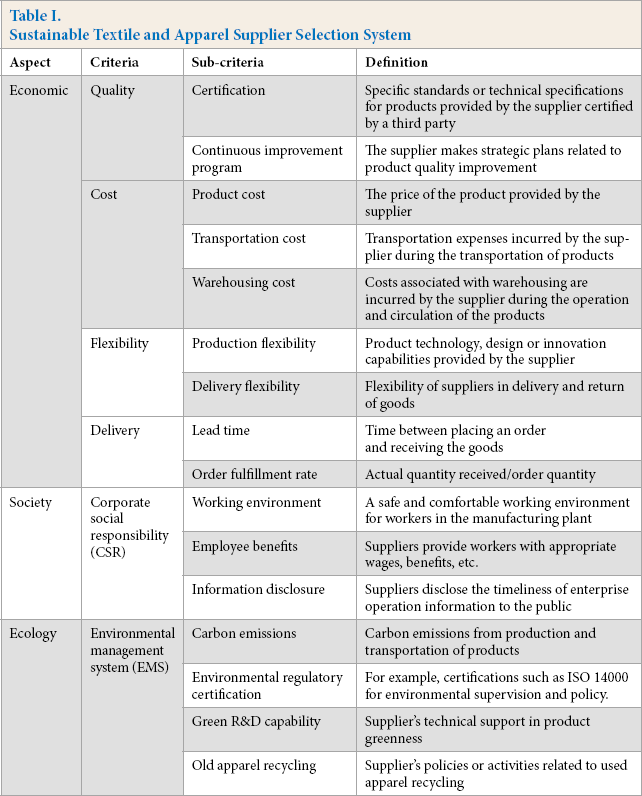
As a global fashion apparel company, company A has adopted advanced strategies and practices in all aspects of the textile and apparel supply chain, and also put forward new requirements for its suppliers. On the economic level, in order to enhance the competitiveness of company A to respond quickly when facing fluctuations of market demand, flexible indicators based on the characteristics of the textile and apparel industry were constructed. This standard is divided into two sub-standards. Production flexibility refers to the technology and innovation ability that suppliers need to have to meet the requirements of consumers on apparel design and materials. Delivery flexibility means that the supplier can not only increase the supply quantity in time when the demand suddenly increases, but also provide the customer service of returnable goods. Refundable and exchangeable customer service refers to the service that customers can return or replace for no reason within a certain period of time after they consume, such as seven days. Delivery flexibility puts forward higher requirements for rapid market response of suppliers.
At the social level, company A attaches great importance to human rights awareness and emphasizes that the working environment and conditions of workers will have an important impact on performance. Company A regularly publishes the working status of the supplier's factory on the Internet. 1 According to the supplier list provided by company A, 163 suppliers in Bangladesh work for company A, which is the main manufacturing country of company A. For a long time, the safety of fire has often troubled Bangladeshi apparel manufacturers. 24 Company A has a responsible attitude towards the society. It not only publishes such information in a timely manner, but also initiatively takes many measures with Bangladeshi manufacturers, such as monitoring factory compliance and providing training for factory workers, to avoid adverse impact of manufacturing suppliers on the brand. These measures have reduced the frequency of relevant accidents. 1 Therefore, in setting up the index system, corporate social responsibility (CSR) is taken as the standard, and the working environment, workers’ rights, and information disclosure are taken as sub-standards to complete the construction of the evaluation system of apparel suppliers at the social level.
At the environmental level, company A tries to carry out green ecological actions throughout the supply chain. In the production of raw materials, company A has improved the quality of cotton, which is the main raw material of apparel, to reduce the adverse impact on the environment. The United States is the world's largest exporter of cotton, and data show that a quarter of the pesticides in the United States are used in the production of cotton. 25 In the interview with the raw material purchasing manager of company A, they have invested a lot of money in the use of sustainable organic cotton over the years. Organic cotton can be grown without the use of pesticides or chemical fertilizers, greatly reducing the negative impact on the environment. In addition, company A actively participates in the Better Cotton initiative, striving for better innovative farming technologies for cotton farmers. Company A adopts a large number of recycled materials in its product line. To meet the standards of sustainable materials, company A obtained independent third-party certification for each material category. For example, organic fabrics have been certified by the Global Organic Textile Standard (GOTS) and recycled textiles have been certified by global recycling standards (GRS), so as to enhance the sustainability of the supply chain.
In distribution and transportation, to reduce carbon emissions in the distribution system, company A adopts efficient and clean transportation modes such as ferries and trains as the main distribution mode from the supplier to the distribution center, to reduce the annual carbon dioxide emissions by at least 700 tons. 1 At the sales terminal, company A has launched an apparel conscious consumption plan to global consumers. Consumers can return any old apparels of any brand with any conditions in the stores of A brand globally, and get a 15% coupon in return to encourage customers’ next consumption behavior. This green retail not only saves ecological resources, but also contributes to reducing environmental pollution. Therefore, company A also puts forward the corresponding requirements for suppliers. In their EMS, suppliers are required to closely follow the environmental protection plan in terms of carbon emissions, environmental regulatory certification, green R&D capacity, and old apparel recycling, to build a green and sustainable textile and apparel supply chain.
The PROMETHEE Method of Hesitant Fuzzy Language
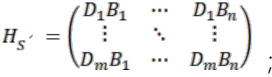
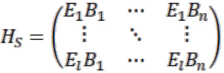
There are m decision makers (represented by D), n indicators (represented by B), and l scheme (represented by E). Specifically, there are seven steps:
(1) Determine the importance language term set S of n indicators evaluated by m decision makers, and the language term set S of l schemes evaluated by m decision makers under n indicators. After the decision makers are invited to complete the evaluation, the hesitant fuzzy language index importance evaluation matrix HS′ and the scheme criterion performance evaluation matrix HS are constructed (Eqs. 1 and 2).
(2) Determine the weight value of the importance of each indicator according to HS. Where 0 ≤ ω ≤ 10 and

(3) According to HS, determine the positive ideal solution


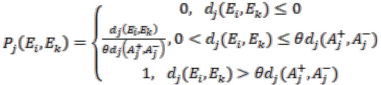
(4) Determining the preference function. Under the benefit and cost attribute Bj, the degree to which the scheme Ei is better than Ek is expressed by the preference function. The linear criterion preference function after the introduction of the hesitant fuzzy language is improved as follows, where i, k = 1,2,…, l; j = 1,2,…, n (Eq. 6).
(5) Determine the priority index π(Ei, Ek). The priority index indicates the degree to which the scheme Ei is better than the scheme Ek, and the closer it is to 1, the better the scheme Ei is compared to the scheme Ek. Where i = 1,2,…, l; j = 1,2,…, n (Eq. 7).

(6) Calculate the inflow φ+ (Ei) and the outflow φ− (Ei) of each scheme according to the priority index (Eqs. 8 and 9).


Among them, j = 1,2,…, n; k = 1,2,…, l. φ+ (Ei) indicates the degree of Ei is superior to other solutions. The larger the value, the higher the superiority of Ei relative to other schemes; φ− (Ei) indicates the possibility that other schemes are superior to scheme Ei. The larger the value, the higher the superiority of other schemes relative to the scheme Ei.
(7) Calculate the net flow of the scheme Ei (Eq. 10):

The larger the φ(Ei), the better the goodness of the scheme Ei. If φ(Ei) > φ(Ek), it indicates that the scheme Ei is better than the scheme Ek. Based on this, the ranking of all schemes can be obtained.
Case Study
Method Application
Step 1
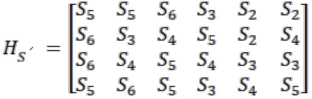
First, determine the importance weight of the six indicators in this study by the expert scoring method. The linguistic term set S’of the importance assessment of the six criteria can be expressed as S'= {s'0 = very unimportant, s'1 = not important, s‘2 = relatively unimportant, s‘3 = general, s‘4 = relatively important, s‘5 = important, s‘6 = very important}. The linguistic term set S of each evaluation object's performance under each indicator can be expressed as S = {s0 = very poor, s1 = poor, s2= relatively poor, s3= medium, s4= relatively good, s5 = good, s 6 = very good}.
In order to obtain more fair and reasonable evaluation results, questionnaires were distributed to four evaluation experts for investigation. The four experts D, D2, D3, and D4 are store managers from four stores of different brand A, who are responsible for determining the importance and weight of the six indicators and evaluating the performance of the four selected suppliers. In the evaluation process, when each expert gives his own evaluation of each indicator or the performance of each supplier, they may have different opinions and sometimes even cannot reach a consensus. For example, one expert may consider the quality of supplier E1 to be “excellent,” while another may consider it to be “average. 1 If there is no consensus among experts, the fuzzy assessment information formed by decision makers is expressed as {S3, S6}. If four experts agree that the performance of an indicator of the supplier is “relatively poor,” then the fuzzy evaluation information formed by the decision maker is expressed as {S2}. According to the results of a survey questionnaire score, the conversion function

Step 2
Since four experts with equivalent speech rights were selected in the study, the arithmetic mean was used to calculate the weights of the six indicators. According to Hs’, the weights of quality (B1), cost (B2), flexibility (B3), delivery (B4), corporate social responsibility (B5), and environmental management system (B6) are obtained by Eq. 13.

Step 3
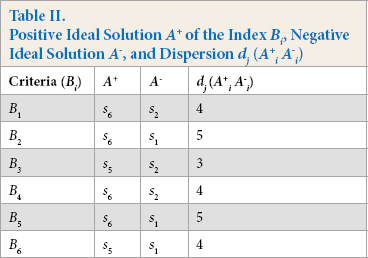
This step determines the positive ideal solutions of hesitant fuzzy language A+ = {s6,s6,s5,s6,s6,s5} and negative ideal solutions A− = {s2,s1,s2,s2,s1,s1}. Calculate the dispersion dj (A+i A−i) between the positive ideal solution A+ and the negative ideal solution A−, as shown in Table II.
Positive Ideal Solution A+ of the Index B., Negative Ideal Solution A−, and Dispersion d. (A+iA−i)
Step 4
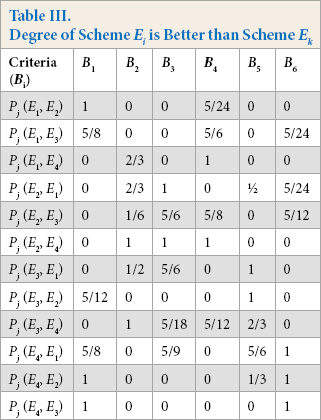
This step further determines the preference function. According to the needs of decisionmaking facts and the preference of managers of company A for strict superiority take θ = 0.6. Under the selected six indicators Bj, the degree to which supplier Ei (i = 1,2,3,4) is superior to the other supplier Ek (k = 1,2,3,4) is calculated by the improved linear criterion preference function. The calculation results are shown in Table III.
Degree of Scheme Ei is Better than Scheme Ek,
Step 5
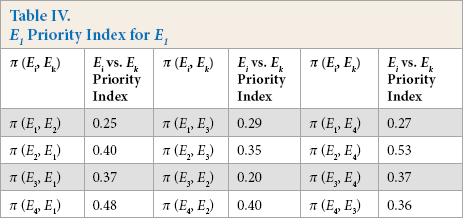
According to PROMETHEE method step (7), the priority index can be obtained (Table IV).
E1, Priority Index for E1,
Step 6
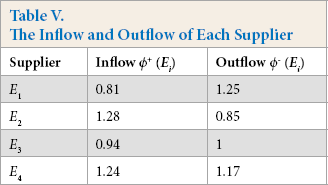
Calculate the inflow φ+ (Ei) and the outflow φ− (Ei) of each scheme (supplier) according to PROMETHEE method steps (8) and (9) as shown in Table V.
The Inflow and Outflow of Each Supplier
Step 7
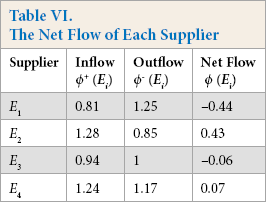
Calculate the net flow of each supplier according to PROMETHEE method step (10) as shown in Table VI. It can be seen that the performance evaluation order of these four suppliers is E 2 > E4 > E3 > E1.
The Net Flow of Each Supplier
Results Analysis
According to the above calculation results, for brand A, E2 was the best supplier among the four selected suppliers. By comparing the transformed fuzzy language information and ranking results, although E2 was selected as the best supplier, it did not perform best in every indicator, and even performed “poor” in some indicators. For example, in CSR indicators, E3 and E4 obviously performed better than E2, but they were not the best suppliers; in terms of quality index evaluation, E2 is the worst among the four suppliers. However, E2 has its own advantages. For example, E2 performed relatively well in terms of cost, flexibility, and delivery, which were very competitive for the textile and apparel industry. The supplier suitable for company A can be more reasonably selected through the construction of the indicator system of economy, society, and ecology, rather than selecting from a single aspect and obtaining one-sided results.
Conclusion
Under the pressure of market, public, and ecology, textile and apparel enterprises can break through the obstacles by engaging multiple enterprises. The concept of sustain-ability has been a boon for the textile and apparel industry, while increasing the demand on suppliers. For a long time, the problem of supplier selection has become a difficult problem for scholars and entrepreneurs. The textile and apparel industry is characterized by unpredictable customer demands, tremendous product varieties, and high levels of products and service. At the same time, with the continuous increase of social attention, the textile and apparel industry should take into account social and environmental responsibilities while meeting its own economic benefits. From current research status, the construction of a supplier selection system of fashion apparel enterprises is not complete. The establishment of indicators lacks comprehensiveness, and some indicators are not closely related to the apparel industry. Therefore, in the construction of the index system, we fully combined the industry characteristics of textile and apparel enterprises, and brought the flexibility required by the fast fashion industry into the index system. It promotes the views of production flexibility and delivery flexibility, highlighting that apparel suppliers need flexibility, not only in product design and innovation, but also in delivery and return of goods, so as to improve the competitiveness of apparel brands. This research starts from the economic, social, and environmental perspectives, and breaks through the previous thinking of unilaterally considering a certain factor. This study establishes six first-level indexes of quality, cost, flexibility, delivery, corporate social responsibility (CSR), and environmental management systems (EMS), and sets up 16 second-level indexes to innovatively construct a sustainable supplier selection system for the textile and apparel industry. This work uses the PROMETHEE method of hesitations and fuzzy language to select sustainable supplier partners in the apparel industry chain and enhance the overall performance of the supplier chain.
Although the literature review and case study given here are helpful for textile and apparel enterprises to select suppliers according to an evaluation system, the fashion industry is a complex and dynamic industry. The A apparel enterprise may not represent the specific situation of the entire industry. As the apparel industry may continue to change in the future, the supplier selection system proposed here for company A may not be comprehensive enough in terms of the index system. In the future, more attention can be paid to the details of textile and apparel supplier selection and a more complete supplier selection system can be built.