






Abstract
Functional garments are required to be closely and properly fitted on diverse human limbs. However, most manufacturers classify their products based on a number of anthropometric statistical parameters of Caucasian body sizes. This work focuses on the diversities in the real curved shapes, and their detailed anatomy characteristics, for Chinese people. Differences in the 3D-scanned human calves’ shapes and circumference profiles between Chinese male and female subjects were identified through primary component analysis, extracted, and compared. Results show that calves of males were longer in length, straighter, and had a larger circumference within the belly of gastrocnemius, while females were found to have shorter overall length, more bent, and had a smaller gastrocnemius. Females had a larger averaged circumference. The focus of this study was on the size design of compression stockings.
Introduction
Fitting functional textile garments, such as compression and supporting garments, on a variety of human limbs, are the key issues for the designers and manufacturers. Risks of improper size of those garments can lead to discomfort, skin irritation, temporary dents, broken skin, or even local ulcers in the skin.1-5 For instance, medical compression stockings (MCS) of non-compliance or improperly worn are reported as more likely to cause negative effects and aggravated symptoms, such as swelling, blood congestion, or extravasation in the physiotherapy of chronic venous insufficiency (CVI).6-11 Since somatotypes of different races are generally recognized as different and with unique characteristics, those functional garments shall be under ideal condition designed and targeted at a certain race. To date, however, the size designs and published standards such as RAL-GZ387 and BS:6612 for functional garments are largely regulated by many western institutions and best for Caucasians.2,12,13 There is a lack of fitting studies of garments for Chinese people. Meanwhile, anthropometry study of limbs and corresponding standards currently still contribute a large portion of the designs instead of the studies on 3D shapes.
In recent years, the 3D digital scanning technique has become one of the most convenient and accessible tools to extract the detailed body shapes defined by surfaces and anthropometric measurements for ready-to-wear apparel in the fashion industry and for healthcare applications. However, reported studies mainly restrained their focuses on the anthropometry research of human limbs via 3D body scanning, such as categorizing body sizes,14,15 delivering body anthropometric measurements for apparel fitting design,16-18 simulation of wearing,19,20 and so on. There is still a lack of analysis and indicators of the difference in human limb 3D shapes and other relevant profiles between males and females.
Therefore, in this present work, we present an in-detailed study on 3D human calves’ shapes and circumference profiles using the principal component analysis, to deliver the most primary variation in Chinese human calves’ shapes as well as in circumference profiles, and the differences between Chinese males and females. A set of selected parameters as indicators among subjects were identified, extracted, and compared, and the difference between male and female subjects were presented and analyzed. This study provides a reference for the size design of compression stockings, the methodologies of which could inspire the design and manufacturing of other fitted functional garments for other limbs and for other races.
Methods
Principal Component Analysis on Human Calf Shapes
According to the Laplace Law, the compression exerted by outfits depends on not only the elongation of the fabrics, but also the curved shapes of limbs. Principal components analysis (PCA)21,22 was implemented for fast extraction of most primary differences components (PCs) among subjects’ 3D shapes and circumferential profiles of calves. All to-be-analyzed information, i.e., scanned 3D calf shapes as well as circumference profiles, was vectorized first, through re-arranging the vertexes into shape vectors, which form the matrix of observations. Ten the most significant variations of samples, as well as their weights, can be extracted by determining the eigen vectors and values of the covariance matrix of the observations. Therefore, in this study, the dimension of each principal component (PC) was three times the number of vertices for calves. The eigen vectors describing the most frequent observations of samples can be sorted in an order of their importance in representing variations within the original data set.
The PCA calculations were conducted with Matlab by self-programed scripts, which yielded the averaged shape, eigen values and eigen vectors of the input sample vectors. Hence the shapes and visualizations of the PCs can be realized by Eq. 1.
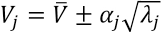
α
j
and λ
j
are the
j-th eigen vector (representing the j-th
direction of PC) and eigen value (representing the intensity of variation in the
corresponding j-th direction), respectively.
Subjects
A total of 225 subjects (Chinese residents, with 145 females and 80 males) agreed and participated in this research. 92% of the subjects were middle-aged (between 40∼60), which were reported as major sufferers of CVI and users of compression stockings. 23 Initial examination showed that 56% of the 225 subjects recruited had varicose vein symptoms on one or both legs (higher than CEAP-C2) 2 , although the severity and location varied. Hence, it's suggested that the recruited subjects were appropriate representative targets for studying the variation of calf shapes. Subjects were already aware of relative information, the compression therapy of CVI using MCSs, procedures of scanning, as well as personal 3D body shapes to be collected prior to test.
Devices and Data Collection
An NX-16 automatic full-body scanner ([TC] 2 , USA) was used in this study to observe and produce true and full-scale 3D human models. To facilitate the computing process while keeping the origin shapes, resolutions of scanning were uniformly sampled as 5 degrees in the circumferential direction and 1 mm in the height direction. During scanning, subjects wore only underwear, adopted a normal posture and stood still in the scanning booth until the scanning was accomplished.
The human left calves were isolated from the whole scanned 3D body shapes by identifying upper limit of tibia (knee) and limits of fibula (ankle) of the calves, and retaining the middle section within (part of human calf). Calves were stored for further analysis. The reason for choosing left calves for analysis was that varicose veins start and grow on the human calf. Meanwhile, for the right-handed (majority), the left leg is used for long-time weight support, and more likely suffer from varicose veins.
Before analysis, all isolated calves were standardized by making the whole calf vertical, to exclude the variation of shapes caused by difference in orientation.
Results and Discussion
PCs of Calves’ Shapes
The original 3D vertexes of extracted calves were vectorized, through arranging the x, y, and z coordinates of each vertex to form a column shape vector. As aforementioned, PCA was applied to have the primary variations of male and female calves’ shapes. The first four orders of variations indicated by top four PCs constituting the major variances (92%) were visualized and shown in Fig. 1, while the orders of variance were compared and summarized in Table I.
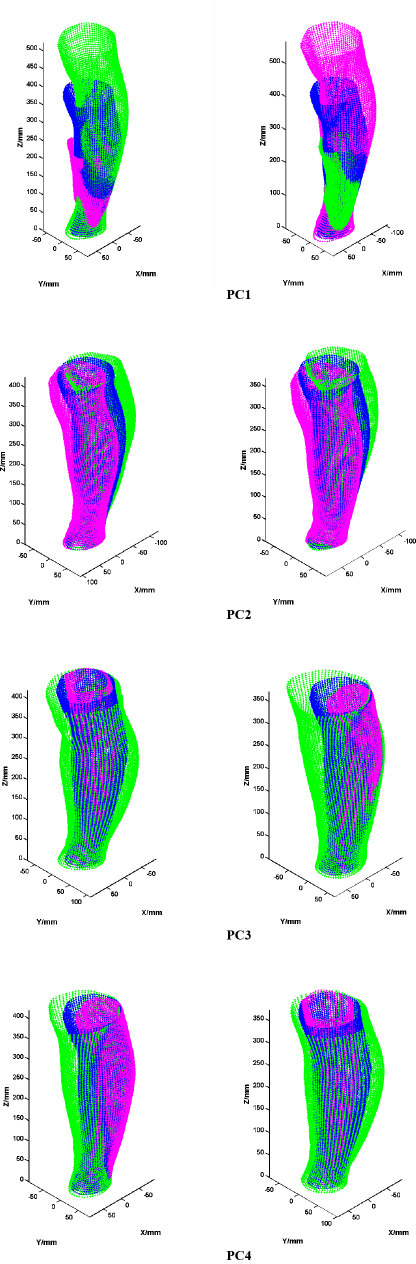
First four PCs of male calves (left column) and female calves (right column).
Difference of Variance between Male and Female Subjects’ Calves Shapes
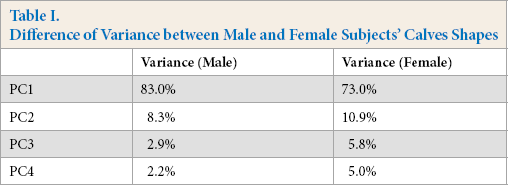
It can be seen from the results that for male subjects, the first four PCs reflected the variance in height of the calf, bending of calf forwards/backwards, bending of calf outward/ inwards, and overall diameter of calf, respectively. For female subjects, however, PC3 and PC4 were in opposite orders. This result shows that height of calf, bending radius of tibia, and overall circumference were the factors of most diversity. It can also be preliminarily concluded from Table I that there was a larger variation in calves’ heights for males, while female subjects revealed a greater diversity in bending of the calf bones.
Difference of Variance between Male and Female Subjects’ Circumference Profiles
PCs of Calves’ Circumference Profiles
A circumference profile of a limb is a natural vector formed by circumferences of cross-sections along normalized length direction. According to the Laplace Law, circumferences of calves are directly linked to the average pressure exerted due to fabric membrane stretching. For designing fitted functional garments fabricated by low-modulus fabrics, it's more desirable to observe variation in circumference profiles.
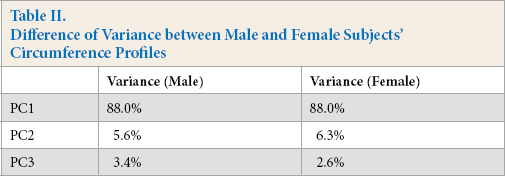
PCA was applied to show the primary variations of male and female calves’ circumference profiles. The top three variations were visualized by principal components (PCs) and shown in Fig. 2, with the orders of variance compared and summarized in Table II.
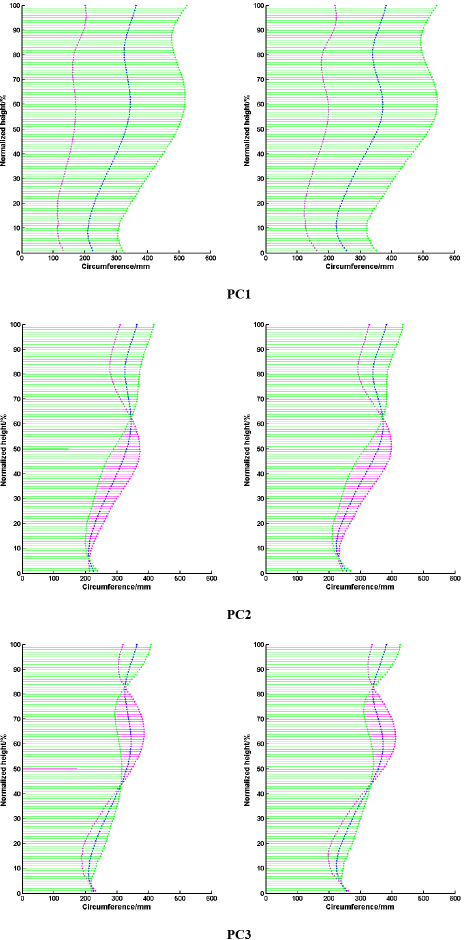
First three PCs of male circumference profiles (left column) and female circumference profiles (right column).
It can be seen from the results that for both male and female subjects, the first two PCs revealed the majority variance (>92%) and reflected the overall circumferences of the calves, as well as the relative size of bulging gastrocnemius. This result shows that overall circumferences as well as relative size of bulging gastrocnemius were the factors of most diversity. Fig. 2 also indicates that female subjects tended to have larger averaged circumferences than male subjects.
Differences in Selected Characteristics of 3D Calves between Males and Females
As indicated by the PCA results on calves’ shapes, indicators of characteristics were defined to further extract the difference between male and female subjects. As suggested by the PCs, the length of calf, fitted diameter of the bending calf (tibia), and calf circumference at the belly of gastrocnemius were specially chosen as indicators. The fitted diameter of the bending calf (tibia) was obtained by identifying the edge of the tibia on skins of the scanned calves and calculating the mean radius using a circle curve-fitting. The calf circumference at the belly of gastrocnemius was defined as the maximum circumference in the inner zone of the calves. For all subjects, the three indicators were calculated and plotted in the Fig. 3.
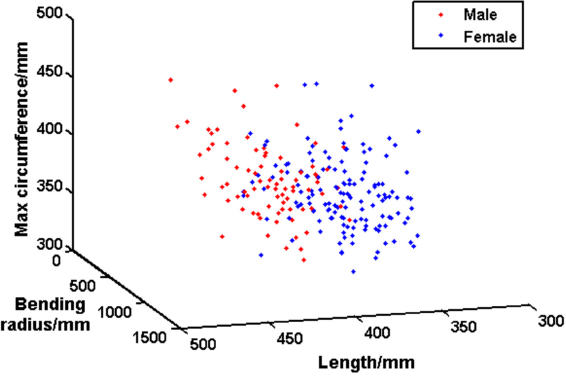
Calf length, bending radius, and maximum circumference of male and female calves.
It's clear from Fig. 3 that calves of male subjects had longer length, greater radius (which means calves were more straight), and slightly smaller maximum circumference, while female subjects had shorter overall length, more bending, and slightly greater maximum circumference. The findings were generally in accordance with previous results of PCA and with common sense that male are taller and less fat in calves.
Differences in Characteristics of Circumferential Profiles between Males and Females
Similarly, and suggested by the PCs, two indicators of characteristics were defined and extracted to further analyze the differences in male and female circumferential profiles, i.e., the averaged circumference at the belly of gastrocnemius (within 20%∼70% of height), and the relative dimension of gastrocnemius defined by c(45%)/c(63%), where c(45%) and c(63%) are the circumferences of calf at 45% height and 63% height, respectively. The reason for choosing 63% height as the base of normalization is that there was nearly no significant difference in PC2 at 63% height as shown in Fig. 2. For all subjects, the two indicators were calculated and plotted in the Fig. 4.
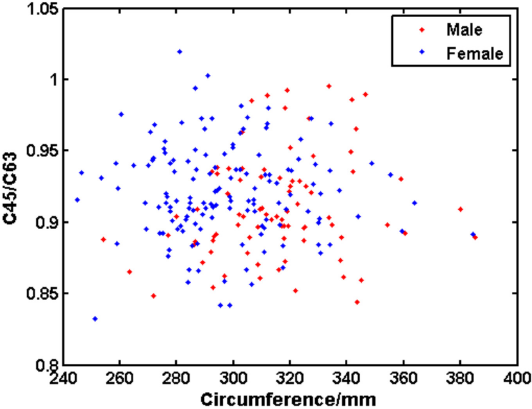
Circumference and c(45%)/c(63%) at the belly of gastrocnemius of male and female circumference profiles.
Fig. 4 shows that male subjects had a mean higher circumference at the belly of the gastrocnemius than female subjects, showing that the male subjects had more muscles. For the ratio of c(45%)/c(63%), however, there was no significant difference between male subjects (0.91) and female subjects (0.92). Since the physical information of subjects was not included in this analysis, this observation needs further confirmation.
Conclusion
PCA was performed on the 3D shape of calves of Chinese subjects, as well as with the circumference profile of calves. Primary variations were identified, with parameters compared between female and male subjects. The results show that there was a larger variation in calves’ heights for males, while female subjects revealed a greater diversity in bending of the calf bones. Female subjects tended to have larger averaged circumferences than male subjects, although male subjects had a larger size of gastrocnemius. Tree indicators for 3D calves’ shapes and two indicators for circumference profiles were proposed. Analysis of the indicators show that calves of male subjects had longer length, greater radius (which means calves were more straight), slightly smaller maximum circumference, and larger circumference within the belly of the gastrocne-mius, while female subjects had shorter overall length, more bending, a slightly greater maximum circumference, and smaller gastrocnemius. There was no significant difference between male subjects and female subjects when considering the ratio of c(45%)/c(63%) and the degree of bending of the calves. The observed PCs for 3D calves and circumference profiles would help manufacturers to pilot reasonable size distribution of garments for male and female potential users. The results of analysis would contribute to the size design of functional garments for Chinese people and inspire the study of shape variation for other human limbs.
Footnotes
Acknowledgements
This research was funded by the National Science Foundation of China (Grant No. 51603039), the Fundamental Research Funds for the Central Universities, the Key Laboratory of Textile Science and Technology (Donghua University), Ministry of Education, the Initial Research Funds for Young Teachers of Donghua University, and also sponsored by Shanghai Pujiang Program.
Technical support and trial assistance by group mates and colleagues are sincerely appreciated by the authors.