




Abstract
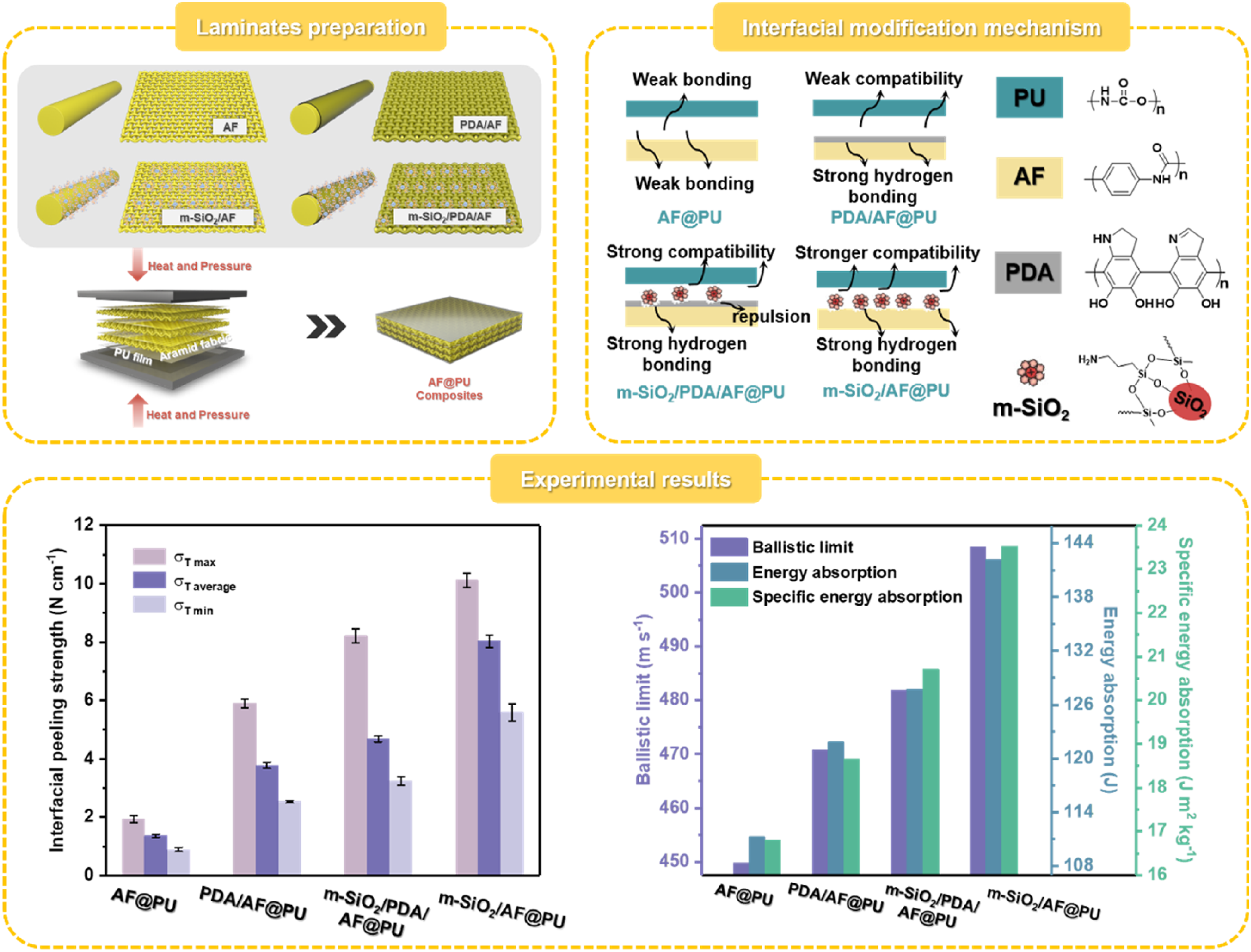
The aramid fiber reinforced polyurethane composites (AF@PU), which exhibit high strength and lightweight characteristics, have attracted widespread concerns for advanced personal protective systems. However, the interface is essential to influence the stress transfer efficiency but frequently overlooked. In this work, polydopamine and γ-aminopropyltriethoxysilane modified SiO2 (m-SiO2) were utilized to strengthen the interface. Attributing to the strong bonding strength between fibers and polymer resins improved by m-SiO2 at the interface, the tensile, flexural, and compressive strength of m-SiO2/AF@PU are maximally increased. The deposition of abundant m-SiO2 enhances the interface roughness, the interfacial peeling strength of the m-SiO2/AF@PU is increased by 490.4%, and the interlaminar shear strength is increased by 51.1%. In addition, m-SiO2/AF@PU demonstrates the maximal energy absorption value; the ballistic limit velocity is improved from 449.8 m s−1 of AF@PU to 508.5 m s−1 of m-SiO2/AF@PU. This work highlights the interface strengthening and ballistic performance, thus providing an efficient guideline for the design of next-generation fiber reinforced polymer resin composites.
Get full access to this article
View all access options for this article.
References
Supplementary Material
Please find the following supplemental material available below.
For Open Access articles published under a Creative Commons License, all supplemental material carries the same license as the article it is associated with.
For non-Open Access articles published, all supplemental material carries a non-exclusive license, and permission requests for re-use of supplemental material or any part of supplemental material shall be sent directly to the copyright owner as specified in the copyright notice associated with the article.
