






Abstract
Non-circular profiled fibers are generally synthetic fibers that have a modified cross-section shape, which are created to mimic natural fibers or to obtain special properties. The shape of the cross-section has great influence on the properties of profiled polyester (PET) fibers and their fabrics. The structure and properties of fat-shaped and hexagonal-shaped profiled PET fibers and ordinary PET fibers, as well as the properties of their knit fabrics were characterized. Experimental results showed that air permeability, heat retention, and wrinkle resilience of profiled PET fabrics were better than that of circular a cross-section PET fiber fabric, while the circular cross-section PET fabric was softer than the profiled PET fiber fabrics.
Introduction
Development and research on novel textile materials continues based on market expectations. Polyester (PET) fiber products, having a high market share, have the advantages of good elasticity, high strength, heat resistance, good chemical corrosion resistance, and dimensional stability. They are widely used not only for garments and decoration, but also for industrial use. However, the cross-section of conventional PET fiber is circular, which has some limitations, such as easy pilling, poor water absorbency, and air permeability. Differential fibers, such as profiled fibers, have become a popular approach to modified conventional fibers, as they have particular properties.1-4
Non-circular profiled fibers have been developed with a triangular shape since the 1950s, initially created as a silk substitution. 5 After decades of progress, the categories extended to hollow fibers, starry fibers, cruciform plus-shaped fibers, and so forth.6,7 Various profiled fibers were designed to improve pilling resistance, heat retention, self-cleaning, stiffness, elasticity, luster, breathability, hygroscopicity, and other properties.7-9 Triangular-shaped fibers were quickly developed and extended to filtration, composites, and other applications.10-12
Hollow PET fibers could be obtained, with more than nine holes in one fiber, by numerically-controlled electrical discharge machining. 13 Hasan et al. studied the tensile, thermal, and wetting properties of cruciform-shaped fibers. Scanning electron microscopy (SEM) images of filament cross-sections demonstrated that cruciform plus-shaped PET possessed a larger cross sectional area and perimeter.
The capillary wetting of cruciform plus-shaped PET was also increased, but the tenacity and elongation decreased.14-16
So far, many products use triangular cross-section and hollow fiber PET, while the mechanism and performance of other profiled PET fibers remain to be studied (e.g., flat-shaped and hexagonal-shaped PET fibers).17,18 Flat-shaped and hexagonal-shaped PET fibers were relatively simple to process, low in cost, and easy to develop textile products. In this work, high value-added knit fabrics were fabricated from micro-fine flat-shaped and hexagonal-shaped profiled PET fiber. Fiber morphology, and yarn and fabric performance, were investigated and analyzed.
Experimental
Knitted Fabric Preparation
Three different PET plain knitted fabrics were produced by a computerized flat knitting machine (YF132A-II, Yuefa Machinery Manufacturing Co. Ltd., China) using micro-fine draw texturing yarn (DTY) circular PET filament, and hexagonal-shaped and flat-shaped PET filaments (176 dtex/288f, Shaoxing Jiali Chemical Fiber New Material Co. Ltd., China.). Flat-shaped and hexagonal-shaped filaments were relatively simple to process, low in cost, and easy to produce. Regular DTY filament was also used for comparison to investigate the influence of cross-section shape on the properties. The knitting process and actual knit fabrics are shown in Fig. 1.
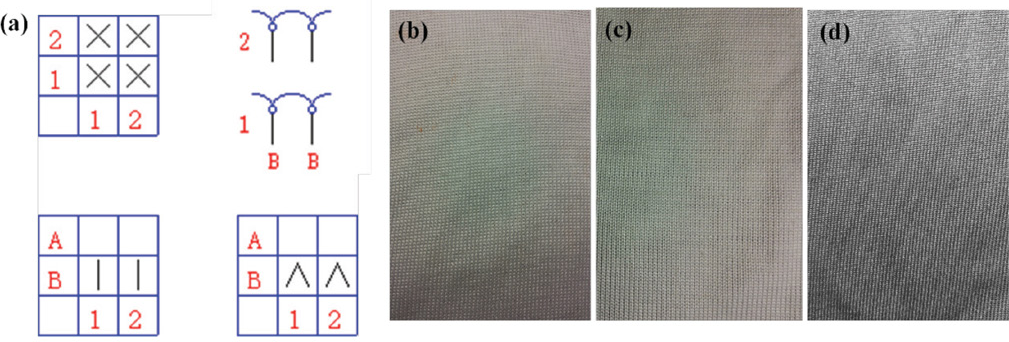
(a) Knitting diagram. Actual knit fabric made of (b) circular cross-section fiber, (c) flat-shaped cross-section fiber, and (d) hexagonal shaped cross-section fiber.
Fiber SEM
SEM is often used to observe the cross-section and longitudinal morphology of fibers. 14 A fiber slicer was used to make slices from the three kinds of section fiber, and then, the slices were coated by a sputtering coating apparatus. Finally, the cross-section of the samples were observed by SEM (SNG-3000, Sec Co. Ltd., South Korea).
Yarn Fineness Test
A YG068 yarn length measuring instrument and FA2104S electronic balance were used to test and calculate the fineness of ordinary PET, flat PET, and hexagon PET filaments ten times each.
Yarn Mechanical Properties
The tensile properties of filament yarns were measured by an electronic single yarn strength machine (YG061F, Laizhou Electronic Instrument Co. Ltd., China) to compare the influence of different profiled fibers on tensile strength and elongation. 19 The test was performed with a sample length of 250 mm, at a temperature of 20°C, and relative humidity (RH) of 65%.
Fabric Structure Analysis
Even in the same knitting process, PET yarn knitted with different cross-sections would also affect the structure of fabric. Therefore, the vertical and horizontal density, thickness, and gram weight of the three fabric samples were also characterized. Stitch density was measured using a fabric densitometer. The thickness of the knitted fabric was measured using a digital fabric thickness tester (YG(B)141D, Wenzhou Darong Textile Instrument Co. Ltd., China), and the pre-tension was 20 g.
Fabric Mechanical Properties
The longitudinal and transverse mechanical properties of knitted fabrics were measured using an electronic fabric strength testing machine (YG065H, Laizhou Electronic Instrument Co. Ltd., China). 20 The test included three longitudinal pieces and four transverse pieces, with a test distance of 10 cm. The sample, with a width of 50 mm and length of 300-330 mm, was drawn to fracture at a constant speed and the breaking strength and elongation were recorded.
Fabric Wearability
To understand the wearing performance of fabrics made of profiled fibers, elastic recovery, pilling resistance, softness, air permeability, and thermal and moisture resistance were measured. 21 All test samples were cut into a specified dimension, at 20 °C and 65% RH for 24 h.
A digital fabric crease elasticity instrument (YG(B)541E, Wenzhou Darong Textile Instrument Co. Ltd., China) was used to test the elasticity of materials. An automatic stiffness instrument (YG(B)022D, Wenzhou Darong Textile Instrument Co. Ltd., China) was used to test the flexibility of samples. The air permeability of the samples was measured by using an automatic fabric permeability instrument (YG-B461E-II, Wenzhou Darong Textile Instrument Co. Ltd., China). A thermal and moisture resistance instrument (SGHP-10.5, Measurement Technology Northwest Thermal Measurement & Line Control Products Co. Ltd., USA) was used to test the thermal resistance and moisture resistance of the samples.
Results and Discussion
SEM Morphology
It can be observed from Fig. 2 that the cross-section of the ordinary PET fiber was round or oval, while the other two were profiled: flat and irregular hexagon shapes. The longitudinal morphology of the three fibers were slightly different: the circular cross-section fiber was smooth and cylindrical, the flat-shaped fibers had small ribs, and the hexagonal-shaped fiber had many edges. From the result of the yarn fineness test, the fineness of the circular-shaped, flat-shaped, and hexagonal-shaped filament yarns were 173.8, 175.6, and 177.7 dtex, respectively. The yarns were all composed of 288 single filaments.
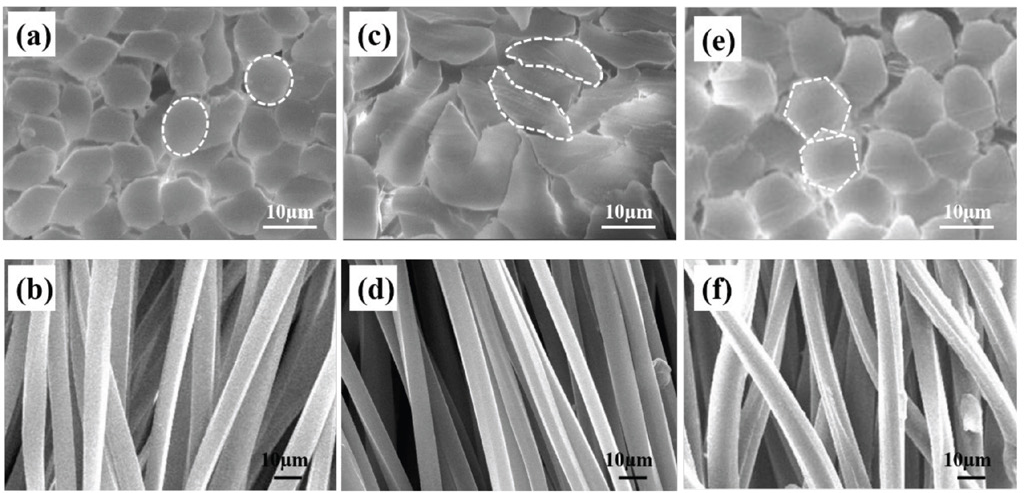
Profiled fiber transverse and longitudinal section form. (a) and (b) circular cross-section fiber, (c) and (d) flat-shaped cross-section fiber, and (e) and (f) hexagonal-shaped cross-section fiber.
Yarn Mechanical Properties
Fig. 3 shows that the breaking strength of the three filament yarns was not significantly different. The breaking strengths of circular-shaped, flat-shaped, and hexagonal-shaped filament yarns were 31.80, 32.57, and 32.86 cN/tex, respectively. There were no big differences among these yarns based on error analysis. 22 The elongation at break of circular-shaped and flat-shaped filament yarns were 20.34% and 22.71%, and the elongation at break of hexagonal-shaped filament yarns was 33.37%.
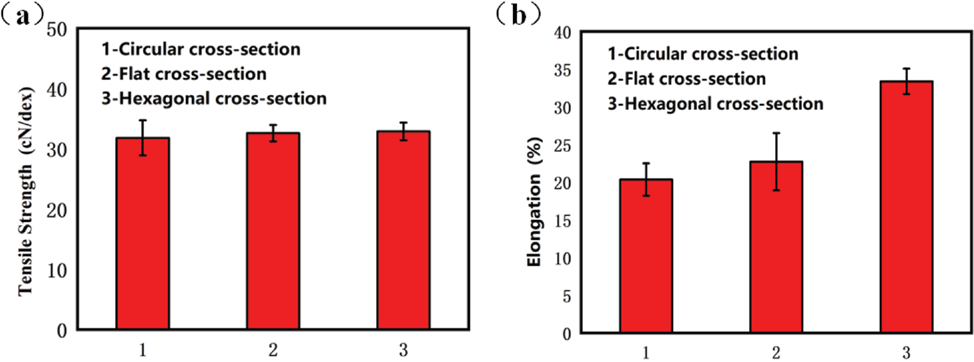
Mechanical properties of yarns. (a) Tensile strength and (b) elongation at break.
Fabric Structure Analysis
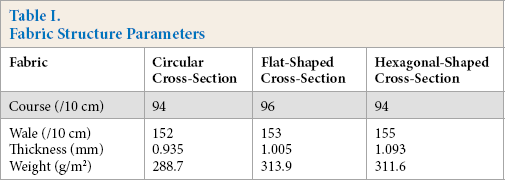
Table I shows that the horizontal and vertical density of the fabrics were basically the same. The thickness of the circular, fat, and hexagonal-shaped fiber fabrics were 0.935, 1.005, and 1.093 mm, respectively, showing no significant differences. Theoretically, based on the same yarn fineness and fabric structure, the fabric thickness could be influenced by different fiber cross-sections and initial modulus.
Fabric Structure Parameters
Fabric Mechanical Properties Analysis
Fig. 4 shows that the longitudinal and transverse breaking force, and elongation at break of circular-shaped PET fabric were all less than that of flat-shaped and hexagonal-shaped profiled PET fiber fabrics. Regarding the longitudinal breaking force and elongation at break, the hexagonal-shaped fiber fabric values (746 N and 143.37%) were relatively higher than the circular-shaped (626 N and 98.13%) and flat-shaped (719.33 N and 135.11%) profiled fiber fabric values. For the transverse breaking force and elongation at break, the flat-shaped profiled fiber fabric values (609 N and 185.01%) were relatively higher than the circular-shaped (409.75 N and 125.83%) and hexagonal-shaped (512.25 N and 134.00%) fiber fabric values. The fabric breaking force did not agree with the yarn breaking strength, which may be influenced by the fabric structure (e.g., thickness and take-up).
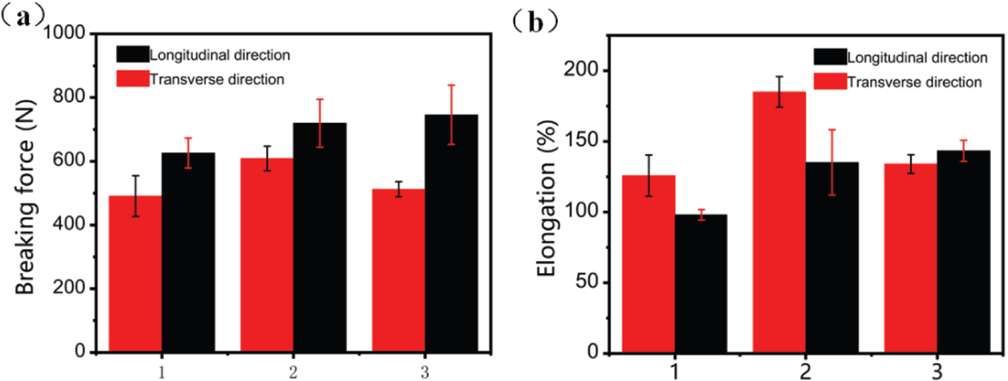
Fabric mechanical properties. (a) Breaking force and (b) elongation at break for 1—circular cross-section fiber fabric, 2—flat-shaped cross-section fiber fabric, and 3—hexagonal-shaped cross-section fiber fabric.
Fabric Wearability Analysis
Generally speaking, the greater the fabric crease recovery angle was, the less the difference was between the fast recovery angle (after 15 s) and slow recovery angle (after 30 min). It can be seen from Fig. 5a that the wrinkle recovery of the three kinds of fabrics were all good compared to the original circular cross-section PET fiber fabric. Among them, the crease recovery rate of flat-shaped and hexagonal-shaped PET fiber fabric were 17.47% and 21.57%, respectively, in the longitudinal direction, and 90.94% and 94.90% in the transverse direction, respectively, which was comparable to that of the circular-shaped PET fiber fabric (23.28% longitudinal and 85.14% transverse) after error analysis. 23 When the fabric was wrinkled, the force to produce small deformations of the profiled PET fiber fabric was greater than that of the circular-shaped PET fiber. When applying the same external force, the deformation of the profiled fiber fabrics was small, and the wrinkle resistance of the fabrics were improved. Basically, use of heteromorphosis sections are beneficial to improve the wrinkle resistance of fabrics. 24
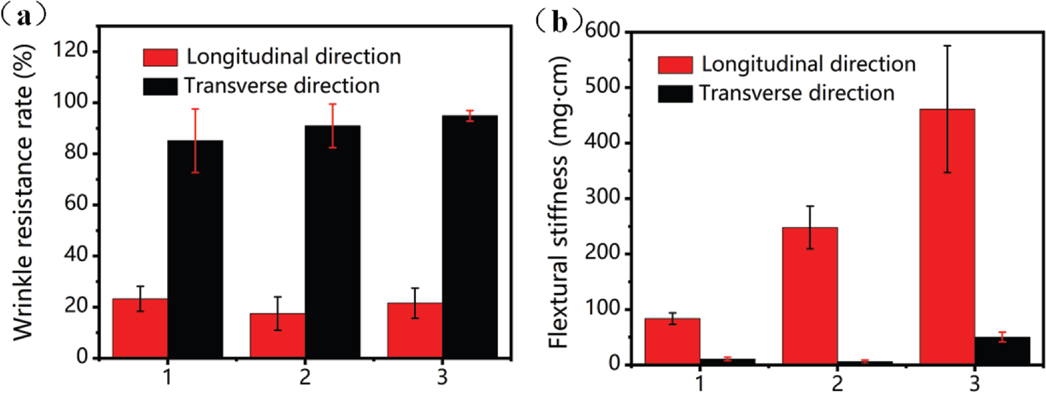
Fabric wearability. (a) Crease recovery rate and (b) flexural stiffness for 1—circular cross-section fiber fabric, 2—fat-shaped cross-section fiber fabric, and 3—hexagonal-shaped cross-section fiber fabric.
From Fig. 5b, it was observed that the flexural rigidity of the circular-shaped PET fiber fabric was less than that of the profiled fiber fabrics, showing that the circular-shaped PET fabric was more flexible. Furthermore, the longitudinal and transverse bending stiffness of the hexagonal-shaped fiber fabric were the greatest (461.14 and 50.20 mg·cm), which demonstrated that this fabric was not easy to bend. Therefore, the hexagonal-shaped PET fiber fabric had excellent rigidity.
The air permeability value of the circular-shaped PET fiber fabric was relatively low (2765.45 mm/s), as compared with the flat-shaped (3017.38 mm/s) and hexagonal-shaped PET fiber fabric (3178.85 mm/s) as shown in Fig. 6a. Fabrics made with profiled yarns had more spaces than that of the circular section yarns, because the profiled fibers could not be as close together as the circular section fiber in yarns. 25 Furthermore, compared with the flat-shaped PET fiber, the hexagonal-shaped PET fiber had better air permeability, because the fiber had more grooves in the fiber direction, which provided larger fiber gaps inside the yarns.
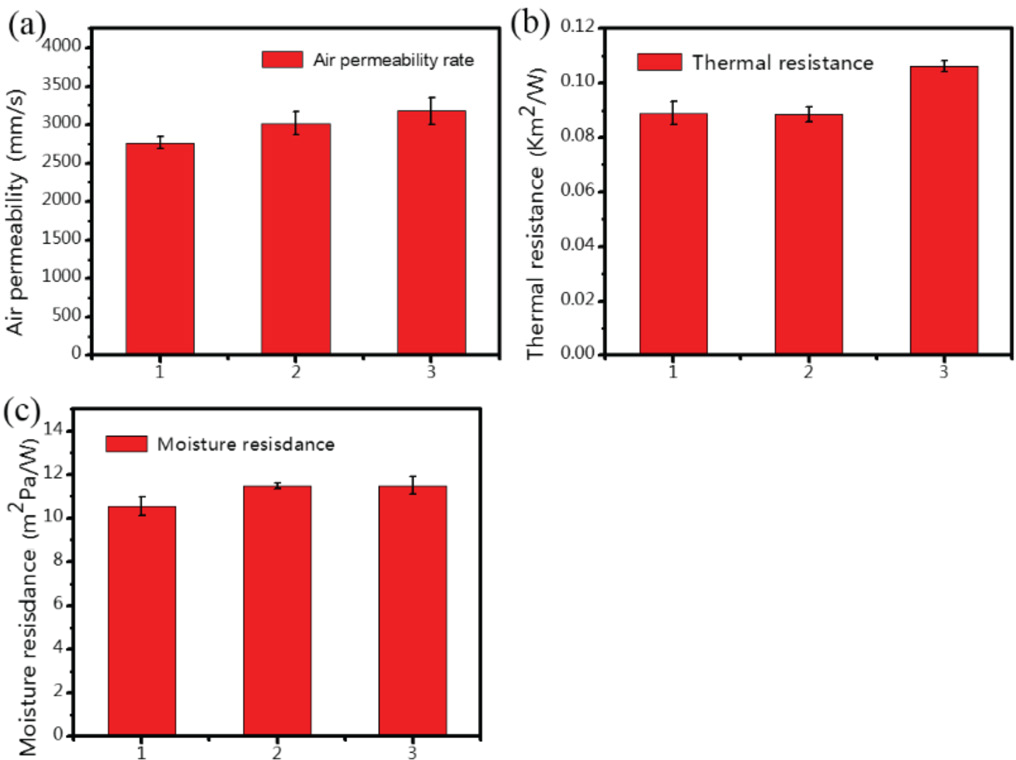
Fabric wearability. (a) Air permeability, (b) thermal property, and (c) moisture property for 1—circular cross-section fiber fabric, 2—fat-shaped cross-section fiber fabric, and 3—hexagonal-shaped cross-section fiber fabric.
The profiled fibers could store more still air in fabrics, which resulted in their improved heat retention properties. 25 Fig. 6b shows that the thermal resistance of the hexagonal-shaped fiber fabric was the greatest (0.106 km2/W). On the other hand, because of the poor moisture absorption of PET, the moisture resistance values were all relatively high, and there were no great differences among the three samples (Fig. 6c).
Conclusion
The influence of different cross-section shapes of PET fiber on the properties of their knit fabrics were studied. SEM confirmed the circular, flat and hexagonal shape of the filament PET fibers. It also showed that the flat-shaped and hexagonal-shaped fibers possessed some grooves on the surface. Consequently, the knit fabrics made of profiled fiber had good mechanical properties, wrinkle resistance, stiffness, and thermal resistance. The fabrics had a stiff hand, which can be considered for use in decoration applications as well as in knit coatings for apparel application.
Footnotes
Acknowledgement
The authors wish to thank the Scientific and Technological Research Project for Public Welfare of Shaoxing (No. 2017B70048), the Zhejiang Provincial Natural Science Foundation of China under Grant No. LGJ18E030001, and the Major Science and Technology Project Funding of Guizhou Province (No. [2014]6006).