






Abstract
Access to water sources is critical because it can affect cotton fiber growth, yields, and quality. It is of interest to determine how a water-limited field environment compares to a well-watered environment, especially when it comes to how cotton quality and surface characteristics are affected. In the current investigation, metal ion quantities were monitored using inductively coupled plasma-optical emission spectroscopy (ICP-OES). The effect of variety and field treatments on high volume instrument (HVI) parameters were examined. The results were quite variable overall, with reflectance (Rd) and strength having the least statistically different means among the quality parameters.
Introduction
Growing areas, such as the Texas Great Plains, with dry conditions can make cotton farming challenging and expensive when it comes to water treatment of cotton crops. Many producers have turned to irrigation to supplement rainfall. Others often totally depend on irrigation, different row spacings, and planting patterns, to get maximum cotton yields and profits. An understanding of how cotton lint surface chemical properties may lead to better predictions of quality parameters and improved textile processing would be advantageous. 1 Varying amounts of non-cellulosic materials, such as waxes, sugars, trash, organic materials, and metals can be found on lint surfaces.2-3 Specifically, metals on the surface of cotton fibers have been previously investigated to determine their effect on dyeing, processing efficiency, yarn quality, frictional properties, spinning, and fiber quality parameters such as micronaire. 4 Of the metals studied previously, potassium was found to be the most abundant due to the major role it plays in the development of cotton, while magnesium, aluminum, calcium, silicon, and sodium were found present in smaller amounts. 5 Copper and iron have been connected to the yellowing of finished denim goods. 6 Salts of metals such as magnesium may form at elevated temperatures during processing and affect dyeing. 7
Previous studies on metal content have been reported on raw and treated cotton fiber, yarn, and fabrics. 8 Varying levels of calcium and magnesium were observed following scouring of the fiber. 9 This variability was reported to be due to the formation of metal-dye component complexes that were water insoluble. Specifically, non-linear relationships between calcium and maturity ratio were attributed to high calcium concentrations and incomplete removal of pectin, which binds to calcium. 10
Potassium, calcium, magnesium, and sodium all decreased in the opening and carding cotton processing steps. Higher reductions in calcium and sodium concentrations compared to potassium and magnesium levels pointed to their existence as surface-related species. 9
The interaction between potassium and calcium concentrations in arid and semiarid climates has been reported to show high leaf potassium and low leaf calcium amounts during a well-watered season. In contrast, the opposite is true in drier climates. 10 Thus, the study of the effect of field environments is of interest.
For detection of metal ions in cotton, the electric “fame” or plasma in inductively coupled plasma-optical emission spectroscopy (ICP-OES) has proven to be advantageous when compared to the combustion flame used in atomic absorption (AA) spectroscopy. 11 ICP-OES offers a higher gas temperature, less active chemical environments, and multi-element determinations. Other advantages of ICP-OES include a high dynamic range and the opportunity to perform ultra-trace analysis.
The potential for metal ion concentrations to vary with water-limited versus well-watered cotton surfaces was the focus of this study. Seven cotton varieties were investigated with ICP-OES to quantify the fiber metal ion concentrations. The high volume instrument (HVI) was used to measure cotton fiber quality parameters with subsequent determination of correlations with metal ion content and field conditions.
Experimental
Cotton Field and Design of Experiment
The cotton varieties in this study were grown in a 1.3 ha field (denoted as F119) and irrigated using subsurface-drip tape, buried 0.2 m below plant rows, and spaced every 1.02 m. The field site was located at the Maricopa Agricultural Research Center in Maricopa, Arizona (33° 4’ 15.0” N, 111° 58’ 27.1” W), where average annual rainfall is less than 200 mm, and daily average high temperatures (June to August) exceed 40 °C. 12 The field season extended from planting May 13, 2014 to final harvest November 13, 2014. The experiment consisted of 35 varieties submitted to the Regional Breeders Testing Network (RBTN), (a program sponsored by Cotton Incorporated, Cary, NC, USA) to evaluate available cotton varieties for yield and fiber quality. The seven varieties selected were grown under drip irrigation. The experimental design consisted of two treatments, well-watered and irrigated field conditions replicated three times in an alpha (0, 1) lattice design. The field was drip irrigated several times per week during the season. Initially both treatments received equal irrigation amounts, May 26-July 3,4. The irrigated treatment was initially imposed on July 4, 2014 and continued until irrigation was terminated for both treatments in September. Irrigation amounts were scheduled according to FAO-56 crop evapotranspiration (ET) procedures, 13 and verified with soil moisture data collected using neutron moisture probes at locations throughout the field. Estimated seasonal irrigation amounts were 963 mm and 840 mm, respectively for the well-watered and irrigated treatments. Irrigation applied to the well-watered treatment, replaced 100% of the FAO-56 modeled crop evapotranspiration amounts, whereas approximately 85% of ET was replaced by irrigation for the irrigation treatment. Petioles were collected July 3, 11, 24, and August 5. Fertigation was applied July 3 (9.2 kg/ha) and Aug 1 (18.4 kg/ha). Flower counts were done from June 28-July 11. Stand counts were completed and tallied July 31. Plant heights were recorded four times and ended July 8. Soil moisture was measured in vertically-installed access tubes via neutron moisture probes in 0.2-m depths, from 0.1 to 1.5 m, weekly to bi-weekly, beginning June 18 and ending September 23. RBTN hand-harvest boll samples were collected October 14. The seven varieties selected for metal ion analyses were: Acala 1517-99, DP 393, NM 1303, FM 958, MD-DC, PX06520-42-2-3, and AU51038. These varieties were selected at random.
Statistical Analysis
All data were analyzed using the SAS PROC GLM MANOVA (Statistical Analysis Systems (SAS) software, Version 9.4 (SAS institute Inc., Cary, NC, USA) for multivariate procedure with estimates of means and standard errors generated using LS MEANS. SAS PROC GLIMMIX was also used to investigate whether the LS MEANS differed among treatments. In addition, PROC CORR was used for correlation analyses (version 9.4; SAS Institute Inc.). Mean separation was conducted using Fisher's protected least significant difference (LSD) at the 0.05 level of probability. Because the field experimental design was an alpha 0-1 lattice design, which is a modified incomplete block design, field conditions (irrigated and well-watered) and varieties were considered to be fixed effects, and field conditions were used as blocks. In this specific experiment, the block effect was of interest since field conditions were part of the overall objectives.
Sample Preparation
For sample preparation of each cotton variety, 0.5 g of cotton were weighed and placed in a Teflon vessel. Next, 20 mL of 1:1 nitric acid to purified water (Millipore Direct Q UV Model) was added to the cotton sample and the vessel was allowed to sit for a 10 min pre-digest. Next, the vessels were plugged, capped, and tightly closed with a white tightening block. Then, the vessels were placed in a composite sleeve. Next, the samples were placed aside for 10 min for pre-digestion. Following this, the vessels were placed on a turntable in such a way that the turntable would be balanced in the microwave accelerated reaction system (MARS6, CEM Corporation, Matthews, NC, USA) acid digestion chamber.
The following program was used once the turntable was in the MARS6. The temperature was linearly ramped up to 200 °C over 10 min. Next, the temperature was held at 200 °C for 10 min, and then cooled down for 15 min. While still inside the MARS6 unit, the samples were allowed to cool further for 5 min. The samples were then taken out of the MARS unit and allowed to cool to ambient temperatures for 10 min. The vessels were then opened and the digested liquids were then diluted by adding 2 mL into 25 mL of purified water in plastic volumetric flasks.
ICP-OES
A Teledyne Leeman Labs Prism High Dispersion ICP-OES was used for this study. Two reference lines (Hg-194.227 and axial Mn-257.610) were checked at the beginning of every run to ensure correct plasma position, wavelength alignment, and torch alignment. Before running the samples, active wavelengths were chosen for the specific runs. Standard solutions were prepared with 4% acid to match the acid concentration of the samples. Using the Leeman Labs Salsa software 4.0, the standards and sample solutions were selected and defined. Once standards were run, the corresponding calibration curves were checked to determine the accuracy of the measurement. Finally, if the calibration curves yielded R-squared >0.999, the samples were run. Each run was performed in triplicate and averaged. Concentrations were calculated on a dry basis (µg of metal/gram of cotton). The HVI measurements were carried out at Cotton Incorporated on the same samples used in the digestion and ICP-OES.
Results and Discussion
Metal Ions
Eight metal ions (potassium, calcium, magnesium, sodium, copper, iron, manganese, and zinc) were identified in the raw cotton fiber and were analyzed with ICP-OES. The ICP-OES metal ion results were calculated on a dry basis (µg metal/g of cotton fiber). The letters in the following tables indicates statistical differences (different letters) or non-statistical differences (same letters) between the means of the studied variables under the two field conditions. With the exception of magnesium (Mg), there were no statistical differences for well-watered and water-limited field conditions (Table I) for the individual metal ions averaged over the seven cottons.
Metal Ions Means by Water Treatment (μg Metal/g of Cotton)

However, there were statistical differences among varieties for several metal ions (Table II). The variety PX06520-42-2-3 grown under well-watered conditions had the highest concentration of potassium (K) and was statistically different from the other varieties. The variety MD-DC grown under well-watered conditions had the lowest concentration of potassium (K) and was statistically different than the other varieties (Table II).
Average Metal Ion Concentrations Yielded from Cotton Fiber Surfaces
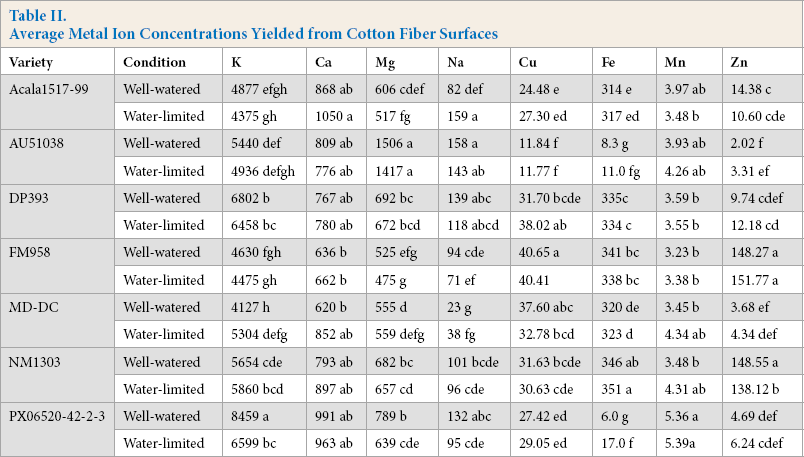
There was no statistical difference among the varieties for calcium (Ca). The variety AU51038, grown under both field conditions, had the highest concentration of Mg with no statistical differences. The variety FM958 had the lowest concentration of Mg among the varieties in this research. Acala1517-99 grown under water-limited conditions and AU51038 grown under well-watered conditions had the highest sodium (Na) concentrations. FM958 grown under both field conditions had the highest concentration of copper (Cu) and AU51038 grown under both field conditions had the lowest concentration and those varieties were statistically different. NM1303 grown under both field conditions had the highest concentration of Fe. Mn, in general, had the lowest concentration among the metal ions studied in this research, and there were no statistical differences among the varieties. AU51038 had the lowest concentration of Zn and it was statistically different from other varieties grown under both field conditions.
One thing to note is that the values for Zn and Fe had very different concentrations depending on the variety or the field condition, whereas the other metal content appeared more consistent. This may be due to soil properties where metal concentrations could be affected.14,15
Fiber Quality Parameters
Fiber quality analysis was done in a controlled environment lab. Eight quality parameters were analyzed using an HVI instrument (Tables III and IV). For field treatments, there was no statistical difference for micronaire and elongation, but small statistical differences were found for length (UHM), uniformity (%), strength (g/tex), short fiber (inches), and fiber color (Rd and +b) (Table III). As a trend, the well-watered samples exhibited overall higher values for the UHM (inches), strength, elongation, uniformity index, and Rd. Under water-limited field conditions, samples exhibited overall higher values for micronaire, short fiber content (inches), and +b, suggesting the water-limited field condition was both favorable, with higher micronaire, and unfavorable, with short fiber content and yellowing of the fiber.
Fiber Quality Means by Field Conditions

Cotton Fiber Qualities of Varieties Grown Under Two Field Conditions
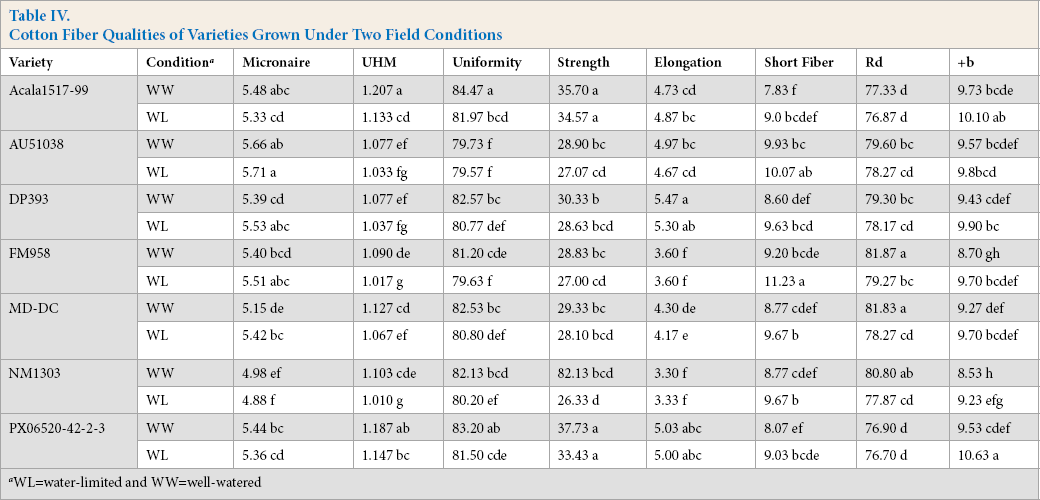
WL=water-limited and WW=well-watered
As shown in Table III, the means of the field conditions for micronaire and elongation were not statistically different, but Table IV showed micronaire differences among varieties. Thus, the micronaire parameter had various relationships with various fiber quality parameters. The variety AU51038 had the highest micronaire in this study and showed no differences between field conditions, and variety NM1303 had the lowest micronaire and showed no differences between field conditions. Variety NM1303 (lower micronaire) was statistically different than AU51038 (higher micronaire) (Table IV). The only variety that showed field condition differences within the same variety was MD-DC. One thing to note is the high micronaire values may be due to late harvesting.
For the upper half mean length (UHM), all varieties in this study had a length above one inch. Acala1517-99 and PX06520-42-2-3, grown under well-watered field conditions, had the highest length with values of 1.207 and 1.187 in. respectively, and these two varieties were not statistically different. The varieties NM1303 and FM958 grown under water-limited conditions had the lowest upper half mean length with values of 1.010 and 1.017 in. respectively and were statistically the same. For the UI, Acala 1517-99 and PX06520-42-2-3, grown under well-watered conditions, had the highest values of 84.47 and 83.20 respectively. However, those were not statistically different. Acala 1517-99 and PX06520-42-2-3, grown under both field conditions, were the strongest fibers in this study, and both were not statistically different between them. Yet, they were statistically different from the other varieties. For the fiber elongation, DP393 had the largest mean (5.47%) and was statistically different from the other varieties, and the varieties FM958, DP393, and NM1303 had the lowest mean elongation. All varieties had a short fiber content above 7.8%, and FM958 and AU51038, grown under water-limited conditions, had the highest short fiber concentration. For the color fiber parameters (Rd and +b), FM958 and NM1303 grown under well-watered field conditions had high reflectance (Rd) values (81.87 and 80.80) and a low +b values (8.70 and 8.53). It is often desirable for a fiber to have high reflectance and low +b values, which is indicative of fiber yellowness.
Correlations
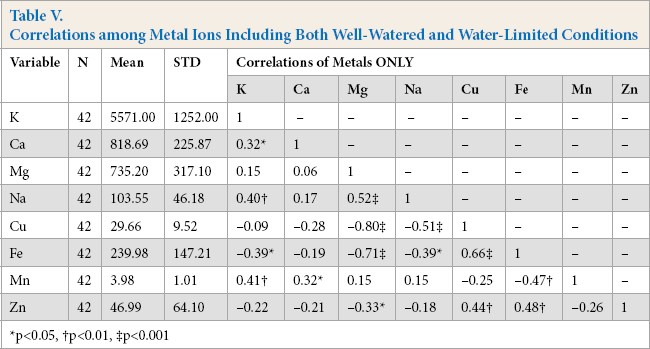
The correlations between metals and fiber quality parameters were investigated (Tables V–VII). The use of correlations in this study was important because the presence of two or more metals could have negative effects, such as calcium and magnesium forming insoluble complexes during dyeing (Tables V and VI). 7 Magnesium has a very significant correlation with sodium, copper, and iron, with correlation values of 0.52, −0.80 and −0.71 at p < 0.001, respectively. Sodium had very significant negative correlation with copper (−0.51) at p < 0.001. Thus, as sodium increased, copper decreased with a high probability. Copper had a very significant positive correlation with iron (0.66) at p < 0.001.
Correlations among Metal Ions Including Both Well-Watered and Water-Limited Conditions
p<0.05,
p<0.01,
p<0.001
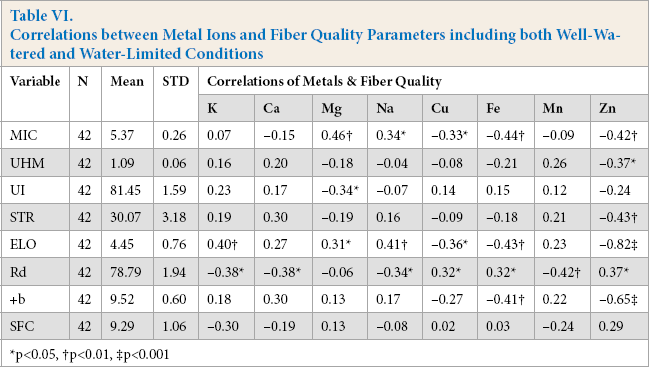
Correlations between Metal Ions and Fiber Quality Parameters including both Well-Watered and Water-Limited Conditions
p<0.05,
p<0.01,
p<0.001
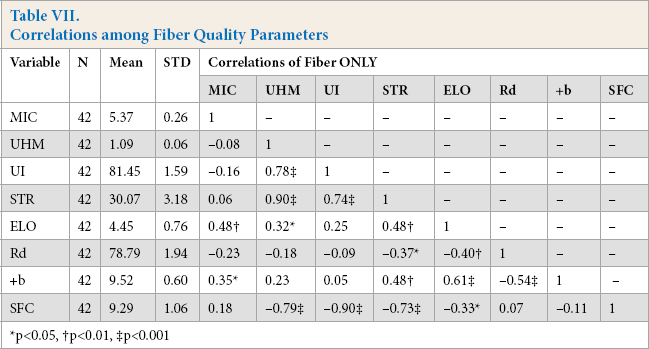
Correlations among Fiber Quality Parameters
p<0.05,
p<0.01,
p<0.001
The relationships of metals with cotton fiber parameters are of interest for prediction purposes. Table VI depicts correlations of metals ions with cotton fiber quality parameters. In terms of the fiber quality parameters and metals, zinc had a very significant negative correlation with elongation (−0.82) and +b (−0.65) at p < 0.001. This finding was not in agreement with a previous study on the effect of zinc application to cotton plants, where a positive correlation existed between elongation and yellowness. Table VII depicts the correlations among fiber quality parameters. The UHM had a very significant positive correlation with the uniformity index (0.78), and strength (0.90), and it was negative correlated with short fiber content (−0.79) at p < 0.001. These finding were plausible since all of these length properties are related. Short fibers are not usually uniform and break easily, while the UHM of fibers tend to be more uniform. The uniformity index had a very significant positive correlation with strength (0.74) and a very significant negative correlation with short fiber content (−0.90) at p < 0.001. Again, short fiber content are not inherently uniform or strong. Strength had a very significant negative correlation with short fiber content (−0.73) at p < 0.001, which makes sense since short fiber content are not usually strong. Elongation had a very significant correlation with +b (0.61) at p < 0.001. This finding is not straightforward since elongation and color values are not immediately apparent. Reflectance (Rd) and +b, as expected, had a very significant negative correlation (−0.54) at p < 0.001. Since these are both color attributes, this result seems valid.
Conclusion
Microwave acid digestion and inductively coupled plasma-optical emission spectroscopy (ICP-OES) were the methods of choice to determine the amounts of eight metals (potassium, calcium, magnesium, sodium, iron, copper, manganese, and zinc) in cotton grown under different field conditions. Metal ions were detected and investigated on cotton fiber from plants grown under well-watered and water-limited field conditions. With the exception of magnesium, the water-limited and well-watered conditions did not yield statistical differences in the metal ion amounts. Thus, it appears that both conditions were favorable for the metals studies. The exception was magnesium metal, which showed some distinction between the well-watered and water-limited conditions. In terms of a varietal effect, PX06520-42-2-3 dominated for the alkali metals, but no variety was favored by the transition metals studied.
In contrast, the HVI fiber quality parameters were found to be statistically different with the exception of micronaire and elongation. When correlating metals with fiber parameters, zinc had a very significant negative correlation with elongation (−0.82) and +b (−0.65). A database was created to include the seven cotton varieties studied and their corresponding HVI parameters. As a proof of concept, the correlations between metals, HVI parameters, and cotton varieties were noted and will be included in a database to track these parameters and facilitate future metal, HVI parameters, and variety performance.
Footnotes
Trade names are used solely to provide specific information. Mention of a trade name does not constitute a warranty or an endorsement of the product by US Department of Agriculture to the exclusion of other products not mentioned.