





Abstract
A comprehensive understanding of the waste cotton supply chain and different end-of-life options is essential to promote cotton recycling and reuse. This study analyzed global and US data to understand the quantity, current sources, and destinations of waste cotton. Globally, 11.6 million metric tons of waste cotton are generated per year during cotton garment production. This study also reviewed different options for recycling both pre-consumer and post-consumer cotton waste via chemical and mechanical processes. Different applications of waste cotton were compared to their virgin counterparts from technical, environmental, and economic perspectives. Unlike most previous studies, this research included applications that are not traditional textile products (e.g., biofuels and composites), shedding light on potential new markets for waste cotton that will not compete with virgin cotton.
Keywords
Introduction
Global cotton production exceeded 26 million metric tons in 2018 to meet the growing demand for textile products.1,2 Cotton represents a third of the total textile market, 1 and the production is projected to increase by 6.5% in 2019. Growing cotton production places stress on the environment, with respect to land, chemicals, and water. In 2004, cotton production accounted for 2.6% of global water use. 3 Cotton production also uses significant chemicals, including pesti-cides. 4 It was estimated that cotton cultivation accounted for 11% of the world pesticide consumption in 2013. 5
Virgin cotton is mainly used as the raw material for clothing, which is then worn and disposed. The US Environmental Protection Agency (US EPA) estimated that 9.5 million metric tons of apparel and textiles end up in landfills each year in the United States, 6 and less than 1% of the clothing produced is recycled back into new clothing. 7 However, it was estimated that more than 80% of the cotton wastes are suitable for mechanical recycling into new textiles. 7 A study estimated that if textile waste is all diverted from land-fills, there would be sufficient starting material for a viable recycled cotton industry. 7 Using recycled cotton has the potential to reduce the use of water, energy, pesticides, and dyeing chemicals, and reduce landfill waste. 8
Some opportunities to enhance waste cotton recycling and reuse have been explored at the policy, industry, and academic levels. For example, the 2015 European Union (EU) Circular Economy Action Plan launched a three-year effort to transit European economies toward circular reuse of materials, especially focusing on textile collection and recycling. 9 In the United States, the Council for Textile Recycling measured a 40% increase in textile waste between 1998 and 2009 with only a 2% increase in landfill diversion. In response, the Council set a goal for the United States to produce zero landfill-bound textile waste by 2037. 10 In the textile industry, several companies are developing industrial-scale technologies to upcycle waste cotton using mechanical and chemical recycling methods. Start-up companies such as Evrnu 11 in the United States, Renewcell 12 in Sweden, and TeKiDe in Finland have been developing industrial-scale chemical recycling of post-consumer cotton, in which cotton garment waste is dissolved into and extruded as a fiber. 13 Another example is Recover, a Spanish company that shreds pre-consumer waste while maintaining the staple length of the cotton fiber so it can be respun. 14
Established companies such as Lenzing 15 are looking to add recycled yarn to their supply chain in hallmark products. Lenzing, one of the largest textile companies in the renewable fiber business, launched Tencel lyocell made with Refibra technology in 2016. The company introduced pre-consumer waste cotton, in addition to wood pulp, into their Lyocell product with a goal of further including post-consumer waste cotton. 15 Large fashion brands such as H&M, Levi's, and The North Face have begun recycling programs that reward their customers for bringing back old clothing. H&M increased its annual textile collection from 12,000 to 21,000 metric tons of garments from 2015 to 2018. 16
Given the growing technological interest in cotton recycling, significant efforts have been made in academic research to address technical barriers in cotton reuse, such as characterizing different types of the mixed textile waste, 17 enhancing separation efficiency of cotton from polyester blends,18,19 and developing value-added products from waste cotton that can be used in place of virgin material.20,21
Despite the current movement in the cotton recycling field, there are knowledge gaps that hinder the implementation and adoption of cotton recycling and reuse. First, there is a lack of understanding of waste cotton supply chains. The waste cotton supply chain can be complex and have large variations across various companies and regions. A confident estimation of quantity and quality of waste cotton available at different supply chain stages is essential to inform decision making for end-of-life options. Second, although some studies have evaluated the technical feasibility and environmental benefits of different waste cotton options, few of them have provided a comprehensive review and comparison of different applications from a life-cycle perspective.
This paper addresses the previous two knowledge gaps by providing a comprehensive review of waste cotton supply chains in the United States and different waste cotton applications from technical and environmental perspectives. Global data and analysis of supply chain and material flow for countries other than the United States were also reviewed for comparisons. Both mechanical and chemical recycling, and the potential applications of recycled fibers were reviewed and compared with virgin counterparts. The data collected and presented in this paper will be helpful for further quantitative analysis related to the cost and environmental impacts of different end-of-life options for waste cotton. The review and discussions could also inform future strategic planning and decision making for large-scale promotion and adoption of waste cotton recycling and reuse.
Review of Supply Chain of Waste Cotton Streams
Waste cotton is produced at almost every step in the production of a cotton garment. A good understanding of the type, quantity, and quality of the waste cotton alone within the supply chain will be helpful to identify hotspots suitable for recycling and reuse. Fig. 1 is an estimation of cotton waste generated in the global supply chain of cotton and garment production using standard cotton processing methods. The percentages shown in each box represent the ratio of input material that is wasted or does not flow to the following steps.
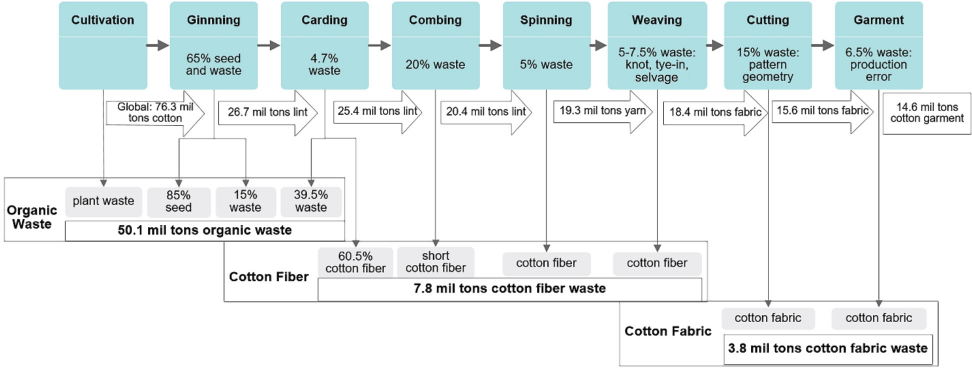
Production begins with the cultivation of cotton, where waste is left in the field to decompose. Next, in the ginning process, cotton fiber is separated from the lint (∼35% of seed cotton) is separated from cottonseed and trash, and lint is used in the next spinning process. 22 For the non-lint fraction, ∼85% is the cotton seeds that can be used to make oil or stock feed, and the remaining 15% is classified as a waste product. 22 However, this waste product is potentially usable for ethanol manufacturing, fertilizer, or oil spill clean-up. 22 Next, the cotton fiber travels in bales to be spun. In preparation for spinning, the bales are opened, blended, cleaned, and carded. In the carding process, studies showed that 4.7% of the material is separated as waste, and of that waste, in fat and undercard wastes, 65% and 56% of the fiber has the potential to be recovered, respectively. 23 Next, in the drawing process, the sliver is blended, straightened, and the density is adjusted to the desired level. In the combing process, the final waste is removed to obtain fine, strong, smooth, and uniform yarn. Combed yarn is more expensive than carded yarn and creates a high-quality product; however, the process removes on average 20% as waste. 24 Thiswaste is largely usable in applications requiring cotton linter quality material, such as dissolution and respinning. 20
Next, in preparation for spinning, the sliver is condensed and lightly twisted into a finer strand or roving. The roving is spun using one of three main systems: ring, rotor, or air-jet spinning. While waste can vary based on the spinning process and machine, yarn waste is about 5%. 25 Finally, the yarn is woven into fabric on a loom. Cotton waste depends on the weaving pattern and machine choice. In air-jet looms, 5.0 to 7.5% of the cotton is removed as waste due to knotting, tying in, selvage, and errors. 26
In garment production, the fabric is cut and sewn using a variety of patterning and finishing methods. It is estimated that conventional pattern cutting creates about 15% wastage of material, even if the pattern has been optimized by a com-puter.27,28 Finally, fabric waste is produced during the sewing process due to excess fabric, errors, or sample garments. In a study of fabrication of traditional style T-shirts, ∼6.5% of waste was left over from sewing and quality control. 27 Both yarn waste from weaving and cutting waste of fabric are high-quality sources of cotton for reuse.
Pre-consumer cotton fabric waste includes fabric from the garment fabrication stages as well as deadstock, damaged yardage, and samples; these represent the most commonly reused cotton material for high value-added applications because the yarn type, treatments, dyes, and yarn density are all known, and the fibers have no wear. Quantifying pre-consumer waste is difficult because many businesses have private waste removal contracts that are not required to report tonnages picked up, the destination of the material, or its contents. 29 Textile manufacturers may sell, donate, or pay for recycling methods, allowing for the recovered materials to be used for applications requiring less material or down-cycling into shoddy for insulation or rags. In addition, some apparel manufacturers destroy unsold material to not compromise the brand. 30 Often apparel companies and stores do not report the percent of unsold material for strategic business purposes or since it may not reflect well on brand marketing.
For post-consumer waste textiles, a few studies have analyzed the current end-of-life material flows of waste textiles in Europe.31-35 A study from the United Kingdom indicated that the combined waste from clothing and textiles was about 2.35 million metric tons in 2004, with 13% going to material recovery, 13% to incineration, and 74% to landfill. 31 Approximately 25% of textile waste was collected through donation shops such as the Salvation Army. 32 The destination of discarded textiles varies with market conditions. In 1999, in the United Kingdom, 43% of used clothes went to second-hand clothing, 22% to filling materials, 12% to wiping cloths, and 7% to fiber reclamation. 32 The Textile Recycling Association in the United Kingdom estimated that in Europe on average about 15–20% of disposed textiles were collected while the rest was landfilled or incinerated. Of the collected material, about 50% was down-cycled and 50% was reused, mainly through exporting to developing countries. 33 However, there are large variations within European countries. Germany collected about 70% of disposed of textiles for reuse and recycling where only a fraction was separated for incineration. 33 Denmark collected 40.5% of used textiles for reuse and recycling via Non-Governmental Organizations (NGOs) and private collectors, while 38.5% ended in mixed waste for incineration. 34
More end-of-life cotton data can be found be found in a report developed by multiple research institutes in Sweden, Denmark, Norway, Finland, and Iceland to build more robust textile reuse infrastructure and policy development. 35 Each Nordic country was able to estimate about 80% of their post-consumer textile flow; however, the study concluded that the market for textile waste recycling is limited, due to the lack of recycling technologies available and high cost. 35 A recent study published by Daystar et al. collected consumer data from more than 6000 global respondents from China, Germany, Italy, Japan, the United Kingdom, and the United States regarding the use of T-shirt, knit collared shirts, and woven pants. Their results indicated that on average, 38% of consumers donated used clothes to charity, 26% throw them away, 15% re-use or use them for a different purpose, and the rest of consumers gave them to friends, kept them in the closet, or sold them. 36 To the best of the authors' knowledge, few studies have reviewed or analyzed the destination of both pre-consumer and post-consumer textile waste in the United States, nor focused specifically on the end-of-life of cotton. This study reviewed relevant data and technologies to address this knowledge gap.
In the United States, about 98% of the apparel sold is imported, 37 so trade data can inform the amount of cotton apparel in the United States. According to the US Department of Agriculture (USDA), 2.7 million metric tons of cotton apparel (5,992 million raw-fiber equivalent pounds of cotton textiles) was imported in the United States in 2017. 25 Usually, not 100% of apparel is sold, but retailers rarely disclose the data of unsold inventory. This study estimated that 70% is sold and 30% is unsold (Fig. 2) based on the data from liquidation and salvage firm estimates. 38
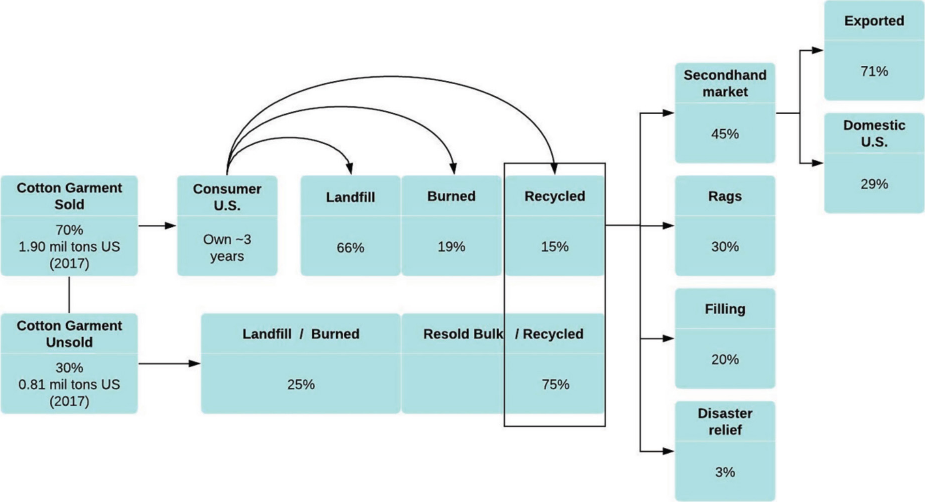
For cotton garments sold, the US EPA estimates that 15% are recycled, 19% are combusted with energy recovery, and 66% are sent to landfill. 6 According to the American Textile Recycling Service, 45% of the clothing recycled is sold in second-hand markets, 30% is used as rags, 20% is used for upholstery and stuffing, and 3% is donated as disaster relief. 39 Themajority of second-hand garments donated in the United States are exported. One study suggests that 71% are exported, resulting in a total of 32% of recycled textiles being sold to foreign countries for resale or down-cycling. 40 According to the United Nations' Commodity Trade Statistics, around 790,000 metric tons of worn apparel and textiles are exported from the United States each year. 41 However, such data is not broken down by fiber types, but it can be estimated that if 1/3 of all textiles are cotton, 1 260,000 metric tons of cotton fiber that are incorporated in used textiles are exported.
For the clothing that goes unsold, to the best of the authors' knowledge, there is no known citable source that tracks what retailers do with unsold inventory. It is estimated that manufacturers recycle or resell in bulk about 75% of the inventory that is not sold. 42 The remaining 25% is presumably destroyed or thrown away. However, these estimates need to be further verified in the literature and are shown in Fig. 2. Anecdotal accounts and reports suggested that retailers destroy inventory and send to landfill, but the frequency of the practice is unknown. 38 Alternatively, retailers may sell their inventory in bulk to liquidation companies where it is distributed in stores, online auctions, or overseas. The extra inventory may be placed online for sales or sold in an online marketplace when there is a limited quantity. In addition, the company may choose to donate or recycle their clothing, a system through which recycling companies identify optimal down-cycling or reuse methods.
End-of-Life Options and Fiber Property Requirements for Waste Cotton
Intensive efforts have been made by the industry and academia to promote the circular economy in the textile industry. Many opportunities related to the reuse and recycling of textile materials have been explored, and they can be grouped into five categories—reuse, fabric recycling, fiber recycling, polymer/monomer recycling (usually applied to polymer-based materials or polymer/fiber blends), and energy recovery. Moreover, fiber and fabric recycling usually produce either lower-grade (down-cycling) or higher-grade (upcycling) products.43,44 Different end-of-life options have impacts on different stakeholders in textile supply chains (Fig. 3) and usually generate products that have a large variation in economic value. For example, burning textile materials for heat or electricity is a relatively straightforward process, but does not bring much revenue given the current low price of energy. Cloth reuse and fabric recycling encourage the second use of cloth and textile materials; previous studies indicated the benefits of reducing life-cycle environmental impacts.4,32,45,46 However, such environmental benefits are achieved mostly by avoiding the production of fabric, which may hamper the demand for virgin textile materials. If a product is not readily recyclable, changing the product design could be an alternative. Design for recycling is an emerging concept in recent decades and has been explored for different products such as composites 47 and automo-biles. 48 Some studies investigated the potential of including recycling into fashion and textile product design,49-52 and mentioned the challenges in understanding and evaluating different recycling options and technologies. In the following sections, the two major categories of cotton recycling methods—mechanical and chemical recycling—are reviewed.
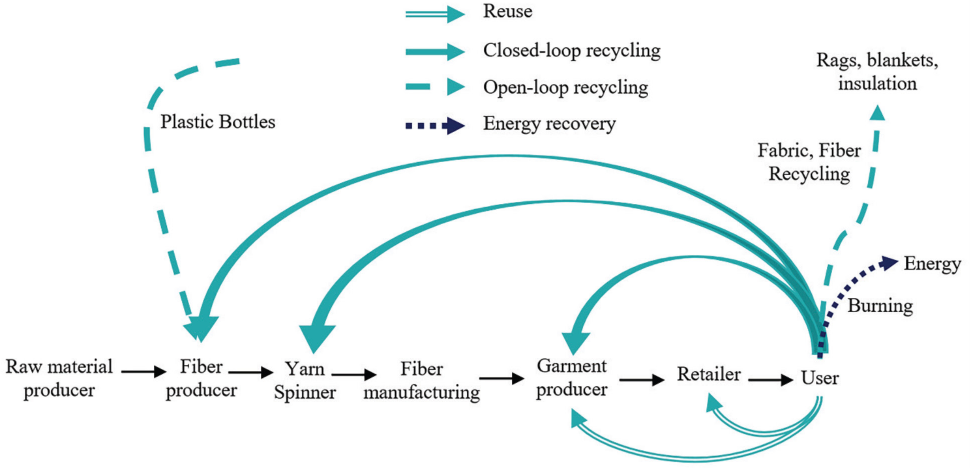
Common end-of-life routes for textiles (including cotton and other materials). 4
Mechanical Recycling
Mechanical recycling begins with cotton material, and cleaning and cutting the fabric into smaller pieces. The fabric is shredded until it is in a fibrous state that can be used for processes such as re-spinning into yarn or for manufacturing into nonwoven textiles. 53 Mechanical recycling shortens the staple fiber length, which lowers the quality by decreasing strength and softness. Generally, only pre-consumer waste is used for mechanical recycling because post-consumer waste does not produce high-quality fiber after wear. This method limits the source of available material to recycle. Fabrics that include mechanically recycled material can only use 20–30% of recycled fibers before the quality of the fabric is significantly reduced. 21
Some companies have begun offering mechanical recycled pre-consumer waste cotton. For example, Recover cotton fiberizes pre-consumer waste using a new technology that maintains the staple length of the fiber at 15 mm rather than below 10 mm, which is typical of waste processing. 14 Virgin cotton is typically 22-20 mm. The process allows them to blend a higher percentage of recycled material.
One study applied life cycle assessment (LCA) to evaluate the cradle-to-grave environmental impacts of Recover's cotton production. 14 The study showed that significant environmental savings was achieved by including recycled cotton content even at a low blending ratio such as 20%. However, the results of this study may not be applied to dyed products, as the study assumed that the virgin cotton product was dyed, and the recycled product was not. A few LCA studies evaluated the impacts of mechanically recycled cotton produced by other companies. Miljögiraf conducted an LCA of mechanically recycled cotton commissioned by H&M and reported that mechanically recycled cotton had lower environmental impacts in all impact categories compared to virgin fiber. However, the study did not evaluate the quality reduction of recycled cotton fiber that may limit the applications of the final product. 8 Another LCA study was conducted by Korhonen and Dahlbo in Finland, in which cotton and other textile waste were mechanically recycled to produce oil absorbent mats to replace mats made from polypropylene. 54 Although their results indicated that mats made from recycled textiles generated five times less greenhouse gas (GHG) emissions than their counterparts, the economic feasibility, and product quality were not evaluated. To promote the sustainable use of waste cotton, it is critical to understand not only the environmental benefits, but also product quality and economic competitiveness compared to virgin counterparts. Moreover, Spathas reported different blends of virgin cotton fibers and recycled fibers with polyester (PET) fibers, concluding that electricity consumption (i.e., during yarn spinning) was a predominant contributor to the environmental impacts. In the cases where recycled cotton fiber was blended with PET, the upstream production of PET was the major contributor to the environmental impacts. 21
In addition to yarn and other textile products, a possible high-value application without chemical treatment of waste cotton is composites, especially those in the automotive, building, and construction industries. 55 A few papers were published recently to investigate the application of recycled cotton fibers in polypropylene reinforcement without further treatment.56-58 Using cotton for cement-based composites used in building construction was also reported in multiple studies.59,60 Although their results demonstrate feasible mechanical properties of applying waste cotton to composites, it is unclear about the environmental impacts and economic feasibility of such applications. Most studies focused on the cost and technical feasibility of incorporating recycled cotton into a product in isolation.55-60 In reality, if the price/availability/performance is not better than other virgin alternatives, it is unlikely that industry/customers will choose the untested or more variable/risky recycled cotton as a raw material.
Other studies showed that the pulverized cotton (350 micron length and 20-40 micron width) supplied by Solvaira Specialties produced from recycled T-shirts could be incorporated into composites, nanocellulose,61-63 and 3D printing materials. 64 Recycled cotton has also been used as fiber for paper products, filtration devices, and personal care and hygiene products.
Chemical Recycling
Chemical recycling of cotton waste is used to produce new fibers that can be used in a variety of products. Table I shows a list of potential applications of chemically-recycled products from waste cotton. A variety of chemical recycling processes for cotton waste were identified in the literature. For energy applications, conventional processes include gasification, pyrolysis, pretreatment, and/or enzymatic hydrolysis.65-67 For fiber regeneration, many processes have been developed such as waste cotton dissolution in urea solvent systems and wet spinning, ionic liquids, and enzymatic saccharification.68-71 The products of these processes could be further upgraded to or directly used in different applications. Those applications are listed in Table I with the information on virgin products and their key properties. The key properties of virgin products are identified; if the recycled cotton price/availability/performance is not better than other virgin alternatives, it is unlikely that industry/ customers will choose the untested or more variable/risky recycled cotton as a raw material.
Chemical Process and Products from Cotton Waste with Possible Applications and their Virgin Alternative Products
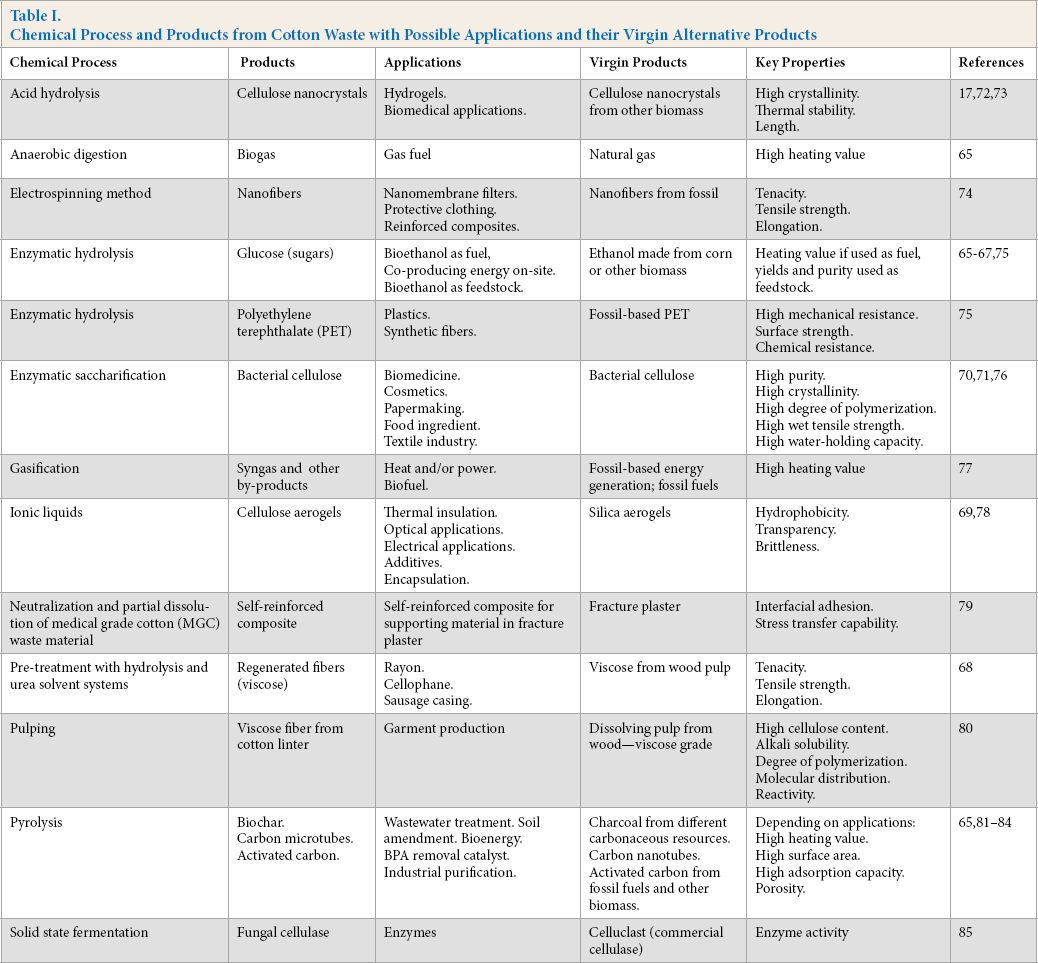
For energy applications, previous studies mainly investigated five types of products, including bioethanol, pellets, biogas, biofuel such as biodiesel, and biopower.66,67,77,86–95 A few studies explored the technical feasibility and environmental impacts of bioethanol production from cotton-based waste using enzymatic hydrolysis and fermentation,66,67,89,90 but none of them have estimated the costs that are critical given the current low prices of oil, nor were they compared to inexpensive starch or sugar as raw materials. Another example of renewable energy products that can be produced from cotton waste, specifically cotton stalk, is fuel pellets with a higher heating value (HHV) of 20.9 MJ/kg reported by Sharma-Shivappa and Chen. 91 This study compared cotton-based pellets with pellets from wood sources (e.g., hardwood and softwoods) with the HHV of 17.6 to 20.8 MJ/kg. They concluded that the cotton-based pellet is comparable with wood pellets from an economic/technical/environmental perspective.
Biogas (mostly methane) is another application that has been explored for waste cotton. Biogas can be produced from cotton through anaerobic digestion and further upgraded to bio-methane that can be used as natural gas using the existing gas infrastructure.92,93 Waste-cotton can be gasified for co-producing heat, power, and biochar. Biochar is a carbon-rich material and has potential applications in wastewater treatment, 94 agriculture management (e.g., application to the soil to reduce nutrient leaching), 95 and bioenergy, 96 as well as having an indirect benefit on mitigating climate change. 97 In addition to heat and power, the syngas produced from cotton gasification can also be used for biofuel production. 77 Another pathway to convert cotton to biofuel is to produce bio-oil through pyrolysis and then upgrade to biofuels. Many studies86-88,90,92,98 have investigated different pretreatment strategies such as steam explosion, alkali, and acid processes among others for biofuels like ethanol production, but little information has been reported regarding the economic or environmental benefits of cotton-based energy products, which are essential for market adoption, especially given the currently low fuel prices.
Compared to energy products, bio-based products may be a high value-added option for waste cotton. For example, carbon fibers (CFs) are high-performance materials that have wide applications in the composites, military, aerospace, and sports industries. 99 Several studies evaluated the technical feasibility of converting waste cotton to CFs.99-101Although previous studies indicated high technical feasibility, the potential environmental and economic implications of cotton-based CFs are unclear. It may be challenging to evaluate such implications because the benefits of cotton-based CFs highly depend on the final applications of CFs. Another possible bioproduct from waste cotton is activated carbon (AC), a carbonaceous material with high surface area and broad industrial and medical applications.102,103 For example, Wanassi et al. used waste cotton as the precursor to produce AC for anionic dye removal from textile wastewater. 104 Currently, most AC can be produced from a variety of carbonaceous sources such as coal, bamboo, coconut husk, wood, and agricultural residues. 105 Depending on the biomass quality and process operations, the yields and quality of AC could have large variations. 106 Understanding the quality of cotton-derived AC and its performance in different applications is critical to further research, development, and deployment in this area. Furthermore, little research has been done to understand the economic/environmental implications of using waste cotton to produce AC and how such implications may be different for various industrial applications.
Another potential application is the closed-loop recycling of cotton waste (i.e., using cotton waste as raw material) 44 to produce regenerated fibers with similar properties as viscose from wood pulp that is currently used in the textile industry as a raw material. 68 Liu et al. developed a mild hydrolysis treatment and two solvent systems to dissolve cotton waste, followed by wet spinning to produce regenerated cellulose fibers. 68 Another study 107 investigated the degree of polymerization of regenerated fiber from cotton waste. They found that cotton lint waste had higher mechanical properties compared to regenerated cellulose fibers from wood pulp. However, none of the previous studies evaluated the feasibility of regenerated fibers from an economic or environmental point of view.
An emerging application of waste cotton is cellulose nano-crystals (CNC), which have gained a lot of interest in the nanocomposite field because of their unique properties and easy modification for a variety of potential applications. 72 Milanez et al. used a hydrolysis treatment with sulfuric acid to produce CNC and evaluated the impacts of various acid concentrations and reaction times. 17 Their results indicated that the properties of CNC from cotton waste, such as thermal stability, are similar to CNC from commercial cotton. 17 However, the final applications of CNC will determine the best-operating conditions (time and temperature) for this process. In addition to the applications discussed above, Table I also includes others. For example, one study reported the use of medical-grade waste cotton to produce a self-reinforced composite for supporting materials in medical equipment, such as fracture plaster. 79 Another study reported the use of waste cotton to produce cellulose aerogels via the ionic liquids technique for thermal applications, additives, and encapsulation materials. 69
Compared to mechanical recycling, fewer LCA studies were performed to quantify the environmental benefits of using chemical recycling of waste cotton.4,21 Spathas evaluated the environmental impacts of a chemically-recycled viscose yarn from cotton waste compared to viscose yarn from wood pulp. The study indicated that compared to virgin yarn, recycled yarn showed less impacts on eutrophication and acidification and a significant reduction of freshwater consumption, but it has a greater global warming potential. 21 Thecontribution analysis from the same study showed that the upstream production of viscose fiber was the major contributor to the environmental impacts for both cases. In addition, the collection and sorting (a step not necessary for viscose yarn from wood pulp) and electricity for the recycled yarn were the other stages contributing to environmental impacts. Sandin and Peters reviewed 41 papers that evaluated the environmental impacts of textile reuse and recycling; 76% of those studies were related to cotton. 4 Their review indicated that most previous studies showed environmental benefits of waste cotton reuse and recycling as a result of not producing virgin cotton. Trough chemical recycling, there are many promising applications of waste cotton that do not compete with virgin cotton (e.g., composites, bio-based products, and biofuels—Table I). More efforts are needed in developing LCAs for different waste cotton applications through chemical recycling to identify the most environmentally-beneficial applications.
Although economic feasibility is a key performance indicator for waste cotton applications, most previous studies focused on technical aspects without investigating the economic implications. A few studies have applied techno-economic analysis (TEA) to evaluate the economic viability of waste cotton applications, but all of them focused on energy-related products.88,108,109 Ranjithkumar et al. reviewed different pretreatment processes to convert cotton waste to bioethanol and found that the pretreatment stage contributed about 30% of the total cost of bioethanol production. 88 Holt et al. and Nunes et al. evaluated the economic and environmental benefits of using textile waste for producing thermal energy. Their results indicated that compared with fuel-oil, wood pellets, and wood chips, briquettes made from cotton lead to 80, 75, and 70% of annual fuel cost reduction, respectively.108,109 As discussed previously, there are a variety of waste cotton applications other than energy products. More research is needed to better understand the economic implications of different waste cotton applications and potential tradeoffs between environmental and economic sustainability.
Most chemical recycling technologies reviewed in Table I are emerging technologies that have not been fully commercialized. A few processes (e.g., gasification, pyrolysis, and pulping) have been commercialized, but commonly use other types of feedstock. For example, gasification has been used to convert coal into hydrocarbons or for combined heat and power production in the industry for a long time. 110 Biomass gasification was extensively investigated in recent decades for various biomasses, including cotton,92,93but large-scale application is still limited, mostly due to economic constraints and technical viability for biomass that has a large variability in regional availability and quality. 101 Pyrolysis is another technology with a long history of industrial use (primarily used to convert wood to char), but limited applications for other types of biomass, like cotton, due to the lack of commercial interest in char and bio-oil final products. 112 Compared to gasification and pyrolysis, pulping could be a more promising option for waste cotton, given that it was commercialized for biomass conversion to products like viscose that have a large, mature market. Processes, such as the lyocell process,15,113,114 use cellulose from various biomasses. A recent pilot project in Finland demonstrated the technical feasibility and environmental benefits of converting waste cotton into viscose that was then used for regenerated fiber production through patented cellulose carbamate (CCA) technology.113-117
Properties and Quality of Waste Cotton for Recycling
Possible cotton reuse applications depend on the quality and properties of waste cotton sources. This includes quality at the fabric level such as rips, stains, mildew, and coatings, as well as quality at the fiber level such as length of fiber and density. Quality of pre-consumer waste cotton is often easy to assess because the history of the fiber cultivation and processing is known. Post-consumer cotton, however, experiences different wear and treatment conditions, may have unknown fiber blends, and ages an unknown amount of time. Post-consumer textiles are often graded and sorted into as many as 160 categories by hand by highly-skilled workers. 118 Fiber aging, processing from previous applications, and damage during use or processing are common factors that need to be considered for recycling and reusing waste cotton.
Fiber Ageing
Although the history, age, and treatment of post-consumer cotton are unknown in many cases, the cotton aging mechanism can shed light on some information. Cotton is an organic, high molecular weight cellulose polymeric material. Major structural changes occur as it ages, as well as complex chemical changes. These changes can be classified into five categories: physical aging, photochemical degradation, thermal degradation, chemical attack, and finally mechanical stress. 119
Physical aging of a fiber is the time since the glass transition temperature (Tg) of the material was last exceeded. During physical aging, amorphous regions relax and density, often creating a stiffer, but more brittle, material.
Exposure of textiles to light contributes to photochemical reactions that involve the destruction and formation of covalent bonds.
Thermal effects cause physical and chemical changes in the fiber and penetrate through the bulk, causing structural changes in the crystalline and non-crystalline regions.
Chemical attack generally increases chemical diversity, which generally increases reactivity. Cellulosic fibers like cotton are less susceptible to chemical attack than protein fibers. Cotton fibers are degradable in normal populations of microorganisms, which impact their properties.
Mechanical stress affects the mechanical properties and viscoelastic nature of polymers.
Assessing Fiber Quality and Properties
In addition to the property changes resulting from aging, the fiber must also be assessed for treatments to determine possible methods of reuse or required treatments. Some major principles of consideration for fiber reuse include the following. 120
Dyes and finishes used.
Blends: cotton is often blended with other fibers to improve fabric properties such as stretch, strength, and feel. However, fabric blends are difficult to reuse because of different fibers having different chemical compositions and properties. Many researchers are working to develop fiber separation technologies to increase recycling and reuse via dissolution of cellulose68,90,120,121 or polyester. 122
Length of staple fiber. As the staple length of fiber decreases, the value of the cotton for yarn spinning decreases. The fibers of the highest quality have fiber lengths between 25–65 mm, whereas lower quality cotton has fiber lengths between 10–25 mm.
The degree of polymerization is reported to be in the range of 6000-10,000, but may be up to 15,000. 120 Degree of polymerization decreases as the fiber ages.
Water retention decreases: cotton fiber consists primarily of cellulose, and since there is no hemicellulose or lignin working as blockers during drying, the cellulose fibrils coalesce during drying. As the fibrils clump together, it partly hinders the future rewetting of the fiber and the fabric cannot gain as much water. 123
Tenacity increases: for a cotton fabric to be functional as a garment, it must balance elongation and recovery properties to be comfortable and move with the body. Aging causes embrittlement and increases tenacity, thus reused cotton is often combined with virgin material to provide sufficient elastic properties.
Decreased functionality: increased cross-linking and decreased degree of polymerization from aging can decrease chemical reactivity. This results in a fiber that does not adequately take finishes and dyes. Chemical reactivity in reused cotton can be artificially increased by cleaving bonds to increase the available functional groups. 121
Quality Requirements by Application
Possible reuse applications depend on quality, property, and treatment assessment. A comprehensive understanding of the quality requirements for each reuse method is the foundation for identifying the most suitable applications for cotton waste of varying qualities.
Clothing and fabric: donated clothing undergoes a manual inspection for fabric type, garment size, and condition. Those conditions can include signs of wear, stains, stretch, transporta tion, and rips. Most donation centers will have designated employees to separate donated clothing into designated categories (some have as many as 350 grades). 124 Fabric quality is assessed similar to a garment. Large fabric pieces that are of post-production quality may be used in textile applications as high-value products. If the fabric is of lower quality or in small pieces, it can be used in down-cycling applications.
Fiber: cotton may be chemically or mechanically recycled. For chemical recycling, cotton sources must be 100% cotton, but further requirements are lenient and the quality of most post-production and post-consumer cotton is acceptable because it can be modified before use. For example, removal of color from cotton waste is the biggest challenge for dyed garments, along with removal of functional coatings, adjustment for the degree of polymerization of cellulose, and increasing chemical reactivity. 20 More importantly, cotton should have the same quality as cotton linter for dissolving and spinning. Haule et al. showed that cotton waste from denim had very good properties compared to lyocell fibers, with an increase in tenacity (22%) and modulus (45%) over lyocell fibers; nonetheless, the elongation at break decreased by ∼13%. 111 The recycled fibers properties will vary depending on the type of waste used (pre- or post-consumer); post-consumer waste is best used for producing nonwoven materials or for building materials insulation. 53 On the other hand, pre-consumer waste can be spun into yarns with good quality fiber; nonetheless, shorter fibers lengths are used.53,125 Thelargest reported cotton staple fiber being fiberized and used in recycled garments is 10–15 mm. 14 For reference, high-quality fiber length is 25–65 mm. 120 Furthermore, recycled yarns must be spun with virgin cotton to preserve fabric touch and elasticity properties. The typical blends are 30% recycled cotton and 70% virgin materials. 14 Such processes can produce a 50 tex mid-to-thick yarn.
Down-cycling: cotton can be down-cycled from garment quality fabric to a variety of applications as long as there is no mildew, odor, or hazardous contaminant present. Cotton can be aged, stained, ripped, and stretched. Applications include rags, filling materials for wall insulation, and reinforcement for construction, nanofibers, paper, and nonwovens.4,46
Energy: cotton can be burned for energy recovery and heating value is a key property. Sharma-Shivappa and Chen reported the heating value for cotton waste ranging from 6 to 20.9 MJ/kg. Cotton waste can be converted to other energy products with higher heating contents such as fuel pellets (20.9 MJ/kg), bio-oil (37.2 MJ/kg) and for combustible gases (CO + H2, 14 MJ/m3). 91
For other applications, the quality requirements depend on the virgin products that waste cotton needs to compete with.
Directions for Future Research
Based on this review, to promote sustainable cotton recycling and reuse, there are a few areas that need further efforts.
A strong need to estimate the current actual flows of cotton in (1) waste and rejects from different industrial sectors, (2) retail wastes, (3) collections at donations centers, and (4) end-of-life stages of cotton after their use to define flows and locations of end-of-life cotton. Many products are unrecyclable from practical standpoints; there simply are not large enough volumes of these products concentrated in convenient locations to make collection/sorting/transporta tion and processing into new products even a reasonable proposition. Only through the strong understanding of where and how much waste cotton exists can an exploration of new markets for this material be successful. Data is needed to define where and how available waste cotton is now, to explore the feasibility of applications from recycling them.
LCA and cost analysis (e.g., TEA or life cycle cost analysis) for different end-of-life options of waste cotton. Most previous studies focused on the technical feasibility of incorporating recycled cotton into a product without investigating potential environmental impacts and economic viability.
A better understanding of quality requirements and market potential for different applications of waste cotton. Many studies have investigated the quality requirement of recycling and reusing cotton for garment and fabric applications. However, the quality requirement for other applications needs more efforts. Furthermore, the market potential of different waste cotton applications and the market of their virgin products need to be better understood. It may not be reasonable to use recycled cotton if their virgin products/competitors are already considered more favorably in the market.
Footnotes
Acknowledgments
This project was sponsored by Cotton Incorporated. We thank Dr. Karen Leonas for the discussion of waste cotton sources.