






Abstract
Modification of polyester fibers for more economical dyeing at lower temperatures without a carrier are considered in this study. Polyester dyeing is carried out industrially under rigorous conditions at high temperatures and under increased air pressure, and are treated with various solvents (primary alcohols) to make the fibers more permeable. As a result, the sorption properties, as well as the disperse dye dyeing ability, are improved. Dyeing of a modified polyester fabric at lower temperatures yielded better results than the standard dyeing of the unmodified polyester under the same conditions. The effects of fiber modification were analyzed through water absorption properties, wetting, swelling, differential scanning calorimetry (DSC), and Fourier transform infrared (FTIR) methods, and the degree of dyeing of the fabric was evaluated using CIELab parameters.
Introduction
Polyester (PES) fiber has a significant place in the textile industry for the production of various fabrics or knitwear for widespread use. In addition to its excellent properties (e.g., strength, elasticity, and resistance), there are also some poor properties that cause several serious problems during the production and use of PES textile materials and products. One of the problems is that these hydrophobic fibers have a structure that make the diffusion of even small molecules of disperse dye more difficult. The dyeing of PES takes place mainly at a temperature of up to 110 °C (with a carrier), a high temperature (HT) process (up to 140 °C) and a Termosol process (180–210 °C, 30–120 s).1–3
The moisture content received by PES textile materials and products is very low due to poor hydrophilic properties and poor capillary absorption, which makes the static electrical properties of these fibers very pronounced, causing problems during production and use. 4
Some of the solutions to these problems were presented in recent research and are related to the modification of the surface of PES materials to create conditions that would provide more economical dyeing and sufficient absorption of moisture from the environment. Also, in such treatments, the properties achieved are most often similar to the properties of natural fibers. 4
In general, the dyeing speed was increased by using suitable dyes, changing the structure of the fibers, and changing the dyeing conditions.5,6 Also, the rate of dye diffusion can be improved by increasing the permeability of the fiber or by increasing the fiber swelling ability. This can be achieved by pre-treatment with solvents or ionic liquids, as well as by adding carriers—simple organic compounds with small molecules and a certain affinity for fiber—in a dyeing solution.7,8
This study describes the research of the application of some organic solvents (primary alcohols) to modify PES fibers when, due to anisotropic swelling, it is expected to create a more permeable fiber surface. Also, superficial micro defects in fiber volume can occur, as well as changes in physical and mechanical properties. In places where the solvent penetrates, due to the concentration of stress, separate micro cracks are formed that extend into the depth of the fibers. The aim was to modify PES fibers, making them more permeable to moisture and dye molecules when dyed at atmospheric pressure. The use of alcohol (i.e., more environmentally-friendly) modifiers is an interesting route since classic organic solvents are mostly used. During the dyeing process of modified PES, the dye penetrates the interior through a now more porous surface. Due to the physical and chemical interaction, it is retained in the fibers, ensuring saturation and permanent dyeing.
Experimental
Material
Raw, white 100% polyester (PES, polyethylene terephthalate) fabric was used with the following basic characteristics: plain weave structure, warp and weft yarn counts of 32 × 2 tex, warp and weft yarn densities of 28 and 22 /cm, respectively, and fabric weight of 314 g/m2.
Methods
Modification
The PES modification procedure is as follows. The fabric samples were treated in pure solvents (1-butanol, C4H9OH, 1-pentanol, C5H11OH, and 1-octanol, C8H17OH) for 60 min at a temperature of 100 °C using a reflux apparatus with a solvent-to-fabric ratio of 50:1. The alcohols used were primary or higher alcohols containing 4 to 10 carbon atoms, were moderately viscous, and had fruit fragrances. These alcohols were selected based on their ability to promote fiber swelling, availability, low cost, and ecological acceptability. Increasing the number of carbon atoms reduced the solubility of these alcohols in water, which also influenced the choice of these alcohols for PES modification.
Dyeing
The dyeing of PES fabric modified in this way was carried out with a disperse dye (C.I. Disperse Yellow 54, molecular formula C18H11NO3, and molar mass of 289.29 g/mol, Yumco) in a laboratory dyeing apparatus (Linitest Original Hanau). The three-dimensional structure of this dye is shown in Fig. 1.
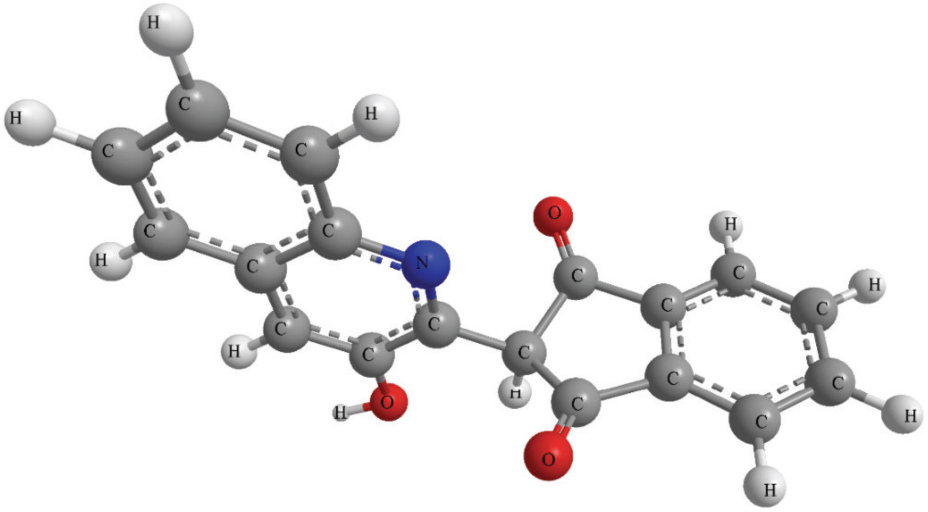
3D structure of Disperse Yellow 54 using ChemBioDraw Ultra 14.0.
The dyeing procedure was performed as follows. The PES fabric sample (5 g) was treated in the bath with a constant volume of 250 mL, the dyeing temperature was 98 °C (temperature was increased at a rate of 3 °C/min), and the dyeing time was 60 min. In addition to 2% owf dye, a dispersing agent (1.5 g/L Alviron W, Texticolor), and formic acid (Tehnohemija) for adjusting the solution pH to 4.5, were used.
Analysis
The morphology of the PES fiber surface was observed using a JEOL JSM - 6610LV (JEOL, Japan) scanning electronic microscope (SEM). The samples were dried for 4 h at 110 °C; the surface was vaporized with gold and observed in the instrument chamber with a voltage of 30 kV.
Fourier transform infrared (FTIR) spectra of PES samples were performed on a Bomem Hartmann & Braun MB-series FTIR spectrophotometer in the wavelength range of 4000 to 400 cm– 1 .
Thermal properties of the PES samples were observed using a DSC Q20 differential scanning calorimeter (DSC). The scanning speed was 10 °C/min and the temperature range was 25 to 300 °C Approximately 5 mg of the samples were heated in hermetically sealed aluminum containers with continuous purification by nitrogen at a flow rate of 50 mL/min.
The percentage of crystallinity of the samples was calculated by using the ratio of the melting enthalpy of the actual sample over the melting enthalpy of 100% PES crystals using Eq. 1. If the cold crystallization exotherm registered in the diagram, then subtraction from the melting endotherm was performed. 9

Δ
Water Absorption
Water absorption was determined according to DIN 53923. 10 The textile samples (10 × 10 cm) were fixed on a perforated plate test sieve and then placed on the bottom of a basin filled with water, using slanted immersion to avoid the development of air bubbles below the fabric sample. The samples were kept in the water for 1 min before they were removed (still fixed on the perforated plate test sieve), three of the needles holding the sample were removed, and the perforated plate test sieve was fixed horizontally, allowing the fabric to hang for 3 min (to remove the water excess) before it was weighed again.
Wetting Time
Wetting time was determined according to AATCC TM27. 11 A drop of water was carefully deposited on the taut surface of the specimen and the time required for a specular reflection of the water was recorded as the wetting time.
Swelling Degree
The swelling degree was determined by measuring the fiber diameter using a Leica microscope. The results were expressed as a percentage change relative to swelling in the solvents.
Each of these sorption methods used five samples to measure the tested parameter, and the results shown were the mean of these measurements.
Color Measurements
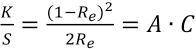
The relationship between dye concentration and its reflectance value is given by Kubelka-Munk equation (Eq. 2). 12
The reflectance spectra of all PES samples were measured using a Datacolor Spectrafash SF600X (Datacolor International, USA), following the guidelines stated in AATCC EP11-2009 and using a calibrated UV instrument with specular component included, illuminant D65, and the CIE 10° supplemental standard observer settings. 13
Results and Discussion
Treatment of PES Fabric
It is known that the treatment of PES fibers with organic solvents usually causes swelling and partial reorganization, and therefore changes in the structure of the polyester, in particular the relationship between amorphous and crystalline regions. 14 Swelling can bring about the development of porosity, leading to a material with a controlled, permeable structure that facilitates the passage some other matter, in this case, dye molecules. 14
SEM was used to analyze changes in the morphology of the PES fiber surface. SEM micrographs of PES fibers before and after treatment are shown in Fig. 2. The surfaces of the original and treated PES fibers were smooth, indicating that the action of dilute alcohol did not significantly damage the fiber surfaces.
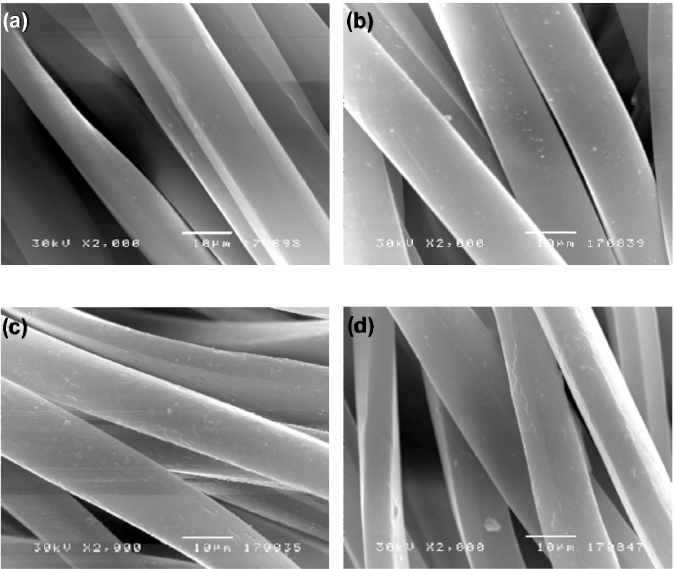
Micrographs of PES fiber samples. (a) Raw, (b) modified with butanol, (c) modified with pentanol, and (d) modified with octanol.
Certain changes in the surface of modified fibers were visible (e.g., swelling, cracks, and peeled parts), which are associated with the combined action of primary alcohols having a higher number of carbon atoms and heat on the surface of the PES fibers.
Similar changes were noticed also in previous work, showing the micrographs of PES filaments dyed by the two-step crazing method in the presence of different concentrations of butyl alcohol. The most intense color was observed for the sample treated in a medium with a concentration of butanol of 15%. 14
FTIR Analysis
Fig. 3 gives comparative FTIR spectra of modified and unmodified-raw PES samples. Structural transformations can be determined by the changing intensity of a functional group, the emergence of a new or loss of an existing group, and so forth. From the spectral lines in Fig. 3, there were practically no major changes; the positions and size of the bands were largely identical with minimal variation. The slight changes in the spectra of the modified polyester samples are indicated by the arrows in Fig. 3.
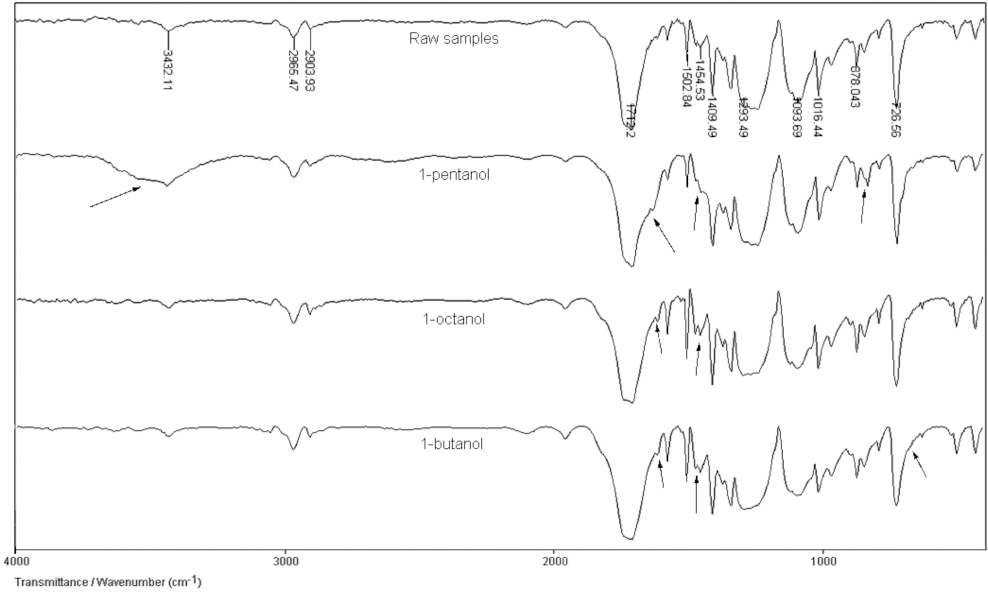
FTIR spectrum of raw and modified samples of PES fabrics.
These absorption peaks were attributed as follows. Asymmetric and symmetry stretching aliphatic vibrations of methylene C–H groups, bending vibrations of methylene C–H groups, in plane aromatic ring C–H deformations, ester (C–O) trans stretching, and CH2 out-of-plane bending vibrations were observed at 2965, 2903, 1454, 1409, 1293, 878, and 726 cm–1, respectively.15,16
According to the literature for identifying the change in crystallinity, the band at 1341 cm–1, belonging to the CH2 wagging of the trans conformation of the ethylene glycol group, is widely used. This trans conformer, with its close packing structure, is favored in the crystalline phase. On the other hand, there are various explications about the appearance of this band during phase changes.15,16
The bands at 3432 and 1016 cm–1 were attributed to intermolecular O–H bonded to C=O groups and O–H out-of-plane bending in the terminal carboxylic domains of PES. The absorption peaks at 1502 and 1093 cm–1 were assigned to C–C and C–O–O stretching vibrations. A strong band at 1712 cm–1 corresponded to C=O symmetric stretching of carbonyl groups.15,16
DSC Analysis
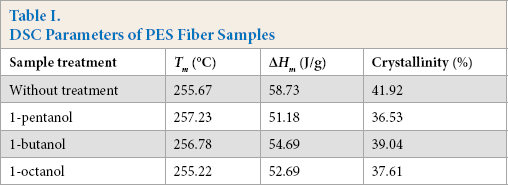
The DSC diagram curves and the quantitative results of the modified samples resemble an unmodified PET sample (Fig. 4 and Table I). DSC is used to determine the heat flow as a result of phase transitions, as a function of time and temperature. This method provides information on endothermic and exothermic changes during these transitions. 9
DSC Parameters of PES Fiber Samples
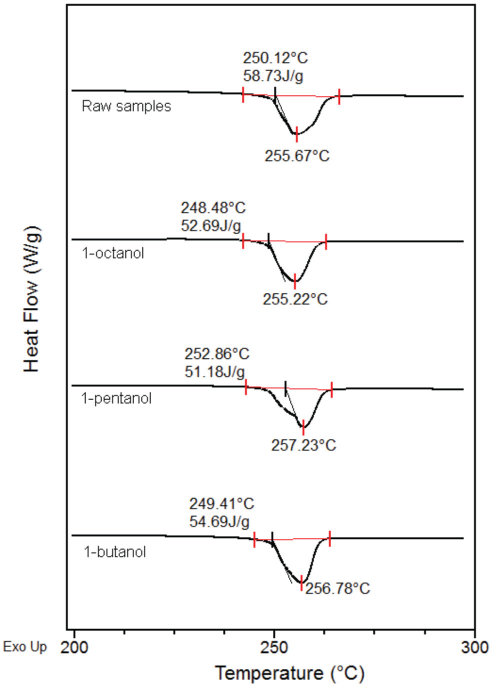
DSC diagram of PES fiber samples.
By the appearance of the curves in Fig. 4, the structure of the PES sample was unbroken (i.e., the macromolecular chains appeared to be differently oriented due to alcohol modification). These small differences can be related to the penetration of solvents into the structure of fibers (swelling occurs in the range of 6% to 11%, with the diameter of the fibers being larger after swelling) followed by partial disturbance of the inner structure. The chemical structure of the fibers was not drastically disturbed as indicated by the DSC and FTIR results. The melting temperatures and enthalpy (melting heat) were approximate, indicating that PES modification using primary alcohols had a slight effect on the macroscopic structure of PES.
The degree of crystallinity was slightly less after PES modification, which was associated with the combined influence of solvents and heat on the crystalline regions, resulting in “sofening” the fibers. PES modification with 1-pentanol caused slightly greater reorganization in structure, as it had the lowest crystallinity (36.53%) of all the samples tested.
In similar DSC studies of PES, researchers found that with temperature rise, with the samples reaching the melting temperature (
The semi-crystalline polymers containing the crystalline and amorphous components had very significant characteristics, with a percentage of crystallinity related to the total amount of the crystalline component relative to the amorphous component. 17
Shorter chains have more free ends per unit volume compared to long chains. These ends of the chain can move freely from the segments at the center of the chain by generating more free volume. The shorter chains, the smaller the number of entanglements that prevents or delays the relaxation of molecular chains. 17
Wetting Analysis
The change of the sorption properties of hydrophobic PES fibers deserves attention as it can ease the production, leading to a range of textile products enriched with additional, new properties.
Water absorption by modified PES fabric, 178%–190% (SD = 5%–6.8%, Cv = 2.8%–3.5 %), confirms the fact that modified samples have better results that show an increasing of this test parameter compared to an unmodified sample, 143% (SD = 5.5%, Cv = 3.8%).
Treatment with solvents can be an effective method for improving the surface wetting ability of hydrophobic polymer surfaces. The raw sample of PES fabric showed the slowest wetting, 390 s (SD = 7%, Cv = 1.8%). The best results (i.e., the most hydrophilic surface of the textile and the fastest wetting) was with 1-pentanol, 10 s (SD = 2.8%, Cv = 28.3%). Treatments with other alcohols showed somewhat slower wetting (1-butanol, 14 s, SD = 2.4%, Cv = 17.5%; 1-octanol, 11 s, SD = 2.4%, Cv=22.3 %).
Effect on Color
Table II shows the values of the CIELab system parameters for different dyeings of unmodified and modified PES fabric. According to the dyeing and other results, it seems that the dye diffusion mechanism in polyester fibers treated with primary alcohols does not follow the porous matrix model, despite the presence of cavities that are probably formed due to solvent treatment. It seems that the diffusion mechanism is identical to that of untreated polyester fibers above the glass transition temperature. This is a free volume model. 14
CIELab Parameters for Dyed PES Fabrics
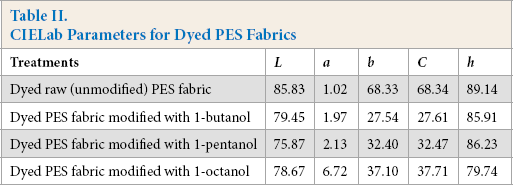
The increase of dye absorption after treatment with solvents can be attributed to the increase in the mobility of polymer segments in the regions with greater amounts of amorphous areas in PES fibers due to solvent treatment, while the crystalline areas decreased partially. 14
Based on the results of reflectance spectrophotometry (Table II), the
A similar study presented CIELab color coordinates for PES dyeing with Terasil disperse dyes. It was observed that the dyeing temperature had the greatest influence on the dyeing of new PES fibers, which was especially noticeable in the use of high-energy dyes. In this case, the color strength increased by about twice in every 0.5 °C to a dyeing temperature of 120 °C. 19
In another study, single-phase dyeing of polyethylene terephthalate (PET) fabrics was investigated, as a new method of dyeing, by combining pre-treatment and dyeing under alkaline conditions. The results showed that for each disperse dye, the values of
Figs. 5 and 6 show the reflectance and
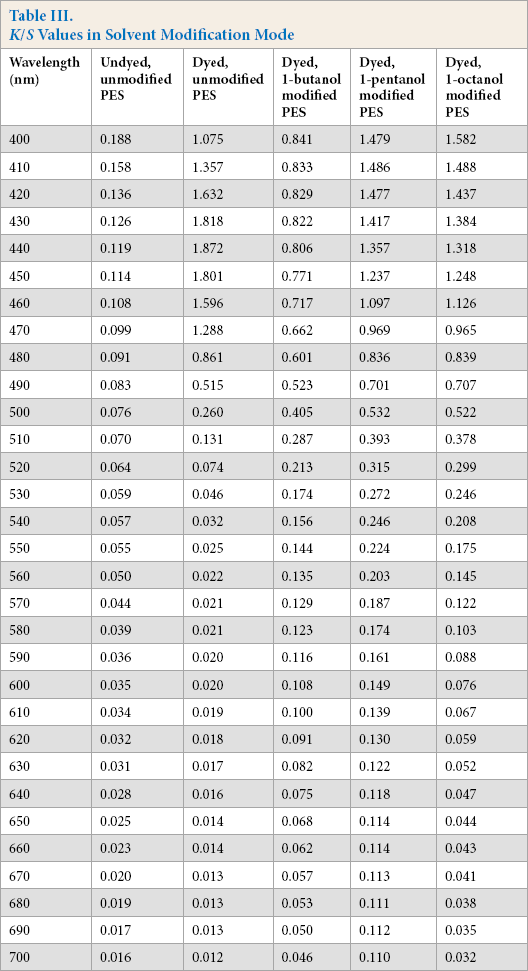
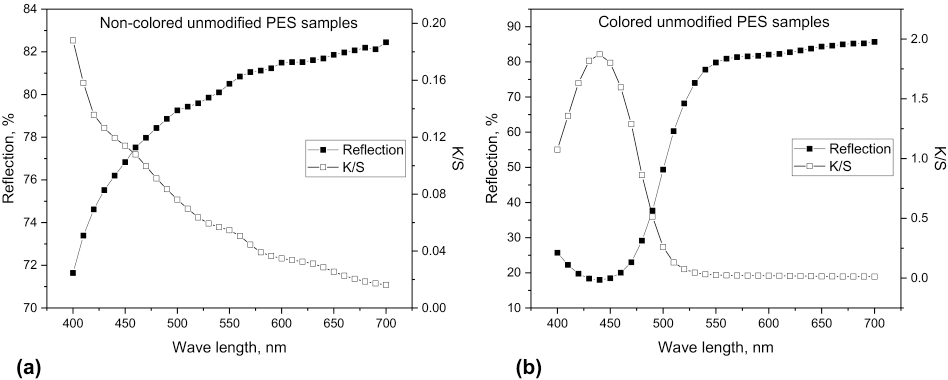
Reflectance and
Fig. 6 presents the reflectance and
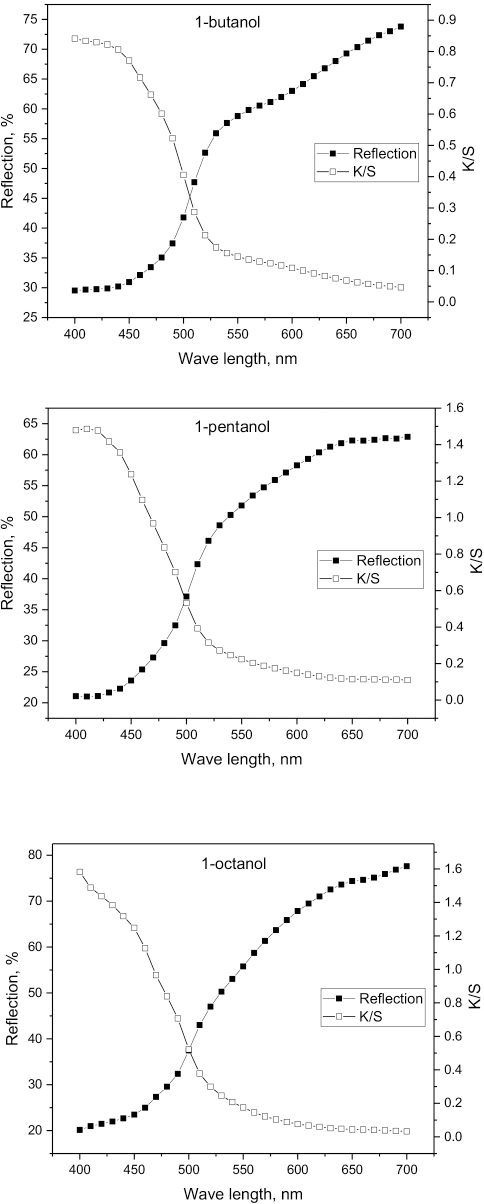
Reflectance and
Conclusion
Based on this study, it can be concluded that higher alcohol modified polyester (PES) fabrics can be successfully dyed with a conventional disperse dye at the boiling point without a carrier. Treatment preceding dyeing changed the surface and internal morphology, thereby improving sorption and dyeing properties. Using FTIR and SEM, changes due to the interaction of PES and higher alcohols were confirmed. From the study of CIELab parameters, the process of dyeing modified PES fabrics gave better results than dyeing of unmodified sample. More dye was found in PES fibers that were modified with higher alcohols. Pretreatment of PES fabric with 1-pentanol proved to be the best and the most effective in terms of the results achieved during modification and after dyeing.
The modification of the PES fabric using a higher alcohol medium is a relatively simple method for changing the surface morphology of polyester fibers. The alcohols used had pleasant smells (fruit scents) and are not particularly harmful to humans and the environment.