





Abstract
The flame retardant, diethyl methacryloylphosphoramidate (DMPP), was synthesized by the reaction of diethyl chlorophosphate with methacrylamide and triethylamine. DMPP was grafted onto polyethylene terephthalate (PET) fabrics by electron beam (EB) irradiation. scanning electron microscopy (SEM) images and Fourier transform-infrared (FT-IR) spectra showed that the flame retardant was successfully grafted on the surface of PET fabrics. The morphology of the grafted fabrics after burning showed a porous protective layer on the surface. The FT-IR spectra showed that the flame retardant generated a large amount of phosphorus oxygen-nitrogen compounds after burning. The limiting oxygen index (LOI) of the grafted fabrics increased with the increase of DMPP concentration. The char length of fabrics treated with DMPP after combustion decreased from 30 cm to 5.9 cm, which demonstrated effective flame resistance.
Introduction
Textiles are widely used and essential in human daily life. 1 Functional textiles such as antibacterial,2–7 water repellent,8–10 UV-resistant,11,12 and flame-resistant textile materials13–15 have been extensively studied and developed. Most textile products do not have flame resistance, which makes them able to support combustion in the event of a fire. In addition, textiles are often responsible for the spread of fires.16,17 Therefore, the development of flame resistant textile materials is necessary and has applications in various fields.18,19
Flame retardants can be divided into halogen-containing and halogen-free flame retardants. Halogen-based brominated flame retardants exhibit excellent flame-retardant efficacy. However, they release toxic gaseous hydrogen halides during the combustion process and cause environmental pollution, which limits their application.20–22 As a result, researchers are looking for more environmentally-friendly flame retardants. Phosphorus, nitrogen-based, and silicon-based flame retardants have attracted the attention of researchers. Phosphorus- and nitrogen-based flame retardants can release relatively little corrosive gases and exhibit smoke suppression properties during the combustion process, 19 making them promising candidates for many applications.
Polyethylene terephthalate (PET) fabrics exhibit high strength, high elastic recovery properties, good thermal stability, and good corrosion resistance. PET is one of the most commonly-used textile materials in the world. However, at high temperatures, it easily forms droplets that can then support a fire. 23 Furthermore, numerous studies showed that PET fabrics are susceptible to thermal decomposition and degradation at high temperatures.24–27 Therefore, the development of flame-resistant PET fabrics is of importance. However, PET fabrics are difficult to modify due to a molecular structure that lacks reactive groups. It is thus of primary concern for public safety to render PET fabrics less flammable in an economically and environmentally-friendly manner.
Electron beam (EB) irradiation has been widely used in materials’ modification due to its high efficacy. Compared with the conventional pad-dry-cure method, the EB irradiation process is energy-saving and environmentally friendly as it does not require high curing temperatures and an initiator in the treatment of textile materials. 28 EB irradiation technology was applied for the modification of cables for improved heat and flame resistance,29,30 and for medical materials, such as the combination of chondrocytes with hydrogels, that are implanted to repair damaged cartilage.31 The use of EB for the modification of PET fabrics is a novel and effective method; EB can produce free radicals on the materials within several minutes. These free radicals can spontaneously react with other molecules or molecular chains, 32 endowing the fabric with new functionality.33,34 Thus, the EB irradiation process provides an effective way for the functional modification of PET fabrics.
In this study, the flame retardant DMPP was synthesized and EB irradiation was applied for grafting DMPP onto PET fabrics (Fig. 1). The effect of penetrant and irradiation dose on the weight gain rate of the PET fabrics was studied. The flame resistance of the grafted fabrics was evaluated. In addition, the morphology and breaking strength of the grafted fabrics were investigated in detail.
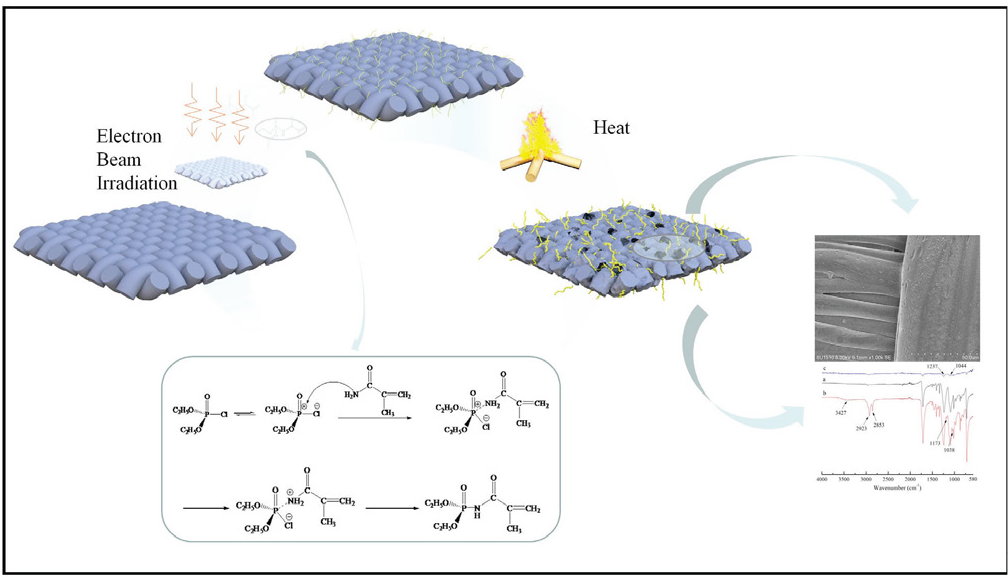
Schematic illustration of the flame retardant treatment of PET fabrics.
Experimental
Materials
Scoured and bleached PET fabrics (76 warp × 68 weft density, 100 g/m2) were purchased from Wujiang Zhong Peng Textile Co. Ltd. Diethyl chlorophosphate (95%) was purchased from Suzhou Wufan Biological Co. Ltd. Methacrylamide (97%) and dimethyl sulfoxide-d6 (D, 99.9%) were purchased from Beijing J & K Technology Co. Ltd. Triethylamine (99%), tetrahydrofuran, and penetrant Span 80 were purchased from Sinopharm Chemical Reagent Co. Ltd. All chemicals were used without further purification.
DMPP Synthesis
The DMPP synthesis procedure was previously reported in the literature and is shown in Scheme 1. 35 Briefly, diethyl chlorophosphate (7.25 g, 42 mmol) was added to 30 mL of tetrahydrofuran (THF) and stirred at 0–5 °C under nitrogen atmosphere. Then triethylamine (TEA, 4.25 g, 42 mmol) was added to the solution as an acid binding agent. Methacryl-amide (5.02 g, 59 mmol) was dissolved in 50 mL of THF, added dropwise to the above solution, and kept at 0∼5 °C under nitrogen atmosphere. After the addition was complete, the temperature was raised to 35 °C and reacted for 10 h. 35 After the reaction, triethylamine hydrochloride was removed by vacuum filtration, and THF was removed by evaporation. The crude products were dissolved in deionized water by ultrasonic treatment, insoluble materials were removed by vacuum filtration, and water was removed by evaporation. The products were dried at 45 °C in a vacuum oven, and a yellowish viscous liquid was obtained. The product yield was about 85%.
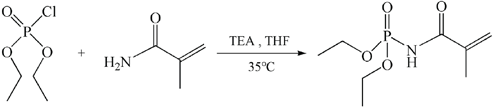
The synthetic route to DMPP.
The phosphorus group (O=P-O) in DMPP has good thermal and chemical stability. 36 The C=C group can then be grafted onto PET fabrics. 13
Electron Beam Irradiation
An EB150/20-250LD electron beam accelerator (Hubei Eray Nuclear Technology Co. Ltd., China) was used for the irradiation treatment under nitrogen atmosphere. The effects of the dose of radiation and the amount of penetrant on the weight gain rate of the fabrics were studied.
Nuclear Magnetic Resonance Analysis
Proton nuclear magnetic resonance ( 1 H-NMR) spectra (400 MHz) of DMPP was obtained using a Bruker AV III 400 MHz NMR instrument (Bruker AXS GmbH, Germany), and DMSO-d6 was used as the solvent.
Fourier Transform Infrared Analysis
Fourier transform infrared (FT-IR) spectra of DMPP and the char residues of PET and the grafted fabrics were obtained by a Nicolet 10 FT-IR spectrometer (Nicolet Instrument Corporation, Madison, WI, USA), which were collected in the region of 4000-500 cm–1 with a spectral resolution of 2 cm–1 and 64 scans. Methacrylamide was tested using an Attenuated Total Reflectance (ATR) accessory, and other chemicals and fabrics were tested using KBr pellets.
Scanning Electron Microscopy Analysis
The morphology of the specimens and burned areas of PET and the grafted fabrics (after flammability testing) were studies by scanning electron microscopy (SEM) using a Hitachi TM-3030 SEM (Hitachi, Tokyo, Japan).
Preparation of Flame-Resistant PET Fabrics
PET fabrics were washed thoroughly with acetone and dried at 60 °C for 1 h. The flame retardant DMPP was dissolved in 30% ethanol solution to prepare the finishing solution. The PET fabrics were soaked in the above solution at a 1:50 liquor ratio (LR) and padded to get 100% wet pick-up. The padded PET was placed in the EB equipment and irradiated. The grafted fabrics were washed with ethanol to remove monomer from the surface of the fabrics, dried to constant weight at 60 °C, and weighed. The weight gain rate of the grafted fabrics was calculated using Eq. 1.

W0 (g) is the initial weight of the original PET and W1 (g) is the weight of the grafted PET after washing and drying.
Flame-Resistant Fabric Testing
PET and the DMPP-grafted fabrics were subjected to vertical flammability and limiting oxygen index (LOI) tests. Vertical flammability tests were performed on a YG815 vertical flame gauge (Shan Dong Anqiu Jiangbei Textile Instruments Co. Ltd., China) according to the GB/T 5454-199714 vertical method of textile combustion performance test. The size of the samples were 300 × 80 mm. The LOI test was carried out on an LFY-605 Oxygen Index Flammability Gauge (Shan Dong Textiles Science Research Institute, China) according to the GB/T 5455-199713 oxygen index method of textile combustion performance test. The dimensions of samples were 150 × 58 mm. The average values of five repetitive measurements were reported.
Thermogravimetric Analysis
Thermogravimetric analysis (TGA) was conducted on a TG Q500 thermal analyzer (TA Instruments, USA) under a nitrogen atmosphere at a flow rate of 100 mL/min. Samples (4–5 mg) were heated from 35 °C to 600 °C at a heating rate of 10 °C/min. Onset of degradation was obtained from the resulting TGA thermograms.
Breaking Strength
Breaking strength testing was performed with a YG (B) 026D-250 electronic fabric strength tester according to GB/T 3923-1997. 4 Five parallel samples (5 x 20 cm) were tested and the average breaking strength was calculated.
Washing Stability
The washing stabilities of the treated samples were investigated using a Launder-Ometer (SDL Atlas) according to AATCC TM61-1996. 6 The treated samples (6 × 8 cm) were placed in stainless steel canisters, which contained GB/T detergent water solution 6 and 50 stainless steel balls. The washing was completed at 42 rpm and 49 °C for 45 min. One washing cycle was equivalent to five machine washings. After a certain washing cycle, the samples were washed with distilled water and dried at 45 °C for 1 h.
Results and Discussion
DMPP Characterization
Fig. 2 shows the 1 H-NMR spectrum of DMPP. Two multiplets at 1.80 ppm were attributed to the -CH3 groups. One triplet at 5.71–5.21 ppm corresponded to the =CH2 group. The signals at 3.86 ppm were assigned to the protons of the -CH2- groups. The characteristic absorption peak at 8.51 ppm (H-3) was the -NH- signal band in DMPP. All the observed bands indicated that DMPP was successfully synthesized.
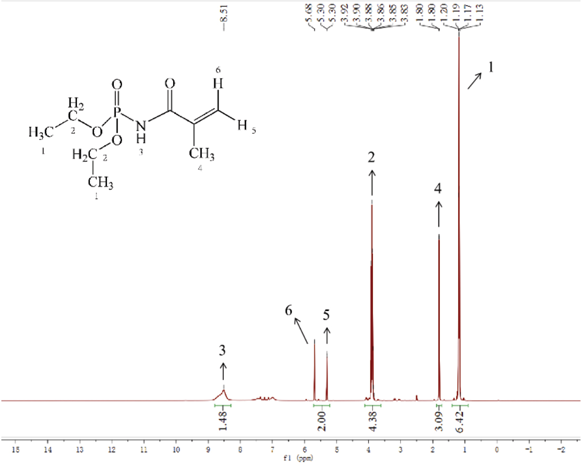
1H-NMR spectrum of DMPP.
The FT-IR spectra of methacrylamide, diethyl chlorophosphite, and DMPP are shown in Fig. 3. The FT-IR spectra of DMPP showed two bands at 2985 and 2927 cm–1 corresponding to -CH3 and -CH2- groups, respectively, in the flame retardant skeleton. A weak band at 3362 cm–1 was attributed to the -NH- bending vibration. The bands at 1677 and 1634 cm–1 were ascribed to the C=O and C=C bending vibrations in DMPP. 37 Furthermore, the two bands at 1228 and 1026 cm–1 were characteristic of P=O and P-O-C bending vibrations, respectively.
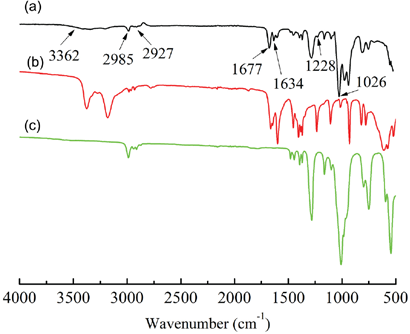
FT-IR spectra of (a) DMPP, (b) methacrylamide, and (c) diethyl chlorophosphite.
Penetrant and Irradiation Dose Treatment Effects
The relationship between weight gain rate and the amount of penetrant added is depicted in Fig. 4. The weight gain rate of the fabrics increased with the increase of the penetrant added. When the loading of penetrant increased to 0.4 wt %, the weight gain rate of the PET fabrics reached 15.21%. Due to the lack of hydrophilic groups in the molecular structure of PET fabrics, the finishing agents have difficulty to penetrate into the interior of the fabrics. The addition of a penetrant can improve the absorption of DMPP into the fabrics. The results showed that Span 80 enhanced the infiltration capacity, and the weight gain rate of the PET fabrics was improved to certain degree. A 0.4 wt % of Span 80 was chosen for EB treatment of the PET fabrics in the following experiments.
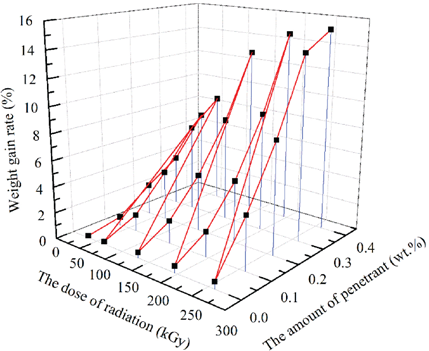
The influence of penetrant and irradiation dose on weight gain rate of PET fabrics.
Fig. 4 also illustrates the relationship between the irradiation dose and the weight gain rate of the treated fabrics. The number of flame retardant monomer free radicals reacting with the PET fabrics increased with increased irradiation dose, resulting in the increased weight gain rate of the PET fabrics. High irradiation doses, however, can have a negative effect on the fabric breaking strength. For these experiments, a 195 kGy irradiation dose was chosen for EB treatment of the PET fabrics. Grafted fabrics with 35 wt % DMPP were prepared for further testing using 0.4 wt % Span 80 and 195 kGy irradiation dose.
Grafted Fabric Characterization
SEM analysis of the original PET and the grafted PET fabrics was carried out to examine the surface morphology (Fig. 5). The original PET fabrics showed a smooth surface, and the gap between the fibers was distinct, while the surface of the grafted PET fabrics became very rough with obvious attachments, which indicated that the flame retardant DMPP was coated onto the fabric surface successfully.
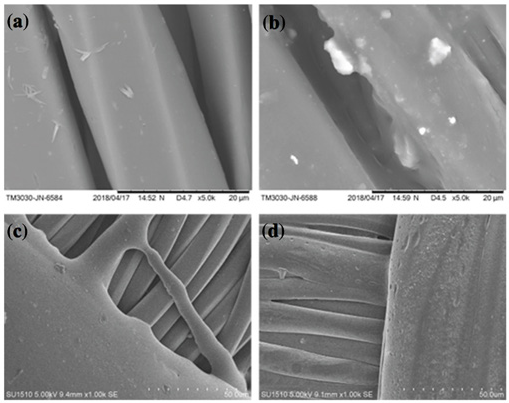
SEM images of (a) PET at ×5000, (b) grafted PET at ×5000, (c) burned PET at ×1000, and (d) burned-grafted-PET at ×1000.
After the vertical burning test, a layer of droplets formed on the surface of the original PET fabrics (Fig. 5c), while the flame retardant grafted fabrics formed a protective layer with small holes on the surface, as can be observed in Fig. 5d. The gases from the decomposition of the nitrogen-containing components reduced the oxygen density. 38 These types of protective layers on burned areas were also observed in other studies, and the burned surface morphology was linked to the flame retardancy of the phosphoramidate and phosphorus-nitrogen containing flame retardants.39,40
FT-IR spectroscopy was used to examine the chemicals present on the grafted PET before and after thermal decomposition, and the results are shown in Fig. 6. Compared with untreated PET fabrics, the FT-IR spectra of the grafted PET fabrics exhibited several new bands at 2923, 2853, 3427, 1173, and 1038 cm–1, which were attributed to the vibration bands of -CH3, -CH2-, -NH-, P=O, and P-O-C in DMPP, respectively. The new bands indicated that the phosphorus nitrogen flame retardant DMPP was successfully grafted onto the PET fabrics.
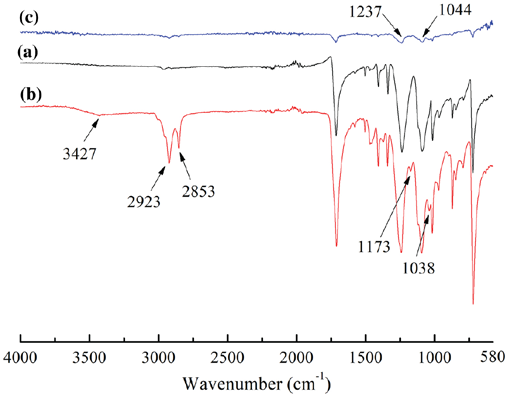
FT-IR spectra of (a) PET, (b) grafted PET, and (c) burned grafted-PET.
After the vertical burning test of the grafted PET fabrics, the characteristic bands of DMPP had disappeared, and two new bands at 1237 and 1044 cm–1 appeared, which were attributed to the formation of -P=N- and -P-OH, respectively. 41 Water might play a role in the decomposition of DMPP since the absorption bands of -P-OH indicate that the water formed from the decomposition of PET fabrics could react with DMPP. 42 The attachment of DMPP onto PET fabrics generated phosphorus-based oxygen-nitrogen compounds during the combustion process, thereby promoting char formation and improving fabric flame-resistant properties.
Flame Resistance
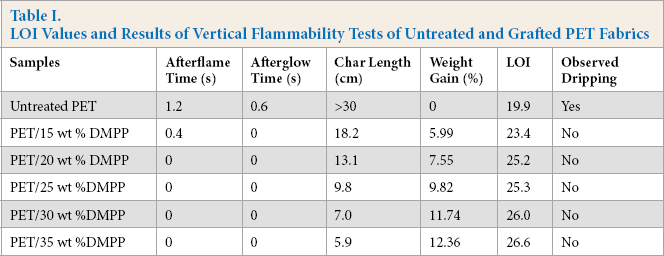
LOI and vertical burning tests were performed to evaluate the flame resistance of the grafted PET fabrics. Fig. 7 shows the images taken after the vertical burning test and Table I summarizes the test results for the grafted samples. According to the previous studies, PET fabrics showed poor flame resistance properties with char lengths greater than 30 cm in the vertical combustion test.42,43 Table I shows that the weight gain rate of the grafted PET increased with the increase in DMPP monomer concentration. The char length decreased with increased flame retardant concentration, indicating that fabric flame resistance increased accordingly. When the flame retardant concentration reached 20%, the char length of fabrics decreased to 13.1 cm, which demonstrated great fabric flame resistance. No droplets were produced during the burning of the fabrics, and no afterglow burning occurred after removing the flame. The LOI value of the grafted PET increased from 19.9% of untreated PET fabrics to 26.6% of the grafted PET fabrics when the 35% DMPP concentration was used. The increased LOI further indicated that the grafted PET fabrics provided greater flame resistance.
LOI Values and Results of Vertical Flammability Tests of Untreated and Grafted PET Fabrics
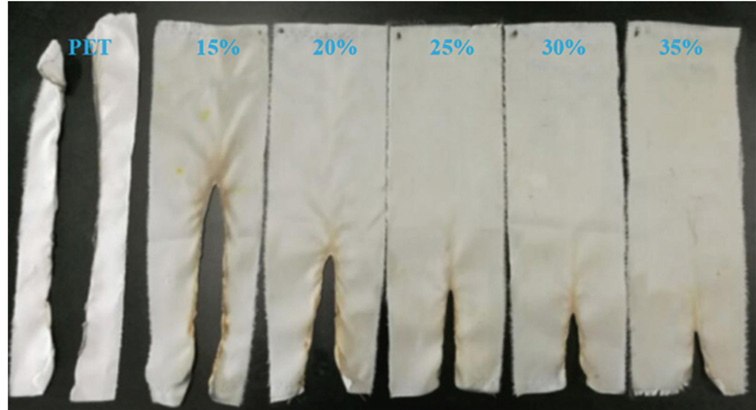
Vertical flammability test results of untreated and grafted PET fabrics.
Thermal Behavior
The grafted PET fabrics used in the thermal behavior tests were prepared using a 195 kGy EB irradiation dose and a DMPP concentration of 35 wt %. As shown in Fig. 8, the grafted PET fabrics began to decompose at 142 °C, which was much lower than the initial decomposition temperature (362 °C) of the original PET fabrics. The initial decomposition temperature of the DMPP-treated PET fabrics decreased due to the lower stability of the P-O-C bonds as compared to that of C-C bonds. 44 From the DTG diagram, it can be seen that use of the flame retardant significantly reduced the maximum decomposition rate of the PET fabrics, which has a direct practical significance for fabric flame resistance. However, the residual carbon content of the grafted PET fabrics was slightly less than that of the original PET fabrics. This might be due to the phosphorus component and the fact that the PET molecule in the flame resistant fabric decomposed at the same time as the temperature increased, resulting in the formation of carbon oxides.
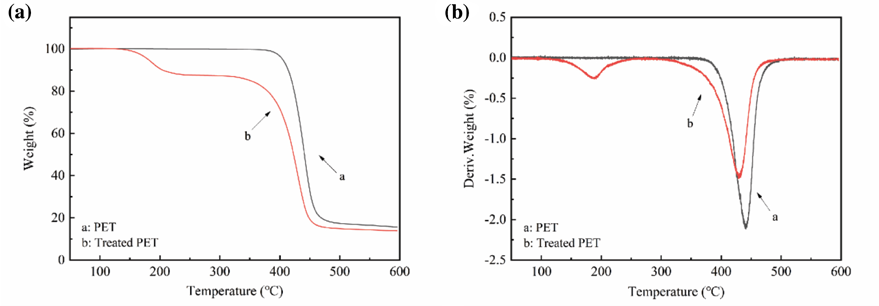
Degradation thermograms TG (a) and DTG (b) curves of PET and grafted PET fabrics.
Breaking Strength
The breaking strength of PET fabrics before and after treatment is shown in Fig. 9. After treatment with 35% DMPP using EB irradiation (195 kGy), the breaking strength of the grafted PET fabrics decreased by 8.8% and 6.1% in warp and weft directions, respectively, compared with the original PET fabrics. EB irradiation could cause damage to the molecular structure and crystallinity of PET fabrics, reducing the regularity of the fibers, 45 and resulting in decreased fabric breaking strength. The small decrease in breaking strength is acceptable for most practical applications. The whiteness of the grafted fabrics decreased to a certain extent and the grafted fabrics became slightly stiffer.
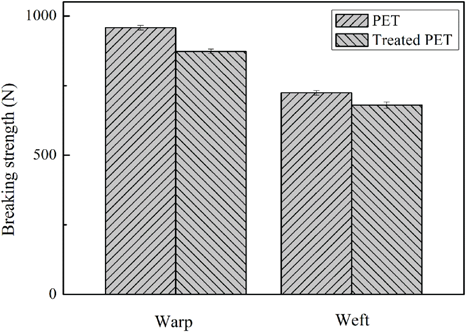
Breaking strength of untreated and grafted PET fabrics.
Washing Stability
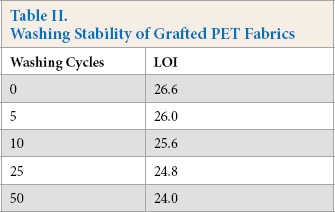
The washing durability of the grafted PET fabrics was investigated, and the LOI test was carried out after various washing cycles. The results are shown in Table II. The EB irradiation dose and DMPP concentration used were the same as for the fabrics in the breaking strength test. After 10 washing cycles, the LOI of the grafted PET fabrics was 25.6, which was similar to that of the grafted PET with 25 wt % DMPP. The LOI of the grafted PET was 24.0 after 50 washing cycles, which was much greater than that of untreated PET fabrics, indicating that DMPP was grafted onto the PET fabrics.
Washing Stability of Grafted PET Fabrics
Conclusions
The phosphorus and nitrogen flame retardant DMPP was synthesized and characterized by 1 H-NMR and FT-IR, and grafted onto PET fabrics by EB irradiation. The vertical burning test results of the grafted PET showed that the char length of the grafted PET fabrics decreased with increased DMPP concentration. When the flame retardant concentration reached 20%, the char length of the grafted PET fabrics was less than 15 cm, and the LOI of the grafted PET fabrics increased by 26.6% compared with the untreated PET fabrics, showing good flame resistance. The grafted PET fabrics degraded at a lower temperature and had a lower maximum decomposition rate in nitrogen atmosphere compared with that of the ungrafted fabrics. The breaking strength of the grafted PET fabrics remained 91.2% and 93.9% in warp and weft directions, respectively. Considering the good flame resistance and small strength loss of the grafted PET fabrics with DMPP, the EB irradiation process has good practical application for flame-resistant textile materials.
Footnotes
Acknowledgments
This work was supported by the national first-class discipline program of Light Industry Technology and Engineering (LITE2018-21) and the Project of Jiangsu Science and Technological Innovation Team.