






Abstract
In this study, we investigated the changes in the morphology, crystal structure, and mechanical properties of poly(acrylonitrile-co-vinylchloride) under various spinning conditions such as distance and concentration of coagulation bath and draw ratio. In addition, the diffusion rate of the solvent from the fiber during coagulation was studied to investigate the correlation between the properties of spun fiber and coagulation conditions. The mechanical properties and the crystal orientation were improved with the draw ratio at a constant concentration of the coagulation bath. Micro voids were decreased with increased initial dimethyl sulfoxide (DMSO) concentration in the coagulation bath at a constant temperature. In addition, the correlation between the spun fiber and its spinning conditions during the coagulation process was determined, leading to optimal spinning conditions.
Introduction
As the danger of fire due to explosion and terrorism has increased, demand for and interest in fame-resistant materials are increasing. Flame-resistant materials are being mandated in the United States and Europe due to fire and environmental regulations, and its market is steadily grow-ing.1,2 However, most fame-resistant materials are expensive or not suitable for fibers, so they are difficult to use for protecting the human body.
Acrylic copolymers having a content of acrylonitrile (AN) of 35% to 85% by weight are called modacrylic polymers, and are mainly used as a fame-resistant materials by copolymer-izing with a halogenated compound monomer such as vinyl chloride (VC) and vinylidene chloride (VDC).3-5 Modacrylic fiber has good fame resistance and soft hand for their cost and maintains high fame resistance even when blended with cotton. Generally, modacrylic fiber is produced by a wet-spinning process, because it is not melted.6,7
In wet spinning, the coagulation process is an initial fiber forming step that yields a major differences in fiber morphology and properties. Therefore, it is the most critical element in determining the optimal spinning conditions in the spinning process. Fiber formation is caused by diffusive interchange between the coagulation bath and the solvent in a spinning dope. When the viscous polymer is extruded in the coagulation bath through the spinneret, the solvent in the fiber is diffused into the coagulation bath because of the differences in the dimethyl sulfoxide (DMSO) concentration. At this time, the viscous polymer is solidified, and fibers are formed. Therefore, in wet spinning, the coagulation process is one of the most important manufacturing processes for determining the properties of the fibers. Studies on the coagulation process are actively progressing.8-10
In this study, the model equation using experimental data of diffusion and coagulation was determined, and the effects of the coagulating and drawing conditions on the fiber investigated.
Experimental
Wet Spinning
In this study, poly(acrylonitrile-co-vinylchloride) was prepared by emulsion polymerization. The feed ratios of monomers were 50:50 for acrylonitrile-vinyl chloride copoly-mers. Sodium lauryl sulfate (SLS) was used as the emulsifier, and ammonium persulfate (APS) was used as an initiator. The polymer was obtained through reaction at 50 °C for 5 h.
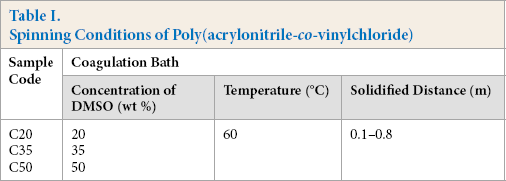
The spinning dope was a solution of poly(acrylonitrile-co-vinylchloride) in DMSO. The concentration of the polymer in the spinning dope was 20 wt%. As shown in Fig. 1, the fiber was spun by the wet-spinning process with DMSO solvent using a 100-hole spinning nozzle, and the hole diameter on the spinning nozzle was 0.07 mm. The experimental conditions are shown in Table I.
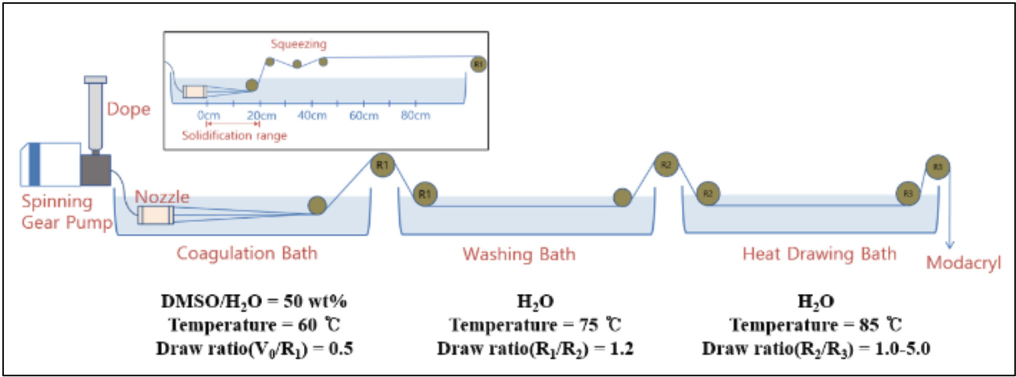
Schematic diagram of wet-spinning process.
Spinning Conditions of Poly(acrylonitrile-co-vinylchloride)
Diffusion and Coagulation Process
To investigate the diffusion behavior of the solvent, the residual solvent concentration in the coagulating fiber was measured according to the distance from the spinning nozzle and the initial DMSO concentration (20, 35, and 50 wt%) in the coagulation bath. The residual solvent concentration was measured using the refractive index (RI) of the remaining solution squeezed from the coagulated fiber. The nonlinear equation for the diffusion of fibrous materials was then derived and compared with the experimental data.
Evaluation Methods
Scanning electron microscopy (SEM, Hitachi SU8000, Japan) was performed to investigate the fiber morphology resulting from the conditions of the coagulation bath.
Single fiber testing was carried out using the Favimat instrument (Textechno). The average values of the fiber fineness, elongation, and tensile strength were measured 10 times for each sample. In addition, wide angle X-ray scattering (WAXS, Bruker D8 discovery) analysis was performed to investigate the crystal structure and fiber orientation.
Results and Discussion
Diffusion and Coagulation Behavior
Assuming that the materials in the fiber diffuse radially in an infinitely long
cylinder, Fick's second law (Eq. 1) can be applied. 
To accurately understand mass transfer by diffusion, it is necessary to apply accurate boundary conditions to the interface between the two phases. Therefore, the infinite concentration boundary condition at r = R is used as in Eqs. 2 and 3.


Assuming that the diffusion coefficient D is independent of the
concentration, Eq.
4 can be applied. 
The distance of the coagulation bath Z is expressed as Eq. 5.


Therefore, as shown in Fig. 2, when the distance from the spinning nozzle Z increases infinitely, all the terms converge to ca due to its exponential function.
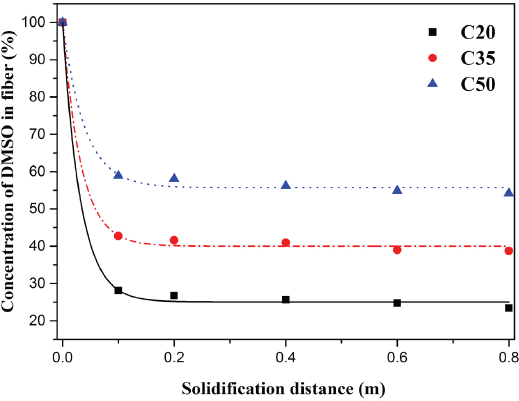
Solvent concentration in the fiber with distance of coagulation bath.
The change of solvent concentration in the fibers tended to remarkably decrease after 0.04 ± 0.01 m of the solidi-fication distance, and the concentration was unchanged after a further 0.23 ± 0.01 m of the solidification distance.
In Fig. 3, the concentration of water in the fiber increased with the solidification distance—it was confirmed that the residual solvent in the fiber was replaced by the water. The results could be extrapolated due to the diffusive interchange between the coagulation bath and the solvent in the spinning dope.
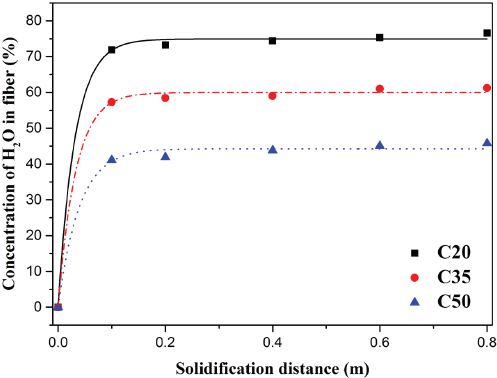
Water concertation in the fiber with distance of coagulation bath.
Morphology of Coagulated Fiber
Fig. 4 shows SEM images of the fibers formed based on the initial coagulation bath DMSO concentrations. The number of micro voids decreased when the initial DMSO concentration of the coagulation bath was increased. The micro voids are formed by desolvation in the fiber. When the initial DMSO concentration of the coagulation bath was low, the differences in solvent concentration between the spinning solution and the coagulation bath became high. In this case, the diffusion and coagulation rates were fast, which caused a large number of micro pores (Fig. 4a). On the other hand, when the initial DMSO concentration of the coagulation bath was high, the differences in solvent concentrations was low and the desolvation speed was slowed. As a result, the number of micro pores was reduced and the sectional structure became dense.
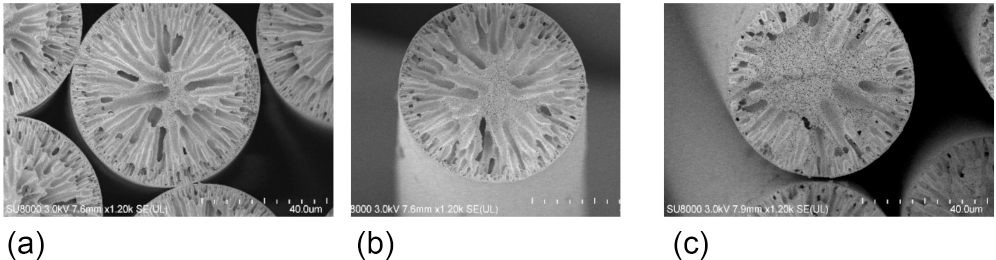
SEM images of poly(acrylonitrile-co-vinylchloride) fiber cross sections with the DMSO concentrations of the coagulation bath (×12,000). (a) 20 wt%, (b) 35 wt%, and (c) 50 wt% DMSO.
Mechanical and Orientation Properties of the Fiber
As shown in Table II, the tensile strength of the fibers increased with the drawing ratio, which can be explained by the WAXS data. The degree of crystal orientation was calculated by Eq. 712,13 using the azimuthal peak in Fig. 5.
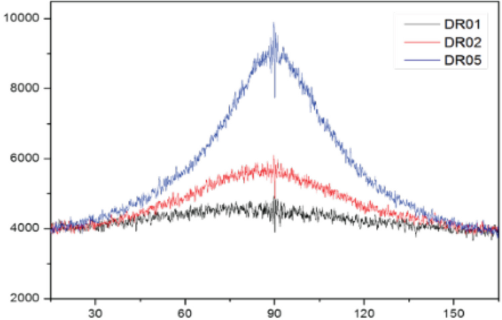
Azimuthal graphs of drawn fibers.
Characteristics of Crystal Structure and Mechanical Properties of Poly(acrylonitrile-co-vinylchloride) Fibers with Draw Ratio


X is the orientation of the crystal and FWMH is a full width at half maximum of the azimuthal peak. The intensity and sharpness of the curve in the azimuthal graph tended to increase with drawing ratio. This was confirmed by the 2D WAXS patterns in Fig. 6. The crystal orientation improved with the drawing ratio and the physical properties of the fibers were positively influenced.
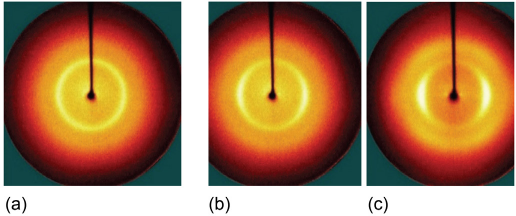
2D WAXS patterns of poly(acrylonitrile-co-vinylchloride) fibers with draw ratio (DR). (a) DR = 1, (b) DR = 2, and (c) DR =5.
Conclusions
The coagulation process of wet-spinning for poly(acrylonitrile-co-vinylchloride) was studied theoretically and experimentally. According to the model equation derived from Fick's 2nd law, when the distance from the spinning nozzle Z increased infinitely, all the terms converged to ca due to its exponential function. This was confirmed by investigating the residual solvent contents in the fibers with the solidified distance and the initial DMSO coagulation bath concentration. Therefore, it was confirmed that the minimum solidification distance of the fiber was greater than 0.24 m for this wet-spinning process.
By analyzing the morphology of the coagulated fiber according to varying concentrations, the fiber structure became denser at higher initial DMSO concentrations of the coagulation bath. This appeared to be due to the slow diffusion rate. The concentration of the coagulation bath was optimal using 50 wt% DMSO.
As the drawing ratio increased, the tensile strength also improved. This was confirmed by the orientation of the fiber crystal in WAXD analysis. The optimal drawing ratio was 5.0.