






Abstract
There is much recent interest in antennas constructed from conductive fibers/ink and textiles. This study determines the influence of fiber material and the structure of a woven fabric on its dielectric properties. Results showed that both the dielectric permittivity and the dielectric loss tangent of the woven fabric were related to fiber contents and fabric structure properties, and generally decreased with increased porosity and decreased fabric compactness. ANOVA analysis showed that the linear density of yarn, fabric weaves, and fiber contents were major factors in determining the dielectric properties of woven fabrics. These results will provide a guideline for substrate selection in designing fabric-based electric device such as UHF RFID antennas.
Keywords
Introduction
There is much recent interest in antennas constructed from conductive fibers/ink and textiles.1-3 Traditionally, antenna substrates are constructed with a solid film or plate with little loss of accuracy and high dielectric permittivity. However, textile materials have electrical properties sufficiently different from standard traditional antenna material. Accurate antenna modeling and design requires knowledge of the effective permittivity of the textile,1,4-7 a topic that was not adequately addressed to date in much of the available literature. 8
As a special kind of flexible material, 9 the dielectric properties of a woven fabric are determined by the structural and material parameters. Woven fabrics have certain features, such as a regular repeat of unit structure in two dimensions and specific geometry of the unit structure, that determine the regular dielectric properties. 8 However, some factors, such as natural variation among the individual fibers, yarn geometry, and variation due to processing through different production stages, make the yarns and fabrics irregular and non-uniform to some extent, and makes exact prediction of dielectric properties very difficult.
Theoretically, Bal et al. estimated that the dispersion of effective permittivity given by different mixing equations at 1 kHz lies between 2.028 and 2.400 for typical woven fabrics with a low fiber volume fraction. 8 Li et al. also used the rule of mixtures to estimate the dielectric constant of 3D woven glass fabric. At 2.45 GHz, the values of permittivity and tangential loss, respectively, were 1.17∼1.77 and 0.006∼0.032, depending on the fabric structure and fiber properties. 10 Mustata et al. observed that the dielectric behavior of natural cellulosic fiber woven fabrics at 50∼20 kHz depends on the fiber types and fabric structure parameters. The relative permittivity nonlinearly increased with fabric density, and had a parabolic relationship with the weft density as well as with the warp density. 11 Liu et al. studied the effects of fabric structure and yarn density on the dielectric properties of polyester fabric at 100 kHz to 10 MHz. A significant influence of the structural parameters of polyester fabric was not observed. 4 Naito studied the effect of frequency on the dielectric properties of a composite fabric, and concluded that the permittivity increased with increased frequency. 5 Jayaramudu studied the effects of temperature and frequency on the dielectric properties of a natural fiber. 6 The dielectric properties of the natural fiber was affected by the temperature and was low due to the decreased fiber orientation polarization. The dielectric loss tangent (tanδ) decreased with increased frequency. Both studies mentioned the effects of frequency, however, the relationship between the dielectric properties and the structural parameters of the textiles at microwave frequencies was unclear.5,6
This study was performed to determine the dependence of the dielectric properties at microwave frequencies on the basic properties of textile materials, and to systematically study the influences of fabric structural parameters and typical material types on the dielectric properties. An ANOVA analysis on the dielectric properties of textiles was performed to determine the major factors.
Experimental
Materials
The samples consisted of woven fabrics with differences in warp density and weft density, in warp and weft yarn count, in fabric weaves, and the yarn fiber type (Table I). Except for Group 6, the other fabrics were woven cotton fabrics after desizing.
Basic Properties of the Woven Fabric Samples a
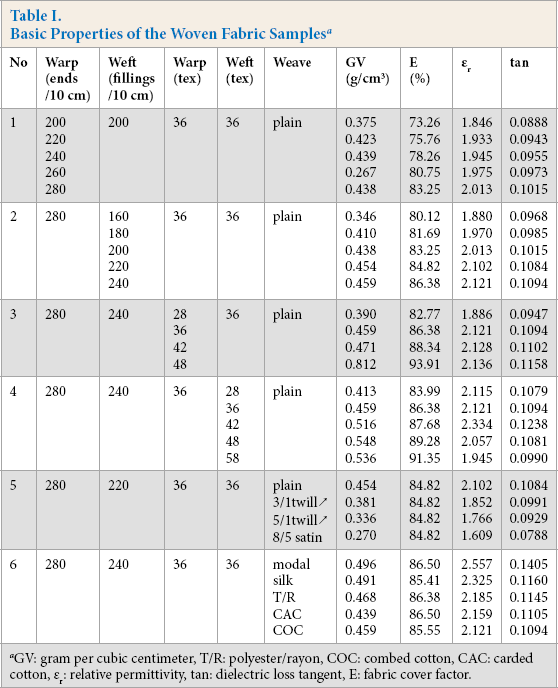
GV: gram per cubic centimeter, T/R: polyester/rayon, COC: combed cotton, CAC: carded cotton, εr: relative permittivity, tan: dielectric loss tangent, E: fabric cover factor.
Measurement and Analysis
The fabrics were divided into six groups based on the change of parameters. The fabric samples were placed in a constant temperature and relative humidity (RH) chamber (22-23 °C and 63-65% RH) for 24 h before testing. The dielectric properties in the frequency range of 700 to 1300 MHz were tested using a Microwave Q-Meter resonant cavity testing system (Poland). Due to the intrinsic characteristics of the textile, air humidity and temperature can affect the dielectric properties of the textile, 7 so the experiment was performed under constant temperature and humidity conditions.
Each sample was tested five times and their average value was calculated. To discover the significant factors of the dielectric properties, an ANOVA analysis on the structural and property parameters was performed.
Results and Discussion
Fabric Density
The resulting dielectric properties of cotton fabrics with different fabric densities are shown in Fig. 1. The permittivity and tanδ values increased with an increase in fabric warp density, but initially increased as the weft density increased and then decreased as the weft density increased further. When the fabric weft density increased, the gap between the weft yarns became smaller and the fabric was more compact and thicker, leading to an increase of permittivity and tanδ. 12 However, when the weft density reached a certain point, the warp yarns began to crimp and the weft yarns straightened, resulting in decreased fabric thickness and subsequent permittivity reduction.
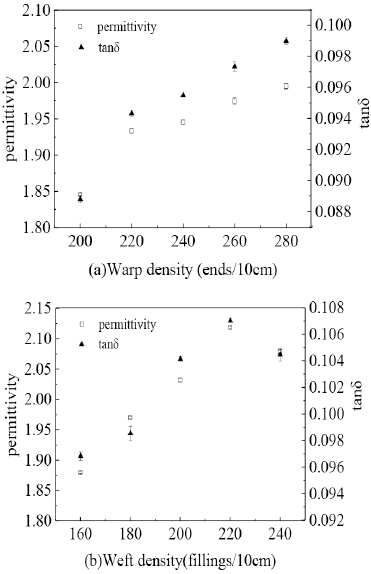
Dependence of cotton fabric density on the dielectric constants.
Yarn Count
The effects of yarn count on the dielectric properties of plain cotton fabric are shown in Fig. 2. Both permittivity and tanδ values increased with increased warp yarn count. On the other hand, the dielectric constants changes nonlinearly with increased weft yarn count. When the weft yarn count increased, the gap between the yarns became smaller and the permittivity and tanδ increased. 13 However, when the weft yarn count increased to a certain point, their bending rigidity surpassed those of the warp yarns. 14 In this way, the weft yarns tended to straighten, and the fabric firmness and thickness decreased due to the change of fabric structure, resulting in a decrease in permittivity and tanδ.
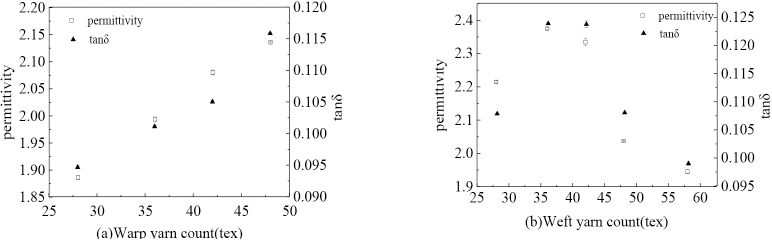
Dependence of cotton yarn count on the dielectric constants.
Fabric Weaves
Fig. 3 shows that the plain cotton fabrics had the highest permittivity and tanδ values, followed by the 3/1 twill↗, the 5/1 twill↗, and the satin fabric. Fabric can be viewed as a mixture of fibers incorporating air, with air affecting the fabric's dielectric properties. 15 The structure of plain cotton fabric was relatively compact, and therefore, less affected by air. However, the satin fabric had a larger gap containing more air, reducing permittivity and tanδ values.
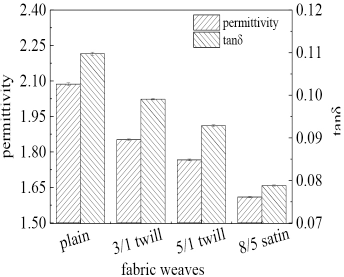
Effect of cotton fabric weaves on the dielectric properties.
Fiber Contents
The influences of yarn fiber contents on the dielectric properties of the test fabrics are shown in Fig. 4. The modal fabric had the highest permittivity and tanδ values, followed by the silk fabric, the blended fabric, and finally the cotton fabric. The dielectric properties of fabrics made from different fibers were directly related due to the polarization effect. 10 The degree of crystallinity, permanent dipoles, mobility of free charge, and defects all contribute to dielectric responses, and at ultra-high frequencies, the dielectric responses depends on the mobility of dipoles. Generally, cotton fibers, with highly-oriented fibers and high crystallinity relative to the regenerated modal fibers, makes the molecule chains difficult to rotate, resulting in a small relaxation polarizing response. Similarly, the degree of crystallinity of silk fibers was a little less than cotton fibers and greater than the regenerated cellulose fibers. In this sense, fiber moisture absorption plays an important role due to the dipoles of water molecules.16-18 Generally, the hygroscopicity of fibers were in the order of modal > silk > cotton.
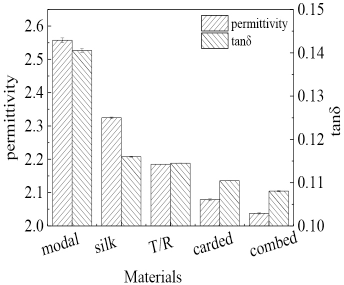
Effect of fiber contents on dielectric properties.
ANOVA
The ANOVA analysis on the dielectric properties of the test textiles showed that the yarn density had no significant effect on the dielectric properties. In addition, the dielectric properties of the test fabrics were greatly correlated with yarn count, fabric weaves, and fiber materials.
Due to the effect of fabric compactness on dielectric properties, Fig. 5 shows the dependence of the dielectric constants on the fabric volume density with the same weaves and fiber contents. These fabrics with the same fiber materials did not show a consistent increase in dielectric constants with increased volume density. In this sense, the fabric structures played an important role in determining the dielectric properties of fabric materials.
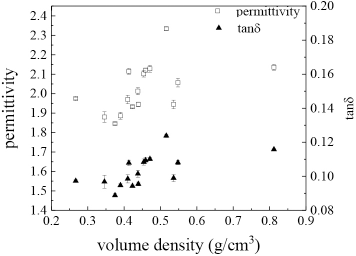
Dependence of dielectric constants on volume density of fabrics.
Conclusions
On the basis of the Q-meter resonant cavity method, this research studied the influence of woven fabric structural and material parameters on dielectric properties. It was concluded that the yarn counts, fabric weaves, and fiber contents were the major factors contributing to different dielectric properties. Generally, the dielectric constants were positively correlated with fabric yarn density, and fabric with high compactness and hygroscopic fibers had high permittivity and tanδ values.
Footnotes
Acknowledgements
This work was financially supported by the National Natural Science Foundation of China (No. 51405079) and the Fundamental Research Funds for the Central Universities.