






Abstract
Woolen fabric is the main fabric in suit manufacture regardless of fashion visual or quality request consideration. Interlinings play an important role to improve the formability, silhouette performance, and fabric hand value, which enhance suit performance and quality. The purpose of this study is to subjectively analyze the hand value of woolen fabric with interlinings and to assist in exploring the judges gender and education background influence on evaluation results. A subjective test was created using a questionnaire based on AATCC EP5. Four kinds of hand values (stiffness, softness, smoothness, and total hand value) were evaluated by 40 judges in two panels to evaluate the judges’ gender and education background influence on fabric hand value evaluation. The results show overall consistency on both panels.
Introduction
In recent years, people wear suits at formal occasions in everyday life, at work, or in formal social gatherings. 1 Fabric quality and aesthetics are important requirements for suits. Wool is a popular fabric for suit manufacture. It is a natural fabric with good air permeability and wearing comfort. As suits need to achieve the aesthetic silhouette, interlining plays an important role in accessories to create and maintain good silhouette, and build shape into detailed areas of a suit, which also help to achieve the requested fabric quality and aesthetic value. Here, interlinings refer to fusible interlinings.
Fabric hand is a comprehensive sensation when fingers touch the fabrics, and hand value quantized the fabric hand evaluation, which is an important index in evaluating the comfort of clothes.2,3 Fabric hand value is a specific property of textiles, mostly determined subjectively. 4 Subjective hand evaluation is based on human sensitivity and experience, which involves not only physical but also physiological, psychological, and social factors.5-7 Many researchers pay attention to the subjective evaluation of fabric hand, usually conducted for various physical characteristics.
Ndengue explored the tactile perception and friction on the surface, 8 and Liao has studied the effect of fabric touch perception on temperature and humidity. 9 There are some subjective sensory evaluations of different kinds of fabrics for garments. 10 However, subjective evaluations of woolen fabrics with fusible interlinings have been virtually zero in suit manufacture. Fabric quality is generally perceived through tactile sensations.
The need for hand assessment of apparel fabric is escalating to improve the quality and technology of textile products. 11 Tactile sensation or impressions arise when fabrics are touched, squeezed, rubbed, or otherwise handled. Howorth and Oliver for the first time identified the three quality attributes, which directly affect the handle of suiting fabrics, namely fullness, springiness, and stiffness. 6 Fabric quality and performance measures were evaluated by reactions obtained not only tactilely, but also visually. 12 Thus, fabric quality and apparel aesthetics influence each other, and the suit preference scores were evaluated in terms of stiffness, softness, smoothness, and total hand value (THV). The judgement is given after referring to the personal experience, as well as natural skin sensitivity. Many impact factors led to different hand value results.
One of the impact factors is who judges. The gender and educational background affect the main category of consumers or judges, which influence the hand value evaluation results. Based on traditional suit manufacture, we explored the fusible interlining efficiency on woolen fabric with and without interlinings by subjective hand value evaluation. Here hand value refers to stiffness, soft-ness, smoothness, and total hand value. This study aims to explore the subjective hand value according to the different gender and educational background of judges, which can affect garment design and retailing. To this end, male and female, textile background and non-textile background college students, as hand value judges, assessed the hand value of woolen fabric with interlinings.
Research Method and Procedures
Materials
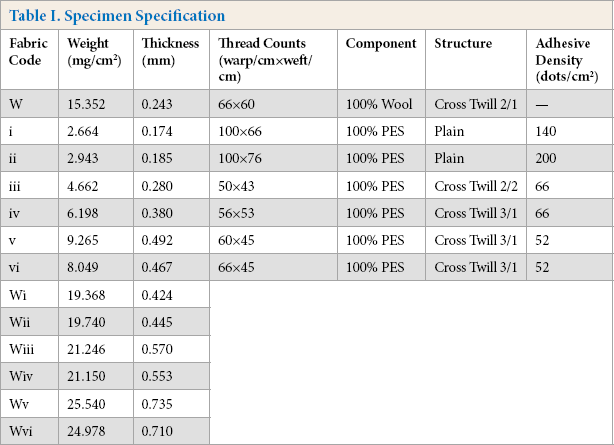
One kind of light weight woolen fabric (W) was used. Among the interlinings on the market, six types of fusible interlinings (i-vi) recommended by the company (CO. KG Vlieseline) for light weight woolen fabric were used as test fabrics. After fusing, woolen fabrics with interlinings were fabrics Wi-Wvi. PES refers to the polyethersulfone (PES) substrate fabric of interlinings. The specifications of the test fabric are illustrated in Table I.
Specimen Specification
A continuous fusing machine (PPS-L600, Maschinenfabrik Herbert Meyer GmbH, Germany) was used with straight conveyor belt, and fusing treatment parameters of the woolen fabric were adopted: 115 °C; speed: 3 m/min; pressure: 5 N/cm2.
Method of Subjective Evaluation
The statistics of the article are based on the IBM SPSS Statistics 22.0 (IBM Corp., Armonk, NY), which included a reliability check, t-test value, and radar chart used to reflect hand value properties. Reliability in statistics and psychometrics is the overall consistency of a measure. 13 A measure is said to have a high reliability if it produces similar results under consistent conditions. It is the characteristic of a set of test scores that relates to the amount of random error from the measurement process that might be embedded in the scores. Scores that are highly reliable are accurate, reproducible, and consistent from one testing occasion to another. 14 Cronbach's alpha statistic is widely used in the social sciences. A t-test is most commonly applied when the test statistic would follow a normal distribution, if the value of a scaling term in the test statistic were known. When the scaling term is unknown and is replaced by an estimate based on the data, the test statistics (under certain conditions) follow at distribution.
The fabric hand evaluation was based on the AATCC EP5. Following this standard, an evaluator presented a specimen in a prescribed manner and was asked to handle the specimen in a prescribed sequence. Judges avoided activities involving extreme exercise and should not expose hands to temperature changes or moisture after washing hands prior to specimen evaluation. All the judges understood the experimental objective and attended the panel voluntarily. Seven specimens using the prescribed manner were presented to a judge. The subjects were asked to touch and feel all the woolen fabrics with and without interlinings of a certain size (20 × 20 cm) and asked if they were able to freely write down the score of each specimen.
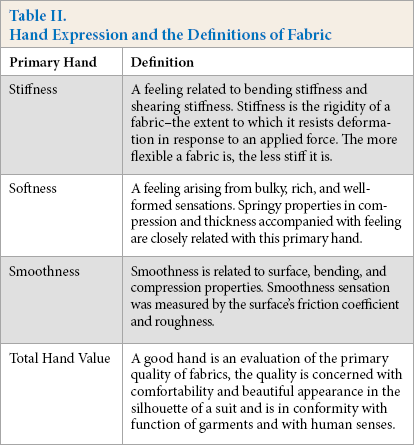
Judges were blindfolded, so that they could not see the fabrics, but could feel and handle them freely. 15 For this study, the panel size was composed of 40 judges, which was divided into two groups. One group was a panel of gender influence to evaluate fabrics—20 males and 20 females were invited and their average rating on different interlinings was analyzed. The other group was a panel of education background influence to evaluate fabric hand value, textile, and non-textile background judges, which were 20 people to evaluate fabrics through the same procedures. Judges ages from 25 to 30 years old evaluated the fabric hand attributes. Each of them had suit purchase experience and they were interested in fabric hand and quality as well. The subjective hand value evaluation focus was on the primary hand value: stiffness, softness, smoothness, and total hand value (THV). THV is total fabric quality from the optimum combination of primary hand value. Primary hand expression and the definitions for fabric are shown in Table II.
Hand Expression and the Definitions of Fabric
Questionnaire
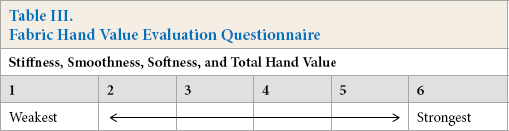
The evaluation scale ranged from 1 to 6 (1 was the weakest and 6 is the strongest value of the hand properties) as shown in Table III. Seven specimens were evaluated and each fabric tested three times on four hand value properties (stiffness, softness, smoothness, and total hand value) for a total of 21 questions finished by each judge. The time taken to answer the questionnaire from person to person was about 10-15 min.
Fabric Hand Value Evaluation Questionnaire
Results and Discussion
Reliability Check
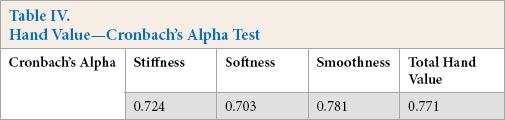
To make sure the subjective test results are effective, this study checks the Cronbach's alpha test and finds all the hand value reliability statistics are highly effective with a range from 0.703 to 0.781 (value > 0.7 for Cronbach's alpha are considered a good internal consistency). The theoretical value of alpha varies from 0 to 1, since it is the ratio of two variances and the variance in the denominator is always at least as large as the variance in the numerator. Higher values of alpha are more desirable. Some professionals, as a rule of thumb, require a reliability of 0.7 or higher, with 0.6 as the lowest acceptable threshold before they will use as an instrument. 16 Table IV shows the Hand Value Cronbach's Alpha Test details.
Hand Value—Cronbach's Alpha Test
Results of Questionnaires
This analysis is conducted using one sheet containing complete answers to the seven kinds of fabrics evaluation three times, for a total of 21 questions for all the judges. To analyze the factor scores in detail, the respondents are grouped. In the comprehensive evaluation of hand values, the respondents say that both gender and education background of judges affect the fabric hand value evaluation.
Gender Influence
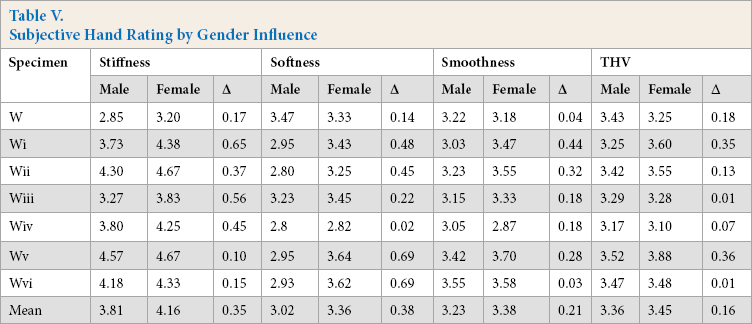
For subjective hand evaluation, 20 males and 20 females were invited and their average ratings on the specimens were analyzed and shown in Table V. Male and female ratings are similar. The differences in rating between each sample of male and female are less than 0.4 (mean value) and total hand value show the minimum difference with 0.16. Fig. 1 shows the primary hand value and total hand value by gender influence, and the results are valid and consistent. Fig. 2 shows the hand value evaluation results by gender influence. It reflects stiffness and has the highest score for both male and female judges. Females give a higher rating than males, especially for stiffness and softness. Males and females have similar scores in terms of THV and smoothness. Fig. 3 shows that there are significant changes after fusing the interlinings in terms of the stiffness and softness for both male and female judges. The stiffness value has a remarkable increase for male and female judges and the soft-ness value decreases especially for male judges. The relationship between gender and hand value are shown in Table VI. From the results of t-test, only softness has a significant correlation with gender influence, which Sig is 0.030 (less than 0.05). This shows that fabric softness has significant correlation with gender influence on the hand value evaluation. In addition, all the t-values are negative, indicating that females give higher sores than males. This may be because females are more sensitive than males for fabric hand value evaluation.
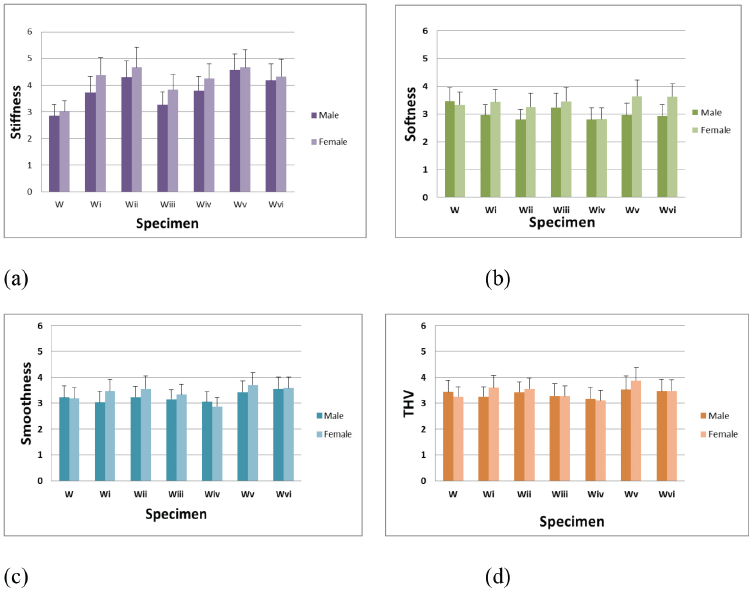
Fabric hand value results by gender influence. (a) Stiffness, (b) softness, (c) smoothness, and (d) THV.
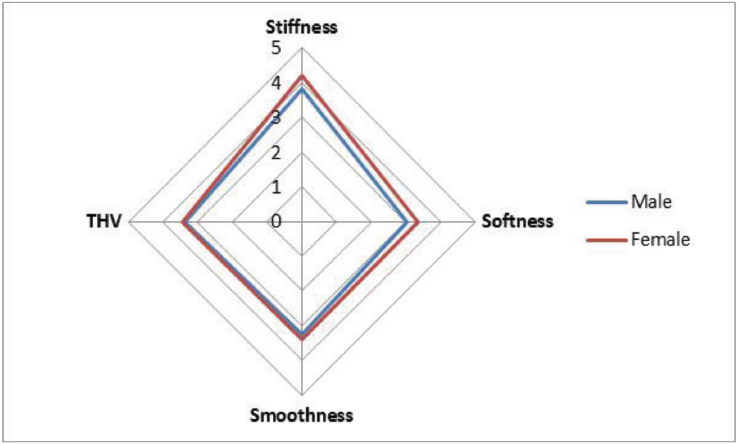
Hand value of fabric results by gender influence.
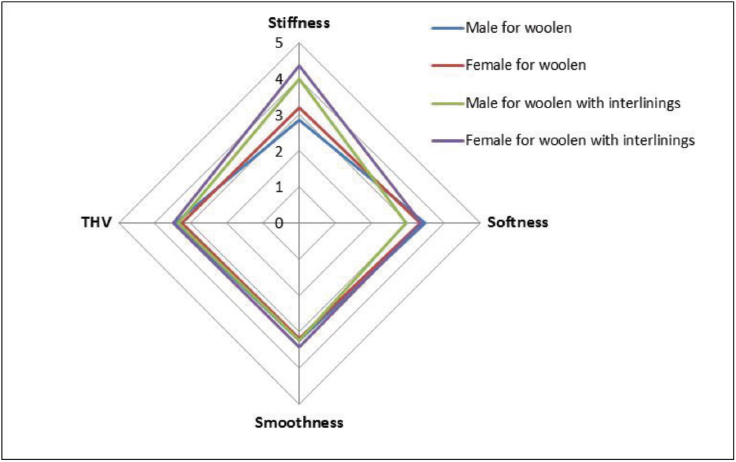
Hand value of woolen fabric with and without interlinings by gender influence.
Subjective Hand Rating by Gender Influence
Statistical Relationship between Gender and Hand Value

2-tailed
Education Background Influence
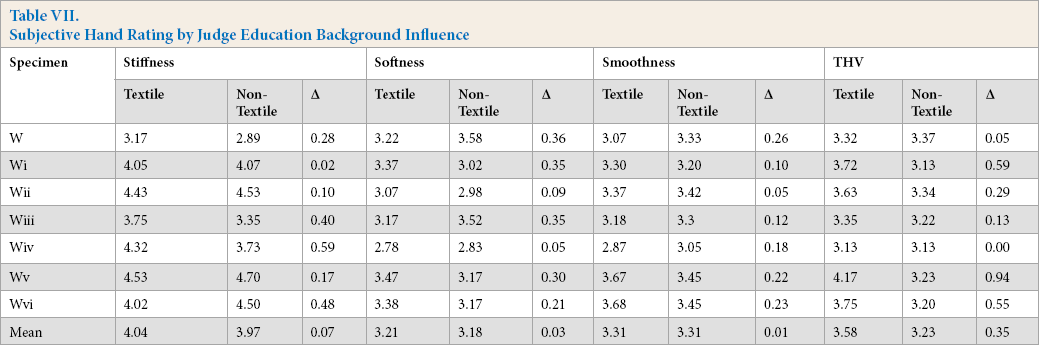
In terms of a judge's education background influence on subjective hand value evaluation, 20 textile and 20 non-textile background judges were invited and their average ratings on the specimens were analyzed and shown in Table VII. The evaluation results of this group's ratings are similar to the differences less than 0.4 score. Fig. 4 shows the primary hand value and total hand value by education background influence. The results are valid and consistent on both education backgrounds. Stiffness values are obviously changed after fusing interlinings in comparison with other primary hand values. Fig. 5 shows that both textile and non-textile background judges have a similar score and non-textile background judges rate a little bit higher on the softness value. All the results are around 3—stiffness has the highest score, while THV has the lowest value. Fig. 6 reflects that there are significant differences in terms of the stiffness, softness, and THV before and after fusing interlinings to woolen fabric. The stiffness value obviously increases, while softness value decreases. Judges with a textile background give a higher value compared to the non-textile background judges. The relationship between judge educational background and hand value is shown in Table VIII. Only the total hand value has a significant correlation with educational background evaluation (Sig is 0.024, which is less than 0.05) based on t-test results. Furthermore, the t-test value of stiffness, softness, and total hand value are positive, which indicates that judges with textile backgrounds have higher sores for fabric hand value evaluation. This may be because those judges with a textile background are more sensitive than the judges without a textile background for fabric hand value evaluation.
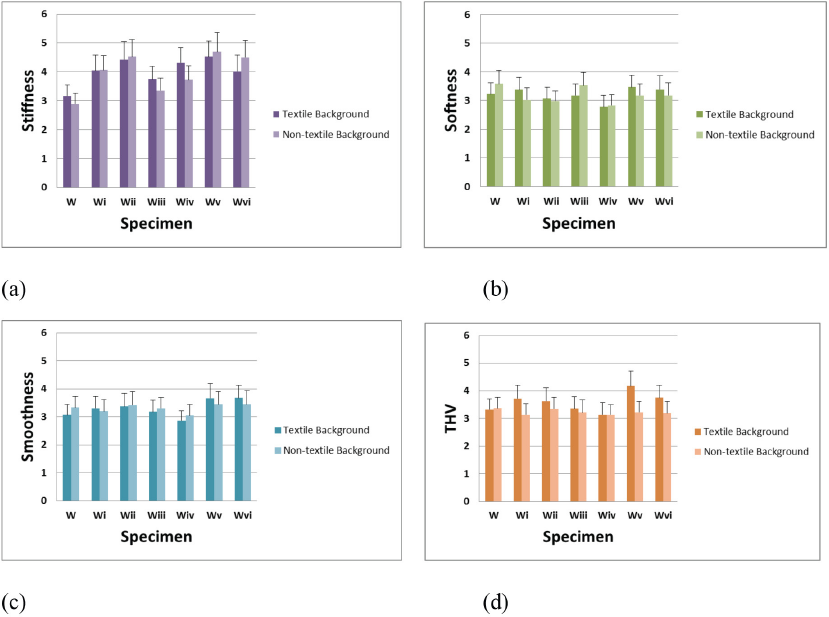
Fabric hand value results by education background influence. (a) Stiffness, (b) softness, (c) smoothness, and (d) THV.
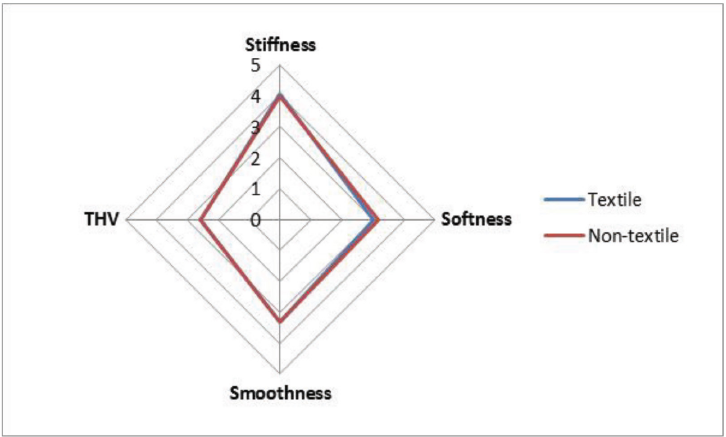
Fabric hand value results by education background influence.
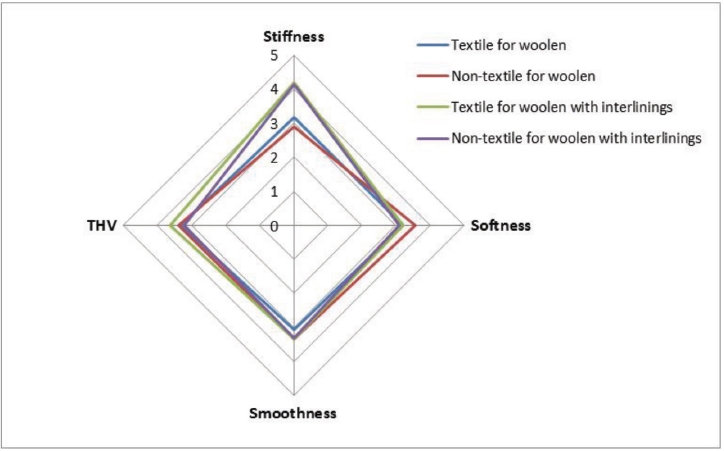
Hand value of woolen fabric with and without interlinings by education background influence.
Subjective Hand Rating by Judge Education Background Influence
Statistical Relationship between the Background and Hand Value

2-tailed
Conclusion
A t-test analysis was conducted to evaluate the answers given in the subjective hand value evaluation. Judges‘ gender and education backgrounds affected the fabric hand value evaluation. Judges‘ gender affected softness evaluation through the statistical analysis, however, judges‘ gender did not significantly correlate with stiffness, smoothness, and total hand value evaluation. Females had a higher tactile sensation on fabric hand by giving a higher rating. Judges‘ education background affected THV evaluation, however, it did not significantly correlate with stiffness, softness, and smoothness evaluation statistically. Judges with textile background had a higher tactile sensation on fabric hand by giving a higher score. These hand values brought up by the evaluators will become an important guiding-principle reference for fabric manufacture, and suit design and merchandising. In order to improve the related study in the future, the number of evaluators and fabric samples could be enlarged, in addition, the hand value property could be extended to crispness and anti-drape properties.
Footnotes
Acknowledgments
The authors would like to thank CO. KG Vlieseline for providing the fusible interlinings, and The Institute of Textile and Clothing and The Hong Kong Polytechnic University for project support.