





Abstract
Real systems approach the ideal by solving technical and physical contradictions. Optimization of system engineering (SE) is achieved when the problem is solved at the level of technical contradiction. When the problem is solved at the level of physical contradiction, the idealization of SE is achieved. Two possible ways of achieving ideality are described in this paper. The expansion process flows at the level of SE (i.e., idealization of another type), and the reduction process flows at the subsystem level (i.e., idealization of the first type). A procedure of mathematical modeling is presented for determining the level of ideality as a criterion for filtering protective suit (FPS) effectiveness, which can be used as a standard for determining the ideality of any SE.
Introduction
The process of obtaining the optimal solution for most engineering problems is very complex, time-consuming, and requires use of computer resources. In practice, various methods are used to offer approximate (i.e., sufficient) solutions to existing engineering problems. However, inventology, as a science of innovative creativity, starts from the fact that, in every technical and technological problem, it is necessary to seek its ideal final solution (IFS). 1 Inventology is based on the Theory of Inventive Problem Solving (TRIZ, Russian abbreviation) that essentially identifies, emphasizes, and eliminates technical and physical contradictions in the system (S), and does not tend to create a compromise through optimization of parameters. This system is fundamentally different from, but can be complimentary to, Six Sigma methods, which are used to identify areas of product quality improvement.
The term technical contradiction (TC) is the key to the TRIZ concept. One TC represents two contradictory features of the system. Improving one part or one feature of a system (e.g., increasing the protective power of FPS) automatically aggravates some of the other characteristics (e.g., it reduces the comfort of wearing it). In accordance with TRIZ, the problem is solved only if TC is identified and eliminated. Demonstration of the application of the 40 Principles of TRIZ, as its most popular tools, is explained through numerous examples of technically, technologically, and ecologically appropriate products.2,3
In 76 Innovation Standards, as the following essential TRIZ tool, each class of standards is divided into sub-classes and sub-groups.2-4 To solve technical problems using TRIZ standards, it is first necessary to determine which class the given problem belongs to, and then into which sub-class and group it can be classified.
Once the ideal system is reached, then its mass (m), dimensions (d), and energy capacity (E) tend towards zero, and the ability to execute the main useful function (MUF) is not reduced. Ideality is always reflected in the maximum use of the existing system resources, both external and internal. The less costly the resources and the more they are prone to be used, the more ideal the system. The ideal equation was first suggested by Altshuler 4 , and it implied that the degree of ideality was inversely proportional to the sum of the useful functions of the system, on one hand, as well as the collection of the harmful system functions and the cost of its functioning, on the other hand. Mathematically, this can be expressed by Eq. 1.

I is the ideality or IFS of the system, ΣF are the total functional possibilities (usages) of the system, ΣC is the total harmfulness of the system, and ΣD are the total costs of the system maintenance.
The ideality of the system, as expressed in Eq. 1, can be increased in one of three possible ways: by increasing the useful functions in the upper value of the fraction, by reducing the harmful functions and costs (prices) in the lower value of the fraction, and by combining the previous two modes. However, due to increased demands for objectivity and validity of the methodology for estimating the achieved degree of ideality in some engineering system, there are efforts to express Eq. 1 with the most precise quantitative meaning. In doing so, the real system must approach the ideal system by resolving contradictions, using all available resources, minimizing components, and using new physical, chemical and geometric phenomena and effects, without increasing harmful functions. 5
In this study, a filtering protective suit (FPS) was used as a particular example of system engineering (SE) in determining the ideality using the mathematical modelling method. The FPS is a filtration suit that protects the user's body from highly toxic substances (HTS). Unlike an isolation suit, the FPS is a physiologically improved way of providing percutaneous protection. It enables users to stay longer in a contaminated area, enabling them to do more work.
The aim of this study is to present the version of Eq. 1 with the most precise quantitative meaning. Based on the described methodology in this specific case, induction can be used as the analogous procedure to measure the ideality of any engineering system.
The Law of Increasing Ideality Degree
According to TRIZ, the law of increasing the ideality degree is one of eleven laws of the evolution of SE. 1 In reality, there is no ideal system. In any useful system, there are some harmful products. It is this harmful system that is actually an ideal system, because no one creates it and it organizes itself. 1 The harmful system has the same structure as the useful one. Since the harmful system exists in real terms, it uses the resources of the useful system very subversively, like a parasite. At the step of the algorithm where it is necessary to choose directions for removing the conflict, hypotheses are placed under which conditions the conflict will be removed. This can be exclusion of the cause of the conflict, neutralization of its consequences, changes in the mode of operation of the device, changes in external conditions, and so forth. According to the hypothesis, certain changes are proposed, and the task is to ask how these change in the conditions of a particular system can be made. The task conditions should contain sufficient information about the components of the system problem area, about the characteristics of its functioning, and about a defect that is to be removed. Therefore, in the conditions of the task, what kind of result is to be defined (i.e., the ideal final solution (IFS)). There may be several ways to eliminate the conflict, and in that case the order of the task is to be determined. The first one that gets solved is the one that is assumed to be the most likely and the most reliable remover of the conflict. The results from execution of the steps are formulated tasks that have a certain order of solving.
TRIZ software can be used to accelerate and facilitate this process. It contains files with trends in the development of system engineering and the lines of their evolution. Since only a material object is needed to execute the function of a system, a fading (idealized, reduced) system has to be executed by other systems, adjacent systems, sub-systems, or super-systems. The remaining part of the system is thus transformed to execute the additional functions, that is, the functions of the missing system.
This “other” function can be analogous to its own when there is a simple increase in the MUF of a given system. If the functions do not match, there is an increase in the number of system functions. The system's failure and the increase in MUF or the number of executable functions are actually two sides of the general idealization process (Eq. 2). 5

For example, throughout the entire development of products for body protection against highly toxic substances (HTS), the physiological suitability increased, but the protective characteristics of the garments, which in this case represent the measure of MUF implementation, were not reduced.
Another type of idealization occurs when the MUF increases, and mass, dimensions, and energy capacity remain unchanged or grow disproportionately low in relation to MUF growth (Eq. 3). 5

This type of idealization is typical, for example, of old types of protective clothing, which used to have an inner protective layer that did not differ much in the mass and dimensions of the filtration materials of modern protective suits, but their functional possibilities were considerably weaker.
The general type of SE idealization contains two processes: reduction of m, d, E and increase of MUF or all useful functions of the system (Eq. 4). 5

For SE to develop over time, then, as a rule, development begins with the process of idealizing another type, by what is sometimes called expansion of the system. At this stage, the number of system functions increases, and accordingly, the sub-systems that realize the additional functions appear in its composition. Thus, for example, in protective clothing, a sub-system is being introduced that allows the body to cool. Subsequently, the number of functions executed by the system is stabilized, and the process of idealizing of the first type, called reduction or transformation, starts. Often, both processes of idealization occur simultaneously, and at the system level, the process of expansion begins (i.e., idealization of another type), and at the sub-system level, the process of reduction or transformation (i.e., idealization of the first type). 5
SE expansion always starts from the substance. It is precisely at the substance level that the effects of those factors preventing the increase of MUF are strongly demonstrated. Ten the transformation phase of the system occurs. From Eq. 5, it can be seen that the ideal (IFS) is achieved first through SE expansion, and then through its transformation (e.g., transition from a mono system to bi-and poly-, and then back to the mono system), but with improved or completely new functional characteristics. 5

By expansion of Eq. 1, it is possible to achieve a relationship of the so-called weighted sums (Eq. 6). 6

The k, l, and m coefficients represent the significance of the useful system functions, costs, and harmful system functions, respectively.
Eq. 6 is still non-functional, because the terms have different units (e.g., the protective power of the filtration suit cannot be added to its mass or mass to the cost). This problem can be solved by switching to normalized parameters, without units, but in that case, the equation has at least two basic problems: mathematical and subjective linearity. Namely, if the system functionality doubles, it does not automatically mean that its ideality will increase (Eq. 7). 6

Many small advantages of an SE can compensate for one major (limiting) defect. Accordingly, from the standpoint of mathematical linearity, Eq. 7 needs to be reexamined. This equation should also be reconsidered from the point of view of subjective linearity, as techniques and technology are developed to meet the needs of users. The user must decide whether and how to define satisfactorily the SE. For example, if the cost of producing FPS is reduced by 5%, this is good; and if it is reduced by more than 10%, this is extraordinary. However, in practice this is not realistic, because the user's response to the same level of parameters in the same product can vary depending on external circumstances, which the equation completely ignores. For example, if a person, by chance, finds themselves in a very dangerous life situation (e.g., an accidental release of HTS), they will probably not hesitate to use the first FPS that they can find, ignoring its effectiveness of protection. However, if the same person is in a normal life situation, which does not endanger them, they will choose between more options, and pick adequate clothing that is guaranteed to protect against a certain type of HTS. Their answer is different in two different situations, in spite of what Eq. 7 claims.
Improvement of SE Parameters based on User Feedback
Improving any SE means improving one or more of its main parameters. Displaying the absolute value of parameter P cannot show whether the selection of this parameter is good or bad, whether it's too much or too little, and so forth. Therefore, P for an interval should be normalized (Eq. 8). 6

Pn is the normalized parameter for the interval Pmin, and Pmin and Pmax are the minimum allowed and maximum necessary parameter values, respectively.
Pmin and Pmax have a real physical meaning. Their values are oftentimes established by suitable standards, product quality regulations (PQR), or tactical and technical requirements (TTR), in which case they are legally binding. Pmin is the minimum allowed value of a parameter, below which the user will not accept a SE asset under any circumstances. For example, if users are continuously exposed to HTS, it offers one-time filtration disposable clothing, which can protect the user for several hours; most probably no one will buy it regardless of its advantages (e.g., low price, comfort, or availability). If protective clothing is good enough for all-day and multiple protection, it is most likely to be purchased. Therefore, somewhere between these two values is a minimal protection time under which no one will consider purchasing such clothing, and above it there will be the probability of purchase. Similarly, Pmax is the maximum necessary parameter value where further overrun is not essential to the user and is not necessarily considered an improvement. For example, if the standard stipulates the protection time of 6 min for a FPS, which guarantees absolute protection to the user, and the test shows that it realistically equals 80 min, it is unlikely to be purchased. Therefore, there is always a certain limit beyond which further improvements are meaningless. Since the quality of SE resources is determined by several parameters of different meaning for the user, it is necessary to introduce the ponder factor. This can be included as follows (Eq. 9). 6
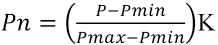
K is the ponder factor, where 0 < K < 1.
As previously mentioned, when assessing the ideality of SE, not so much of the value of the parameters achieved is taken into account, but more the user's response to their improvement, (i.e., the K factor). This also depends on another factor, called the degree of saturation of the market, or the degree of availability of this parameter on the market (L). In a market with low competition (L headed towards 0), even small improvements are valuable, while the user in the highly saturated market (L headed towards 1) could be uninterested, even if they were offered a significant improvement in the SE. Therefore, for one parameter (in FPS it is comfort) the equation should be modified as follows (Eq. 10). 6

S is the user's satisfaction with the achieved parameter value P, and L is the market saturation coefficient (0 < L < 1).
If the measuring units are such that the improvement of the SE implies a decrease in the parameter value (e.g., in FPS, for the increase in the average cardiac frequency, surface mass and prices are undesirable effects), the equation changes according to the following (Eq. 11). 6

Total Characteristics of the SE
At this point, total characteristics of the SE can be calculated, and they can be referred to as IFS (Eq. 12). 6

IFS is the practical value of the ideal final solution; Si is the user's satisfaction with the value of parameter Pi, and n is the parameter number.
In addition, the relative harmful regime Ri can be calculated as a negative contribution of each parameter of the SE value (Eq. 13). 6

Eq. 13 represents a limiting case in which all Si = 1 => IFS = 1. This means that all functional parameters reached their top values, and the costs decreased to the level of insignificance. A system like this perfectly matches an ideal system. It functions only where necessary, when needed, and in a desired manner.
Experimental
Materials and Methods
This paper deals with experiments that were conducted to test the basic physical and mechanical characteristics of FPS-M00 (manufactured by Proizvodnja Mile Dragic, Zrenjanin, Serbia), FPS-M1, FPS-M2, and FPS-PUP (manufactured by Trayal Korporacija, Krusevac, Serbia). Materials used in experiments had the following properties:
FPS-M1 was untreated and the inner layer was double cotton gauze impregnated with activated carbon powder and reinforced with a polyamide fabric.
FPS-M2 was untreated and the outer layer was an oleophobic and hydrophobic textile material based on a mixture of cotton-polyester; the material of the inner layer was the spheres of active carbon material (ACM) glued to the fabric and covered with another fabric.
FPS-PUP was untreated and the outer layer material was an oleophobic and hydrophobic textile material based on a mixture of cotton-polyester; the inner layer material was a powder of activated carbon impregnated with polyure-thane foam (PUF) and pressed between two light fabrics.
FPS-M00 was untreated and the outer layer material was an oleophobic and hydrophobic textile material based on a mixture of cotton-polyester; the material of the inner layer was ACM glued to the fabric and covered with another fabric.
FPS was tested for the raw materials, surface mass, thickness, breaking forces, intermittent elongation, and ripping forces. Air permeability and water vapor tests were also performed to test the basic functional characteristics of the FPS. The protective power of the FPS against HTS was tested using a sophisticated dynamic gas chromatographic method, and the protection time for the effect of HTS drops was determined using Yperite under dynamic working conditions. 7
The testing of the heat transfer process through various materials embedded in the FPS was carried out under laboratory and field conditions. The appropriate anthropometric and ergometric indicators and measured thermoregulation characteristics were tested as well. 7 This made it possible to compare the materials according to all the relevant thermo-regulation parameters of the body.
The surface mass of the tested materials was determined, 7 using analytical scales (Libela Preciz), with an accuracy class of 3 and an accuracy of 20 g. Five samples measuring 15 × 15 cm, with a surface area of 100 cm2, which were brought to a standard state after 24 h, were cut. The samples were dried at 105 ºC to a constant mass and then were measured.
Respondents were subjected to physical effort, and thermo-regulation tests were conducted 8 in a hot air environment (30 °C), and under field conditions. The testing methodology in the climate chamber consisted of continuous measurement of microclimate conditions by the MiniLab device (Ligh Laboratories).
Microclimate conditions testing was carried out before the start of each heat load test. Thermoregulation was tested by calculating the average skin temperature from the collection of temperatures obtained by measuring from four points on the skin by thermo-elements. 8 This measurement was continuous. Internal temperature (Tc) measurement was discontinuous, and was carried out by introducing the probe into the ear canal every 5 min. 9 Each subject had their heart rate continuously monitored using Biotel.33 The electrodes were placed on the chest of the subjects and an electrocardiographic signal sent telemetrically.
Simulation of different intensities of respondents’ work, which corresponds to the performance of the assigned tasks, was achieved at a speed of 5 km/h on a treadmill in the climatic chamber.
For a subjective assessment of the thermal state (comfort), McGinnis heat scales were used. 10 The test was interrupted if there was a decompression of the thermo-regulation, that is, when Tc exceeded 39.5 °C, or when the heart rate exceeded 190 bpm.
Results and Discussion
Results showed that protective suits FPS-M2 and FPS-M00 presented a significant improvement when compared to domestic FPSs of previous generations: FPS-M1 and FPS-PUP. Both FPS models are comparable to modern means of personal percutaneous protection when all examined characteristics are taken into account. Testing of the protective properties of FPS against the effects of HTS was conducted by the total process of penetration of S-iperite vapors through their materials. During hours of examination, in all models of FPS, output contamination density did not reach 4 μg/cm2, which fulfilled the set requirements of TTR and standards. 7
The respondents had an ideal (maximum) feeling of warm comfort when wearing FPS-M00 for a majority of the experiment (80 min). When wearing FPS-M2, the respondents declared that they felt comfortable for the first 40 min, but in the following period a “jumpy trend” of discomfort increase occurred. 11 After finish-ing the experiment for each respondent in a particular FPS model, a survey was performed on the elements of the comfort state, and the results are given in Table I.
Rating the State of Comfort while Wearing FPS a
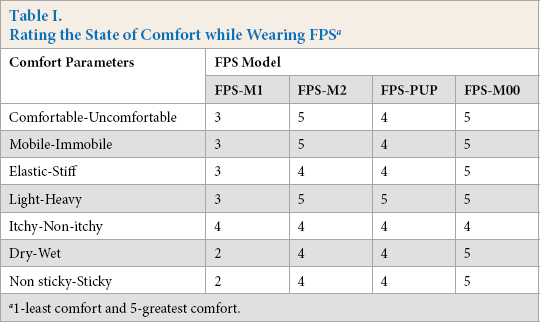
1-least comfort and 5-greatest comfort.
While conducting physiological suitability tests under field conditions by performance of specific tasks, it was found that in all subjects performing work (under dynamic conditions) there was some “overheating.” This phenomenon was absent during the execution of tasks under static conditions, so it can be concluded that “overheating” was not significantly influenced by the FPS model, but by the intensity of performing certain activities.
When comparing FPS-M2 and FPS-M00 (Table II), in terms of surface mass of outer and inner layer, FPS-M00 had 30 g/m2 greater surface mass and 80 g/m2 greater inner layer mass. The total surface mass of FPS-M2 was smaller by ∼110 g/m2 compared to FPS-M00. For production of a set of FPS, 5 to 6 m2 of material was required. Therefore, FPS-M2 had a smaller mass than FPS-M00 by 550 to 600 g. Difference in FPS mass can represent an important factor for choosing an FPS model for army equipment.
Quality Characteristics of FPS
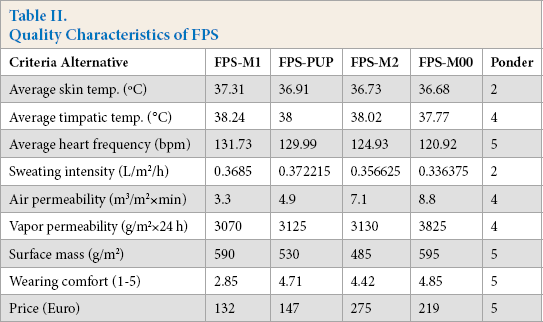
The lowest heart rate values were established when using the FPS-M00, followed by FPS-M2, FPS-PUP, and FPS-M00 (Table II). It was of great importance that during the examination of all four FPS models, the heart rate did not exceed 190 bpm, which led to interruption of the experiments.
However, from a practical point of view, it was necessary to determine values of key parameters for calculating the IFS. The highest K value belonged to the heart frequency as the most important physiological parameter, which directly impacts the safety (life) of the user, followed by surface mass, wearing comfort, and price. Parameters that had the maximum K value from Table II were used for calculation of ideality in Table III.
Achieved Degree of Ideality in Construction of FPS
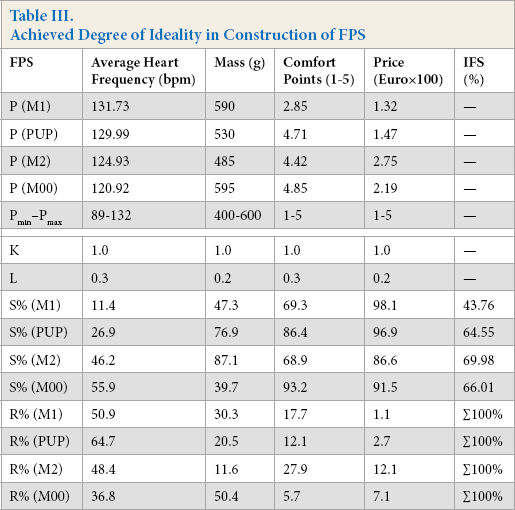
The FPS-M2 model reached an ideality of 69.98%, and model FPS-M00 was 66.01%. This result was surprising, considering that the FPS-M00 average heart frequency, comfort, and price were better when compared to FPS-M2. Applying optimization of the listed parameters according to the paper, 7 FPS-M00 had an overly better means. However, applying the equation for calculating ideality showed that the difference in mass, as an unwanted parameter, was so much better for FPS-M2 that this parameter was the prevailing factor in deciding the greater total ideality of this means.
Increasing ideality of both FPS models can be achieved by increasing their individual parameters. In the case of FPS-M2, constructional changes that would contribute to the lower value of heart frequency (R = 48.4%) need further study, and in the case of FPS-M00, fixing the surface mass parameter (i.e., total mass (R = 50.4%)) should be addressed. This process is called technical improvement or innovation of a lower inventiveness level. However, one possible way for achieving greater ideality of FPS may be to use a self-decontaminating material in the outer layer impregnated with nano-particles (e.g., TiO2), 12 which would represent a totally different conceptual approach to the development of this SE. This approach would represent an FPS innovation of a higher level of inventiveness.
Conclusion
This study describes two possible ways of achieving idealization of SE. The idealization of the first kind occurs when the mass, scale, and energy capacity of a system tend to be zero, and MUF, or the number of executable functions, remains unchanged. The idealization of another kind occurs when MUF, or number of executable functions, increases and mass, scale, energy capacity remain unchanged or grow disproportionately less in relation to MUF growth. Often, both processes of idealization take place at the same time, at the level of the system running the process of expansion (i.e., the idealization of the other kind, and at the level of the subsystem, and the process of reduction, that is, the idealization of the first degree).
The equation for calculating the degree of SE ideality as a measure of efficiency can be recommended for wider use. Starting from the structural characteristics of textile materials, the selection of suitable materials for the outer and inner layer of FPS was evaluated, based on application of thin-layer sorption carbon materials. If FPS-M00 and FPS-M2 protection characteristics are compared, it can be concluded that both models met the set requirements per the standards. In a positive sense, FPS-M00 distinguishes itself with its quality and price, and FPS-M2 with its smaller mass by ∼600 g. Contrary to the expectation, and in relation to the results obtained by applying the optimization method, the FPS-M2 model achieved an ideality of 69.98% and FPS-M00 was 66.01%. This means that FPS-M2 should be adopted by the Serbian Armed Forces as the ideal means of SE. This conclusion was reached after the multi-criteria ranking of functional characteristics, characteristics of physiological similarity, protective characteristics, weight and price, which all resulted in a ranked list, necessary for the calculation of ideality for these two SEs. This example shows the real significance of applying the idealization method when developing and adopting SEs.
With the induction method, it is possible to develop an analogous procedure for measuring the ideality of any SE asset, which is essential for planning and evaluating the outcomes of innovations relating to their efficiency, for selecting and evaluating business strategies, comparing competing heterogeneous systems, assessing concepts and identifying secondary problems, and analyzing the lifespan of any SE.
Footnotes
Acknowledgements
The authors wish to thank the Ministry of Education, Science, and Technological Development of the Republic of Serbia for supporting this work, Grant No. TR34034.