






Abstract
Naturally brown-colored cotton (NBCC) fibers have been reported as having excellent antibacterial and antioxidant properties. Generally, NBCC fibers are used in blends with other fibers (e.g., white cotton fiber) to improve yarn qualities and also produce more color shades. The antibacterial properties of NBCC/white cotton blends were investigated as spunlace nonwoven fabrics in this study. Pure NBCC fiber showed antibacterial activity of 91.7% and 86.9% against Staphylococcus aureus and Escherichia coli, respectively. Antibacterial activities of the blends containing greater than 70% brown cotton were very similar to those of NBCC fiber. The effects of scouring, laundering, and sunlight exposure on the antibacterial activity of the NBCC/white cotton blends were reported.
Keywords
Introduction
Naturally brown-colored cotton (NBCC) fiber has inherent color and needs no dyeing, which can reduce wastewater discharge and energy consumption.1,2 NBCC products have the advantages of gentle luster and soft hand, as well as good wearability. They are thus beneficial to both human health and the environment.3,4 However, NBCC fibers also have some deficiencies, such as the relatively low stability of the fiber color and some inferior fiber qualities.5,6 Although their performance basically meets spinning requirements, it is still difficult for use in developing high-quality products due to its poor fiber qualities. 7 Therefore, NBCC fiber is usually blended with other fibers (e.g., white cotton fiber) at present. 8
NBCC fiber possesses a variety of special properties (e.g., anti-flammability, UV protection, and good durability in daily use). As reported, the limiting oxygen index value of NBCC ranges from 22.4 to 25.4, depending on the species, while that of white cotton is only about 19.0. 9 It should be noted that the UV radiation protection property of NBCC fabrics can be improved after home laundering due to the reduction in fabric porosity resulting from shrinkage. 10
Recently, antioxidant properties, as well as antibacterial properties, of NBCC fibers were discovered, which depends on the intrinsic biological pigments in the fibers. An NBCC variety with a darker color were found to have 2,2-diphenyl-1-picrylhydrazyl (DPPH) and 2,2-azino-bis(3-ethylbenzothiazoline-6-sulfonic acid) (ABTS) free radical scavenging activities 6.9 and 6.1 times that of white cotton, respectively. 11 The percentage reduction in bacterial activity for this dark brown NBCC was 96.4% against Klebsiella pneumoniae and 89.1% against Staphylococcus aureus. 12 Preliminary experiments found that NBCC fibers had good inhibitory effects on the growth of S. aureus and Escherichia coli, with antimicrobial activities of 87.9% and 79.5%, respectively. 12
Since many NBCC products use blended yarns, determination of NBC-blended product antibacterial activity is necessary. The purpose of this work was to investigate the blending ratio on the antibacterial properties of NBCC/ white cotton-blended samples. The effects of scouring, laundering, and sunlight exposure on the antibacterial properties of the blended samples were also investigated.
Experimental
Materials
The brown cotton used was the Caixuan series, while the white cotton was normal variety, Xinluzhong No. 37, and both were supplied by the Zhejiang Academy of Agricultural Sciences. The Gram-positive bacteria S. aureus (ATCC No. 6538) and Gram-negative bacteria E. coli (ATCC No. 8099), both obtained from the Hangzhou Tianhe Microorganism Reagent Co. Ltd., were chosen as the test species. Sodium hydroxide was analytical grade and was purchased from the Hangzhou Mike Chemical Instrument Co. Ltd. The alkaline pectinase and JFC penetrant (a nonionic, fatty alcohol poly-oxyethylene ether surfactant) were purchased from Imperial Jade Bio-Technology Co. Ltd.
Preparation of NBCC/White Cotton-Blended Samples
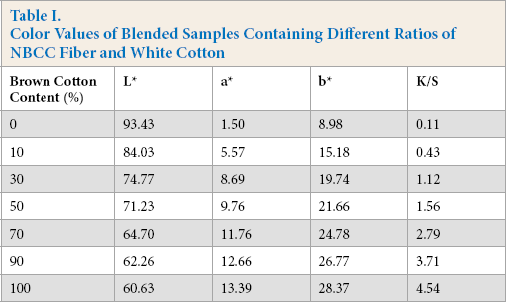
NBCC/white cotton blended spunlace nonwoven samples, containing different ratios of NBCC fiber, were prepared using a Fleissner Aquajet Y500-2 spunlace sample machine. The specific parameters were as follows: the front water pressures were 25 and 35 bar, while the water pressures for the back side were 50 and 55 bar; the spunlace distance was 14 mm; and the speed of the web curtain was 2 m/min. The samples and their color values are shown in Fig. 1 and Table I, respectively. The sample weight was 83.4 ± 1.2 g/m2 and the thickness was 0.92 ± 0.05 mm.

Nonwoven samples of (a) pure white cotton, and blended samples containing (b) 10%, (c) 30%, (d) 50%, (e) 70%, (f) 90%, and (g) 100% brown cotton fiber.
Color Values of Blended Samples Containing Different Ratios of NBCC Fiber and White Cotton
Scouring
The NBCC/white cotton-blended samples were investigated for their antibacterial capacities before and after scouring. Scouring of the samples in this study included alkaline scouring and enzymatic scouring. Alkaline scouring involved treating the samples with a 2 g/L sodium hydroxide solution at a liquor ratio (LR) of 30:1 at 100 °C for 90 min, Enzymatic scouring involved treating the samples with pectinase at a pH of 8.0 ∼ 9.0 after rinsing with hot water. Samples were treated in the enzymatic bath at an LR of 30:1, an enzymatic concentration of 1 g/L, a nonionic surfactant (JEC) concentration of 2 g/L, a temperature of 50 °C, and the treatment time was 90 min. After scouring, the samples were rinsed in water until the pH was neutral, and then dried at 35 °C.
Laundering
Repeated laundering of the samples was performed according to AATCC TM135-2012. 11 It was carried out in a neutral detergent bath with the standard washing procedure using an Haier XQS60-ZY1128 automatic washing machine. For one laundering cycle, the samples were washed together with AATCC Dummy I Wash Load Ballast for 20 min at an LR of 11:1 at 30 °C. A neutral liquid detergent, Blue Moon Cotton & Wool Net care detergent (Guangzhou Blue Moon Industry Co. Ltd.) at a concentration of 2.5 g/L was used. The washed samples were rinsed three times in cool water and then dried at 35 °C.
Sunlight Exposure
Sunlight exposure of the blended samples in this study was simulated using a Xenon Test Chamber (Q-Lab Co. Ltd.). The samples were neatly tiled in the test machine to get uniform insolation at a radiant energy of 32 kJ/m2, a chamber temperature of 40 °C, and a relative humidity of 60%.
Antibacterial Activity
Antibacterial activity of the NBCC-blended samples was evaluated according to AATCC TM100-2004 with slight modifications (ethylene oxide was used for sterilization). S. aureus and E. coli were used as the test bacteria. The samples were sterilized with ethylene oxide and were desiccated at 60 °C. Autoclave sterilization of the NBCC samples should be avoided due to a significant color change when the temperature exceeds 90 °C, leading to a probable chemical change of the pigment structure. 13 The sterilized swatches (0.4 g each) were placed separately in sterile conical flasks and inoculated evenly with 0.2 mL of bacterial liquid (10× dilutions from the stock bacterial solution with a concentration of 1.5 × 10⁵∼3.5 × 10⁵ CFU/mL) and 10 mL of broth culture-medium in incubator shaker at 37 °C for 5 h. Afterwards, the optical density (OD) value of the bacterial suspension at 600 nm was tested using a TU-1950 UV-Vis spectrophotometer (Beijing PUXI Instrument Co. Ltd.) 14 and the percent reduction of bacteria was calculated by Eq. 1.

A is the OD value of the bacterial suspension incubated with samples for 5 h and B is the OD value of the bacteria suspension incubated without samples for 5 h.
Results and Discussion
Antibacterial Properties
The antibacterial activity of NBCC-blended samples against S. aureus and E. coli, after incubation for 5 h, were shown in Fig. 2. Compared to pure white cotton samples, the NBCC-containing samples showed significant antibacterial activities. The antibacterial activity of the NBCC-containing samples increased with increasing NBCC content. The pure white cotton samples showed no inhibition of the two test bacteria. At low NBCC contents (i.e., below 30%), the antibacterial activities of the blended samples improved sharply with increased NBCC content. With NBCC content above 70%, the antibacterial activities of the blended samples were very close to those of the pure NBCC samples, which showed activities of 91.7% and 86.9% against the two bacteria, respectively. NBCC/white cotton blended products had nearly maximal antibacterial activity as long as the blend ratios of the NBCC were equal to or greater than 70%. The performance based on NBCC-content level is important and could be used to guide the exploitation of antibacterial NBCC products.
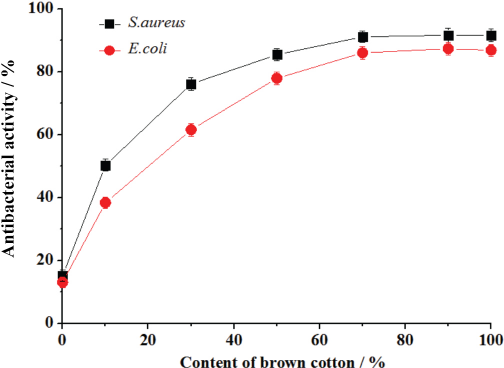
Effects of NBCC content on the antibacterial activities of the blended samples against S. aureus and E. coli.
At present, almost all commercial antibacterial fabrics are finished with antimicrobial agents, with some of them showing antibacterial rates as high as 99%. Although the antibacterial properties of NBCC are inferior to those commercial antibacterial fabrics, NBCC also has potential value for its intrinsic antibacterial properties and natural color features. According to the standard for antibacterial textiles in China (GB/T 20944.3-2008), a sample that showed antibacterial activity greater than 70% against S. aureus and E. coli could be labeled as an antibacterial product, therefore, NBCC fabrics have promising potential use in healthcare textiles.
Scouring Effects
The antibacterial properties of alkaline- and enzymatically-scoured NBCC blended samples were also investigated (Fig. 3). For samples where the NBCC content was less than 30%, both scouring processes gave slightly improved antibacterial activities. For example, after alkaline or enzymatic scouring, the antibacterial activity against E. coli of the blended samples containing 10% NBCC increased to 50.2% and 46.9%, respectively, from 40.5%. However, the effects of scouring on the antibacterial activities of the samples containing greater NBCC fiber contents were not significant. These results were consistent with repeated experimental data and could be attributed to two reasons. As previously reported, the antibacterial activity of NBCC fiber results from the polyphenol-based pigment substances,15,16 which contain free, glycosylated, and/or esterified hydroxyl groups. The ester and the glycosidic bonds are hydrolysable when treated with alkali and pectinase.17-19 The antibacterial activities of these polyphenols are usually related to the number of the free hydroxyl groups on the rings.20,21 When NBCC fiber was scoured with alkali or pectinase, the ester and the glycosidic bonds of the pigment molecules were probably hydrolyzed to more antibacterial-active molecules, thereby improving the antibacterial activity of the NBCC fiber. Scouring could also remove the hydrophobic impurities of cotton fibers (e.g., wax and pectin), thereby increasing the accessibility of bacteria to the pigment molecules inside the NBCC fiber, and making bacterial inhibition easier.
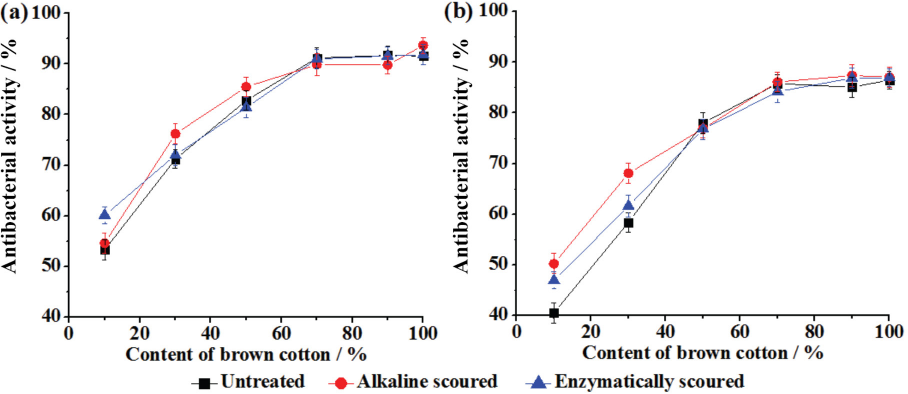
Effects of scouring on the antibacterial activities of NBCC-blended samples against (a) S. aureus and (b) E. coli.
Laundering Effects
The durability of the NBCC-blended samples’ antibacterial activity to home laundering was tested. The pristine and scoured, pure NBCC sample and the blended samples containing 70% NBCC fiber were tested (Fig. 4). The antibacterial activity of all samples decreased against S. aureus and E. coli after the first laundering, and then gradually decreased with increased laundering cycles. This was attributed to the gradual loss of the antibacterial-active molecules in the NBCC fiber after laundering. Fortunately, the NBCC samples still kept good antibacterial activity after 15 laundering cycles. The pure NBCC samples still showed an antibacterial activity of 68.8% and 60.1% against S. aureus and E. coli, respectively, while the 70% NBCC-blended samples antibacterial activity was 68.1% and 59.4% for the test bacteria, respectively. This indicated a relatively good laundering durability and favored the development of antibacterial NBCC products. 22
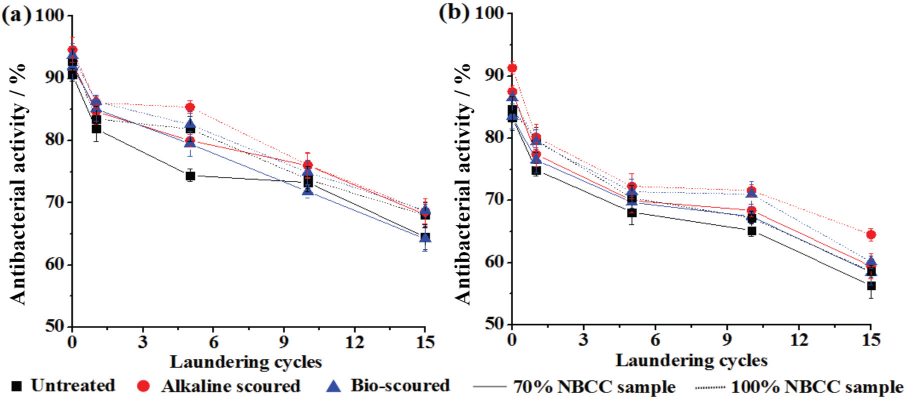
Effects of laundering on the antibacterial activities of NBCC-blended samples against (a) S. aureus and (b) E. coli.
Sunlight Exposure Effects
Investigating the effects of sun exposure on the antibacterial properties of NBCC samples used as clothing material has practical significance. Fig. 5 shows the changes in antibacterial activities of NBCC samples as a function of simulated sunlight exposure time. The antibacterial activity of the pure NBCC sample and the 70% NBCC-blended sample decreased gradually as the insolation time increased. The pure NBCC sample lost 9.8% and 14.3% of its initial antibacterial activity against S. aureus and E. coli, respectively, after an exposure to simulated sunlight for 15 h. This indicates that sunlight exposure had an adverse impact on the antibacterial activity of the NBCC samples. The color and luster of the tested samples did not change significantly after exposure to simulated sunlight. We inferred that the decrease in antibacterial activity may be due to oxidization to similarly-colored pigment substances when exposed to the sunlight. 23 Although the influence of short-term light exposure on the antibacterial activity was not remarkable, long-term sunlight exposure for antibacterial NBCC products in daily use should be avoided to maintain their good antibacterial properties.
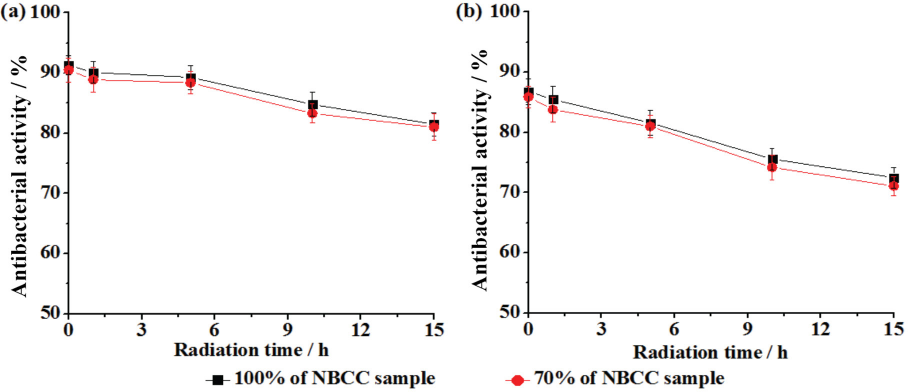
Effect of simulated sunlight exposure on the antibacterial activities of NBCC-blended samples against (a) S. aureus and (b) E. coli.
Conclusions
The effects of blend ratio, scouring, laundering, and sunlight exposure on the antibacterial activity of the NBCC/white cotton-blended samples were evaluated. The data showed that the antibacterial activity of the NBCC-blended samples increased with increasing NBCC content. The blended sample containing 70% NBCC fiber attained antibacterial activity similar to the pure NBCC sample. Either alkaline scouring or enzymatic scouring improved the antibacterial properties of blended samples containing 30% or less of the NBCC fiber, while having no significant effect on samples with greater NBCC fiber content. Home laundering and sunlight exposure had adverse effects on the antibacterial property of all NBCC-containing samples. After home laundering for 15 times, the pure NBCC sample and the 70% NBCC-blended sample still had antibacterial activity of 68.8% and 68.1% against S. aureus and 60.1% and 59.4% against E. coli, respectively. After exposure to simulated sunlight for 15 h, both samples still showed about 81.2% and 72.5% of antibacterial activity against the two bacteria, respectively. These results suggest that the antibacterial activity of NBCC fiber and its blended products were durable. These findings are supportive for the development and use of antibacterial NBCC-containing products.
Footnotes
Acknowledgments
We thank the National Natural Science Foundation of China (No. 51373156) for financial support.