






Abstract
There is a need for nurse scrub jackets that provide physical safety while being designed for comfort and performance. This study evaluates the optimal thermal comfort value of fabrics for nurse scrub jackets by comparing two fabric structures and four different fiber contents. A sweating guarded hot-plate test was used to determine the best fabric for thermal comfort. The result of this study indicated that a knitted structure provided greater thermal comfort than a woven structure. In addition, cotton and polyester fiber contents were superior to rayon at retaining heat within fabrics. This result could provide the basis for producing optimal fabric structures and choosing the best possible fiber contents for future nurse scrub jackets.
Introduction
The National Sample Survey of Registered Nurses reports that since 2008, an estimated 3,063,162 licensed nurses (RNs) were registered in the United States. 1 Due to the growing nurse population, the nursing uniform industry has called into question the different purposes of the uniform.1,2 In recent years, the importance of nurse uniform fabric properties has been recognized. 3 Enhancement of efficient fabric structures is one of the problems the nursing uniform industry faces today; these relate to fabric elasticity, breathability, durability, and thermal comfort, 4 with thermal comfort and elasticity driving innovation in nurse uniforms.3,4 The most popular style of nurse uniforms are scrubs, previously identified as the ubiquitous clothing of surgeons. 5 Nurse scrubs include a top, pants, a gown, and a jacket.5,6 Most nurse scrubs are made of fabric woven from cotton, polyester, or a cotton and polyester blend. 7 Of these, the nurse scrub jacket (NSJ) is popular because of its thermal comfort. The average temperature in a hospital is 22–26 °C, but the temperature of many laboratories is often lower than that. 8 The temperature in a hospital also can vary depending on the room's purpose. Nurses try to maintain their body temperature in response to the various temperature changes in the hospital environment by donning and doffing the NSJ.9,10 For example, outpatient department nurses typically want to wear warmer clothing, whereas surgical nurses prefer cooler clothing. 3 Also, not all nurses are fully happy with a single public temperature; therefore, it is important to enhance their individual thermal comfort via the NSJ. 9
According to a study by Yoo and Barker, the correlation between fabric material and wearing sensation is important to determine actual human thermal comfort responses. 11 Supuren indicated that the relationship between body heat production and heat loss clearly influences thermal comfort; this same phenomenon also contributes to an enhanced exchange of heat and moisture between the skin and the environment through the clothing being worn.12,13 Thermal comfort stems from the significant relationship between thermal insulation and moisture permeability in the fabric.12–14 Thermal transmission, defined as the thermal conductivity, is involved in actual heat transfer from the human body to the environment. 14 Moisture permeability is defined as water-vapor transmission through a worn material that induces a vapor pressure difference between two specific surfaces under specified temperature and humidity conditions. 15
For uniforms directly related to the wearers’ comfort, the study of fabric properties has become increasingly important. 3 Several studies have sought to remedy the shortcomings of the fabric being used to develop nurse uniforms by examining the efficiency of fabric structures for delivering advanced performance features. 16 Kawabata et al. developed the Kawabata thermal tester (Thermolabo) to measure the warm/cool feeling offered by fabrics and reported on the effectiveness of transient heat flux to produce physical comfort in next-to-skin fabrics.13,17,18
Scheurell et al. also found that the thermal comfort of fabric is influenced by several critical factors, including the air ratio of the fiber, fabric thickness, surface color and texture, and fabric hardness or stiffness. 19 Frackiewicz-Kaczmarek et al. quantified the influence of moisture content as it relates to fabric thickness and garment ft. This study demonstrates that fabric structure and fiber type is related to increased moisture movement in garments. 20 The thermal resistance and water-vapor resistance capacities of fabrics also depend on fabric thickness and bulk density.17,19 Xu et al. reported that knitted fabrics are typically more insulating than woven fabrics. 3 The high degree of thermal comfort in knitted fabrics suggests that their use in nurse uniforms can produce improved thermal comfort.12,14 A current industry concern is to find the most appropriate fabrics to enhance the thermal comfort of nurse uniforms. 12
This research analyzes the thermal comfort properties for current NSJs and investigates the optimal conditions for future NSJs. The purposes of the study are (1) to compare the woven fabrics of current NSJs to knitted fabrics in terms of the thermal comfort, and (2) to investigate the most efficient fabrics for improving the thermal comfort level of NSJs based on immediate environmental conditions.
Experimental
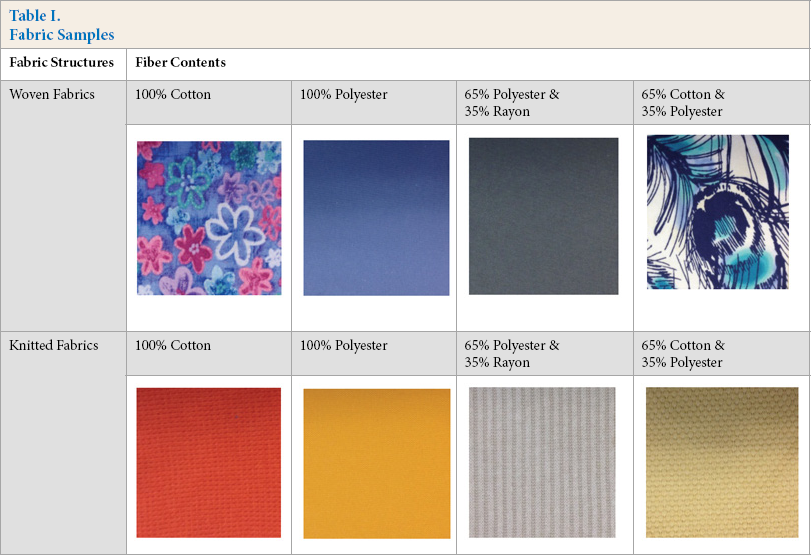
The dependent variables in this study were thermal resistance (Rd) and water-vapor resistance (Ret). The independent variables were two fabric structures (woven and knitted) and four fabric fiber contents (100% cotton, 100% polyester, 65% cotton and 35% polyester, and 65% polyester and 35% rayon). Eight different types of fabrics (woven 100% cotton (W100C), woven 100% polyester (W100P), woven 65% polyester and 35% rayon (W65P35R), woven 65% cotton and 35% polyester (W65C35P), knitted 100% cotton (K100C), knitted 100% polyester (K100P), knitted 65% polyester and 35% rayon (K65P35R), and knitted 65% cotton and 35% polyester (K65C35P) were tested. For the NSJ thermal performance, this study will determine which fabrics have the highest Rct values (i.e., those fabrics that keep the body warmer) and which have the lowest Ret values (i.e., those fabrics with the best moisture ventilation). Accordingly, three hypotheses are presented as follows:
Hypothesis 1 (H1): There are significant differences in Rct and Ret values between woven and knitted fabric structures.
Hypothesis 2 (H2): There are significant differences in Rct and Ret values between the four types of fabric fiber content.
Hypothesis 3 (H3): There are significant differences in Rct and Ret values between the eight fabrics.
Fabric Samples
Four woven fabrics and four knitted fabrics were selected for this study (Table I). The four woven fabrics used in current brands of scrub jackets were W100C, W100P, W65P35R, and W65C35P. Four knitted fabrics were chosen to represent commercial fabrics with the exact same content as the current woven scrub jackets: K100C, K100P, K65P35R, and K65C35P. Each fabric sample was cut into 12 x 12 in. specimens. Three specimens were cut and prepared from each fabric.
Fabric Samples
Hot-Plate Test
The sweating guarded hot-plate (SGHP) test was used to measure Rct and Ret (Fig. 1). 21 The major components of the SGHP are a power enclosure, fluid reservoir, hot-plate assembly, ambient sensors, airflow hood, and thermDAC8 control software. 21 This system maintained a fat measurement area at a constant temperature. A thermDAC8 control software program was written to control and measure the different parameters, such as water supply, rate of condensation and evaporation in the fabric, surface temperatures of the hot-plate, and climatic conditions of the chamber. 22
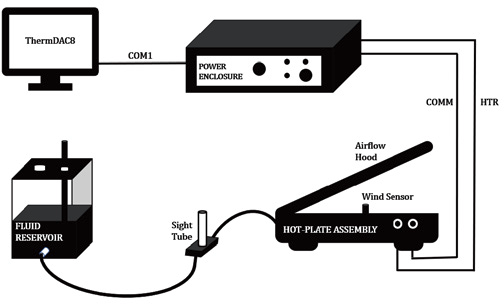
System components of the sweating guarded hot-plate. 21
Rct values from the hot-plate test were used to measure heat transfer through the fabric. Ret values were calculated using the evaporative heat flux value between the plate's surface and the various fabrics. These Rct and Ret tests were conducted using the SGHP standard under experimental conditions. Air temperature and relative humidity (RH) for the Rct test were 20 °C and 65%, respectively. The air speed was maintained at 1 m/s at a point 15 mm above the center of the hot-plate surface. 23 Ret determination was based on an air temperature of 35 °C, an RH of 40%, and an air velocity of 1 m/s. The surface of the hot plate was also completely wetted, and a cellophane membrane film covered the guard section of the test plate to prevent any formation of wrinkles and/or air bubbles. Tree replications of the same experiment were tested to determine the average data.
The data from the hot-plate tests were first analyzed using a t-test for H1 and then one-way analysis of variance (ANOVA) using SPSS software for H2 and H3. Based on the SPSS results, these data were compared to the mean (M) and standard deviation (SD) of the woven and knitted fabrics via an independent t-test for both Rct and Ret. 24 ANOVA tests determined the best fabric for thermal resistance and water-vapor resistance, and post-hoc least significant difference (LSD) tests then defined which fabrics were significantly different. 24
Results and Discussion
Hypothesis 1
Independent t-test results were reported for H1. These results show that the variation in Rct values between woven fabrics and knitted fabrics was significant (t(22) = -3.33, p < 0.05). The Rct values of the knitted fabric (mean = 0.07, sd = 0.00) were significantly greater than those of the woven fabrics (mean = 0.06, sd = 0.00). Therefore, the four knitted fabrics showed improved thermal resistance over the four woven fabrics. According to Huang and Qian's study, the greater the thermal resistance, the more heat is held between the skin and the garments. 25 Consequently, the four knitted fabrics were the most appropriate for the NSJ, as they were the warmest. Therefore, this type of fabric is ideal for wearers who work in zones (i.e., hospitals), where temperatures can be significantly different, because this fabric helps maintain a consistent body temperature.
The result of the independent t-test for Ret value differences between fabric structures showed that the woven fabrics differed significantly from the knitted fabrics (t (22) = 2.61, p < 0.05). Furthermore, the mean of the woven fabric Ret values (mean = 7.68, sd = 1.10) was significantly greater than the mean of the knitted fabric Re values (mean = 6.78, sd = 0.46). This finding indicates that sweat from the body passed more easily through the knitted fabrics than through the woven fabrics. Thus, H1 was supported. The greater Ret value indicates greater resistance to water-vapor transmission. Thus, the four woven fabrics had less water vapor permeability than the four knitted fabrics, making the four knitted fabrics into more comfortable NSJs in those areas of the garment that have a sweating exchange, such as the underarm.
Hypothesis 2
A one-way ANOVA was computed to compare the four fabric fiber contents (100% cotton (100C), 100% polyester (100P), 65% cotton and 35% polyester (65C35P), and 65% polyester and 35% cotton (65P35C)) within the NSJ. The results of the ANOVA showed that Rct values differed significantly among the four different fabric fiber contents (F (3, 20) = 4.288, p < 0.05). Yet, the Ret values (F (3, 20) = 1.706, p > 0.05) were not significantly different among the four different fabric fiber contents. Thus, H2 was supported for Rct but failed for Ret. Ret values were not influenced by whether or not different fabric fiber contents were required, whereas Rct values were indeed affected by the fabric fiber contents.
Hypothesis 3
The results of the ANOVA reported a significant difference among the fabrics in terms of Rct values (F (7, 16) = 83.171, p < 0.00). Thus, H3 was supported for Rct values. LSD post-hoc test results revealed that the eight fabrics could be sub-categorized into two groups (Table II). Group A consisted of K100C (0.079), K100P (0.08), and K65C35P (0.078) fabrics. Group B was comprised of K65P35R (0.061), W65C35P (0.066), W65P35R (0.065), W100C (0.066), and W100P (0.068) fabrics. Analysis showed that Group A fabrics had greater Rct values (Table II) than Group B fabrics. Therefore, the Group A fabrics were the more appropriate fabrics of the two groups for keeping heat between the body and the NSJ, thus ensuring warmth.
LSD Post-Hoc Test Results for Thermal Resistance (Rct) by Eight Fabrics
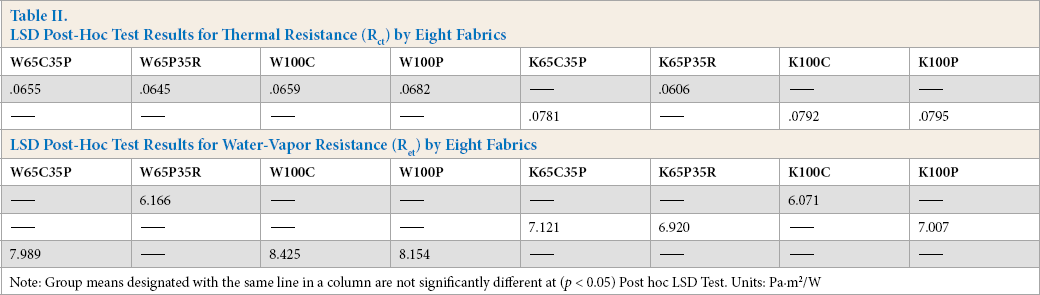
Note: Group means designated with the same line in a column are not significantly different at (p < 0.05) Post hoc LSD Test. Units: Pa•m2/W
According to the results of the one-way ANOVA on Ret values, the main effect for the eight fabrics was significant (F (7, 16) = 9.036, p < 0.00). Thus, H3 was supported for Ret values. As shown in Table II, the results of the LSD post-hoc test categorized these fabrics into three groups. Group A included W65C35P (7.99), W100C (8.43), and W100P (8.16) fabrics. Group B was comprised of K65C35P (7.12), K65P35R (6.92), and K100P (7.01) fabrics. Group C included W65P35R (6.17) and K100C (6.07) fabrics. Group C had significantly lower Ret values than Groups A and B (Table II). Therefore, Group C fabrics had the highest moisture permeability of the three groups, making these fabrics the most comfortable choices for NSJs tested in this study based on Ret values.
Conclusions
This study sought to confirm which NSJ fabrics had the most desirable thermal benefits. The properties of those fabrics currently used to manufacture NSJs, as well as other potential fabrics, were evaluated by comparing different fabric structures and fabric fiber contents for their thermal comfort properties. The study highlighted the importance of vapor transport and thermal transfer properties as predictors of thermal comfort. Several fabrics recently manufactured in the medical uniform industry were tested. The results demonstrated the benefits of an approach to thermal comfort assessment based on investigation of optimal fabric properties for the best thermo-physiological comfort. Moreover, this study demonstrated the value of the measurements made using the sweating guarded-hot-plate as part of comprehensive research designed to explain complex human responses to thermal comfort levels.
This study further demonstrated that the four knitted structures had greater beneficial thermal resistance and water-vapor resistance properties than did the four woven structures. The results also indicated that knitted cotton, polyester, or knitted cotton- and polyester-blended fabrics, offered the greatest thermal resistance. Woven cotton, polyester, and woven cotton- and polyester blended-fabrics also had greater water-vapor resistance, indicating that these fabrics were less permeable to sweat in a microclimate than were the other fabrics tested. Furthermore, in terms of the different fabric fiber contents tested for thermal resistance, the fiber content of polyester- and rayon-blended fabrics that were tested had the least thermal resistance—significantly less than the other fabric fiber contents (C65P35, C100, and P100). Cotton and polyester were superior to rayon for maintaining heat. However, surprisingly, the water-vapor resistance was unaffected by the fabric fiber contents.
The LSD post-hoc test results indicated that all the tested fabrics were significantly different in terms of thermal and water-vapor resistance. Specifically, K65C35P, K100C, and K100P gave improved heat retention between the human body and the worn garment. W65P35R and K100C permitted good moisture movement. K65P35R had the worst thermal properties, and W100C had the worst moisture permeability. Thus, this study not only revealed the differences in fabric thermal comfort properties, but also identified the specific fabric properties of an ideal NSJ. These results can be the basis for manufacturing NSJ fabrics with optimal fabric content and structure to enhance thermal comfort.
Limitations and Future Studies
This study has several limitations in terms of improving thermal comfort conditions for NSJs. First, the researcher only considered a selected set of woven and knitted fabrics that were currently available in the market to test thermal comfort properties. However, based on the effectiveness of these fabric properties to enhance thermal insulation and water-vapor permeation in such textiles, future researchers should address additional characteristics of fabrics, such as thickness, finishes, and textile structures. The types of fiber and yarn that produce thicker fabrics (e.g., weft pile fabrics and terrycloth) can have a significant influence on thermal insulation. 19 Additionally, for this study to be more informative and comprehensive, it should be conducted on other components of nurse uniforms (e.g. pants, tops, and lab coats) to determine their thermal comfort conditions rather than just specimens from one specific garment studied in this report. In future studies, researchers should consider different equipment and/or test methods to examine thermal insulation, such as a thermal manikin, a moisture transmission test, the ASTM E96 cup method, and the Moisture Management Tester (MMT). Such efforts may provide more accurate data related to fabric properties and thereby enable manufacturers to further improve the thermal comfort design of NSJs.