





Abstract
This research deals with the synthesis of hemicyanine-based fluorescent polymeric dyes and their use in acrylic dyeing. Three new hemicyanine dyes were synthesized by the Knoevenagel reaction, and grafted to carboxymethylchitosan (O-CMC) to form polymeric dyes. The resulting dyes were characterized using 1 H-NMR and 13 C-NMR spectroscopy, indicating that these polymeric dyes were successfully synthesized. The practical utility of these polymeric dyes was demonstrated by their successful application on acrylic fabrics to give highly fluorescent colors. The fluorescence, color characteristics, and photostability of these dyed fabrics were tested using a fluorescence spectrometer, a spectrophotometer, and a lightfastness tester. Results showed that acrylic fabrics dyed with these polymeric dyes were fluorescent and had better photostability than the parent dyes.
Keywords
Introduction
Fluorescent dyes absorb light energy of a specific wavelength and re-emit it at a different wavelength. Fabrics dyed with fluorescent dyes have unusually brighter colors and higher visibility than those of non-fluorescent dyes. 1 Because of their intensified perceptibility, textiles dyed with fluorescent dyes can be used in manufacturing articles requiring high visibility such as safety vests for policemen, firefighters, sports clothes, and signage. 2 Many different kinds of fluorescent dyes have been used in textiles (e.g., derivatives of pyrene, coumarin, anthraquinone, 1,8-naph-thalimide, and hemicyanine). 3
Hemicyanine dyes are an important group of fluorescent dyes and have applications in optical power limiting, 4 frequency-upconverted lasing, 5 fluorescence probes, 6 molecular electronics, 7 and elemental detection. 8 Studies on hemicyanine dyes have been largely focused on optical power limiting, two-photon pumped upconversion intracavity lasing, and fluorescence probes. 9 Our research group has synthesized a series of hemicyanine fluorescent dyes, and investigated their application in dyeing wool, silk, and acrylic fabrics to produce fluorescent fabrics.10–13Despite their good dyeing properties, these hemicyanine derivatives do not have adequate photostability for more demanding applications where prolonged exposure to light is involved. Fortunately, there are many ways to improve the photostability of dyes (e.g., embedding in sol-gel coatings, 14 using UV absorbers, 15 controlling the weaving process, 16 and introducing a polymer skeleton to create polymeric dyes). 17
In recent years, our research group has mainly focused on methods to improve the photostability of fluorescent dyes by introducing a polymer skeleton, which can be used as a channel to transfer the energy absorbed by dye moieties resulting in enhanced photostability of synthesized dyes. This study is aimed at designing and synthesizing hemi-cyanine-based fluorescent polymeric dyes with improved photostability, their application in dyeing of acrylic fabrics, and evaluation of their color characteristics, fluorescence, and photostability.
Experimental
Materials
Piperidine, 4-methylpyridine (
4-
Synthesis 1-(5-Carboxypentyl)-4-methylpyridin-1-ium bromide (2)
4-Methylpyridine (
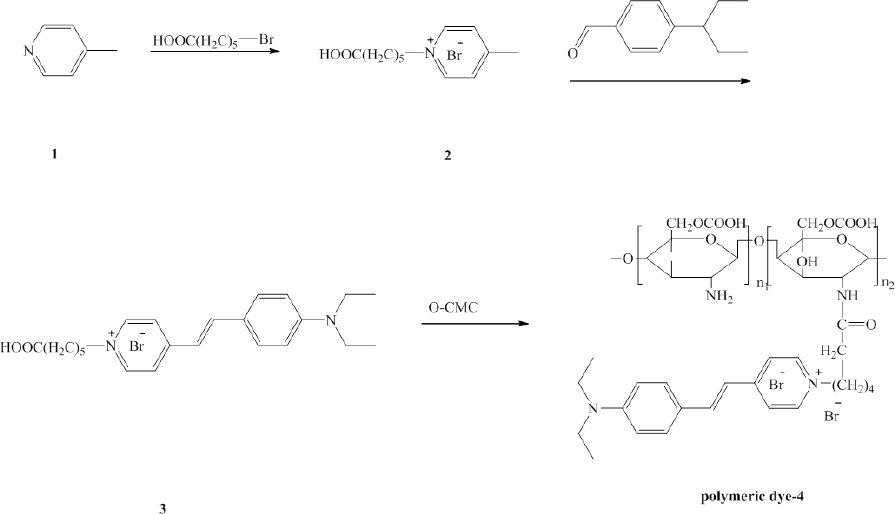
Synthesis of polymeric dye
(E)-1-(5-Carboxypentyl)-4-(4-(diethylamino)styryl) pyridin-1-ium bromide (3)
1-(5-Carboxypentyl)-4-methylpyridin-1-ium bromide (
2-Methylbenzothiazole (5a) and 2,3,3-Trimethyl-3H-indole (5b) Based Intermediates 6a and 6b
Synthesis of compounds
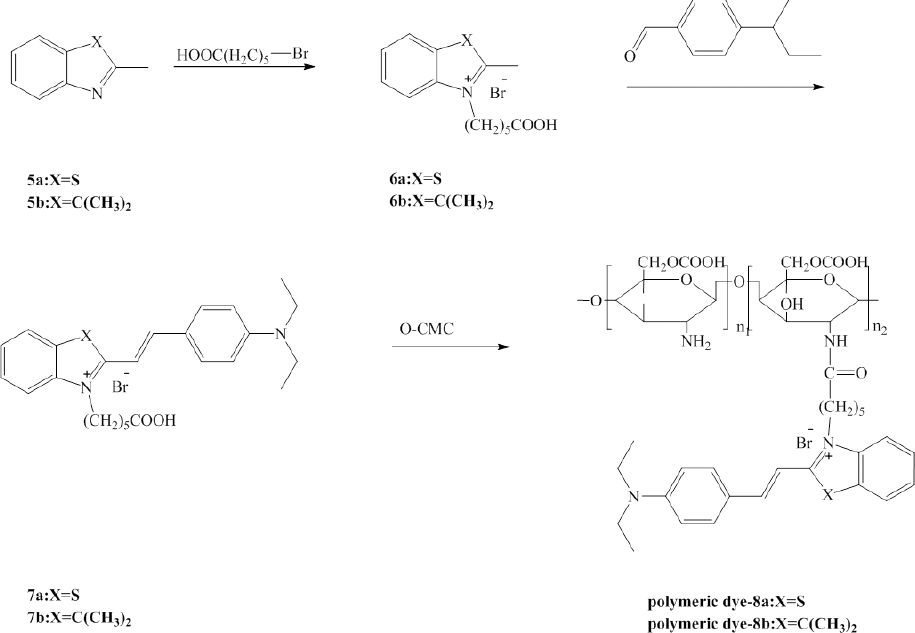
Synthesis of polymeric dyes
Hemicyanine Dye Synthesis
Compounds
Graf Polymeric Dye Synthesis
Hemicyanine dye (
Polymeric Dye Characterization
The distinction between Fourier transform infrared (FTIR) spectra of O-CMC and polymeric dyes can be seen in Fig. 1. Compared to the FTIR spectra of O-CMC, the bands at 1150 cm–1 (C-N stretch in Ph-NH2) and 899 cm–1 (N-H amino deformation) were not present in the IR spectra of the polymeric dyes. In contrast, amide N-H stretching peaks are seen for
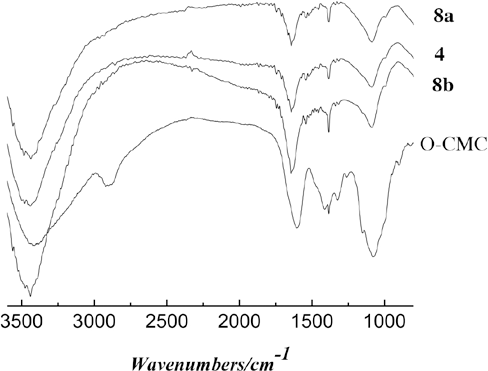
FTIR spectra of the polymeric dyes and polymer skeleton.
The various amide characteristic absorption peaks of polymeric dyes
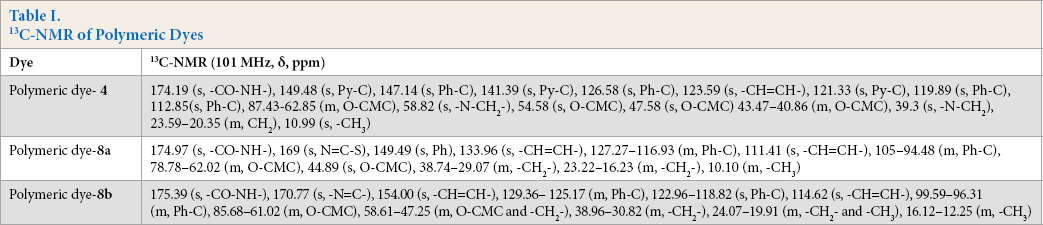
13 C-NMR of Polymeric Dyes
Dyeing
The hemicyanine dyes (
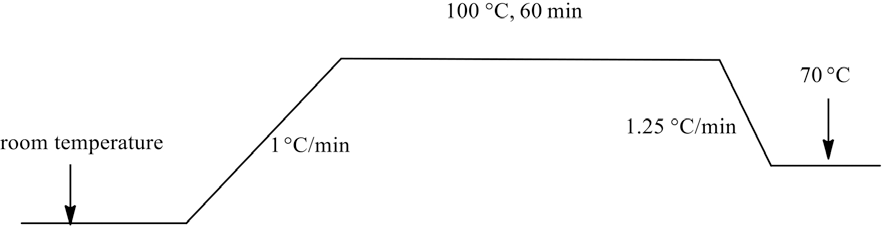
Time-temperature profile of dyeing process.
Analysis
1
H-NMR spectra were recorded with a GCT-TOF NMR spectrometer (Varian) at RT using tetramethylsilane (TMS) as the internal standard.
13
C-NMR spectra of the solid was recorded with a GCT-TOF NMR spectrometer at 101 MHz. The reflectance spectra, chromaticity (x, y coordinates), and apparent color depth (
Results and Discussion
Color Characteristics
Digital photographs of dyed acrylic fabrics and aqueous polymeric dye solutions are shown in Fig. 3. Polymeric dyes
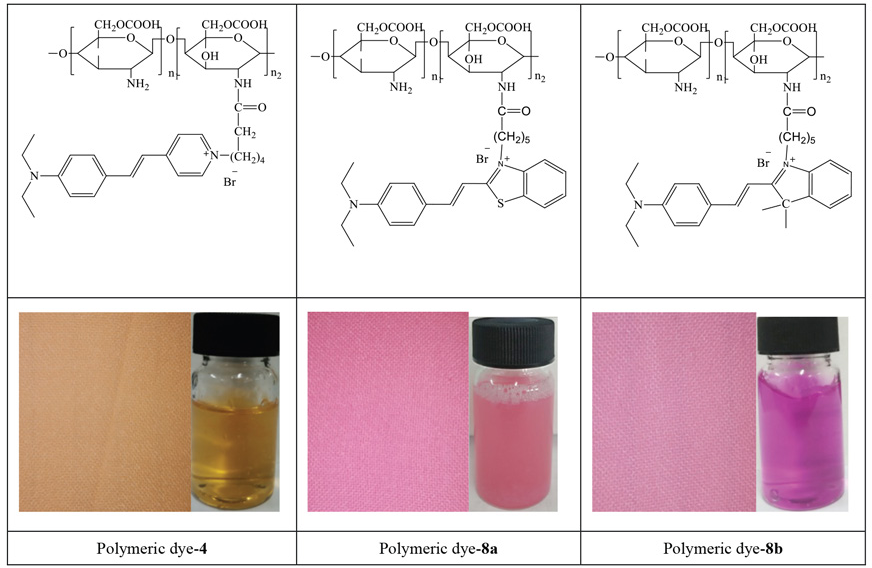
Chemical structure and images of dyed acrylic fabric and aqueous solution of polymeric dyes.
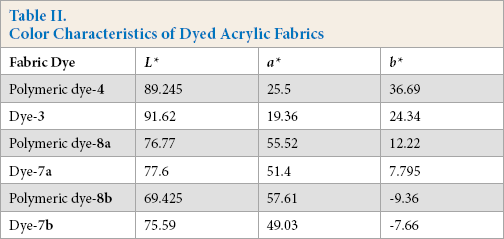
Color Characteristics of Dyed Acrylic Fabrics
Fluorescence Properties
Reflectance and fluorescence spectra are important for characterizing fabric dyed with fluorescent dyes. The visual effects of fluorescent dyes involve both the color when dyes absorb visible light selectively and the resulting emission fluorescence. In Fig. 4, the absorption spectra were in the range of 400 to 550 nm. The reflectance of the undyed acrylic fabrics was around 80%. The maximum reflectivity of acrylic fabrics dyed with three polymeric dyes was around 120%. Furthermore, there were obvious emission peaks in emission spectra of fabrics dyed with the three polymeric dyes (Fig. 5). The maximum emission wavelengths of three polymeric dyes were 558 (
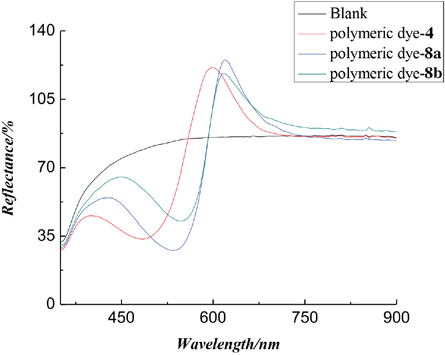
Reflectance spectra of acrylic fabrics dyed with polymeric dyes
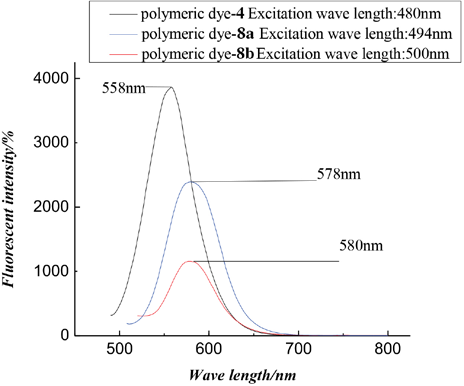
Emission spectra of acrylic fabrics dyed with polymeric dyes
Lightfastness
Fig. 6 shows the effect of light exposure on the
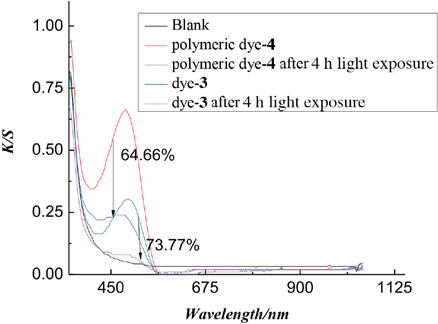
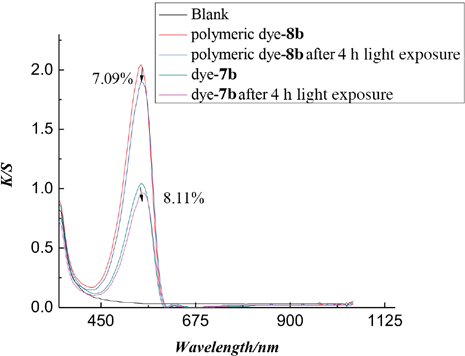
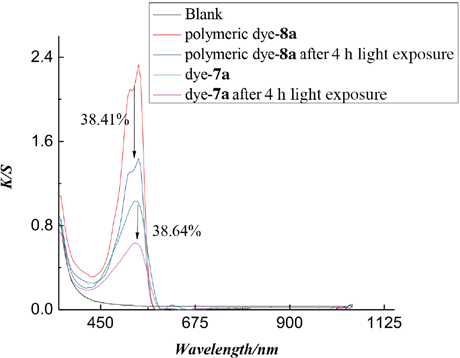
Fig. 9 shows the effect of light exposure duration on relative change in
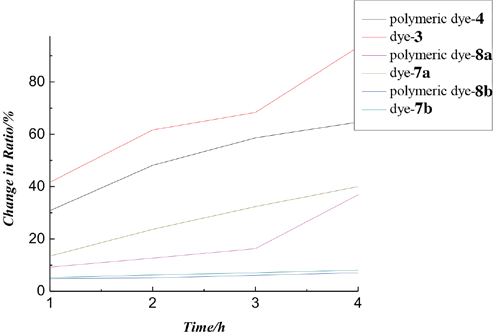
Effect of light exposure duration on changes in
Crockfastness
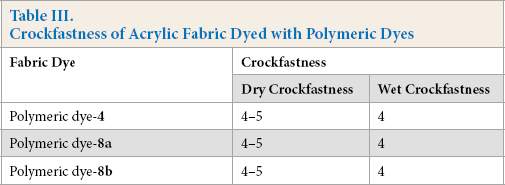
Wet and dry crockfastness of fabric dyed by three polymeric dyes were tested according to the GB/T 3920-2008 standard and evaluated by ISO 105/A03-1993 (Table III). For the fabrics dyed with polymeric dyes, dry crock ratings of 4–5 and wet crock ratings of 4 were attained. Due to the polymeric dyes being ionically-bonded to the fiber, the fabric dyed by the polymeric dyes had similar crockfastness values.
Crockfastness of Acrylic Fabric Dyed with Polymeric Dyes
Conclusions
Tree hemicyanine based fluorescent polymeric dyes (