





Abstract
This paper aims to provide a comprehensive review of body armor research with regards to categories, function, and ballistic performance; demonstrating that the improvement in materials and structures are the two basic factors promoting the technology behind body armor improvements. Additionally, this review also provides a better understanding of body armor, its importance, and the benefits of further developments in this field.
Introduction
Police and members of armed forces may be deployed in extremely dangerous situations and face the risk of serious injury or fatal wounding while carrying out their duties. Body armor is an integral part of a wearer's fighting kit as it plays a key role in protecting police or military personnel from enemy threats, warfare tactics, and military systems.1–7 “The [US] National Institute of Justice has reported that the risk of fatality from firearm assaults is 14 times higher for officers who are not wearing body armour than for those wearing body armour.” 8
Body armor is virtually a requirement for police and soldiers, especially when anti-social behavior and global terrorism seem to dominate the news. Inadequate safety measures could put frontline professionals at unnecessary risks and cause intolerable injuries or harm. In fact, the inclination to wear body armor is nothing novel; various types of materials have been used to protect humans from injuries in battles and other dangerous situations throughout history. Ancient tribes used animal skins and other natural materials to protect their bodies. The warriors of ancient Rome and medieval Europe covered their torsos in metal plates before going into battle. 9 “With the development of civilization, body armor development advanced and was mainly classified into the following three categories.
Armor made of leather, fabric, or mixed layers of both, sometimes reinforced by quilting or felt.
Chain mail, made of interwoven rings of iron or steel
Rigid armor made of metal, horn, wood, plastic, or other tough and resistant material” 10
With the advent of more effective weapons (e.g., guns and cannons) in the 15th century, body armor had to be improved against high-speed projectiles. Use of traditional body armor was not reliable enough against firearms. Silk, used as body armor by the Japanese in medieval times, was not considered as soft body armor in the United States until the late 19th century. However, silk soft body armor was only effective against low-velocity bullets travelling at 400 ft/s or less; early 20th-century ammunition travelled at more than 600 ft/s. 11 “In the First World War, various experiments were carried out to develop soft body armor; linen, tissue, cotton, and silk were used in the padded neck defenses and vests in the UK. Americans developed bulletproof body armor against pistol projectiles by using overlapping steel plates sewn to strong fabric garments in the 1920s and 1930s. Such body armor could offer good protection, but was quite heavy and uncomfortable.” 10 Body armor known as a flak jacket, which provided effective protection against ammunition fragments, was developed in World War II. However, the flak jacket was not good enough against most pistol and rife ammunition threats. In addition, as the flak jacket was sewn with steel plates, it also had disadvantages in weight and conformability that limited its wide use. 11 “ A technical breakthrough of body armor research occurred in the 1960s, when the first ballistic nylon was invented. Body armor made of ballistic nylon had reduced weight and improved ballistic protection.” 10
The revolution in modern body armor generation occurred when DuPont introduced its new aramid fiber, Kevlar, in 1965. This fiber, which is five times stronger than steel on an equal weight basis, is widely used in today's reliable, lightweight bullet-proof body armor. 12 Use of high-strength and high-performance materials in body armor is now common worldwide.
Categories
Body armor mainly functions to protect the human torso from firearm-fired projectiles and fragments from explosions. They can be divided into two main categories based on ballistic threats: soft body armor and hard body armor.13–16
Soft Body Armor
Soft body armor is constructed from many layers of flexible woven or laminated fabrics, or other ballistic-resistant fabrics. They consist of 7–50 layers based on the required protection level and fabric style. The areal density of these fabrics is around 90–250 g/m2 at which the ballistic performance could be accurately demonstrated. These fabric layers are assembled into a ballistic panel. The ballistic panel is in turn inserted into a carrier (an outer layer of garment fabric with no general ballistic resistance) that provides a means of supporting and securing the armored garment to the user. The ballistic panel may be retained or removed from the carrier. 8 The whole armor garment is generally manufactured in the form of a vest to help maintain the wearer's mobility. Cover vest and over vest are the two main styles, as shown in Fig. 1. 17 The cover vest is concealable, worn underneath a shirt, sweater, or casual hoodie, and the over vest is worn over the uniform.
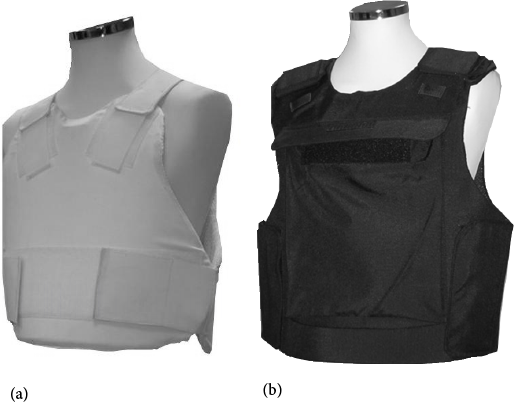
Body armor (a) cover vest and (b) over vest. 17
The fabric of soft body armor is made from synthetic polymeric lightweight fibrous materials that exhibit greatly-improved ballistic-resistance performance. 10 The two main types of fibers used in soft body armor are aramid and high-performance polyethylene. Well-known brands of aramid fibers are Kevlar (DuPont), and Twaron and Technora (Teijin Aramid). Dyneema (DSM) and Spectra (Honeywell) belong to the high-performance polyethylene group. Other important ballistic fibers are ballistic nylon and poly(p-phenylene-2,6-benzobisoxazole) (PBO), albeit they are rarely used in todays market. The energy absorption properties of ballistic fibers have been reported (Fig. 2). 18
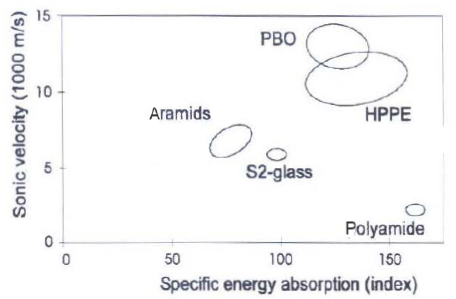
Energy absorption properties of high-performance fibers. 18
Para-Aramid Fibers
A para-aramid fiber consists of long synthetic polyamide chains in which at least 85% of the amide linkages are attached directly to two aromatic rings. The polyamide, poly(para-phenylene terephthalamide), is produced from the reaction between para-phenylenediamine and terephthaloyl chloride at low temperature in a dialkyl amide solvent (e.g., hexamethylphosphoramide, N-methyl pyrrolidone, or dimethyl acetamide). 19 These highly-oriented chains with strong interchain bonding largely determine the para-aramid fiber's unique chemical and physical properties: lightweight, high impact resistance, high strength, excellent thermal and dimensional stability, flame resistance, and cut resistance. These excellent characteristics make para-aramid fibers superior in many protective applications. The scanning electron micrograph (SEM) of a typical para-aramid fiber (Kevlar) is shown in Fig. 3. 19
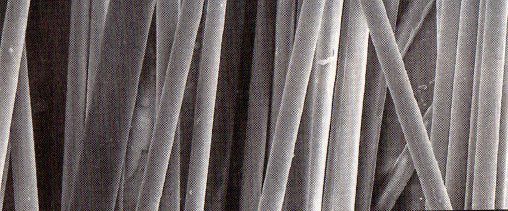
SEM of Kevlar filaments. 19
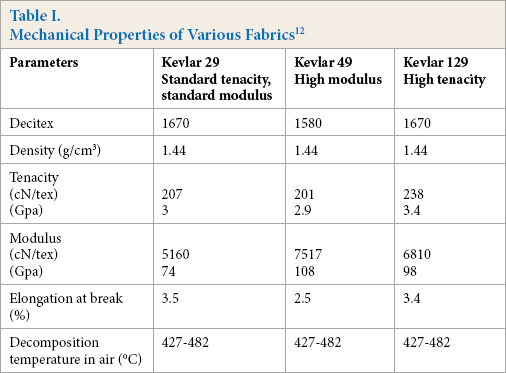
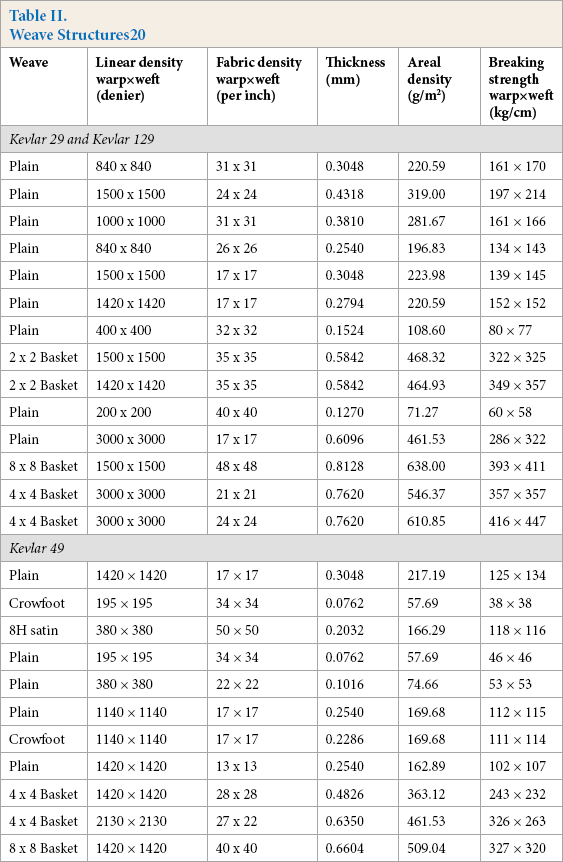
After five decades of innovation, improvements to Kevlar continue. Currently the most common types of Kevlar used in ballistic applications are Kevlar 29, 49, and 129. Kevlar 29 was the first and the original family product type used in life protection applications. Kevlar 49 is a well-known type of high-modulus fiber and Kevlar 129 is renowned for its high tenacity. Their material properties are listed in Table I. 12 The fiber types and the most used woven structures in the fabric panels for soft body armor are listed in Table II. 20
Mechanical Properties of Various Fabrics 12
Weave Structures20
Polyethylene Fibers
Ultra-high molecular weight polyethylene (UHMWPE) is used to prepare high-performance polyethylene (HPPE) fibers by a solution (gel)-spinning process. 21 UHMWPE contains extremely-long chains of very high molecular weight. 22 The highly parallel-oriented molecule chains are the main characteristic of HPPE fibers, which give it properties of high strength and high modulus, but low density.
Other Fibers
Ballistic nylon is a polyamide fiber which has been used in ballistic applications for a long time. The history of nylon fiber usage dates back to World War II. As para-aramid and polyethylene fibers became dominant in protective applications due to their superior mechanical properties, ballistic nylon fiber has diminished in relative importance.
PBO, or Zylon (Toyobo), is another high-tenacity fiber with a fully extended chain structure. It consists of poly(p-phenylene-2,6-benzobisoxazole) rigid chains. 23 It has high strength and modulus and has a higher decomposition temperature than some high-tenacity fibers. However, degradation under UV and visible light may be an issue. 24 PBO fiber-based body armor became controversial when US police officers failed to be protected in 2003. In 2005, Zylon use in ballistic applications was restricted by the US National Institute of Justice. 25
Hard Body Armor
Hard body armor is used against higher level threats, such as rife rounds and metallic components. It is constructed by inserting ceramic, metal, or plastic plates into the pocket which is on the inside or the outside of the soft body armor to provide additional protection. Nowadays, armor grade ceramics include aluminum oxide, silicon carbide, and boron carbide. The materials of those plates possess additional stab-resistance or puncture-resistance abilities due to their tough and rigid properties. 10
Hard body armor is much more weighty and bulky than soft body armor because it contains rigid ceramic or other types of plates required in front and back of the human torso. Due to its weight and bulkiness, it is impractical for routine use by police officers, but is more likely to be worn by military personnel for short periods against high-level threats. Soft body armor is more suitable for routine tasks as it is much more lightweight and comfortable.
Functions
The main function body armor should possess is ballistic resistance, as the most frequent threat faced by police and members of armed forces is from firearms and projectile fragments. Furthermore, stab resistance is important because pointed and sharp-edged weapons are notably fatal threats to police and military personnel, and especially to officers in correctional facilities. 26 Other additional functions of body armor are also considered to protect wearers as much as possible.
Ballistic Resistance
Ballistic resistance of body armor is demonstrated as the ability to absorb the kinetic energy coming from flying projectiles. Body armor consists of multiple layers of very strong fibers, which can absorb and disperse the energy of the impact across a general area when a projectile strikes it. Additional energy is absorbed by each successive layer of material until the projectile has been stopped, or the projectile may penetrate all layers if it possesses very strong kinetic energy. Multiple layers also assist in reducing the effects of blunt force trauma, caused by the force of the impacting projectile against the armor, resulting in non-penetrating internal injuries such as bruises, broken ribs, or other injuries to internal organs. The typical test apparatus for ballistic testing has been described. 27
Six formal ballistic-resistant body armor classification types were established in accordance to the NIJ Standard–0101.06 (NIJ is the National Institute of Justice: a component of the Office of Justice Programs within the US Justice Department engaged in presenting information about selection and application guides on personal body armor). They are Type II-A (9 mm; .40 Smith & Wesson), Type II (9 mm; .357 Magnum), Type III-A (.357 SIG; .44 Magnum), Type III (Rifles), Type IV (Armor Piercing Rife), and Special Type. 28 Ballistic body armor is divided into seven categories— HG1/A, HG1, HG2, HG3, SG1, RF1, and RF2—in the body armor standard for UK police, published by the Home Office Police Scientific Development Branch (HOSDB, formerly PSDB), and supported by the Association of Chief Police Officers (ACPO) Conflict Management Portfolio, ACPO Body Armor Sub-Group, Home Office Public Order Unit, and the Police Federation of England and Wales. 27
Stab Resistance
Stab resistance of body armor is generally strengthened using very tightly woven fabrics or very closely-spaced laminated layers to counteract the high impact forces of stab threats coming from pointed knives, ice picks, or spikes. 8 As the threat impacts the armor, the materials either defect the threats, or slightly stretch before breaking or being severed (due to their very high levels of tensile strength and cut/tear resistance) while the impact force is distributed over a larger area of armor. Multiple layers are also used to dissipate the impact energy from stab threats. 29
Stab-resistant body armor is placed into two categories, based on the kind of threats it is designed to shield. 8 The first category is designated the “edged blade” class; it shields engineered or high-quality blades. The second category, which is named the “spike” class, protects from the types of improvised weapons commonly found in correctional facilities. Within each of these two categories, there are three levels of protection from low-to-high based on the energy that would impact the body armor during an attack. The titles of these levels are given according to the HOSDB body armor standards for the UK police (2007), known as KR1 & KR1+SP1 (low protection level), KR2 & KR2+SP2 (medium protection level), and KR3 & KR3+SP3 (high protection level).
Other Functions
Body armor may also need to have additional functionality (e.g., UV, heat, flame, and water resistance) to accommodate harsh environments associated with armed combat, chemical and biological warfare, and extreme climates. Many manufacturers are competing by providing functional materials to enhance body armors’ various properties. For example, Milliken & Company has released Abrams fabric, an innovative flame-resistant fabric for protective vests providing greater protection against flames and burns in a more durable, printable fabric with the benefits of improved lightfastness and strength. 30 TenCate also produces flame resistant fabrics (Defender M fabrics) to be used in military applications. 31 With regard to waterproof functionality, water-repellent treatment on the ballistic material could be provided by using GoreTex. According to the manufacturer, GoreTex is a water-resistant fabric made of expanded Teflon, which allows perspiration to evaporate, but prevents moisture from reaching the ballistic material. 8 Fierce competition prevails in the body armor application market; manufacturers may need to develop different technologies to ensure superiority over their competitors.
Ballistic Performance of Body Armor
As the major function of body armor is to protect against firearm-fired projectiles and fragments from explosions, numerous studies have been carried out to investigate the ballistic performance of body armor during in the last two decades.32–54 Materials and structures are the two main aspects scientists and researchers have focused on.
Materials
Aramid
Many investigations were performed on the damage and energy absorption behavior of para-aramid armor plates as aramids are regarded as the most widely-used ballistic protective materials. Silva et al. investigated the ballistic resistance of Kevlar 29 reinforced vinyl ester armor plates experimentally and theoretically. 55 A study done by Hayhurst et al. investigated the damage and energy dissipation behavior of para-aramid armor plates with different ply numbers under high-velocity impacts with heavy particles. 56 Akdemir et al. examined the effect of production parameters on the terminal ballistic properties of para-aramid composite armor under different conditions. 57 Additionally, Simons et al. used finite element analysis modeling to investigate the damage behavior of para-aramid armor under various threats. 58 Clegg et al. discussed the damage behavior on the para-aramid armor plate, which consists of 19 plies subjected to threats of 1.1 g weight under ballistic impact. 59 Furthermore, Riewald et al. produced armor plates and helmets made from para-aramid materials and tested their ballistic performance under water immersed conditions. 60 Colakoglu studied the ballistic performance of two different polymer matrix composites for armor design. 61 Finally, Lim et al. also researched the damage behavior of para-aramid armor plates under the ballistic impact of four different projectile geometries by using electron microscopy. 62
DuPont recently released a new type of ballistic material known as Kevlar XPTM, which is reported to provide a 15% reduction in backface deformation and a 10% reduction in overall weight, to maintain its performance under extreme field conditions (e.g., heat, humidity, and mechanical wear). 12
Teijin Aramid promotes Twaron CT Microfilament, which is a highly-resistant aramid fiber made from 1,000 individual fine filaments. More filaments (50%) are used in this type of yarn than traditional aramid yarns. 63 Body armor using Twaron CT Microfilament is reported to be lightweight and comfortable.
High-Performance Polyethylene
DSM introduced Dyneema HB50 in 2007, which was an ultra-strong and lightweight polyethylene material. Panels made with Dyneema HB50 could absorb rife impact rife from AK47s and NATO Balls. It was upgraded to HB80 in 2009 and was claimed to be the highest ballistic performance unidirectional (UD) product on today's market. 64
Honeywell has updated ballistic materials from Spectra Shield II SA-3113 to Spectra Shield II SA-1211, which has strong protection against NIJ threats and substantially reduces blunt trauma. Honeywell's state-of-art technology is Gold Shield GN-2117, promoted in 2009, which has demonstrated up to a 10% reduction in weight but provided higher surface durability and chemical resistance when compared with Honeywell traditional Gold Flex material. 65
The advantages of aramid fiber in higher melt temperature and friction coefficient may be the factors behind this innovation. Nevertheless, the invention of Gold Shield GN-2117 will expand Honeywell's portfolio of ballistic materials for advanced armor systems.
Potential Materials
Nanomaterials
Nanotechnology is predicted to produce revolutionary changes with far-reaching consequences in various areas. Nanostructured materials have great potential in replacing their traditional counterparts to make stronger, lightweight armour. 66 But it is unclear whether this type of materials could provide improvements over heavy armor. Nevertheless, nanofiber-based garments are now likely candidates for providing protection against projectiles.
The new type of carbon nanotube fiber is exemplified by the work of a group from the Department of Materials Science and Metallurgy at the University of Cambridge. 67 Made up of millions of tiny carbon nanotubes, this fiber is very strong, lightweight, and good at absorbing energy at very high velocities. Researchers from this group declared that their material is already several times stronger, tougher, and stiffer than fibers currently used to make protective armor. 67 However, the stable daily output of this product is currently uncertain as it may be hard to meet industrial demand. Further research will be required to increase the productivity of this method.
Wool
The incorporation of wool fibers into aramid fabrics improves the ballistic performance of the fabrics as more energy is absorbed due to increased friction between yarns. 68 Blending in wool also can benefit wearer comfort and improve moisture management. The downside is that the wool is incorporated as yarn at the weaving stage rather than as fiber at the spinning stage due to the large difference in fiber properties between wool and aramid. The interaction between wool and aramid yarns is not tight and a special loom is required to insert them together as parallel yarns to make fabrics.
Ramie
Ramie may be used in the making of bulletproof panels as it is one of the strongest natural cellulose fibres. 69 Bulletproof panels made from ramie fiber reinforced composites are lighter in weight and much less expensive than conventional counterparts made from ceramic plates, aramid composites, or steel-based materials. Ballistic testing of bulletproof panels made from ramie fiber reinforced composites for NIJ level II, IIA and IV was preliminarily investigated and the results were optimistic. 69
Structures
Not only materials, but also structures, can influence the ballistic performance of body armor. Woven, nonwoven, and multi-component structures are mainly used in body armor.
Wovens
Woven structures, especially plain woven, are the most widely-used structures applied to body armor. The ballistic performance of layered woven fabrics can be influenced by weave structure, yarn count, warp × weft construction, and so forth. Corresponding parametric studies were extensively investigated by Ashok and the results are shown in Table II. 20 Plain weaves with a linear density of 1420 denier and fabric density of 17 × 17 ends/picks per inch offer an optimal compromise of breaking strength, weight, and cost savings.
Boundary conditions can also affect the ballistic performance of woven fabrics. Shockey et al. found the ballistic performance of fabric can be increased by clamping on two opposing sides of fabrics. 70 Cunniff investigated the influence of fabric sample dimensions on ballistic properties using Kevlar and Spectra fabric samples. 71 The result was that fabric samples with smaller dimensions could provide higher energy absorption capability. Cork and Foster developed narrow fabrics that were empirically conformed to absorb more energy than wider fabrics against ballistic impacts, especially when gripped in a two-sided configuration. 72 However, narrow fabrics introduced lines of weakness between strips when incorporated into a fabric panel. Another problem was the difficulty of producing whole fabric panels using the narrow fabrics. It was suggested to glue fabrics to an insubstantial mounting frame made from a simple polystyrene composite. However, this was a time-consuming procedure and the related ballistic performance of fabric panels still needed verification as no systematic tests were carried out. This research may encourage further theoretical and empirical work on the efftects of boundary conditions.
The ballistic performance of a woven fabric can be improved by using weft yarns, which have higher tenacity than warp yarns, as suggested by Chitrangad. 73 The weft crimp is often lower than the warp crimp during the weaving process. 74 Therefore, during fabric construction, weft yarns exhibit more tension than warp yarns and are easier to be stretched to break against the ballistic impact. With the tenacity increases in weft yarns, equal warp and weft crimps can be expected and therefore the same amount of deformation in warp and weft directions will be achieved. Such fabric construction enhances the energy absorption during ballistic impact to a higher level.
Stitching is another important factor influencing the ballistic performance of the layered woven fabrics.75–77 Karahan et al. developed three stitch types that were used to combine a different number of fabric layers to form panels. 78 A dramatic reduction of trauma depth (6.7%) was observed with type (c) stitching compared to the type (a) stitching having the same fabric ply number. Bilisik and Turhan made a further study of this by introducing the multidirectional arrangement of fabric layers. 79 Unstitched and stitched were defined as two classifications. Both were further made up of four structure types. The first two types were totally layered Kevlar 29 fabric and Kevlar 129 fabric, and the third type was half-layered Kevlar 29 and half-layered Kevlar 129, all with 14 layers/type. The last one was 12-layer Kevlar 29 fabric oriented ± 45° to the fabric axis and 2-layer Kevlar 129 at the bottom. The resulting trauma depth that was positively affected by stitching was verified again as lower values were found on multi-axis stitched structures, although there was no apparent energy dissipation difference between multi-axis stitched and unstitched structures. However, the stitching could not be made too dense as dense stitching increased the rigidity of the fabric panel, which made the wearer uncomfortable if such a fabric panel was inserted into the body armor carrier.
Nonwovens
Unidirectional fabric structures (a kind of nonwoven structure) are also used in body armor. Unidirectional fabric is generally composed of laminated layers of fabric at right angles. Each layer of fabric is made of densely-packed parallel yarns. As there are no interlacements in the unidirectional fabric structure, the energy absorption of unidirectional fabric should be different from woven fabric. Karahan did comparisons of energy absorption between unidirectional Kevlar and woven Twaron fabrics. The result showed that the former could absorb 12.5% to 16.5% more energy. 78 However, this did not definitely conclude that unidirectional fabric was better than woven fabric regarding ballistic performance as aramid fabrics from different companies were used. As Dyneema is normally used in unidirectional fabric, a comparison of ballistic energy absorption between unidirectional Dyneema fabrics and woven Dyneema fabrics would be more worthwhile.
Multi-Component
The state-of-art technology in body armor research is to use multi-component structures in making ballistic fabric panels as they give greater advantages in ballistic performance over single component structures. Howard found that the structure of using a nonwoven facing on a woven fabric instead of Spectra shield alone could provide stronger capability against handgun fired projectiles at speeds of 350 to 430 m/s. 80 Unlike plain weave fabrics constructed from many interlaced points, which could cause stress wave reflection leading to subsequent early fiber breakage, nonwoven fabrics do not have interlaced points and thus are structurally bulky.
Ballistic performance could be greatly improved by using nonwoven fabrics as cushion layers. Cushion layers, together with impact layers, compose ballistic fabric panels. Cushion layers are the inner layers, close to human torso, that prevent non-penetrating damage (blunt trauma); impact layers are the outer layers that prevent non-penetrating damage and thus are normally made of bulletproof fibers. Lou et al. designed impact layers and cushion layers to resist bullet penetration and non-penetrating damage respectively. 81 This study buffered non-penetrating damage using an elastic cushioning structure combined with nonwoven fabric and chloroprene rubber. This combination helped dissipate impact energy through friction between chloroprene rubber and fibers. Lin also suggested enhancing the ballistic performance using cushion layers. 82 The novel compound cushion materials were made by needle punching and thermal calendaring into a sandwich structure. The sandwich structure was composed of polyester filaments laid on the pre-punched polyamide web with low-melting polyester staple fibers. The apparent buffer effect was achievable using this type of cushion layer.
Others
Coating is also an important way to improve fabric ballistic properties. Ahmad et al. suggested that high modulus natural rubber coatings can be used to improve ballistic performance. 83 Gadow et al. studied ceramic and cement plasma coatings on fiber fabrics to enhance protective performance. 84 High performance polyethylene (HPPE) fabric coated with elastomer was analyzed and was claimed to enhance multi-hit fire performance. 85 Additionally, Kevlar fabrics can be sprayed with STF (shear thickening fluid) in very thin coats to create liquid body armor. STF contains nanoparticles that solidify instantly against sudden impact. Complete protection can be provided (instead of just covering vital organs) by using this liquid body armor. Moreover, fibers coated with zinc oxide nanowires can be used in fabrics that could produce power from body movements. Such fibers may stimulate muscles and give wearers greater strength for physical movements. 86 Body armor made by this kind of fabric could enable soldiers or police officers to march faster, lift heavier objects, and carry more weapons.
Rao and Singh developed a polymer nanocomposite transparent panel and tested its impact resistance behavior experimentally and theoretically. 86 The use of nano-particulate reinforced polymeric adhesives exhibited enhanced impact resistance. Lee and his colleagues researched the influence of silica particle size on the ballistic performance of fabrics impregnated with a silica colloidal suspension. 87 The use of smaller silica particles gave a larger increment of inter-yarn friction at the onset of shear strain.
Conclusion
This paper has reviewed the current technologies used in body armor. Materials used in and the structures of body armor are two major aspects of research in this area. The main ballistic materials used today, aramid and UHMWPE fibers, will continue to play a very important role in ballistic protection. Additionally, fabric structures can be constructed to enhance ballistic performance, with multi-compound structures offering great potential as such structures can provide enhanced ballistic protection by impact energy absorption. Other impact energy absorption methods, such stitching and coating, also have been reviewed.
Researchers are continuing to develop technologies to enhance the ballistic performance for body armor through different solutions. The goal continues to be combining superb high-performance capabilities with extreme lightweight properties in future body armor.