






Abstract
The moisture content of cotton fiber is an important fiber property, but is often measured by a laborious, time-consuming, laboratory oven-drying method. The ability of a laboratory microwave moisture measurement instrument to perform rapid, precise, and accurate fiber moisture measurements was studied. The microwave instrument was calibrated versus two significantly different oven-drying methods. The agreement between the two oven-drying methods was very good, with low residuals observed. The precision of the microwave moisture content measurements was very high, approaching 0.1% moisture. The impact of sample fiber weight was minor, and instrument stability and long-term repeatability were excellent. Microwave cotton fiber moisture content measurement was shown to be viable and applicable for quality control use.
Introduction
Cotton fiber moisture content is an important fiber property, as moisture changes in the fiber can impact the fiber's product quality and downstream performance.1,2 Key areas of concern and interest in cotton fiber moisture content are impact on fiber physical properties, on instrumental measurements of cotton physical properties under non-standard environmental conditions, on textile processing, and on product quality as a result of high moisture content in bales placed into storage or shipped overseas.1,3–11 For laboratory measurements, fiber moisture content can vary as the moisture in the air changes with changes in environmental conditions (temperature and relative humidity (RH)) in the laboratory.
Lawson et al. examined the impact of changing RH on Stelometer fiber strength and elongation, in which changes in fiber strength and elongation were observed with changing RH. 5 Knowlton studied the impact of fiber moisture on the fiber strength measured by the Uster High Volume Instrument (HVI). 7 HVI measured strength increased with increasing fiber moisture content. A definitive study of fiber moisture impacts on cotton physical properties and instrumental results was performed by Thibodeaux et al., in which the impacts of fiber moisture changes (due to changes in laboratory temperature and RH) on HVI measured fiber strength and length were investigated. 8 It was shown that HVI measured fiber strength and length increased with increasing fiber moisture. In addition, this study demonstrated that different varieties can exhibit different fiber property moisture relationships and responses to changing environmental conditions (different linear slopes). To ensure consistency in laboratory measurements of the physical properties of cotton fiber and other materials, standard laboratory conditions for temperature and RH have been established. 9 For cotton, the standard conditions are 21 ± 1 °C and 65 ± 2% RH.
Anthony 10 and Baker et.al. 11 studied the impact of high cotton fiber moisture levels in stored bales. They found that high fiber and bale moisture levels can result in changes in fiber color and, at very high moisture levels, in quality, and processing problems and impacts. In the mid-2000s, reports in the marketplace of quality issues from cotton bales ginned at high moisture levels caused much concern. These concerns were a primary consideration in the US National Cotton Council recommendation, and the USDA Farm Service Agency rule, of a maximum 7.5% moisture content level in bales designated for the Commodity Credit Corporation loan pool.
For laboratory measurements, drying the fiber at a specific time and temperature, better known as the oven-drying moisture measurement method, remains the primary moisture measurement method used internationally. 12 In the United States, the oven method is a standard test method (ASTM D2495-07). 13 There are several terms used to express the moisture present in fibers and yarns by the oven method, but the two primary moisture content parameters are wet-based moisture content (MC) and dried-based moisture content (moisture regain or MR). MC is calculated by determining the weight difference between the original fiber weight and dried fiber weight, then dividing that difference by the original fiber weight to obtain MC (%), as shown in Eq. 1.

Wo is the original fiber weight and Wd is the dried fiber weight.
MR is calculated by determining the weight difference between the original fiber weight and dried fiber weight, then dividing that difference by the dried fiber weight to obtain MR (%), as shown in Eq. 2.

The gravimetric oven methods for fiber moisture measurements are normally low cost and easy to perform, but there are concerns. Primarily, drying the sample at temperatures > 100 °C can remove more than just the water present in the fiber, such as oxidation products, volatiles, loose particles, and so forth.14–16
Although the oven method is the most common method, there are numerous moisture measurement methods in use internationally, involving many different technologies. Rodgers et al. performed a comparative evaluation, in which several different moisture measurement instruments and technologies were compared for their technical and non-technical attributes (in four categories—weight loss (gravimetric), chemical, spectroscopy, and electric).17,18One spectroscopy-type laboratory moisture measurement technology that was not investigated was microwave, in which the microwave signal is used to measure MC and MR, as opposed to heating the sample for gravimetric weight loss measurements. Microwave measurements for cotton fiber MC are not common as laboratory measurements and have focused on MC measurements of the cotton bale after ginning.19–23 Microwave instruments offer the ability for very rapid and accurate fiber and yarn moisture measurements; lower analysis time than oven-based systems; the ability to measure large, more representative samples (>100 g); and are less complicated to calibrate than other spectroscopic instruments. Laboratory microwave moisture measurements are based on low-power microwave resonance technology, in which a low-powered microwave field resonates at a characteristic frequency and curve half-width. 24 When material is added to the sensor, the microwave resonance frequency and the half-width of the resonance curve are displaced proportionally to the moisture level in the fiber sample.
With its measurement speed and sample size advantages, interest in microwave moisture measurements were expressed by spinning mills and testing laboratories (including the cotton Material Testing Laboratory at the Southern Regional Research Center). A comparative evaluation was performed to determine the full capabilities of the microwave-based instrument to rapidly and accurately perform cotton fiber moisture content measurements. The objectives of the evaluation were to 1) determine the capabilities of the laboratory microwave moisture measurement method for rapid, precise, and accurate cotton fiber moisture measurements, 2) determine the impacts of key variables, and 3) determine the ability to use different reference methods. All measurements were performed at the US Department of Agriculture, Agricultural Research Service, Southern Regional Research Center (USDA, ARS, SRRC) facility.
Experimental
Materials and Procedures
The Aqua-Lab moisture measurement instrument (Mesdan S.p.A.) was used for microwave-based MC measurements. Vendor recommended calibration procedures consisted of developing three calibrations representing three different levels of cotton sample cleanliness—cottons with low, moderate, and high trash content levels (CL, CM, and CH). Aqua-Lab measurements for each calibration were prepared on the three cottons under five temperature-RH conditions (standard 21.0 °C/65% RH, and four low-to-high conditions of 15 °C /45% RH, 18 °C/55% RH, 24 °C/75% RH, and 27 °C /80% RH); each condition was performed in duplicate. Per vendor recommendations, the Aqua-Lab sample weight used was the fiber mass required to sufficiently fill the Aqua-Lab sensor or sample chamber (for most cotton samples, ∼125 g).
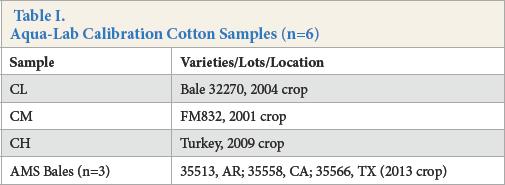
Reference moisture values for the calibrations were obtained using the Scirocco oven (105 °C, minimum of 150 g sample, and were dried until a weight difference in consecutive weighing was < 0.05%). For the Mesdan recommended calibrations for CL/CM/CH samples, the operator chose the calibration based on the relative perceived “cleanliness” or “trash level” of the fiber sample. However, this method was subjective and led to MC differences between different operators. In addition, the development and use of a single MC calibration for all cottons resulted in logistical and productivity gains and advantages. Thus, a combination calibration (Combined) was prepared by combining the results from the three calibration cottons of the CL/CM/CH calibrations and adding five measurements at varying temperature/RH values from three-2013 crop year samples obtained from the USDA-Agricultural Marketing Service (USDA-AMS), for a total of six cottons used in the Combined calibration. The samples are listed in Table I.
Aqua-Lab Calibration Cotton Samples (n=6)
Furthermore, SRRC oven-dried (105 °C, ∼7.5 g sample, dried for 24 h) MC values for the above samples were used to develop SRRC oven calibrations (CL-ARS, CM-ARS, CH-ARS, Combined-ARS); these calibrations were used to determine the Aqua-Lab's ability to perform accurate and precise microwave MC measurements using different oven reference calibration methods.
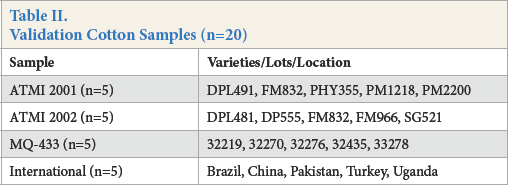
For the comparative MC evaluations, a prediction or validation set of 20 diverse cottons (15 domestic and 5 international varieties) were used to evaluate each individual and the combined Aqua-Lab calibrations (Table II). All Aqua-Lab measurements were made in duplicate for each sample. MC measurements were made for all Aqua-Lab calibrations developed both for the Scirocco and SRRC oven methods (both individual and combined calibrations) under standard conditions. To expand the MC range to be evaluated, the Combined calibrations for both Scirocco and SRRC methods were evaluated with eight additional samples that exhibited either very high or low MC values (four of the original 20 cottons conditioned each under 15 °C/45% RH and 27 °C/80% RH environmental conditions). The Scirocco and SRRC oven MC results for these 28 samples were also used for the comparison between the Scirocco and SRRC oven methods.
Validation Cotton Samples (n=20)
Impact on Microwave Measurements
For the sample weight impact evaluation, the three cotton samples used to develop the cotton cleanliness-specific calibrations (CL, CM, and CH) and Combined calibration were measured on the Aqua-Lab at sample weights of 75, 100, 125, and 150 g (± 0.1 g per sample). In addition, six measurements were made for each of the above samples for the cotton-specific and Combined calibrations to obtain the method precision for the Aqua-Lab methods. Aqua-Lab stability was determined with the 20 comparative cotton samples measured about one year apart.
Analytical Methods and Instruments
Microwave measurements of cotton MC were performed with the Aqua-Lab instrument. Oven reference MC measurements were performed with both the SRRC oven (DKN600, Yamato Scientific America Inc.) and the Scirocco unit. Samples representing higher and lower MC levels were prepared under non-standard conditions in a Climatest environmental chamber (Mesdan S.p.A.). Vendor recommended procedures were followed.
The Aqua-Lab is a microwave–based moisture measurement instrument that measures the fiber's MR, MC, and commercial weight values (Fig. 1). It performs rapid microwave analyses on between 100 to 150 g of cotton fiber using low-power microwave resonance technology. No sample preparation is required—the sample is simply placed directly into the sensor or measuring chamber until full, and a weighted top is placed upon the sample to compress it to a uniform pressure. For fiber measurements, the instrument is normally calibrated with the Scirocco oven system. For this evaluation, it was calibrated to both the large sample-mass Scirocco and low sample-mass SRRC oven reference methods.
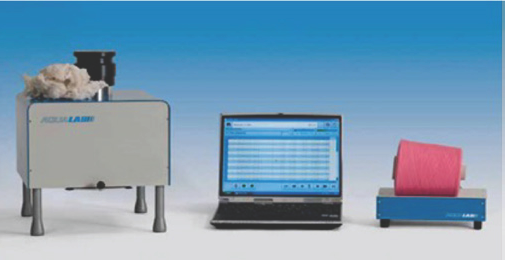
Mesdan Aqua-Lab instrument, with fiber and yarn modules.
Data Analysis
Prior to MC comparisons between the Aqua-Lab microwave unit and the two oven reference and calibration methods (SRRC and Scirocco), it was of interest to determine the method agreement between the two oven methods. The primary comparative parameters were the linear correlation coefficient (R) and linearity (slope nearness to 1.0).
MC comparisons between the Aqua-Lab and two oven calibration methods were performed. The primary comparative parameters were standard deviation of differences, SDD (the standard deviation of the differences in moisture results between the designated reference method and the compared method for each sample; a residual analysis) and two outlier ranges (percentage of samples with differences between the designated reference and compared method). Based on previous discussions with industry partners (e.g., Cotton Incorporated) for outlier limits (desired measurement/ method agreement between evaluated and reference methods/instruments) and the outlier target (% agreement), 17 two outlier ranges were selected for outlier determination—the tight range of > ± 0.30% MC, and a more commonly used MC range of > ± 0.50% MC. The lower the SDD value and the lower the number of outliers, the better the comparative MC method agreement between instruments. The targeted limit for outliers was ≥70% of the samples agreeing with the specified limit (± 0.30% MC and ± 0.50% MC) between the Aqua-Lab and oven reference method.
As noted previously, six measurements were made at four sample weights (75, 100, 125, and 150 g) for three cotton samples (CL, CM, and CH) to determine the measurement variability and precision and to determine the impact of sample weight on the MC results. For each sample weight, the within-sample standard deviation of the six measurements per sample (Sb) was determined for each sample, and this within-sample standard deviation was pooled (Sbp) for the four sample weights. The Sbp and %CV [(Sbp/average MC for the sample) × 100] for each sample were used to establish the measurement variability and precision of the Aqua-Lab method, with a target of < 5.0% C V. The impact of sample weight was established by determining, for each sample, the standard deviation (Swt) between the average of sample weight MC for the four sample weights and by determining the %CV [(Swt/average MC for the sample) × 100], with a target of < 5.0% C V.
Aqua-Lab repeatability on samples measured over one year apart was used to determine the Aqua-Lab stability, with a minimum of 90% of the samples agreeing within ± 0.30% MC between the two measurement periods as the target.
Results and Discussion
Oven Reference Methods Moisture Content Comparison
Two oven MC methods (gravimetric weight loss) were used for this evaluation—the Scirocco oven method and the SRRC oven method. It was of interest to determine the differences in MC results between the two oven reference methods. Good method agreement for MC results, and determination of differences in MC results, between the two methods was desired. In addition, the comparison established the ability of the Aqua-Lab microwave MC instrument to be calibrated by different reference methods.
Good agreement was observed between the Scirocco MC and SRRC oven MC results, as shown in Fig. 2. R was > 0.9, and linearity approached 1.0. A bias was observed between the two methods, with the Scirocco MC results normally 0.5–1.0% moisture higher than the SRRC oven MC results. Considering the differences between the two methods, especially for the differences in the mass of sample heated for each method (∼150 g for the Scirocco oven method versus 7.5 g for the SRRC oven method) and different methods for determining heating/measurement endpoints, the differences in MC results between methods were not unexpected.
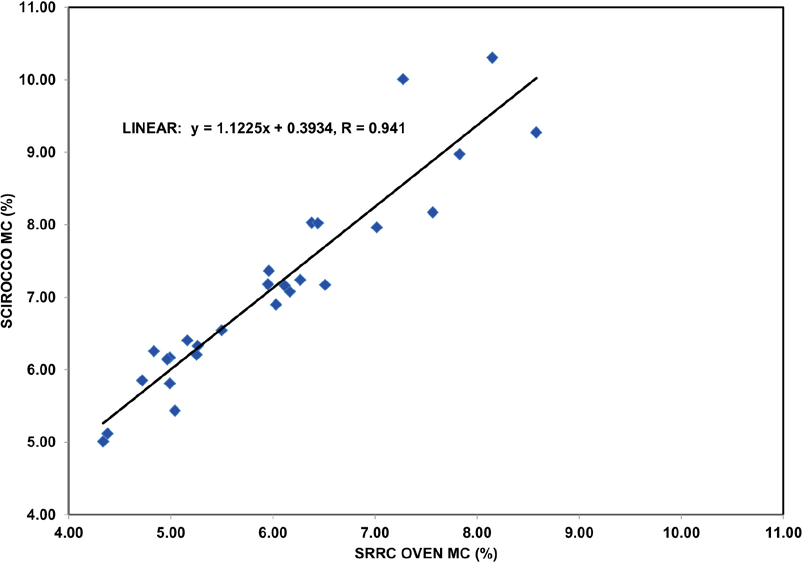
Gravimetric oven comparison: Scirocco oven vs. SRRC oven.
Fiber Moisture Content Method Comparisons
Four MC calibrations were developed for both the Scirocco oven method (CL, CM, CH, and Combined) and the SRRC oven method (CL-ARS, CM-ARS, CH-ARS, and Combined-ARS). The SRRC oven method was used as the reference method for the comparative evaluations. For MC measurements on cotton, the Aqua-Lab fiber measurement/analysis time of < 5 s per readings and two readings per sample were used; total analysis time, including data entry and sample loading, was < 1 min per sample—a very rapid analysis.
Very good MC results agreement was observed between the Aqua-Lab and SRRC oven methods for the Scirocco-developed cotton specific calibrations CL, CM, and CH, with low residuals and a low-to-moderate number of outliers (Table III). A distinctly higher average MC result was observed for the CH sample. This result was not unexpected, as the CH calibration was for high trash samples. It has been shown that cotton trash has a higher MC level compared to cotton fiber, which would result in higher MC levels for the CH calibration. 15
MC Comparisons: Aqua-Lab MC vs. SRRC Oven MC (Scirocco Oven Calibrations)
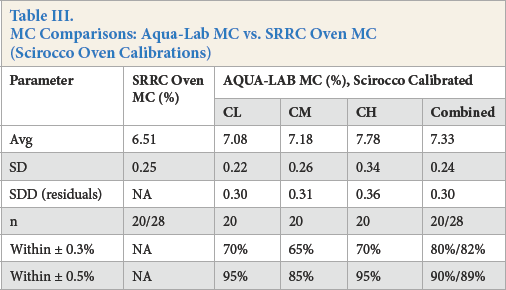
As noted previously, the Aqua-Lab MC results were normally 0.5–1.0% higher than the SRRC oven MC results. For the 20 samples run under standard conditions, a minimum of 85% agreed within ± 0.5% MC for all calibrations; the targeted minimum of 70% method agreement was observed at the tighter ± 0.3% MC for all calibrations, except for the CM calibration. The Combined calibration yielded the best overall Aqua-Lab MC results, with 80% and 90% of the samples achieving the target at the ± 0.3% and ± 0.5% outlier levels for the 20 samples run under standard conditions. The combined calibrations were also evaluated with samples prepared at both low and high MC levels (low and high temperature/ RH conditioned samples; n = 28 total), and the observed high method agreement was also observed over the large dynamic MC range (∼4.5-8.5% MC). The largest deviations were for the samples prepared with very high MC levels, due to sampling effects (moisture rapidly leaving the fiber surface during fiber measurement).
For the SRRC-developed cotton specific calibrations (CL-ARS, CM-ARS, CH-ARS, and Combined-ARS), very good MC results agreement was observed between the Aqua-Lab and SRRC oven methods (Table IV). Overall, low residuals and a low-to-moderate number of outliers were obtained. The average agreement between the Aqua-Lab and SRRC oven MC results were normally within 0.5% MC for the cotton-specific calibrations and within 0.1% MC for the combined calibration. Once again, the highest MC results were for the high trash CH-ARS calibration, due to the higher MC levels of the high trash samples when the calibration was developed. The best overall MC method agreement was obtained for the Combined-ARS calibration, both in average agreement and in overall lowest number of outliers.
MC Comparisons, Aqua-Lab MC vs. SRRC Oven MC (SRRC Oven Calibrations)
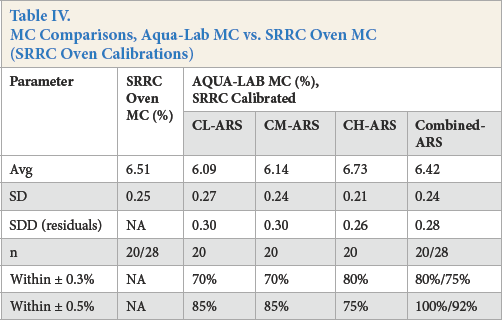
For the 20 samples run under standard conditions, a minimum of 75% agreed within ± 0.5% MC for all calibrations, with CH-ARS yielding the most outliers; the targeted minimum of 70% method agreement was observed at the tighter ± 0.3% MC for all calibrations (including the CM-ARS calibration). Thus, the targeted outlier criteria were achieved. The Combined-ARS calibration yielded the best overall Aqua-Lab MC results, with 80% and 100% of the samples achieving the target at the ± 0.3% and ± 0.5% outlier levels. For the samples prepared at both low and high MC levels (total samples = 28), high method agreement was also observed over the large dynamic MC range (∼4.5–8.5% MC). The largest deviations were for the samples prepared with very high MC levels, due to sampling effects (moisture rapidly leaving the fiber surface during fiber measurement); the high MC result samples resulted in 7% of the outliers for the 28 total samples.
Microwave MC Measurement Precision and Sample Weight Impact
The three distinct cottons used to develop the cotton specific calibrations (CL/CM/CH) were used to determine the impact of sample weight (Average, Swt, and %CV values) on the Aqua-Lab MC results and to determine the measurement precision (Sbp and %CV) and variability for the Aqua-Lab instrument. Scirocco-developed calibrations were used (CL, CM, CH, and Combined for all three cottons). Six Aqua-Lab measurements for each cotton and calibration were made at 75, 100, 125, and 150 g. At 75 g, cotton was present in the unit's sampling zone, but without compression on the fiber; at 150 g, the sample chamber was very full and very compressed. The variability of the six measurements at each weight was used to determine the measurement precision. The variability of the average MC at each sample weight was used to determine the sample weight impact.
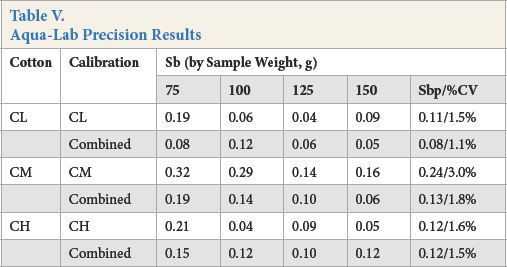
For measurement precision, the pooled Sbp and %CV values for each cotton and calibration at each sample weight are given in Table V. The differences in Sbp values for the six measurements were normally small for all calibrations (< 2.0% CV for all cottons and calibrations except for CM). The largest differences between Sb values at each sample weight were normally for the 75 g versus the 100/125/150 g sample weights, especially for the cotton-specific CL/CM/CH calibrations. The best overall results for each cotton were obtained for the Combined calibration. The small Sbp and %CVs values demonstrate that the measurement variability and precision for the Aqua-Lab MC measurements were excellent.
Aqua-Lab Precision Results
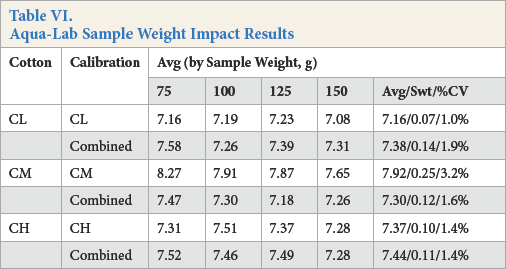
For the sample weight impact evaluation, the average MC, Swt, and %CV values for each cotton and calibration sample at four sample weights are given in Table VI. For all calibrations except CM, the impact of sample weight (75–150 g) on Aqua-Lab MC results were low, with CVs normally < 2.0%. The largest difference among MC results at different sample weights normally occurred for the 75 g MC measurements. For 100 g and higher sample weights, overall very good consistency was observed for the Aqua-Lab MC results. Therefore, the sample weight impacts on the Aqua-Lab MC results were minimal, especially at sample weights of 100 g and higher. It is recommended that the 125-g sample weight be used as the minimum sample weight for the Aqua-Lab MC measurement.
Aqua-Lab Sample Weight Impact Results
Microwave MC Measurement Repeatability and Stability
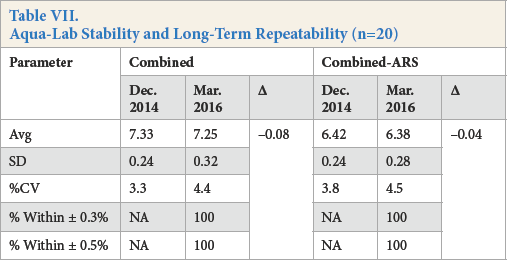
Measurement stability and long-term repeatability for the Aqua-Lab unit were determined by measuring the 20 verification samples on both the Combined (Scirocco oven-based calibration) and Combined-ARS (SRRC oven-based calibration) ∼15 months after development of the original calibrations (Table VII). Excellent instrument and calibration stability and long-term repeatability agreement was observed for both calibrations, with average differences < 0.1% MC, low SDD values, and %CV values < 5.0%. When one considers the variability in MC present in cotton, both from bulk samples and from age, the results demonstrated that the Aqua-Lab is a very stable instrument. Slightly better results were observed for the Combined-ARS calibration stability, with no outliers at the tight ± 0.3% MC and standard ± 0.5% MC target outlier limits and no measurement difference with time were > ± 0.2% MC. This improved stability was desired for our application, as the SRRC oven has served the standard SRRC MC method for several years.
Aqua-Lab Stability and Long-Term Repeatability (n=20)
Conclusions
The ability of a laboratory microwave instrument for rapid, precise, and accurate cotton fiber moisture content (MC) measurements was determined. The cotton fiber microwave MC measurement was very fast (<1 min per sample, total, for duplicate measurements), easy to perform, and required no separate sample weighing or preparation. Very good MC agreement and linearity was observed between the Scirocco high-mass (microwave instrument's standard reference method) and SRRC low-mass laboratory oven reference methods, with the Scirocco oven method normally yielding approximately 0.5–1.0% higher MC values compared to the SRRC oven method. Calibrations based on the Scirocco and SRRC oven methods were developed, demonstrating the microwave method's ability to be calibrated with different reference methods. The method agreements between the microwave MC results and both oven MC results were very good, with all residual and outlier targets met. The best overall results (for both Scirocco and SRRC calibrations) were obtained with the Combined calibrations, and a Combined calibration is recommended for use in cotton fiber measurements (regardless of calibration method). Excellent measurement and analysis precision was observed for the microwave method, especially at sample weights of 100 g and higher. At sample weights of 100 g and higher, the sample weight impacts on the microwave measurement MC results were minimal; based on the recommended vendor sampling procedure, a sample weight of ∼125 g is recommended. The microwave measurement stability and long-term repeatability was excellent, with no outliers observed on repeat MC measurements made over one year apart. Therefore, these results demonstrated that the microwave measurement of cotton fiber MC was versatile, accurate, precise, and fast. This method is an attractive and viable cotton fiber MC measurement for daily and long-term use.