






Abstract
The purpose of this study is to measure the equity of sustainability of sustainable fashion product types, to examine consumers’ purchase intentions, and to study the effect of brand names and cause-related marketing on the product types. The differences among benefit-sought segments on the above variables were also tested. The results show that the highest equity of sustainability did not generate the highest purchase intention. Cause-related marketing significantly influenced the purchase intention on some selected product types regardless of brand names. Benefit-sought groups showed significantly different equities of sustainability, purchase intention, and effects of brand names and cause-related marketing.
Introduction
Due to the increasing interest in environmental protection, a variety of products have recently been created and pro-duced in a way to save our environment. However, are those environmentally-friendly products sustainable enough to be successful in the long term? In other words, is emphasizing the environmental protection aspect of a product enough to appeal to consumers and make them purchase? According to the definition, sustainability is a broad concept that includes not only environmental protection, but also the social and economic viability of the environmental protection. Even if a product is made with environmentally-friendly methods, if it does not satisfy social and economic viability, it will not be successful in the long term. Sustainability of sustainable products (i.e., long term success) can be achieved when all three dimensions are satisfied. However, companies currently focus on emphasizing the environmental protection aspect of sustainable products as a main selling point. For example, in the fashion industry, designers and researchers have proposed various environmentally-friendly fashion products including sustainability in product development (e.g., using organic cotton and reducing waste of fabrics. See literature review section). Retailers have also implemented many sustainable business practices (e.g., eco bags and eco-friendly store lights). However, according to these studies (in literature review section), although the industry offers a variety of sustainable products and retail offers, consumers do not show positive purchase behavior for sustainable products.
Currently, a gap exists between industry offers for sustain-ability and consumers’ expectation/acceptance of those offers. Consumers were especially unsatisfied with the eco-nomic viability of sustainable products (in literature review section). This result supports the need to improve and/or emphasize other aspects of sustainable fashion products to make consumers feel confident in purchasing. Therefore, the purpose of this study is to examine currently existing sustainable products, especially focusing on sustainable fashion products in the market, and to propose possible solutions for long term sustainability.
To achieve this goal, this study will measure consumers’ equity of sustainability on existing sustainable fashion products based on an average of the three criteria of sustainable designs proposed by Day and Townsend. 1 Consumers’ purchase intentions for sustainable fashion products will then be measured. The results will show the sustainable fashion product types that currently satisfy consumers so that the industry can concentrate on and develop these types further. In addition, previous researchers proposed to use brand name reputation and a cause-related marketing strategy to increase consumer purchase (in literature review section). This study will explore if the impact of well-known brand names and cause-related marketing improves consumers’ purchase intentions towards sustainable fashion products. No previous research has studied these two variables for sustainable fashion products and equity of sustainability. Finally, different benefit-sought groups will be tested for different acceptance/preference and the impact of brand names and cause-related marketing on purchasing sustainable fashion products so that companies can set the appropriate strategies based on the target market's benefits sought.
Literature Review
Business Perspectives
Sustainable designs are defined as being
The statistics did not show a significant difference between Recycle and Vintage categories from the consumers’ point of view, therefore, these two criteria were combined.
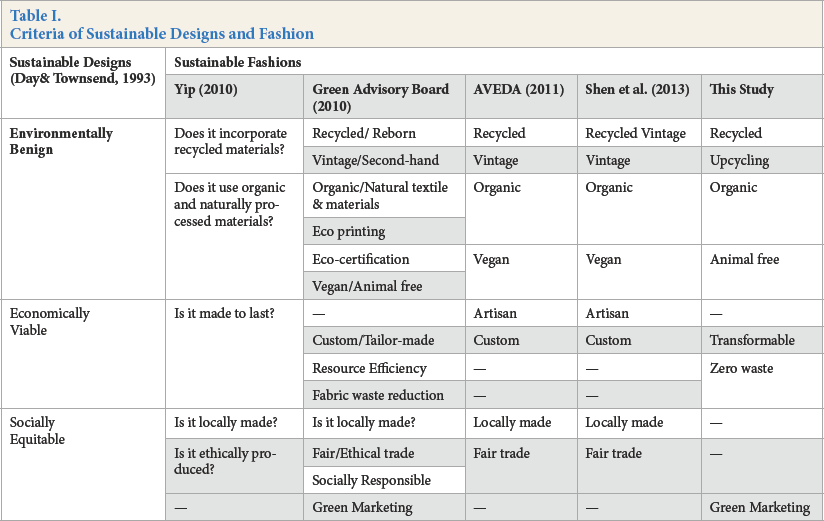
Other researches proposed their own criteria or definition of sustainable fashions, however, there are many overlaps (Table I). In summary, recent product development and manufacturing practices that make fashion products sustainable are: 1) using natural, recycled, reused, or renewable materials, 2) upcycling, 3) reducing waste, 4) using less toxic and water intense materials, 5) eco-friendly packaging, 6) making high quality, long lifecycle products, and 7) promoting and educating sustainability through socially responsible business activities and community partnerships (i.e., a part of cause-related marketing). 6
Criteria of Sustainable Designs and Fashion
Consumer Perspectives
Chan and Wong summarized the issues of eco-fashion (i.e., sustainable fashion products). 6 Consumer perspectives on eco-fashion included high prices,7–17 less fashionable/stylish designs than non-green products,1,9,11–13,15,18 less quality/ liability,10,11,13,16,19 and inconvenient shopping/low acces-sibility.6,7,10,17,19 High price was the main reason consumers hesitated in purchasing sustainable fashion products, even though many other attributes were satisfactory to them. Only 12% of consumers were willing to pay more for green products, and consumers were willing to pay only 5% more for green products than non-green products. 20
Companies offered fashion products that met the three criteria of sustainable designs. However, from the consumers’ standpoint, these products do not meet their expectations, especially regarding economic viability. Economic viability originally measured financial benefit for companies; however, for consumers, economic viability was translated as, not only the price benefit for them, but also other product benefits they value such as style, quality, and convenience. Researchers concluded that consumers did not purchase eco-fashion because they were primarily dissatisfied with product attributes such as style, quality, or accessibility, in addition to their price. Consumers want value for their money by evaluating various aspects of eco-fashion products.
Possible Solutions
Possible solutions for companies regarding the above issues would be to improve the product attributes that consumers value. When consumers perceive savings and value, they feel more confident in trying new green products. 7 Oliver suggests marketers show the long-term cost (lifecycle cost) of green products at the point of sale instead of showing high initial purchase prices. 17 Chan and Wong concluded that companies should improve the workmanship and durability of eco-fashion. 6 They also proposed offering services such as eco-fashion information, aftersales services, giftwrapping, educated sales personnel, and promoting the benefits of eco-fashion. Oliver also recommended that marketers emphasize the services that consumers might value other than green practices alone. 17 He suggested offering different product attributes important to each specific consumer segment; therefore, each consumer segment can receive exceptional offerings other than the green offer. Bonini and Oppenheim suggest bringing eco-products to people because consumers cannot find green products easily. 7 Green fashion products are not widely available compared to energy-saving household goods and green foods. Chan and Wong suggest use of e-tailing and a delivery service to improve accessibility. 6
Sustainability and Purchase Intention
The present study selected the sustainable fashion product types defined previously. The equity of sustainability in this study is determined as an average score of economic viability, social equity, and environmental responsibility for each sustainable fashion product type. This is the same method used to calculate the brand equity. This was determined by an average of the different dimensions of a brand such as brand awareness, perceived quality, brand association, and brand loyalty. 6 Based on previous research regarding the dimensions of sustainable products and the types of sustainable fashion products, Hypotheses 1-1 to 1-4 were developed:
H1-1. Consumers’ equities of sustainability for the sustainable fashion product types are not significantly different
H1-2. Consumers’ purchase intentions for the sustainable fashion product types are not significantly different
H1-3. Consumers’ purchase intentions after adding cause-related marketing to the sustainable fashion product types are not significantly different
H1-4. Equity of sustainability does not significantly influence purchase intentions in all sustainable fashion product types
Consumers have to see the value for their money beyond environmental benefits to make a purchase decision. Researchers suggest more promotional activities to disseminate the benefits of eco-fashion.6,21 According to Lee, labeling showing sustainable business practices helps educate consumers and promote sustainability. 22 More companies are using cause-related marketing, where a certain percentage of sales goes to non-profit organizations (e.g., environmental protection groups) to improve our society/community, to increase the social viability of sustainable products. Cause-related marketing is one of the recent, popular marketing practices used today. Tucker et al. examined consumers’ purchase intentions on seeing ads using cause-related marketing compared to those viewing product-focus ads and image-focus institutional ads—ads using cause-related marketing improved purchase intentions more than the other ads.23 Therefore,Hypothesis 1-5 was developed.
H1-5. Cause-related marketing does not significantly influence purchase intentions in all sustainable fashion product types
However, improving all of the above attributes will take a long time and increase costs, which in turn will increase prices. If companies cannot satisfy consumers with prices, educating consumers about other benefits of eco-fashion would encourage their purchase of sustainable fashions. 7 Currently, only 12% of consumers were eco-conscious consumers. The remaining consumers (88%) showed that when they understood how their purchase of eco-friendly products improved the environment, they were more willing to purchase those products. 7 Therefore, education plays an important role to increase purchase of sustainable fashion products.
Brand Names
Tucker et al. explored the influence of consumer attitudes towards a brand name on their preferences and purchase intention for each ad type. 23 The positive attitude for a specific brand name generated high credibility towards the ad, which in turn resulted in high purchase intention. If well-known brands with high credibility offered sustainable fashion products, it is assumed that the resulting increased purchase intention would solve the low accessibility issue. Consumers generally believe that green products have low performance and quality; therefore, Tucker, 17 and others,6,21suggest that green products from a highly-recognized brand name that consumers already trust would help to improve their credibility. This study will measure the effect of well-known brand names on consumers’ equity of sustainability and purchase intention of sustainable fashion products before and after cause-related marketing. By adding the influence of brand names to Hypotheses 1-1 to 1-5, the corresponding Hypotheses 3-1 to 3-5 were developed.
H3-1. Consumers’ equities of sustainability for the sustainable fashion product types are not significantly different after adding well-known brand names
H3-2. Consumers’ purchase intentions on the sustainable fashion product types are not significantly different after adding well-known brand names
H3-3. Consumers’ purchase intentions after cause-related marketing on the sustainable fashion product types are not significantly different after adding well-known brand names
H3-4. Equity of sustainability does not significantly influence purchase intentions in all sustainable fashion product types after adding well-known brand names
H3-5. Cause-related marketing does not significantly influence purchase intentions in all sustainable fashion product types after adding well-known brand names
Benefit-Sought Segments
Green consumers tend to be female, have a median income of $60,000, live in cities and major suburbs, and be well-educated. 24 However, these authors claim that green consumers behaved based on their psychographics rather than demographics. Tucker et al. and Ku et al. studies tested the influence of green marketing on consumer preferences/ purchase intentions by segmenting consumers based on their environmental benefit-sought behavior (i.e., psycho-graphics).23,25 Both studies showed significant differences among benefit-sought groups in their preferences/purchase intentions when influenced by green marketing. However, only 6% of US consumers were green consumers and 34% were non-green consumers. 17 The majority of consumers (60%) showed opportunistic purchasing behavior—when they saw the value of green products, they were willing to purchase green products. Because the majority of consumers (94%) were not green consumers, this study segmented consumers based on the values they seek when purchasing products (i.e., benefit-sought) rather than segmenting based on their attitude towards the green movement.
Previous research grouped consumers based on their benefit-sought group and tested the significant differences among the groups on many subjects. The most common criteria used to group consumers were product and store attributes they sought when shopping (i.e., benefit-sought). As an example of grouping with product attributes, Hong and Koh grouped consumers seeking economic-value, brand-value, aesthetics/fashion, or easy care. 26 Choi and Koh identify three groups: individuality/fashion, brand name, and practicality. 27 Ten groups were included: fashion, brand, self-expression, budget, practicality, price/variety, customer services/convenience, discount policy, information sources/ promotion, and apparel style. 26 Kim and Lee used six benefit-sought segments based on lifestyle: price-conscious, fashion-conscious, information seeker, self-confidence, local store loyalty, and time-consciousness. 28 Kwan et al. summarized the previous research regarding consumers’ decision-making styles with product and store attributes. 29 Consumers are frequently segmented by brand, price, fashion, time-energy saving, variety, information, store loyal, and so forth.
Benefit-sought segments most commonly studied in previous research were selected for this study, which were price-, fashion-, brand-, convenience-, and quality-conscious, self-expression, and self-confidence groups. Hypotheses 2-1 to 2-5 were developed by adding different benefit-sought segments into Hypotheses 1-1 to 1-5.
H2-1. Benefit-sought groups do not have significantly different equity of sustainability across all sustainable fashion product types
H2-2. Benefit-sought groups do not have significantly different purchase intention across all sustainable fashion product types
H2-3. Benefit-sought groups do not have significantly different purchase intention across all sustainable fashion product types after cause-related marketing
H2-4. Benefit-sought groups do not show a significantly different influence of equity of sustainability on the purchase intention across all sustainable fashion product types
H2-5. Benefit-sought groups do not show a significantly different influence of cause-related marketing on the purchase intention across all sustainable fashion product types
In addition, Hypothesis 4-1 to 4-5 were developed by adding well-known brand names into Hypothesis 2-1 to 2-5.
H4-1. Benefit-sought groups do not have significantly different equity of sustainability across all sustainable fashion product types after adding well-known brand names
H4-2. Benefit-sought groups do not have significantly different purchase intention across all sustainable fashion product types after adding well-known brand names
H4-3. Benefit-sought groups do not have significantly different purchase intention across all sustainable fashion product types using cause-related marketing after adding well-known brand names
H4-4. Benefit-sought groups do not show a significantly different influence of equity of sustainability on the purchase intention across all sustainable fashion product types after adding well-known brand names
H4-5. Benefit-sought groups do not show a significantly different influence of cause-related marketing on the purchase intention across all sustainable fashion product types after adding well-known brand names
Proposed Model
Based on previous research, the authors proposed a new model (Fig. 1) relating the hypotheses. H1 measures the significant differences in equity of sustainability and purchase intention before and after cause-related marketing. H2 measures the significantly different results in H1 between benefit-sought groups. H3 examines the significantly different results in H1 after adding well-known brand names across sustainable fashion product types. Finally, H4 will show any differences in results from H2 after adding well-known brand names.
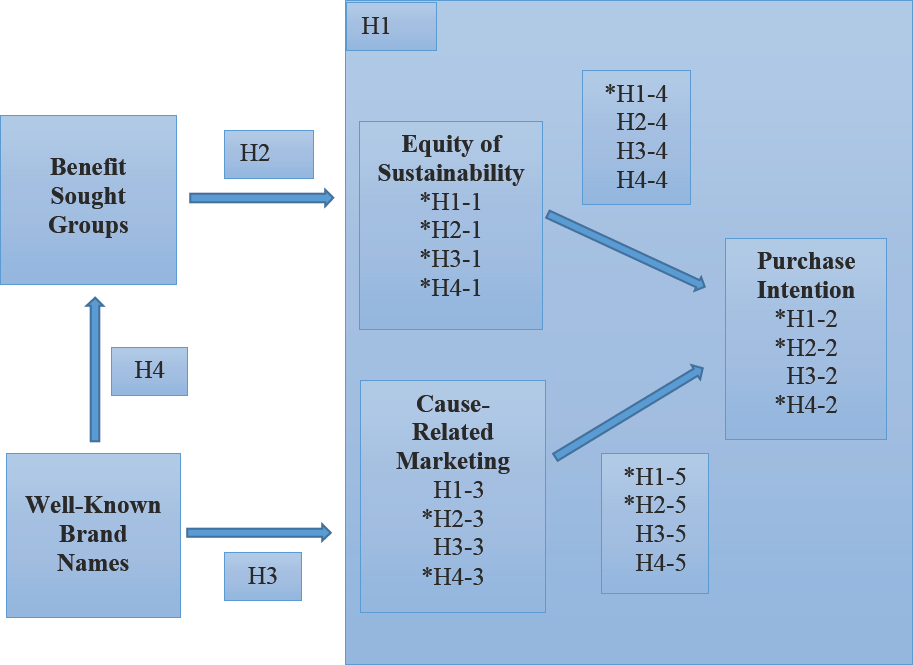
Proposed model and data analysis results (*Rejected).
Research Method
The authors researched the sustainable fashion product types currently offered in the market through online and offline stores. A simple dress from each sustainable fashion product type was selected to minimize the cognitive effort in processing/judging the product attributes. 23
Lee evaluated current sustainable business practices/systems (e.g., labeling/identifying sustainable products, reducing transportation, and using renewable energy) with three criteria similar to Daly and Townsend, which were economic development, environmental responsibility, and social progress.1,22 Likewise, this study will evaluate current sustainable fashion products as to how environmentally-friendly, economically viable, and socially equitable they are from the consumers’ perspective.
Lee measured socially equitable sustainability with questions addressing the protection of consumers’ psychological and physical well-being, the promotion of community, the equal treatment of people, and the provision of necessary services. 22 Cassill and Drake proposed that when consumers evaluate social apparel, they consider social appropriateness as determined by suitability to the individual, good ft, beauty/attractiveness, quality of construction, appropriateness for occasion, comfort, fabric type and quality, its brand and store name, and also whether the apparel is prestigious, sexy, and fashionable. 30 The present study used the above questions to measure the social equity of sustainable fashion products. Daly and Townsend measured the economic aspect of apparel with not only price but also with value, ease of care, and durability from the consumers’ perspective. 1 Lee asked whether the apparel generates long term profit through customer satisfaction, the greatest profit using the least resources, is independent from limited resources, protects consumers’ financial well-being, and frees the consumer from any responsibility and burden. 22 From the consumers’ perspective, the economic viability of fashion is not solely about financial gain. It includes other values such as fashionability, quality, durability, and ease of care. This study included these attributes to measure economic viability of sustainable fashions. Lastly, the statements used to indicate that a product was considered environmentally benign were “Tis is an environmentally-friendly product” and “Tis is a sustainable product.”
Price was fixed in this study to minimize impact on purchase intention because price was the most powerful attribute that affects consumers’ purchase intention on sustainable fashions as discussed earlier, even when other attributes satisfied consumers.
The purchase intention for each sustainable fashion product was calculated as an average of two statements, which are “I will buy this item” and “My willingness to buy this item is high.” The purchase intention after adding cause-related marketing in sustainable fashion product ads was measured with the statements, “If 10% of this sale is donated to a non- profit organization, I would buy this item.”
Participants answered 12 questions to determine their benefit-sought group. After executing factor analysis, the benefit-sought group that had the highest score was the final benefit-sought group for each participant.
Brand name was used as a moderator variable to test the brand name effect on participants’ responses. Two different versions of questionnaires were distributed. One version showed brand names on the product types, which were selected as reliable brand names (from a pretest) based on quality and credibility, and the other version did not show any brand names on the product types. The reliable brand names were well-known brands such as Ralph Lauren, rather than middle to low-priced brands. Both versions included the statement for purchase intention before and after cause-related marketing (e.g., “If 10% of this sale was donated to a non-profit organization, I would buy this item.”). Additionally, selected demographics such as education and age were included. Only female consumers participated in the survey because the stimuli were dresses. Surveys (420) were distributed by a commercial survey data collection company. A total of 399 surveys were usable (non-brand version, n = 190; brand name version, n = 209)—all surveys with any blank answers or having the same answer for most of the questions were removed. The majority of participants were between 25 to 44 years old (22–34 years, 49.1%; 35–44 years, 16.8%) and had a college degree (college degree, 52.6%; graduate school degree, 25.8%).
Results
For H1-1, ANOVA was employed to test the significant mean difference of the equity of sustainability among sustainable fashion product types (Table II). The results show that the upcycling product received a significantly higher equity of sustainability (m = 3.78) than all other sustainable fashion products. Therefore, H1-1 was rejected. Among the product types, recycling received the highest environmental responsibility (m = 4.09) and social equity (m = 3.51), and organic material usage types received the highest economic viability (m = 3.64) which includes quality, fashion, durability, and so forth.
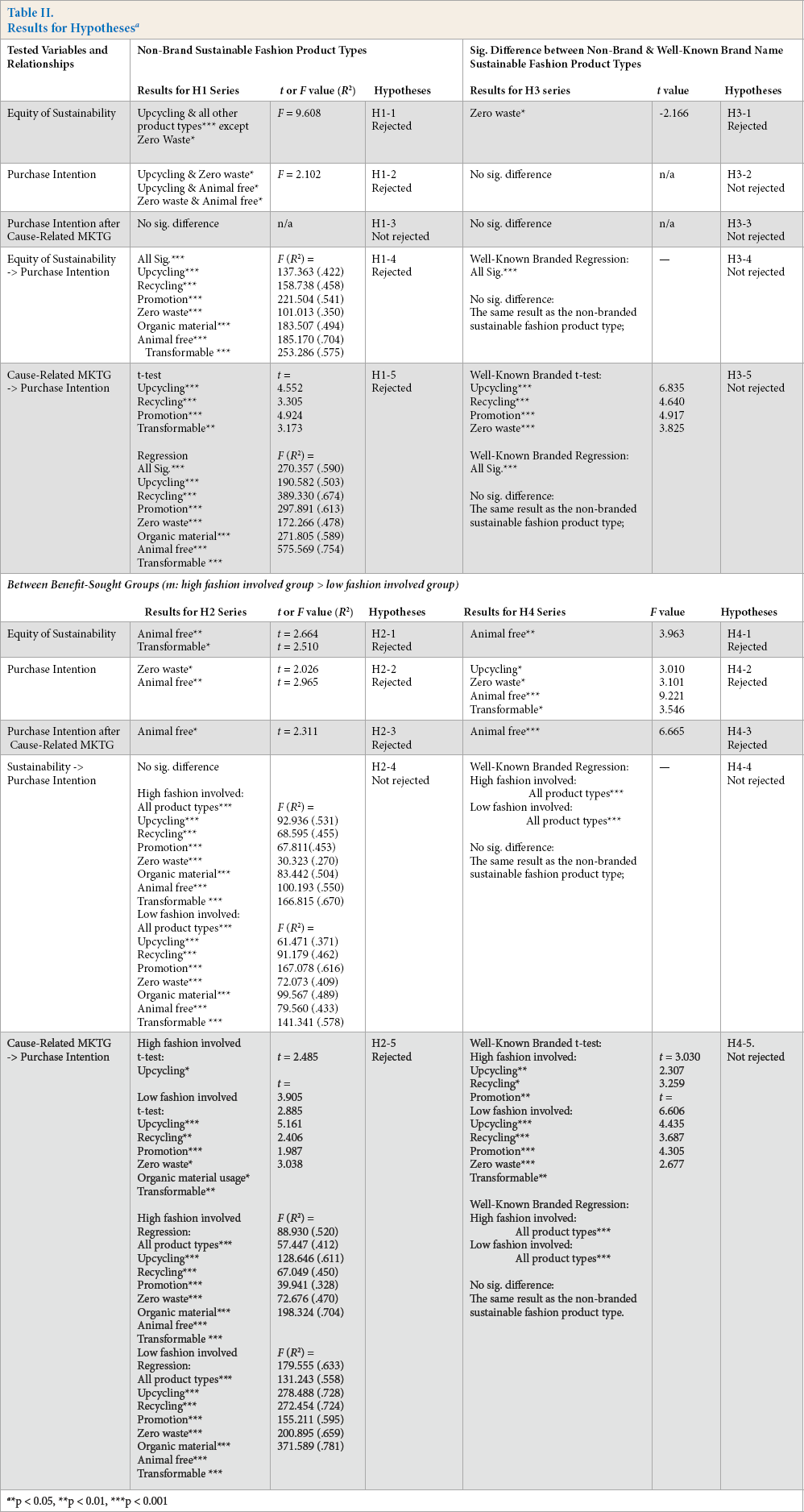
For H1-2, ANOVA results indicated that the upcycling type received a significantly higher purchase intention than the zero waste and the animal free types, and the zero waste type received a significantly higher purchase intention than the animal free type. Therefore, H1-2 was rejected. Participants showed the highest purchase intention on the transformable type (m = 3.24).
When including the cause-related marketing on the product types, ANOVA showed no significantly different purchase intention among sustainable fashion products. Therefore, H1-3 was not rejected. The transformable product received the highest purchase intention after adding cause-related marketing (m = 3.4).
The relationship between the equity of sustainability and purchase intention was tested using linear regression analysis (H1-4). The relationship for all product types was significant. Higher equity of sustainability generated higher purchase intention in all product types. Therefore, H1-4 was rejected.
When testing the effect of cause-related marketing on the purchase intention using a paired
To test the differences among benefit-sought groups, factor analysis was run and generated two different groups. One group included participants who were concerned about brand names, self-confidence, quality, fashion and self-expression, and the other group included price and convenience-conscious participants. It was inferred that the former group was more confidently involved in fashion, and the latter group was less involved in fashion when purchasing clothing.
An independent
Highest Mean Scores of the Variables by Fashion Involvement Groups
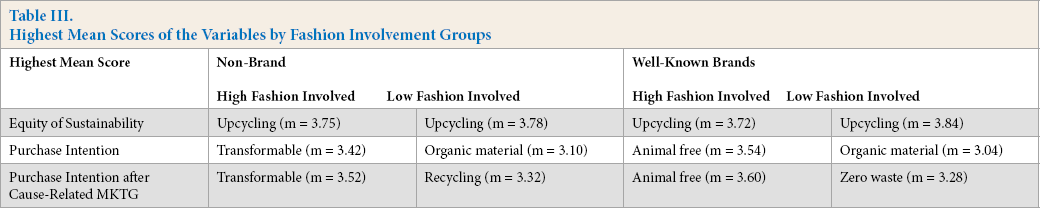
The purchase intention was significantly different between the groups for the zero waste (p < 0.05) and the animal free types (p < 0.01). Therefore, H2-2 was rejected. When considering mean scores, the high fashion involved group rated the transformable type highest and the less fashion involved group selected the organic material usage type as the highest purchase intention (Table III).
Recommendations for Industry
When including cause-related marketing for the products, the purchase intention for the animal free product was significantly different between the groups (p < 0.05). Thus, H2-3 was rejected. When considering mean scores, the high fashion involved group rated the transformable product category highest and the less fashion involved group selected recycling as the highest purchase intention after cause-related marketing.
Using regression, H2-4 tested whether each group showed a different relationship between the equity of sustainability and purchase intention. Both groups showed the significant relationship between two variables in all product types (p < 0.001) which means that a higher equity of sustainability generated higher purchase intention for all product types. An additional
A
Data analysis for the survey adding well-known brand names on the products showed different results from H1 and H2. With well-known brand names on the products, the upcycling type received the highest equity of sustainability (m = 3.79) (Table III). Among the product types, upcy-cling received the highest environmental responsibility (m = 4.15) and social equity (m = 3.53), and organic material usage received the highest economic viability (m = 3.76). An independent
Participants showed the highest purchase intention on the zero waste type (m = 3.16), followed by the organic mate-rial usage (m = 3.14) and transformable types (m = 3.13). An independent sample
When including cause-related marketing for the products, the upcycling type received the highest purchase intention (m = 3.31). An independent sample
The relationship between the equity of sustainability and purchase intention was tested employing linear regression (H3-4). In all product types, after adding well-known brand names, the equity of sustainability significantly influenced purchase intention (p < 0.001), which was the same result as H1-4. To examine the significant difference between the non-branded and the well-known branded products in terms of the relationship, the two unstandardized residuals from the linear regression analysis above for each product type was tested with a
When testing the effect of cause-related marketing on the purchase intention for well-known branded products using a paired
ANOVA was used to examine whether the equities of sus-tainability were significantly different among high and low fashion involvement groups from the non-branded group, and high and low fashion involvement groups from the well-known branded. The equity of sustainability was significantly different among the groups for the animal free type (p < 0.01). Therefore, H4-1 was rejected. When considering mean scores, both groups rated the upcycling type as having the highest equity of sustainability (Table III).
ANOVA showed that the purchase intention was significantly different among the four groups in upcycling (p < 0.05), zero waste (p < 0.05), animal free (p < 0.001), and transformable types (p < 0.01). Therefore, H4-2 was rejected. When considering mean scores only, the high fashion involved group rated animal free type highest, and the less fashion involved group selected the organic material usage type as the highest purchase intention.
When including cause-related marketing with the products, ANOVA results showed that the purchase intention for the animal free type was significantly different among the four groups (p < 0.001) (Table II). Therefore, H4-3 was rejected. When considering mean scores, the high fashion involved group rated the animal free type highest, and the less fashion involved group selected the zero waste type as the highest purchase intention after cause-related marketing.
Using linear regression, H4-4 tested whether each group shows a different result in the relationship between the equity of sustainability and purchase intention after adding well-known brand names. Both groups showed the signifi-cant relationship between the two variables in all product types (p < 0.001), which means higher sustainability generated higher purchase intention. An additional
For H4-5, the
Conclusions and Implications
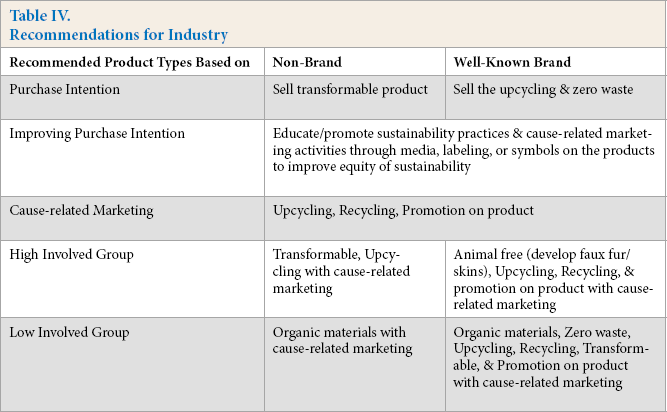
When participants evaluated the sustainable fashion product types without brand names, the upcycling product type received the highest equity of sustainability; however, they were more willing to purchase the transformable product type than the upcycling product type, which was the same result after applying cause-related marketing on the products. Participants believed that if the sustainable fashion product does not have a well-known brand name, the transformable types offer more value because they could be compatible with existing wardrobes and be used long term with changing styles. Therefore, non-brand companies would have a benefit by offering transformable types in which consumers find more value than other sustainable fashion product types (Table IV).
When shown well-known brand names, participants evaluated upcycling types as having the highest equity of sustainability and the highest purchase intention after cause-related marketing. Participants seemed to trust the upcycling product types offered by well-known brand companies, which was consistent with the result of previous research showing that brand name improved credibility and purchase intention of a product. 23 A zero waste type with a well-known brand name received the highest purchase intention before using cause-related marketing and also received a significantly higher equity of sustainability than the non-branded zero waste type. Therefore, it is recommended that well-known brands show their sustainability practice on the product through labels, especially showing a zero waste production label, which is consistent with Lee's proposal. 22 However, statistics did not show a significant influence of a well-known brand name on purchase intention. To summarize, companies that do not have high brand name reputation could compete with well-known brand names in the sustainable fashion market.
When comparing relationships between equity of sustain-ability and purchase intention, the results, for all sustainable fashion product types regardless of brand names, showed that the greater the sustainability, the greater the purchase intention. Thus, again, it is important for companies to educate consumers about their sustainability practices through either promotions or product labels. The significant impact of cause-related marketing on purchase intention was shown in the upcycling, recycling, and promotion types for both non-brand and well-known branded products, which supported the results of Tucker at all. 23 Promoting a donation or support for community/society (i.e., cause-related marketing) on the product influenced consumers’ purchase decisions. Regardless of brand name reputation, the result suggested that companies focus on upcycling, recycling, and promotion for the products when applying cause-related marketing. For example, companies could create/include a symbol of their cause-related marketing or include a symbol of a non-profit organization on the sustainable fashion products for the above product types.
Cause-related marketing did not significantly increase the purchase intention for the fashion products of the organic materials and transformable types. The reason could be that the fashion product with organic materials received the highest equity in economic viability. Regardless of the cause-related marketing, participants would be willing to purchase the organic material type due to economic benefits, which include attributes they seek when purchasing apparel. The transformable products types received the highest purchase intention score; therefore, cause-related marketing might not significantly influence participants’ purchase intention.
Considering different benefit-sought groups, the high fashion involved group scored the variables higher in most sustainable fashion product types in the model than the low fashion involved group. Therefore, it can be concluded that consumers who highly considered many aspects of a fashion product recognized sustainability better and were willing to purchase those products more than consumers who considered the practical sides of a fashion product (i.e., price and convenience).
When companies plan to offer sustainable fashion products, they need to target the high fashion involved group for a better sales outcome. At the same time, educating the low fashion involvement group about the sustainability could increase the equity of sustainability, which would result higher purchase intention (H2-4 result).
Both groups showed the same results in the equity of sustainability; upcycling was the highest sustainable fashion product type regardless of brand names (Table IV). However, as mentioned above, even though participants perceived that the upcycled product type was highly sustainable, they purchased different product types. The high fashion involved group highly intended to purchase the transformable product in the non-brand product types and the animal-free product in well-known brand product types for both before and after cause-related marketing. Well-known brands are the ones that typically consume most real animal furs and skins, and this might influence the participants’ purchase intentions. Companies are recommended to consider these product types depending on their brand types when targeting the high fashion conscious group. The low fashion involved group were willing to purchase the product with organic materials in both non-brand and well-known brands, but cause-related marketing increased the purchase intention on the most of product types (Table IV). Companies targeting a low fashion conscious group should develop/promote organic fashion products and actively promote their community/society involvement.
Regardless of brand names, companies are recommended to develop/find animal fur/skin substitutes to offer animal free products targeting a high fashion involved group. The high fashion involved group scored the animal free types significantly higher than the low fashion involved group in equity of sustainability, purchase intention, and the purchase intention after cause-related marketing. Regardless of benefit-sought groups, greater equity of sustainability generated greater purchase intentions. Again, companies need to inform/promote their sustainability practices to consumers through products or media to improve sales, which supports Lee's results. 22
The high fashion involved group shows a significant influence of cause-related marketing on purchase intention only for the upcycling type in non-branded products. The high fashion involvement group showed high acceptance of non-branded sustainable fashion products. Therefore, cause-related marketing did not significantly increase their purchase intention on many non-branded sustainable fashion product types. However, cause-related marketing was effective for the recycling, product promotion, and upcycling for products with a well-known brand name.
The impact of cause-related marketing on purchase intention was significant for the low fashion involved group in most sustainable fashion product types regardless of brand name reputation. Therefore, when companies cannot appeal consumers with brand names, cause-related marketing plays an important role. Low fashion involved consumers seem to consider the after-purchase impact on the society than the product itself when purchasing sustainable fashion products, which is consistent with Bonini and Oppenheim's results. 7
This study contributes to the field with a new measure for fashion product equity of sustainability, which is applied from the brand equity concept and is applicable to any other product for measuring equity of sustainability. In addition, new factors including equity of sustainability, cause-related marketing, brand names, and benefit-sought groups that influence consumers’ purchase intentions on sustainable fashion products were examined. The results and suggestions of this study could be helpful for developing business marketing strategies depending on their brand name reputation and target customers’ profiles. The recommendations of this study could increase consumers’ acceptance of sustainable fashion products and extend product lifecycles.
Limitations and Future Research
Only female participants were recruited in this study due to sample characteristics. Since male consumers have recently become more involved in purchasing fashion products, a future study needs to test male consumer perceptions about sustainability in fashion and their purchasing behavior towards sustainable fashion products. Also, a cross-cultural study is recommended to examine the differences among countries which have a different level of sustainability perception in fashion and explore whether different sustain-ability practices exist in different countries. Other consumer characteristics than benefit-sought segments could be interesting variables that may have a significant influence on purchasing decisions.