






Abstract
This study characterized fabrics used in firefighters’ protective clothing based on their response to thermal exposure using hot water immersion with compression. The thermal protective performance of compressed fabrics possessing different physical properties was evaluated based on thermal energy transmission under laboratory-simulated hot water immersion. Primarily, mass (hot water) transfer and conductive heat transfer occurred. Different fabric constructions and properties affected mass and heat transfer, affecting the thermal protective performance of the test fabrics. Fabrics including a moisture barrier possessed higher thermal protective performance than fabrics including no moisture barrier, even though the former fabrics had lower thermal resistance values. The position of the moisture barrier affected mass transfer through the fabric. Air-impermeable, heavy, and/or thicker fabric displayed higher thermal resistance and protective performance.
Introduction
The National Fire Protection Association (NFPA) reported over 2,000 firefighter burn injuries across the United States in 2013. 1 The majority of these injuries resulted from inadequate performance of their protective clothing.2,3The performance of firefighters’ protective clothing varies depending upon the nature of hazards faced by on-duty firefighters.4,5 To fully understand the performance of firefighters’ protective clothing in various hazards, thermal exposures faced by firefighters were extensively investigat-ed.6,7 Through these investigations, it was found that water used by firefighters becomes hot, and this hot water may cause burn injuries. It has also been observed that pipelines of hot water may burst in a structural fire hazard (especially those in the chemical, oil, and gas industries), and the hot water released can pose a great threat to firefighters.
Recently, research has characterized fabrics commonly-used in firefighters’ protective clothing under a laboratory-simulated hot water splash.7–11 Different fire-resistant fabrics with diversified properties (e.g., air permeability, thickness, and weight) were exposed to a hot water splash. During the hot water splash, the amount of thermal energy transmitted through the fabric was measured by a sensor. From the thermal energy measured, the time required to generate second-degree burn injuries on firefighters’ bodies was predicted. Tis predicted time was inferred as the “thermal protective performance” of the fabric. The air permeability of the fabric was found to be the most important factor affecting thermal protective performance. Additionally, the weight and/or thickness of the fabric also affected its perfor-mance.11–14 However, firefighters are not limited to thermal exposure by hot water splash. As firefighters often have to kneel or crawl on the ground of the site of a fire to extin-guish fires and/or rescue fire victims, their clothed body parts (e.g., knees, elbows, lower legs) may become immersed in the hot water present on the floor/ground and also compressed on the foor's surface.15,16 Tis hot water immersion with compression causes burn injuries on firefighters’ arms/hands and legs/feet.17,18 From 2007 through 2011, US firefighters sustained ∼38% of all burn injuries on their arms/hands and legs/feet. 19 In consideration of this issue, Mandal, Song, and Gholamreza developed new test methods for evaluating the thermal protective performance of fabrics under the exposures of hot water splash as well as hot water immersion with compression. 20 Tis recent study extensively covered testing equipment and protocols for evaluating fabric thermal protective performance of fabrics. However, this study did not scientifically and thoroughly characterize the fabrics used in firefighters’ protective clothing under hot water immersion with compression exposure.
The present study attempts to characterize thermal protective fabrics under laboratory-simulated exposure of hot water immersion with compression. The thermal protective performance of the compressed fabrics was measured and statistically analyzed. Factors associated with thermal protective performance were investigated using heat and mass transfer theory. Tis study will provide technical data on various factors affecting thermal protective performance. The understanding developed from this study will assist in engineering a high performance fabric for thermal protective clothing that may provide better occupational health and safety for firefighters.
Experimental
Fabrics and Properties
In firefighters’ protective clothing, three types of fire-resistant fabrics—shell fabrics, moisture barriers, and thermal liners—are usually used in layered configurations. In this study, various commercially-available and commonly-used shell fabrics, moisture barriers, and thermal liners (A–E) were selected based on their constructional features such as fiber content, weave structure, thickness, and weight (Table I). By assembling these fabrics, various single-, double-, and triple-layered fabrics were configured (Table II). Tese configured fabrics were: A, AB [A (outer layer) + B (inner layer)], AD [A (outer layer) + D (inner layer)], AE [A (outer layer) + E (inner layer)], EA [E (outer layer) + A (inner layer)], AEB [A (outer layer) + E (middle layer) + B (inner layer)], AEC [A (outer layer) + E (middle layer) + C (inner layer)], AED [A (outer layer) + E (middle layer) + D (inner layer)], and EAC [E (outer layer) + A (middle layer) + C (inner layer)]. In these fabrics, the outer layers directly faced thermal exposure of hot water immersion with compression, inner layers were close to the wearers’ skins, and middle layers were sandwiched between outer and inner layers. Physical properties (i.e., air permeability, thickness, weight, and thermal resistance) of these fabrics were measured using ASTM standards.21–24
Fabrics Used in Study
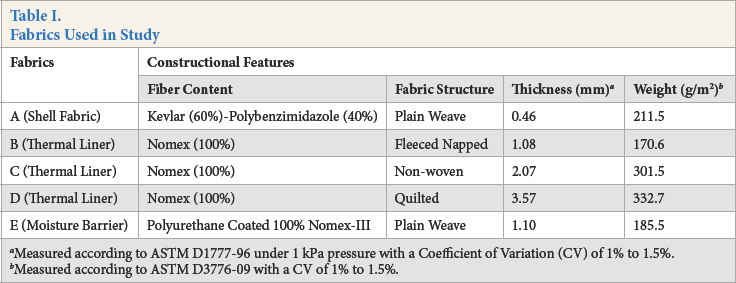
Measured according to ASTM D1777-96 under 1 kPa pressure with a Coefficient of Variation (CV) of 1% to 1.5%.
Measured according to ASTM D3776-09 with a CV of 1% to 1.5%.
Physical Properties of Fabrics
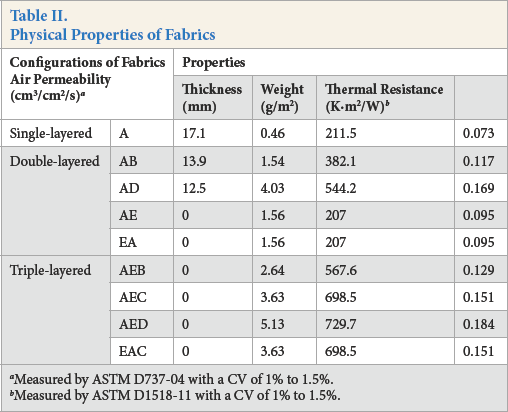
Measured by ASTM D737-04 with a CV of 1% to 1.5%.
Measured by ASTM D1518-11 with a CV of 1% to 1.5%.
Test Conditions
Tree specimens (305 × 305 mm) of each configured fabric were prepared and conditioned at 21 °C ± 1 °C and 65% ± 2% relative humidity (RH) for at least 24 h. Subsequently, the thermal protective performance of the conditioned specimens was measured under the thermal exposure of hot water immersion with compression using a new test apparatus developed at the Protective Clothing and Equipment Research Facility (PCERF) at the University of Alberta (Figs. 1 and 2).
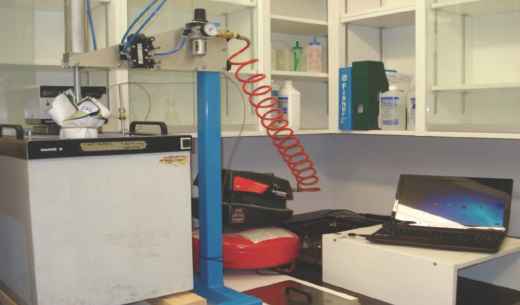
Hot water immersion with compression test apparatus.
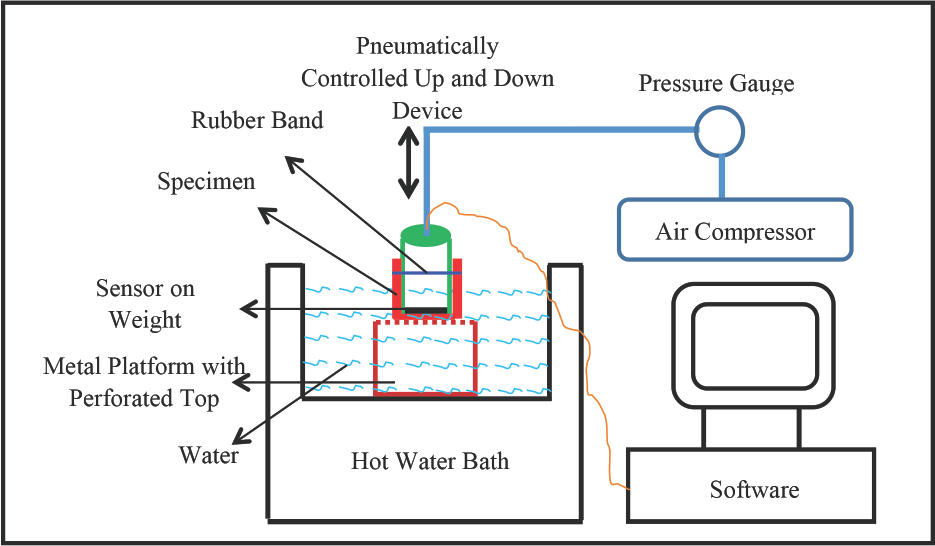
Schematic diagram of the hot water immersion with compression test apparatus.
As shown in Fig. 2, a metal platform with a perforated top surface was positioned on the bottom-center of a hot water bath. Ten, water was poured into the bath up to a level 2.25 in. above the perforated top surface and the temperature of the water was maintained at 85 °C. Next, a specimen was attached with a skin simulant sensor (mounted on a cylindrical weight) using a rubber band. Tis sensor (a slab of 32-mm length and 19-mm diameter) was made up of an inorganic material—colorceron-a mixture of various compounds such as calcium, aluminum, silicate, asbestos fiber, and a binder (Fig. 3). This inorganic material does not have the same values of density (ρ), thermal conductivity (k), or specific heat (Cp) when compared with human skin. However, thermal inertia (a product of ρ (kg/m3), k (W/m·°C), and Cp (J/kg·°C)) or thermal absorptivity (the square root of thermal inertia) of the material is similar to that of human skin.4,25–28 A type-T thermocouple (copper-constantan) was held on the surface of the colorceron slab (by an epoxy-phenolic adhesive that can tolerate temperatures up to 370 °C) to measure the temperature increase of the slab during the hot water immersion with compression exposure.
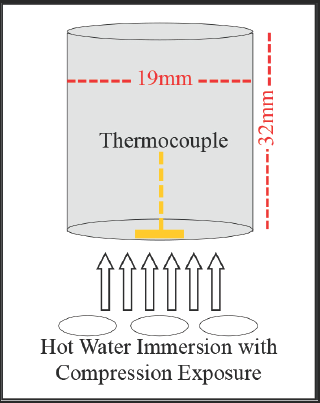
Skin simulant sensor.
The sensor-specimen attachment was immersed in the hot water (85 °C) using a pneumatic device to rest the whole assembly (specimen + skin simulant sensor) fat on the center of the perforated surface (Fig. 2). Here, the pressure of the compressed specimen (between the sensor and perforated surface) was pneumatically controlled at 8.0 psi. During 120 s of thermal exposure to hot water immersion with compression, the thermal energy transmitted through the compressed specimen was processed every 0.1 s using the skin simulant sensor. In this process, the skin simulant sensor worked according to the skin model (Fig. 4). In this model, the thermal energy transmitted within the sensor is represented as a transient, one-dimensional heat diffusion problem in which the temperature within the human skin (epidermis layer) and under the human skin (dermis, subcutaneous layers) varied with the skin depth and exposure time.4,28 Using the epidermis skin temperature measured by the thermocouple attached on the surface of the sensor, the time (in seconds) for second-degree skin burn injuries to occur was calculated by customized software programmed according to the Henriques Burn Integral (HBI) equation (Eqs. 1 and 2).
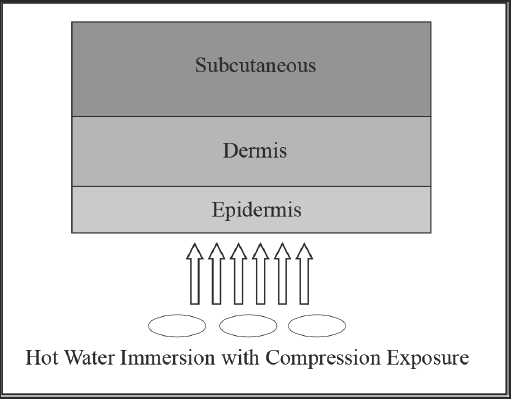
Skin model.
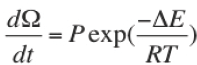
Mathematical integration of Eq. 1 yields,
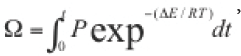
Ω = burn injury parameter (dimensionless), P = frequency factor (2.185 × 10124 s−1 at T < 50 °C and 1.823 × 1051 s−1 at T > 50 °C), ΔE = activation energy (J/kmol), R = universal gas constant (8.315 J/kmol·K) (i.e., ΔE/R = 93534.9 K at T < 50 °C and ΔE/R = 39109.8 K at T > 50 °C), T = temperature (K) at epidermis skin depth of 75 × 10−6 m, and t = time for which T > 317.15 K (44 °C).
The time at which Ω reached a value of 1 in Eq. 2 is called the second-degree burn time.29–31 The average (with a standard deviation of 2.5%) second-degree burn time for three specimens of a particular fabric was inferred as the thermal protective performance value of that fabric. Furthermore, the total amount of thermal energy (kJ/m2) absorbed by the sensor (human skin model) during testing of these three specimens was measured by using customized HBI software that was programmed according to Duhamel's theorem (Eq. 3).

Ti = initial uniform surface temperature (°C) of the sensor, Ts(t) = surface temperature (°C) of the sensor at time t (s), and q”(t) = heat flux (kJ/m2) at time t. The average total energy values for these three specimens were calculated.28,32,33Finally, the total amount of water (g) absorbed by these three tested specimens was also calculated by subtracting the weight (g) of the specimens before the test from the weight of the specimen 30 s after the test, and the total amount of water absorbed in these three specimens was averaged.
Analysis
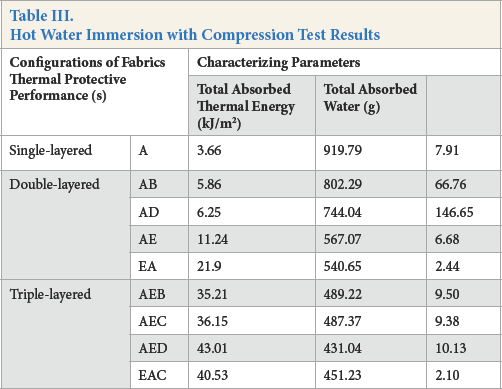
The characterizing parameters—thermal protective performance values of the fabrics, amount of total thermal energy absorbed by the sensor (human skin model), and amount of total water absorbed by the fabrics—obtained from the above experiment are given in Table III. The fabrics’ physical properties (Table II) and the thermal protective performance values (Table III) were normalized between -1 to +1 with an average value set to zero. The normalized variable Xi, norm can be represented by Eq. 4.
Hot Water Immersion with Compression Test Results

X i is the value of a selected variable (air permeability, thickness, weight, thermal resistance, or thermal protective performance), X i, avg is the average value of that particular variable, X i, min is the minimum value of that variable, X i, max is the maximum value of that variable, and R i, max is the maximum range between the average value and either the minimum or the maximum of that variable.
The normalization process minimized redundancy in the dataset by pulling out abnormal factors. To understand the association between fabrics’ properties and thermal protective performance, a t-test was conducted on the normalized dataset using StatCrunch software (developed by programmers and statisticians at Texas A&M University). The association was inferred based on the sign (+ or -) of the T-stat value obtained from the t-test. P-values obtained from the t-test were analyzed to identify fabric properties that significantly affect thermal protective performance. If the P-value for any considered property was less than 0.05, that property was considered statistically significant. A relationship plot was developed between a significant fabric property and thermal protective performance and the coefficient of determination (R 2 ) for the developed plot was calculated. An R 2 value with proximity to 1 was inferred as a strong association between a significant fabric property and thermal protective performance. Inference tests (hypothesis test (P-value) and 95% confidence interval (upper and lower limits) analyses were carried out to understand the differences in the thermal protective performance of various fabrics. The amounts of total thermal energy absorbed by the sensor during fabric testing and the amounts of total water absorbed by the fabrics were used to support any findings associated with thermal protective performance.
Results and Discussion
The thermal protective performance of the selected fabrics (in terms of second-degree burn time in seconds) obtained from the hot water immersion with compression tests is shown in Table III. From these tests, the amount of total absorbed thermal energy (kJ/m2) obtained by the sensor (human skin model) and the amount of calculated total absorbed water (g) by the fabrics are represented in Table III.
The thermal protective performance of the triple-layered fabrics was higher than the single- and double-layered fabrics (Table III). Contextually, this finding was also cor-roborated by Mandal, Song, and Gholamreza in their recent study. 20 Although the porous-structured fabrics trapped air, more air layers and dead air were trapped by the triple-layered fabrics than the single- and double-layered fabrics. As thermal insulation values of this dead air are much greater than those of the fiber present in the fabrics, this dead air was the determining factor for greater thermal protective performance. It is also evident that the thermal resistance of AE was less than AB; however, the thermal protective performance of AE was significantly greater than AB. Tis is because AE contained a polyurethane-coated moisture bar-rier in its structure, while AB did not. Due to the presence of this coated moisture barrier, hot water did not penetrate through the pores of AE towards the wearers’ (firefight-ers') skin (Fig. 5). Consequently, the amount of hot water absorbed in AE (6.68 g) was much less than AB (66.76 g). As a result, AE showed greater thermal protective performance by causing less burns on wearers’ skin. Interestingly, it can also be inferred that AEC (or AE) and EAC (or EA) had the same level of thermal resistance; however, EAC demonstrated greater thermal protective performance than AEC. This was due to the moisture barrier present in the outer layer of EAC, which immediately stopped the penetration of hot water through the pores in the fabric structure. Consequently, the hot water absorption in EAC (2.1 g) was much less than in AEC (9.38 g). Tis low hot water absorption resulted in the greater thermal protective performance of EAC than that of AEC.
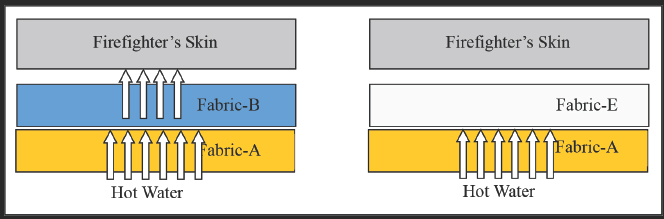
Hot water penetration through Fabrics AB and AE.
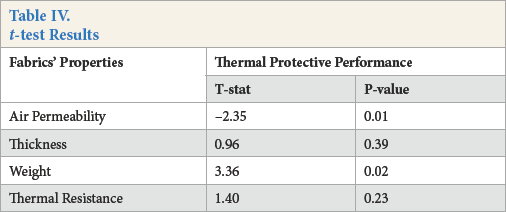
The results of the t-test among fabric properties (i.e., air permeability, weight, thickness, and thermal resistance) and thermal protective performance values are shown in Table IV. Air permeability had a negative T-stat value and the lowest P-value of 0.01 (Table IV). Tis indicates that a significant inverse relationship existed between air permeability and thermal protective per-formance (Fig. 6). Contextually, this result was also supported by Mandal, Song, and Gholamreza. 20 Tis inverse relationship can be reasoned based on Darcy's law (Eq. 5), which states that a fabric with high air permeability allows greater mass (hot water) transfer through its structure.
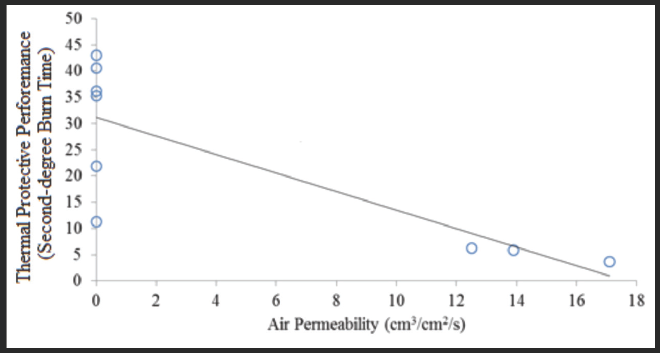
Relationship plot between air permeability and thermal protective performance.
t-test Results
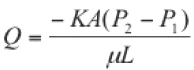
Q = the total discharge of mass per unit time (m3/s), K = permeability of the fabric (m2), A = cross-sectional area of mass flow (m2), P1 = pressure of the hot water before passing through the fabric (Pa), P2 = pressure of the hot water after passing through the fabric (Pa), μ = viscosity (Pa·s), and L = thickness of the fabric (m).34,35 As a result, a significant amount of thermal energy was transmitted through the highly air-permeable fabric, resulting in quick forming burns on wearers’ bodies.
In this context, an inference test was conducted between the thermal protective performance of air-impermeable (i.e., air permeability = 0) and air-permeable (i.e., air permeability > 0) fabrics. It was found that a significant difference existed in the thermal protective performances of air-impermeable and air-permeable fabrics (P-value < 0.05). Tis difference was positive at a 95% confidence level. Based on this finding, it can be inferred that the thermal protective performance of air-impermeable fabrics was usually greater than the performance of air-permeable fabrics. As the values of porosity and tortuosity of an air-impermeable fabric were very low and high, respectively, the flux or flow of mass (hot water) through the air-impermeable fabric was very low according to Fick's law (Eq. 6).
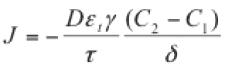
J = flux or flow of mass through the fabric (mol/m2·s), D = mass diffusion coefficient (m2/s), ∊ t = porosity of the fabric (dimensionless), γ = constrictivity of the hot water (dimensionless), τ = tortuosity of the fabric (dimensionless), C2 = concentration of the hot water after passing through the fabric (mol/m3), C1 = concentration of the hot water before passing through the fabric (mol/m3), and δ = thickness of the fabric (m).36,37 Tis low flux or flow of mass resulted in greater thermal protective performance for air-impermeable fabrics in comparison to air-permeable fabrics.
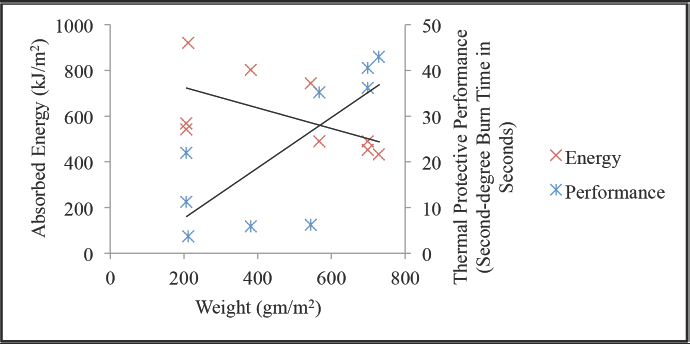
Furthermore, Table IV shows that T-stat values of fabric thickness, weight, and thermal resistance were positive; among these, fabric weight had the lowest P-value (0.02). Tis shows that these properties were positively correlated with thermal protective performance, and that fabric weight had the most significant effect on performance. However, this finding was scientifically conditioned (i.e., the fabric weight cannot affect the performance alone) with the air permeability of the fabric and/or amount of mass transfer through the fabric. Air-impermeable fabrics with heavy weight and/ or greater thickness can trap more insulating dead air in their structure than fabrics with light weight and/or less thickness. As a result, air-impermeable heavy and/or thicker fabrics had greater thermal resistances. Due to these high thermal resistances, the amount of thermal energy transferred through these fabrics or absorbed by the wearers’ skins was low, resulting in slow burn formation on wearers. Moreover, heavyweight and/or thick fabrics can store more thermal energy within their structures (transferring less thermal energy through their structures), which can also enhance thermal protective performance. In this context, a relationship plot among weight, thermal protective performance, and absorbed thermal energy by wearers’ skins is displayed in Fig. 7. As R 2 values were high (Fig. 7), fabric weight possessed strong positive and negative relationships with thermal protective performance and absorbed thermal energy, respectively.
Fabric compressibility can be another important factor associated with trapped dead air in heavyweight fabrics. A highly compressive fabric, once compressed, may release the trapped dead air from its structure, which can alter the thermo-physical properties of the fabric. Tis results in reduced fabric thermal protective performance. Additionally, the tested fabrics were compressed with a perforated hot surface (Fig. 2); this feature causes significant conductive heat transfer (q) from the hot surface to fabric based on Eq. 7.

Δ HF = temperature difference between the hot surface and the fabric (K), ΔXH = thickness of the hot surface (m), k H = thermal conductivity of the hot surface (W/m·K), A = contact area between the hot surface and the fabric (m2), 1/hHF = thermal contact resistance between the hot surface and the fabric depending upon their surface roughness (m2·K/W), ΔXF = thickness of the fabric (m), VA = air volume of the fabric (m3), VF = volume of the fabric (m3), kγ = thermal conductivity of the solid fiber phase of the fabric (W/m·K), and kα = thermal conductivity of the gaseous air phase of the fabric (W/m·K).38,39 This conductive heat transfer may cause significant burns on wearers. In this context, Mandal, Song, and Gholamreza mentioned that conductive heat transfer was more prominent in hot water immersion with compression than the typical hot water splash exposure. 20 They concluded that the transfer of both mass and conductive heat through fabrics significantly lowered the thermal protective performance of fabrics under hot water immersion with compression than without compression.
Conclusions and Recommendations
In this study, various layered fabrics used in firefighters’ protective clothing are characterized by exposure to hot water immersion with compression. Tis exposure critically differs from any other regular thermal exposures (e.g., fame, radiant heat, and/or hot surface contact) faced by firefighters in regard to modes of heat and mass transfer. In regular thermal exposures, the modes of heat transfer through a fabric are usually convection, radiation, and/or conduction; however, a combination of mass and conductive heat transfer occurs through a compressed fabric in the thermal exposure of hot water immersion with compression. The imposed compression on a fabric can also change its thermo-physical properties, which can lower the thermal protective performance of the fabric. In this unique exposure, triple-layered fabrics, which include a moisture barrier in their outer layer, can provide excellent protection for firefighters; in contrast, a fabric with high air permeability may quickly generate burns on firefighters’ bodies.
Tese findings on thermal protective performance of fabrics are quite consistent with a recent study. 20 Consequently, highly air-permeable fabrics are not recommended for use in fre-fighters’ protective clothing. Furthermore, an air-impermeable, heavyweight fabric with low compressibility can be efficiently used to produce protective clothing. However, this air-impermeable and heavyweight clothing may cause heat stress or discomfort for firefighters through ineffective dissipation of their metabolic heat and sweat vapor.4,6 Tis study is limited to a particular water temperature (85 °C) and compressive pressure (8 psi). In the future, this study can be extended to a wide range of temperatures and pressures for an in-depth characterization of fabrics. The findings obtained from this study may assist in producing safer and more efficient high performance thermal protective clothing for firefighters.
Footnotes
Acknowledgements
We appreciate the technical support from Mark Ackerman (Adjunct Professor, Department of Mechanical Engineering, University of Alberta) and Stephen Paskaluk (Research Engineer, Department of Human Ecology, University of Alberta).
We acknowledge funding support from the Natural Sciences and Engineering Research Council of Canada (grant number: RES0008159). Sumit Mandal thanks the University of Alberta for providing him the prestigious Izaak Walton Killam Memorial Scholarship.