






Abstract
Washfastness and crockfastness values were evaluated to study the effects of binder and process parameters on pigment printing. Acrylate- and butadiene-based binders, and three different colorants, were used for pigment printing on 100% cotton fabrics. Sixty-six pigment printed fabrics were evaluated for washfastness and crockfastness by standard test methods. Fastness values were evaluated based on binder, softener, fixator, process, fastness developer, pH, and curing temperature/time. Results indicated that wet crockfastness values were dependent on the processing parameters. In addition, using butadiene-based binder and adding fixator into the printing paste had significant effect on improved fastness values.
Introduction
Pigment printing is the most important and common printing method used in the textile industry because of its simplicity, quality, and economical application. More than 50% of printed textile goods are produced using this method.1–3 Pigments can be applied to any kind of fiber or blend and do not require washing after the fixation process because no unbound colorant is left on the fabric surface, minimizing environmental pollution. 4 Also, there is no change in the hue of the colorant throughout processing. 5 However, pigment printing leads to colorfastness and crockfastness values that are comparably low compared to dyed fabrics.3,6 Therefore, changes in processing that improve colorfastness and crockfastness are important for pigment printing.
Pigment printing has some unique properties. Electrolytes on the water insoluble pigment paste and fabric thickness affected the colorfastness of pigment printed fabric. 7 Therefore, pigment printing paste generally contains binder to help with particle bonding between pigment and fabric. Also, adding thickener, emulsifier, and auxiliary chemicals in the print paste are useful to improve colorfastness and softness on pigment printed fabric.
In a previous study, a comparison of acrylate- and butadiene-based binder showed that butadiene-based binder had better performance in terms of crockfastness, formaldehyde release, and PVC migration. 3 In addition, fabric finishing methods (e.g., UV curing, microwave, and atmospheric plasma treatment) were suggested to improve colorfastness.6,8 However, additional processing leads to more costly and less energy efficient pigment printing.
This study evaluated washfastness and crockfastness properties of pigment printed fabrics under day-to-day mill conditions. Specifically, the type and amount of binder, softener, fixator, pH, and time and temperature effects on washfastness and crockfastness were studied. This research will help textile manufacturers choose the best working conditions to improve fastness.
Experimental
Materials
The experiments were performed on 100% sateen woven cotton fabric. Fabric specifications were: yarn count of 40/1 Ne in both warp and weft direction for a total of 80 yarns/ cm, and fabric weight of 128 g/cm2. As a standard procedure, fabrics were treated by singeing, mercerizing, and bleaching using the exhaust method.
Commercial pigments Red C2B (Ersa), Green KG (Imperon), and Navy Blue CR (Ersa) were used as colorants for pigment printing. Acrylate-based binder, butadiene-based binder, silicone softener Goldsof (MSA), fixator Aqua-bond Pure (non-formaldehyde, Benar), cationic fastness developer, and anionic fastness developer were used for the printing processes.
Method
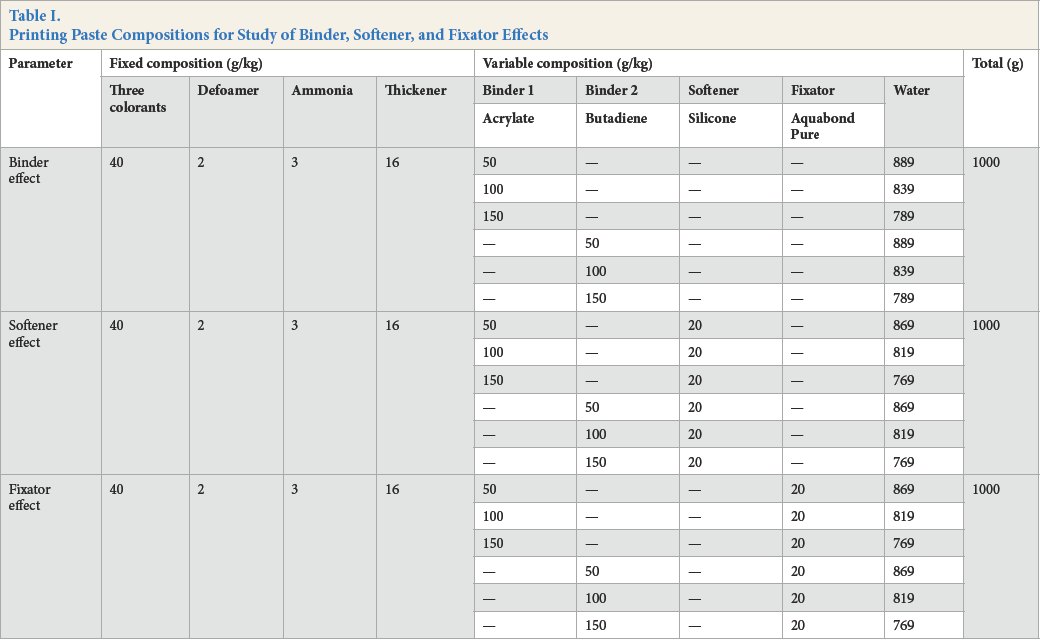
Printing pastes were applied to the cotton fabric on a blade type variant table using a 125 mesh Stork screen at a speed of 20 m/min and with level 6 blade pressure. As a standard procedure, fabrics were dried by hanging and cured at 150 °C for 5 min under mill conditions. The binder, softener, and fixator were the variables studied. Water was added to the recipe to make a total weight of 1000 g. Printing pastes were then prepared as shown in Tables I and II.
Printing Paste Compositions for Study of Binder, Softener, and Fixator Effects
Printing Paste Compositions for Study of Process, Fastness Developer, and Curing Temperature/Time Effects
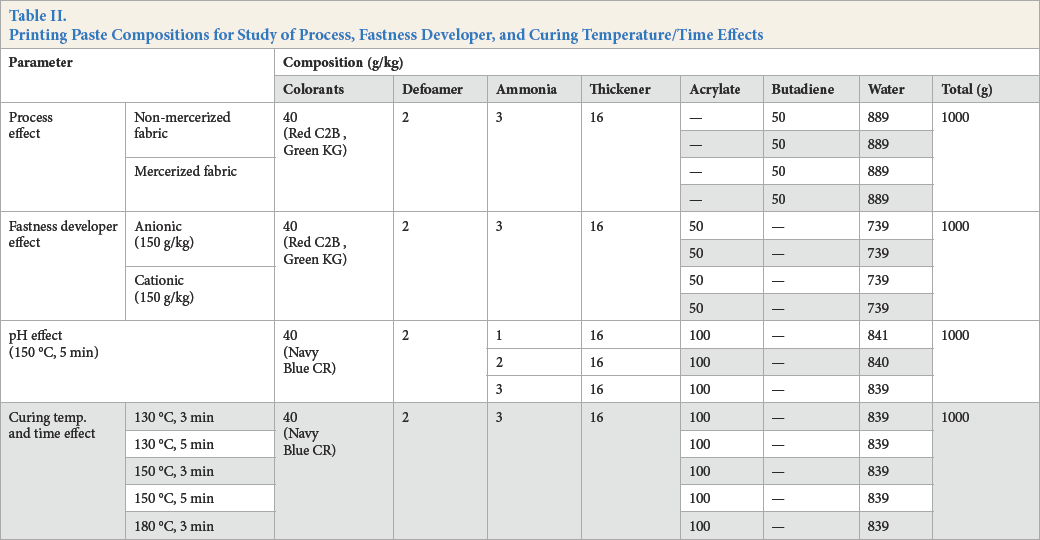
Washfastness and crockfastness values of pigment-printed fabrics were evaluated based on the type of binders and process parameters used. Various amounts of acrylate- and butadiene-based binders were used on 100% cotton fabrics, as well as the three test pigments. Also, a certain amount of fixator and silicone softener were added to the recipes for evaluation. To evaluate the pH value effect, three different amounts of aqueous 25% ammonia by weight were added to the acrylate-based binder recipe for only the Navy Blue CR color print. Tree different fixation times and temperatures were applied for the Navy Blue CR color print. Anionic and cationic fastness developers were evaluated on acrylate-based binder for the Red C2B and Green KG color prints.
Testing
Crockfastness and washfastness were assessed according to ISO 105 C06 A1S and ISO 105X12 respectively.
Results and Discussion
Crockfastness
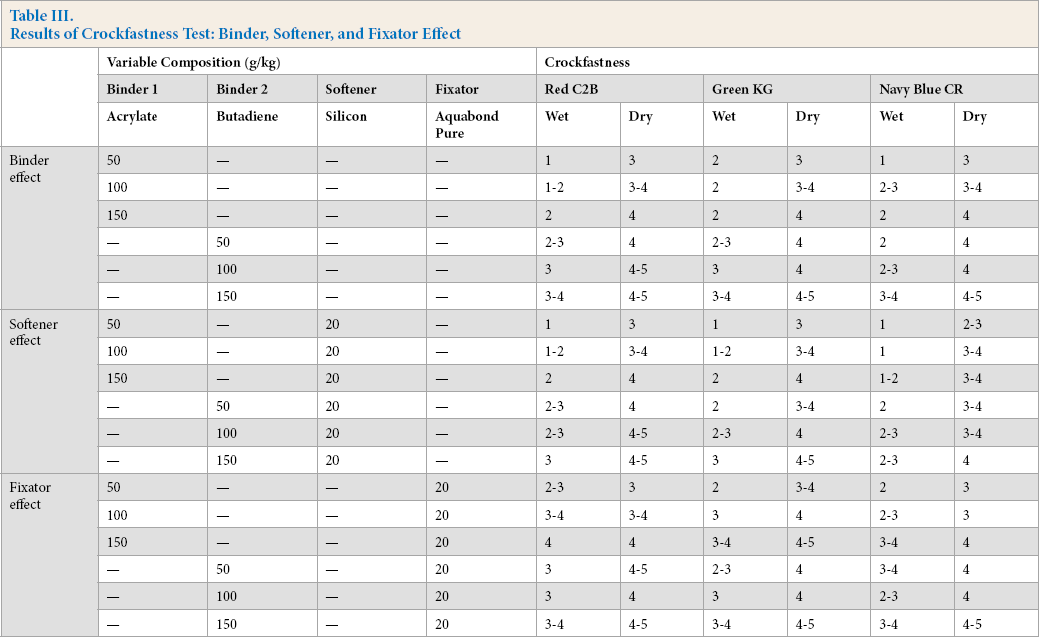
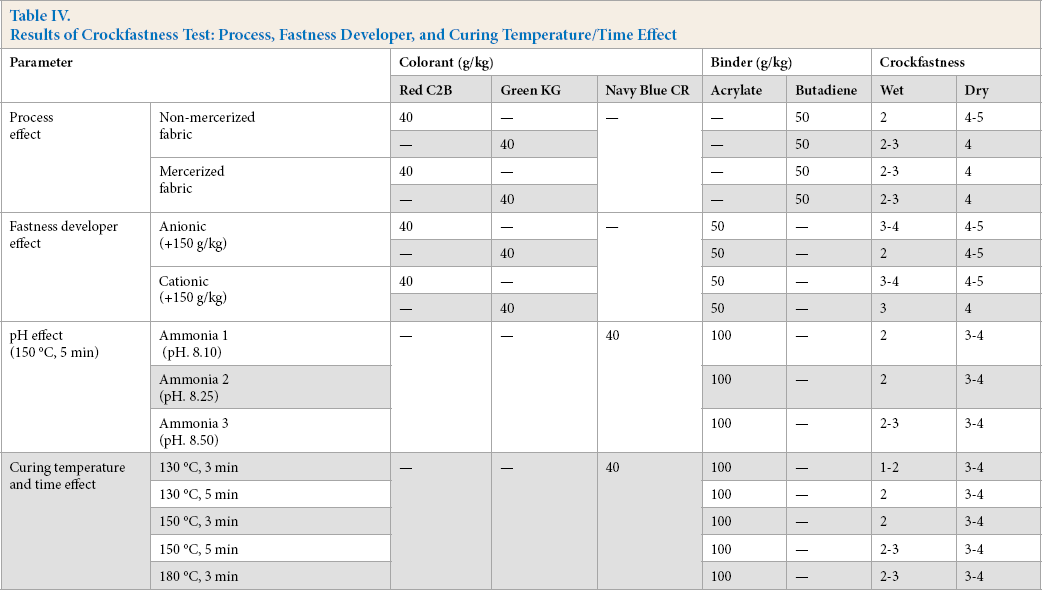
Wet and dry crockfastness values of pigment printed fabrics were evaluated (Tables III and IV). Crockfastness values changed depending on the chemical compositions, including colorant, of the pigment printing pastes. Wet and dry crockfastness values were influenced by the binder, softener, fixator, process, fastness developer, pH, and curing temperature/time used.
Results of Crockfastness Test: Binder, Softener, and Fixator Effect
Results of Crockfastness Test: Process, Fastness Developer, and Curing Temperature/Time Effect
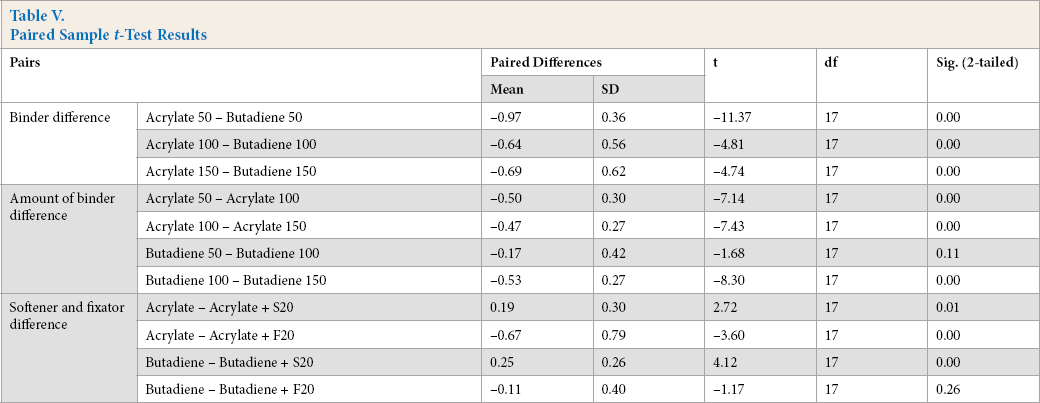
Butadiene-based binder gave better crockfastness values over acrylate based binder by a 0.5 to 1.5 point margin on both dry and wet tests as shown in Fig. 1. The influences of binder types, binder amount, and addition of softener or fixator on crockfastness values were analyzed by paired sample t-test as shown in Table V. The t test results indicated that greater amounts of binder in the paste created significantly improved results for every level (p < 0.05) except between butadiene 50 and butadiene 100. While the presence of softener led to lower fastness values with both types of binders, the fixator improved the fastness results significantly on acrylate-based, but not on butadiene-based, binder. As expected, the dry test results gave much greater fastness values than the wet test results.
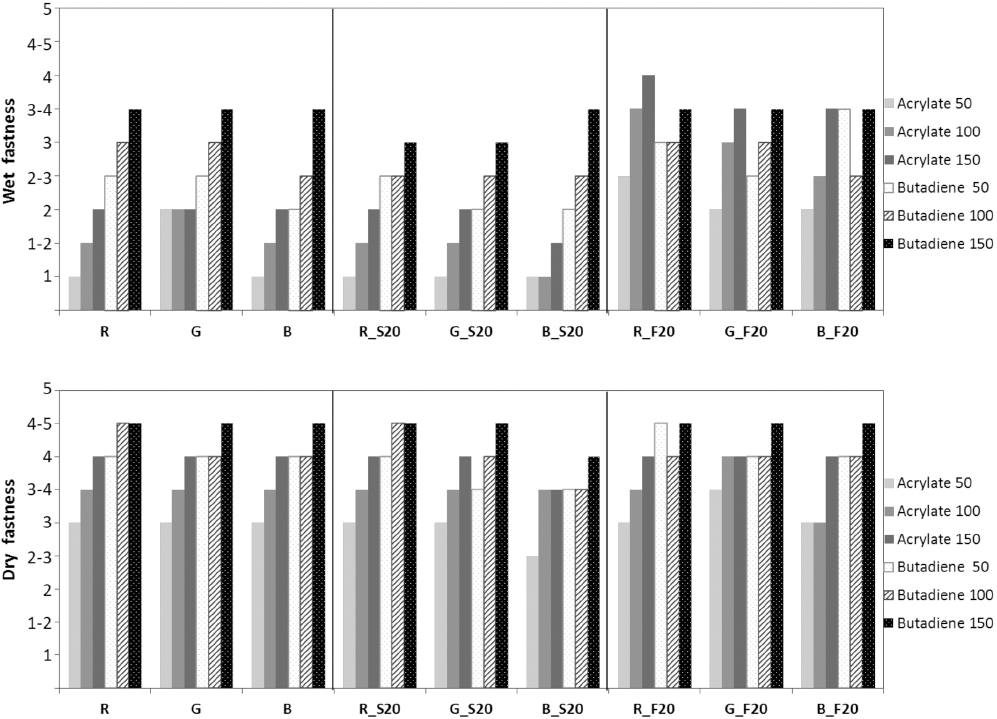
Binder (acrylate and butadiene), softener (S), and fixator (F) effects on wet and dry crockfastness values of Red C2B (R), Green KG (G) and Navy Blue CR (B) colors. This figure was created from Table III. Numbers on the x-axis and in the legends refer to amounts of the chemical (in g/kg) used in the formulation.
Paired Sample t-Test Results
Use of greater amounts of ammonia (creating higher pH values) gave very limited improvement on wet fastness results, but not on dry fastness results. However the curing temperature and time gave improvements in results (Fig. 2).
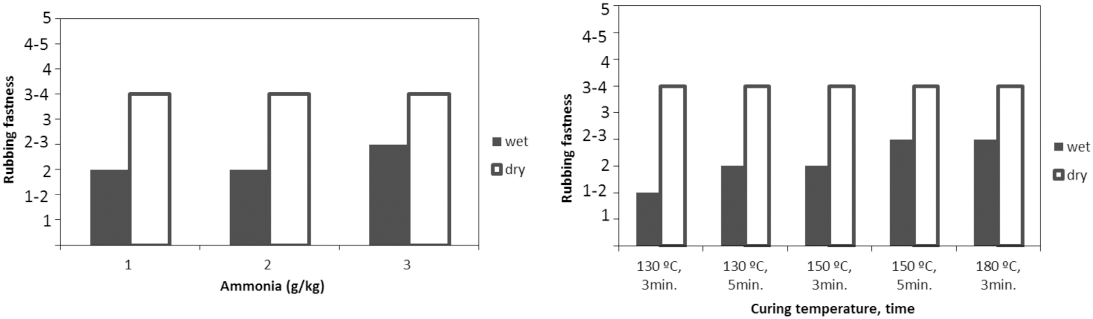
pH, curing temperature, and time effects of acrylate-based binder on wet and dry crockfastness values of Navy Blue CR (B) color. This figure was created from Table IV.
Cationic fastness developer use gave better results in wet rubbing fastness and worse in dry rubbing fastness when compared to use of anionic fastness developer (Fig. 3). These tests were repeated once to verify the results.
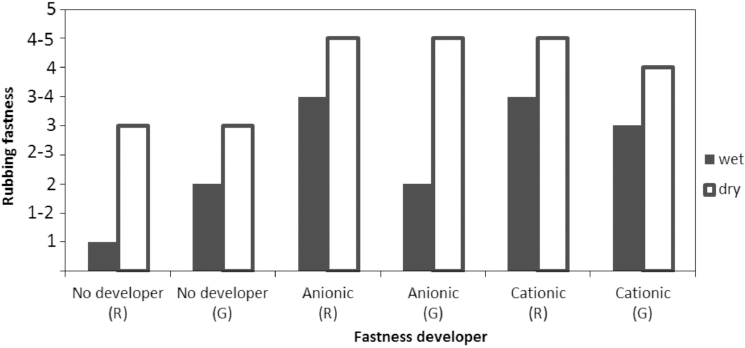
Fastness developer effect on wet and dry crockfastness values of Red C2B (R) and Green KG (G) colors. This figure was created from Table IV.
Washfastness
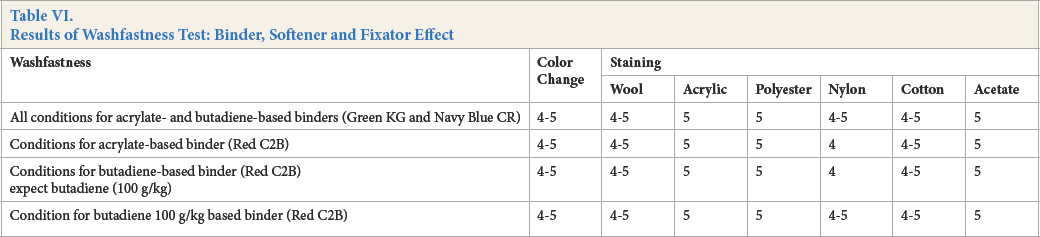
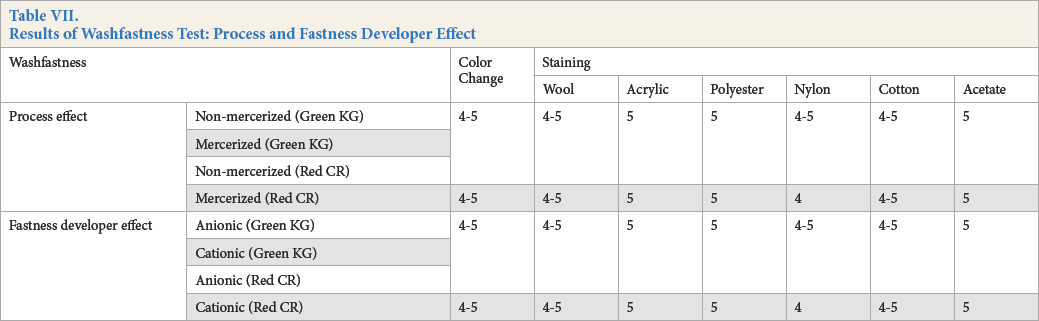
Washfastness results did not show any variation with the exception of red color nylon staining values, which were only 0.5 points lower than the others with the value of 4 (Tables VI and VII). All washfastness values gave very good results (4-5 and 5).
Results of Washfastness Test: Binder, Sotfener and Fixator Effect
Results of Washfastness Test: Process and Fastness Developer Effect
Conclusions
Crockfastness and washfastness values of pigment printed fabrics were evaluated by changing the compositions of the printing paste. While washfastness values showed almost no variation, wet crockfastness values showed significant differences in the test parameter comparisons. Butadiene-based binder gave better performances than the acrylate-based binder by a 0.5 to 1.5 point margin on both wet and dry crockfastness tests. Greater binder amounts improved fastness values. Silicone softener was detrimental to fastness values. However, it generally improved the hand.
Use of fixator improved the wet crockfastness values of acrylate-based binder printed fabric significantly and did have an effect on lower levels of butadiene-based binder printed fabric, but did not improve performance across the board. Use of fixator had marginal, if any, improvement on dry crockfastness values.
Change in pH gave very limited effects, while increasing the amount of ammonia (increasing the pH) was expected to give better results. The curing temperature and time had a significant effect on the results. Cationic fastness developer use created a better (1-point margin) wet crock-fastness result, and created a worse (0.5-point margin) dry crockfastness result when compared to use of the anionic fastness developer.
Consequently, wet crockfastness values strongly depended on the introduced parameters when compared with dry crockfastness and washfastness. In general, butadiene-based binders can meet grade 4 dry crockfastness values, however only 150 g/kg of acrylate-based binder with fixator can meet those levels. In addition, the addition of fixator into the printing paste was significantly effective in improving wet crockfastness values, but marginally effective in improving dry crockfastness values.