






Abstract
We present the first data on our comparative genomic hybridization (CGH)–based strategy for the analysis of ancient DNA (aDNA) samples extracted from fetuses preserved in the Meckel Anatomical Collection in Halle, Germany. The collection contains numerous differently fixed ancient samples of fetal malformations collected from the middle of the 18th to the early 19th century. The main objective of this study is to establish a “standard” aDNA extraction and amplification protocol as a prerequisite for successful CGH analyses to detect or exclude chromosomal imbalances possibly causative for the malformations described for the fetuses.
Keywords
C
The term ancient DNA (aDNA) describes DNA that can be extracted mostly in small amounts and at different stages of degradation from non-living clinical, museal, archeological, and paleontological samples (Herrmann and Hummel 1993). The age of the source material can differ from a few years to thousands of years. In the literature, different molecular genetic investigations on aDNA are described (for review, see Marota and Rollo 2002). We performed the first successful CGH analyses on aDNA extracted from a bronze-age human individual and a 262-year-preserved malformed fetus without former PCR amplification, as described previously (Tönnies et al. 1998; Hummel et al. 1999).
The aim of the Meckel Collection study is to gain deeper insights into the effect of different aDNA extraction and amplification protocols on the quality of CGH results. Additionally, we are interested in the possible identification of cytogenetic imbalances in clinically well-described “ancient” malformed fetuses and in further testing of different confirmatory allele-specific PCR analyses on genomic aDNA probes.
To date, we have extracted aDNA from 19 different ethanol- or formalin-fixed umbilical cord and muscle samples of malformed fetuses under sterile conditions. Recurrent DNA extractions have been performed using standard phenol-chloroform protocols and the Invisorb Forensic Kit as recommended by the manufacturer (Invisorb; Berlin, Germany). The Invisorb Forensic Kit gave repeatedly better results concerning PCR-amplifiable DNA in comparison to standard phenol-chloroform-based protocols. However, in all cases, the total quantity of aDNA extracted was below the quantity needed for successful CGH experiments. As shown in previous experiments, the total amount of genomic DNA needed for detecting known chromosomal imbalances by CGH on metaphase spreads must be 50 ng in 10 μl hybridization solution (5 ng/μl) for a 324-mm2 hybridization area (Hummel et al. 1999). In the literature, different whole-genome amplification strategies, mainly degenerate oligonucleotide primer (DOP)-PCR-based (Telenius et al. 1992) strategies, are described for the amplification of aDNA probes (Kittler et al. 2002). Testing different amplification protocols with aDNA extracted from ethanol- and unbuffered formalin–fixed probes, a simple protocol based on using modified DOP-Primer (5'-CCG ACT
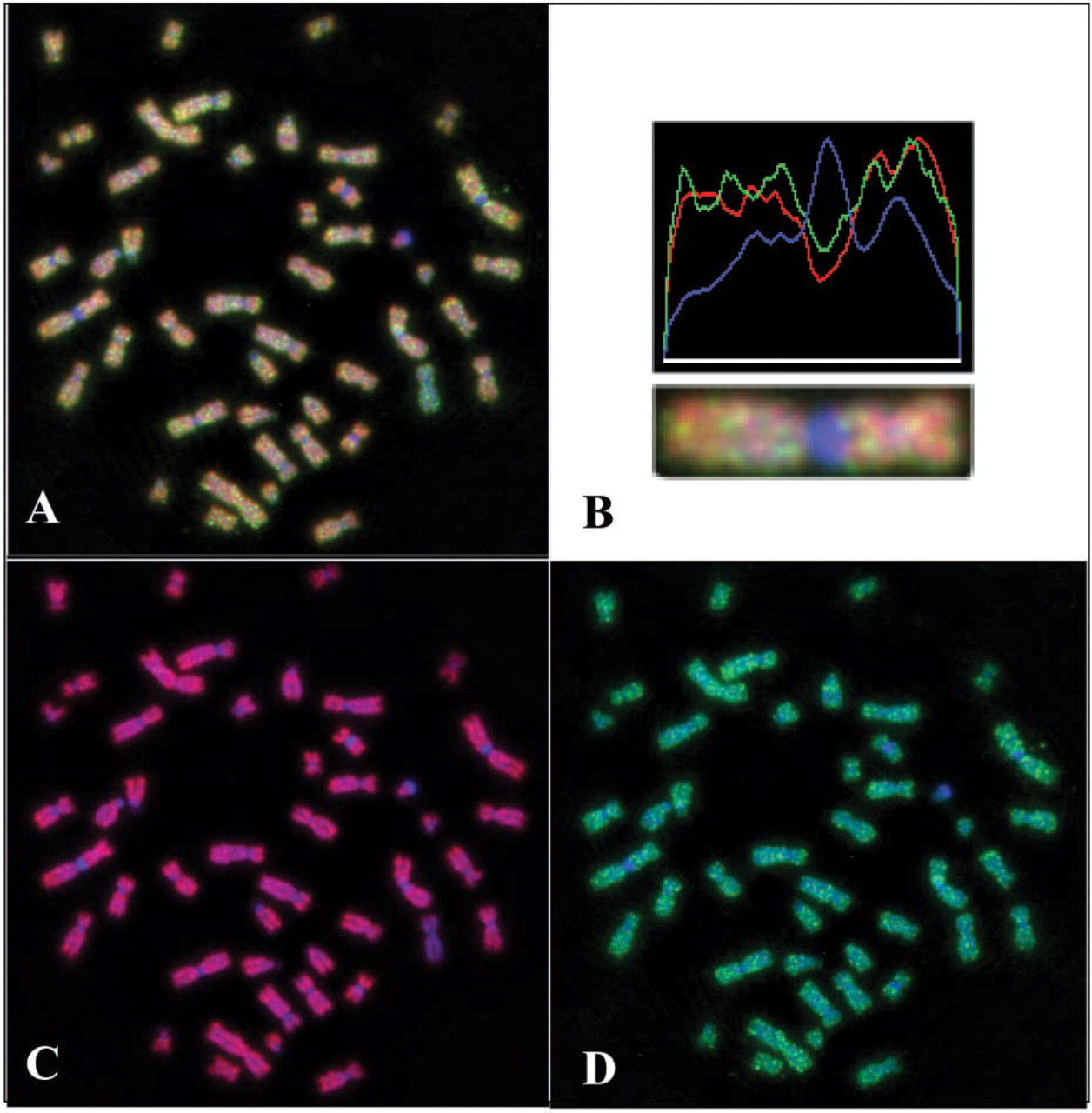
After hybridizing the “contaminated” master mix control, no DNA/DNA hybridizations on human chromosomes could be detected, excluding contemporary human DNA contamination. Additionally, human X- and Y-specific PCR (Kogan et al. 1987; Witt and Erickson 1989) gave no PCR products in these probes. After hybridization and ratio profile calculation, a ratio profile deviation indicating a full or partial euchromatic chromosomal imbalance was not detected in any of the 19 aDNA probes investigated by CGH (for ratio profile example, see Figure 2). Including full numerical chromosome aberrations as trisomy 21 and trisomy 18—both excluded phenotypically in our fetal samples—Gardner and Sutherland (2004) expected a cytogenetic abnormality in 4–8% of individuals with structural congenital malformations, as has been seen in our cases phenotypically. Considering additionally that CGH has a detection resolution for chromosomal imbalances of ~10–20 Mb, the fact that no imbalance has been detected in our samples was not unexpected.
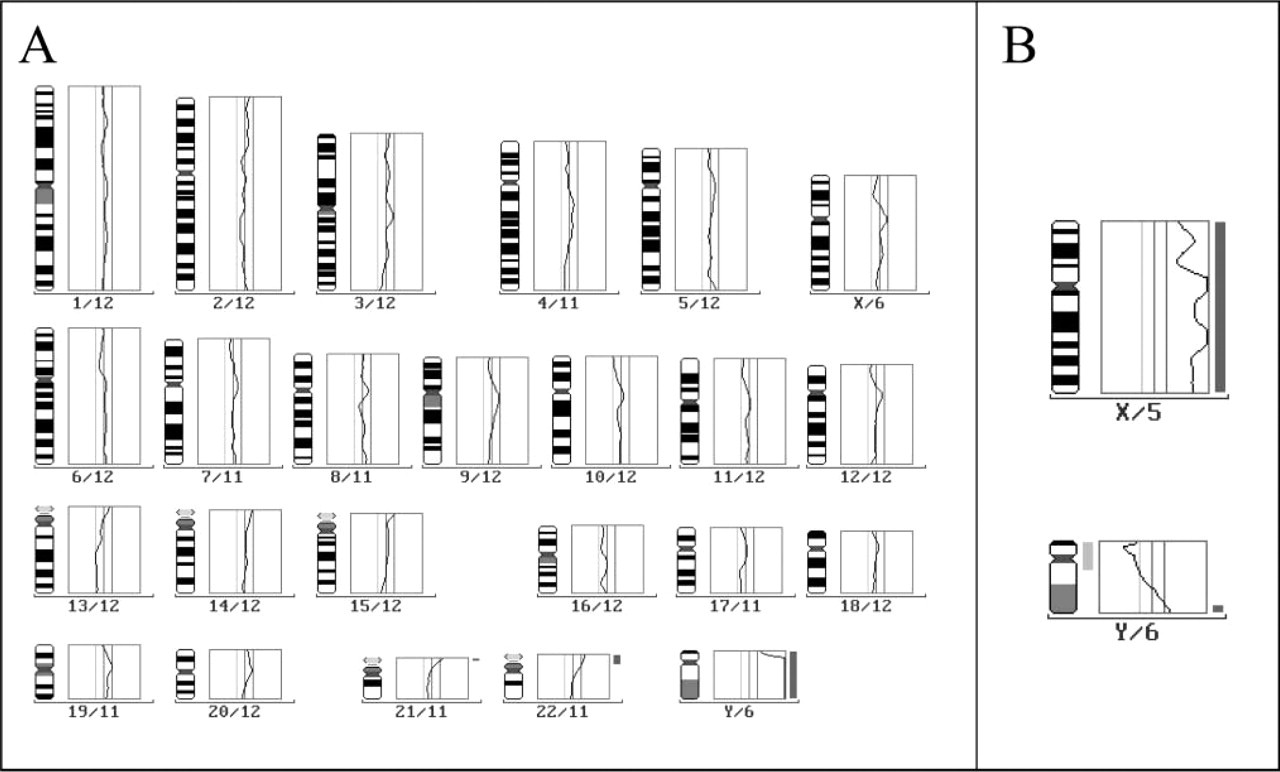
CGH ratio profiles of ethanol-stored aDNA probe number 8 extracted from a 16-week-old fetus described by the anatomist Meckel the Younger in 1826 vs female control DNA (
Our experimental design is based on the use of male and female reference DNAs in independent CGH hybridizations to determine the sex of the fetal aDNA. In contrast to the X-chromosome content, the number of Y chromosomes could not be determined repeatedly with routine diagnostic accuracy. When aDNA probes and female control DNA were used (Figure 2A), the Y-chromosomal ratio profiles often mimicked the existence of a Y chromosome (positive threshold crossing), even in cases in which normal female genitalia were described. However, when a male control DNA was used (Figure 2B), the positive deviation was restricted to the heterochromatic part of the Y chromosome (Yq12) that is routinely excluded from evaluation. We hypothesize that small, degraded aDNA fragments, which are not suppressable by Cot-1 DNA, cross-hybridize with the gonosomal target DNA and simulate a real homolog DNA:DNA hybridization over the Y chromosome. Further PCR-based sex-determining tests on aDNA are in progress to determine the fetal gonosomal constitution and to follow up on the question of whether additional confirmatory aDNA-based tests for potential imbalanced CGH results are feasible using these extracted aDNAs. As has been shown for CGH, first PCR results indicated that positive X- and Y-specific PCR results seem not to be directly dependent on ethanol or formalin fixation of the probes over time. Future analyses of aDNA samples with known chromosomal aneuploidies (e.g., ancient trisomy 18 and/or trisomy 21 cases) will show whether our extraction and amplification strategy in combination with CGH is a reliable tool for the detection of chromosomal imbalances in aDNA probes.
Footnotes
Acknowledgements
Parts of the projects were funded by the Universitäre Forschungsförderung, Charité, Humboldt-Universität, Berlin, Project-Nr. 2001–685, and the Wilhelm-Roux-Programm, Martin-Luther-Universität, Halle-Wittenberg, Project-Nr. FKZ 5–24.