






Abstract
Objectives
To determine the current status of History of Medicine student selected components (SSC) at UK medical schools. This includes the frequency, methods of delivery, assessment, and evaluation of such courses.
Design
An 18-item questionnaire was created, piloted, and then sent electronically in January 2010 to participants pertaining to their History of Medicine SSC provision as of 1 January 2010. Initial non-responders were re-sent the questionnaire in February 2010.
Setting
All UK medical schools.
Participants
The History of Medicine SSC lead or overall SSC lead at each UK medical school were contacted to ascertain their History of Medicine SSC provision.
Main outcome measures
Percentages of History of Medicine SSCs for each objective characteristic were obtained as well as general descriptive data.
Results
Fifteen of the 32 medical schools in the UK offer a History of Medicine SSC. Eleven medical schools (offering a total of 12 SSCs) completed the questionnaire (response rate 73.3%). Eight different teaching methods are used within the SSCs. Medical professionals most frequently deliver the teaching, which most frequently covers the 20th and 21st centuries. Four assessment methods are used among the SSCs, the most common being a group presentation. Questionnaires are the most frequent method of evaluation. There are several factors limiting the provision of some current SSCs, most commonly a lack of staff, teaching facilities, and available time within the curriculum.
Conclusion
History of Medicine is being delivered more frequently in UK medical schools than when previously researched 40 years ago. However, the subject is still offered in a minority of the medical schools. This study offers useful information to consider for the development of current and potential new History of Medicine SSCs.
DECLARATIONS
The study was approved by the Research Ethics Committee at Hull York Medical School in December 2009
NHM came up with the idea of the study and conducted the literature review, research and follow-up, and wrote the first draft of the paper; AKB provided advice on study design, methodology and writing the paper
Introduction
The historical debate for and against including the History of Medicine within medical degrees
There has been a long-running debate as to the potential merits or otherwise of devoting time in the undergraduate medical curriculum to the study of the History of Medicine. Studying the subject has been proposed by some1–5 who argue that knowledge from the successes and failures of our predecessors would reduce wastage of time, money, and energies going over ‘ground already trodden'. 5 Counter arguments have included difficulties in finding time within an already full curriculum for the subject and the need for students to concentrate on both learning modern theory and producing research for future generations.5–7
The History of Medicine had, until relatively recently, struggled to be part of the medical undergraduate curriculum in the UK. A study comparing the provision of the subject within European countries in 1969 suggested it ‘has developed remarkably little in the country [UK] as an academic discipline'. 8 Then, there was only one fulltime faculty position within medical schools in the subject, at the University College London (UCL); the medical schools of Edinburgh and Leeds had some part-time lecturers. This was then confirmed with a report from 1971, the last to publish data on the History of Medicine provision at undergraduate level in the UK. The report did, however, add:
‘A considerable number of departments in Medical Schools and other institutions reported that historical points were normally touched on in the course of teaching, and that some idea of historical development was considered of advantage to the medical student.' 9
Within Higher Education, the History of Medicine was virtually confined to postgraduate history departments and even there, the subject was much the weaker in comparison to the History of Science. 9 By 1987, other than an Interacted BSc degree at UCL having already commenced, Lawrence commented: ‘It is usually at the level of a master's degree that formal training in the History of Science or Medicine is obtained'. 10
However, the subject did flourish in more informal and postgraduate settings. This included the medical societies of Royal Colleges and Societies.11,12 The Worshipful Society of Apothecaries, for example, created Honorary Lecturer posts, student courses, student prizes, and a diploma in the subject.4,13,14 However, a perceived lack of support from medical educators led to the Society writing in 1965 to the subcommittee of the General Medical Council (GMC): ‘If it is worthy of study then it is worthy of a place in the syllabus and of regular teaching appointments in the medical schools'. 13 The recommendations were not taken up. Instead, the largest contributor to the specialty has been the Wellcome Trust. The Trust owns and maintains the Wellcome Institute of the History of Medicine as well as establishing five academic centres, known as Wellcome Units in the History of Medicine throughout the UK. However, such an established organization has previously been thought to be paradoxically accountable for hindering the development of the subject as a formal discipline within medical schools; the History of Medicine has been so well covered by the Wellcome Trust that no medical school or History department could hope to bring together the wealth of reference and research material which it contains. 4
Tomorrow's Doctors and student selected components
The GMC document Tomorrow's Doctors,15–17 suggested that a broader and more humane approach to medical training should be offered in medical schools. Tomorrow's Doctors also suggested a significant proportion of time be set apart for courses, now known as student selected components (SSCs). For these, students could choose parts of their medical education from different options. It has been suggested that subjects within the medical humanities, such as the History of Medicine, were ideally placed to lead to a more ‘humane' product.18–24
To what extent has Tomorrow's Doctors helped develop the History of Medicine as a specialty? This study helps to answer this question under its three broad aims. First, it aims to act as a reference and provide data for the development of SSCs at UK medical schools. Second, it aims to help provide data for future medical educationalists when researching the progression of the provision of History of Medicine in the UK. Finally, it also aims to act as a form of reference for comparison of the provision of the History of Medicine in other countries at this time.
Methods
Developing the questionnaire
An 18-item questionnaire was developed in December 2009 (Appendix 1 – see http://shortreports.rsmjournals.com/lookup/suppl/doi:10.1258/shorts.2011.011077/-/DC1). This methodology was chosen to allow sampling overa wide geographical area and to enable the capture of both quantitative and qualitative data in an efficient, cost-effective, and feasible manner. The questions aimed to ascertain whether the History of Medicine was taught at the particular institution and if so what were the drivers behind this. It also asked about the methods used for teaching, assessment, evaluation, how the content was determined, qualifications of the teachers, and whether there were any limiting factors to delivering the subject. The questionnaire was piloted in December 2009 at Hull York Medical School with the overall SSC coordinator and several humanity SSC providers.
Subjects
Following a telephone discussion in December 2009 with the undergraduate office of each UK medical school, the email address for the coordinator of the History of Medicine SSC or, if this was unknown, of the overall SSC lead, was obtained. The questionnaire was then attached to an invitation letter and sent electronically in January 2010 requesting completion of the questionnaire with answers pertaining to the provision of their History of Medicine SSC as of 1 January 2010. After re-checking the contact details of non-responders, the non-responders were re-sent the questionnaire and invite letter in February 2010.
Data analysis
The data were anonymized, collated and then analysed using PASW Statistic Software Version 17. Percentages with ranges were used for nominal data.
Ethics
The study was approved by the Research Ethics Committee at Hull York Medical School in December 2009.
Results
Descriptives
Fifteen of the 32 medical schools in the UK offer a History of Medicine SSC. Overall, 11 medical schools (which in total, offered 12 SSCs in the History of Medicine) completed the questionnaire (response rate 73.3%, 11/15).
The average time that the SSCs have been offered was seven years (range 0–20). The SSCs run between one and six times a year (average 1.75 times a year). The average number of hours of study per student per SSC was 107 hours (range 27–300). Student numbers per SSC range from 2–300. The SSCs are taught within all years of a medical undergraduate degree but over half include first and second year medical undergraduates (Table 1).
To whom, where and by whom the History of Medicine SSCs are provided
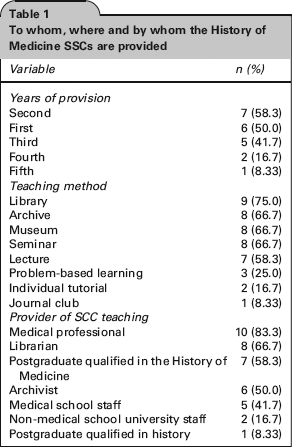
Table 1 also shows that there are eight different types of teaching methods used within the SSCs. In addition, it highlights the diversity of staff that deliver the SSC teaching, the most common being medical professionals.
Table 2 shows the variety of content including a wide range of topics and historical periods within the History of Medicine SSCs. These particularly include the 20th and 21st centuries.
Content of the History of Medicine studied at SSCs

In terms of assessment method, Table 3 reveals that four methods are currently used, the most common method being a group presentation. The same table shows that such assessments most frequently contribute to an overall SSC sum-mative mark for both the whole course and that year of study. In terms of SSC evaluation, Table 3 suggests that questionnaires are the most common method of the six types used.
Assessment and evaluation methods of History of Medicine SSCs

Table 4 shows the favoured advertising methods for SSCs to potential students. It also shows the eight reasons for providing the subject, with the most frequent reason being that it allows breadth to the undergraduate medical degree. Table 4 also suggests there are some factors that may limit the provision of History of Medicine SSCs such as lack of staff, teaching facilities, and time within curriculum.
Types of advertising, limitation factors and aims for History of Medicine SSCs

Discussion
The study describes the current provision of History of Medicine SSCs at UK medical schools. It provides useful up-to-date data as to the frequency of medical schools providing such courses. It is also the first study to identify the range of methods used for delivering, assessing, and evaluating the SSCs as well as the factors that may stimulate or limit their development.
In terms of actual numbers of SSCs, this study reveals that History of Medicine is being more frequently delivered in medical schools then when it was last surveyed and described in the literature around 40 years ago.8,9 In terms of History of Medicine SSCs, less than half of UK medical schools offer them. However, it also confirms that it has not been incorporated into medical school curriculums via SSCs as quickly as has been hoped. 25
This study suggests that for the SSCs that are currently running, many find that there are no limiting factors to the running of these SSCs. In addition three-quarters of the SSCs were created partly due to suggestions from Tomorrows Doctors,15–17 information that continues to act as guidance to medical school education currently and in the future. This, together with the fact that half of the current SSCs were created to some degree due to student requests is in contrast with the overall picture of SSC availability in the UK. A possible explanation is that several of the History of Medicine SSCs may have previously been carried out at a medical school and then disbanded but further research is suggested to test this hypothesis and the reasons behind it.
Information from this study can be used to develop new or current History of Medicine SSCs. As the study suggests, SSCs are currently using the expertise of a variety of professionals and facilities to help engage the students into adult learning. Therefore, an interest to help deliver or even run whole SSCs could come from any area of a medical school and indeed perhaps externally rather than require an existing History of Medicine University department. In terms of assessment methods, there is less methodological diversity. It is not suggested that any change is required for this other than some assessment methods currently used within medical education 26 could be incorporated within the History of Medicine SSCs in the future. For example, strategies such as Portfolios, constructed response questions, and even patient management problems, based on a particular time period, could be considered. However, the study did reveal that developing research and writing skills were important aims for the SSCs, the latter having been suggested nearly a century ago. 3 It is, therefore, perhaps unsurprising that long essays are the most frequent assessment methods that are currently used.
There is currently no general method of advertising the SSCs to medical students. Online methods are more commonly used and again, perhaps could be more frequently used considering the learning profile and needs of students today. No advertising is performed in one medical school. It is not known if this is in keeping with other medical humanity SSCs but for the History of Medicine to reach the medical student it requires greater exposure at an undergraduate level. Current and proposed SSCs in the History of Medicine could increase their self-promotion and part of this may include revealing the reasons that SSCs in such a subject are proposed.
A recommendation from this study is that it be repeated, perhaps bi-annually by an organization or society interested in the delivery of the History of Medicine. This will allow the rate of progression of SSCs in the subject be followed, information that could regularly update educators within the medical humanities as well as allow individual SSCs suggestions of developments and ideas from other SSCs.
It should be noted that four medical schools failed to respond to the invitation to complete the questionnaire although overall the response rate was good. Furthermore, despite the subjects being informed that results would be anonymous, there may be an element of responder bias and social acceptability bias with the questionnaire answers. The latter could be followed up by review of the SSC course curriculum at each institution rather than accepting verbatim the answers from the respondents although some medical schools voluntarily provide copies of their curricula for inspection by the authors.
Conclusion
First promoted by the GMC 18 years ago, SSCs are now a central component of the medical undergraduate curriculum in the UK. This study shows that the History of Medicine is delivered, learnt, and assessed in a variety of ways as a SSC. It also shows that despite such SSCs allowing more definite provision of History of Medicine than that shown by studies in 1969 8 and 1971, 9 it is present in this form in a minority of UK medical schools. Such information can be used to suggest to current and potentially future SSC providers of potential ways of delivering the subject both nationally and internationally.
Footnotes
Acknowledgements
The authors thank the Medical Education Unit at Hull York Medical School for their involvement in the initial stages of the questionnaire and allowing the time to conduct this study. The authors also thank those who took the time to pilot the questionnaire