






Abstract
Objectives
Since 2005, newly qualified doctors in the UK have had their time to prepare for career subspecialization application cut short to 16 months. To have enough time to become a competitive applicant, the choice of specialization may now have to be made as early as in medical school. This study aimed to assess how prepared medical students are towards committing to a specialty while in medical school, and their opinion about having to make such a decision.
Design
A cross-sectional questionnaire. A list of all career specialties available to doctors at the point of specialization was provided and asked students to rank their top choice. An assessment of the certainty of their choice was then determined.
Setting
Questionnaires were distributed at the end of an optional final year medical student academic meeting held at a leading London medical school university.
Participants
One hundred and thirty final year students attended the meeting. Questionnaires were distributed to all attenders; 115 responses were collected.
Main outcome measures
The certainty of career specialization choice was assessed in qualitative form, with responses ranging from ‘not likely’, ‘maybe’, ‘probably’, ‘almost certainly’ and ‘definitely’. Their feelings in having to decide upon career specialty while in medical school was assessed through either a ‘yes’ or ‘no’ response.
Results
A total of 115 responses were collected. The second most common selection was the ‘undecided’ option at 15%. The highest certainty factor occurred at ‘maybe’ with 41% and progressively fewer responses occurred as the certainty factor increased, with only 10% at ‘definitely'; 95% voted ‘no’ to having to decide what they want to specialize in by the end of medical school.
Conclusions
The majority of students have yet to commit to a specialty and almost all agree that they should not have to decide what they want to specialize in by the end of medical school. There is thus greater responsibility from medical schools to incorporate more career discussions into their syllabus.
DECLARATIONS
None declared
None
Approval was sought and granted from the Sub Dean of University College London Medical School, London, UK
VL
VL is the sole contributor
Tanzeem Raza
Introduction
Medical school is a time where students can experience all the different branches of medicine. Not only can they learn about the common and emergency presentations of each specialty, they can start to consider whether a particular specialty could be the one for them.
Modernising Medical Careers (MMC) was launched in the UK in August 2005 to make the training of junior doctors more efficient and create specialists earlier. 1 Following completion of medical school, junior doctors now commence a two-year foundation programme following which they apply for specialty training.
Before MMC, doctors had time to explore the various clinical specialties until they felt ready to commit to one. The application process for specialty training begins each year in December, and now, foundation year 2 doctors with only 16 months clinical experience are expected to commit to a specialty with less knowledge and experience to guide their decision than before.2,3 Interestingly, a study has shown that the likeliness of you actually ending up as a consultant in your selected career preference as a junior doctor is only about 50%. 4 Being a competitive process, applicants need to provide evidence that they are committed to the choice they have made (Table 1). This obviously takes time – applicants ideally have to decide on a specialty earlier still to provide enough time to become as competitive as possible. This is particularly true for the more competitive specialties (Table 2) and those where run-through training is offered (Table 3). Understandably foundation doctors have struggled to make these decisions, 5 causing them significant stress. 6
Evidence of commitment to specialty training

Competition ratios for 2008-2009 applicants. 7 Number represents applicants to post

Run-through training specialties 8 (applicants can apply for a programme that lasts approximately 6 years, leading them to consultant level)

Medical school now needs to become a time where students don't just start to consider whether a specialty could be right for them, but actually begin to decide. Are medical students ready to decide what they would want to do? How do they feel about having to make such a big decision even before their career has started? A small study was conducted to answer these questions, aiming in particular to explore how committed final year students from a typical medical school in the UK are to a clinical specialty, and how they feel about making such a commitment in medical school.
Method
The study was supervised by the Sub Dean of a medical school in London. A cross-sectional questionnaire was designed by the author and first piloted to a small cohort of students, and the questions were subsequently revised to reduce ambiguity. The first section provided a list of all the career specialties available to doctors at the point of specialization. 8 Students were asked to rank their top choice for career specialization. The second section assessed the certainty of their choice in qualitiative form, with responses ranging from ‘not likely’, ‘maybe’, ‘probably’, ‘almost certainly’ and ‘definitely’. Finally, their opinion of having to decide their career specialty while in medical school was collected as either ‘yes’ or ‘no’. Data were collected at the end of a careers meeting held at the medical school. There were 130 students who attended, and 115 responses were collected.
Results
Figure 1 reveals that General Practice is the most popular choice of specialization in the UK cohort selected by 27%. The core medical and surgical specialties are equally as popular at 13% and 12%, respectively. The run-through training posts such as Paediatrics and Obstetrics and Gynaecology were relatively popular at 12% and 8%, respectively. Importantly, the second most common selection was the ‘undecided’ option at 15%.
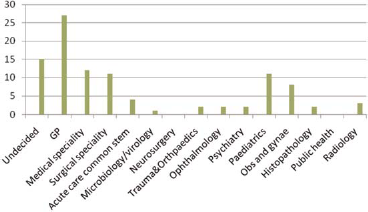
The percentage of first choice responses from final year medical students
How certain are you of your choice of preferences?
Figure 2 reveals that the highest response band for students occurred at ‘maybe’ with 41%. Progressively fewer responses occurred as the certainty factor increased, with only 10% at ‘definitely’.
Do you think medical students should have decided what they want to specialize in by the end of medical school?
Figure 3 shows that the majority of students voted ‘no’, with responses totaling 95%.
Discussion
MMC aimed to make the training of doctors in the UK more efficient. Foundation doctors must choose their career specialty earlier than before. To have enough time to become as competitive an applicant as possible, for some specialties, the decision to pursue them may now need to be made as early as in medical school. This small study suggests that the majority of students have yet to commit to a specialty and almost all agree that they should not have to decide what they want to specialize in by the end of medical school.
This study was conducted through a questionnaire piloted to a small cohort of students to minimize ambiguity and ensure that the questions and interpretation were simple to follow. The questionnaire was delivered at a general meeting with good attendance and the uptake of the questionnaire was successful (115/130). Although lacking in more complex statistical analysis, the results strongly suggest (95%) that medical students do not want to choose their career specialization while in medical school. The study was also limited with only one medical school student body used to represent the medical student opinion.
As doctors in the UK must now begin to decide on their career specialty much earlier, there is greater responsibility from medical schools to incorporate more career discussions into the syllabus,11,12 and foundation schools to continue to encourage careers advice clinics.

How certain are your preferences?

Do you think medical students should have decided on a specialty by the end of medical school?
How do students expected to make such a big decision so early on? Some insight into the structure of specialty training can help make the decision of career choice. Similar to many larger studies, 2 General Practice is the most popular choice of specialization in the UK cohort, selected by 27%. Since 2010, half of the posts available following foundation training have been in general practice, as there is a hope to move many of the serviced offered in hospital into the community. 9 Those interested in hospital-based medical specialties like Cardiology or Gastroenterology (13%), surgical specialties like Vascular Surgery or Urology (12%), or acute specialties like Intensive Care or A&E (4%) undergo a two-year core generic training programme before competing again for specialization. Having these two additional years certainly reduces the stress of deciding on a career specialty so early on. 10 However, those who are interested in following a career offered as run-through training (Table 2) such as Paediatrics (12%) and Obstetrics and Gynaecology (8%), must be aided in their preparations to make these decisions early enough to become as competitive as possible.
Key points
Foundation year 2 doctors with only 16 months clinical experience are now expected to commit to a specialty with less knowledge and experience to guide their decision.
The application process is competitive. Applicants need to decide the specialty they want to pursue with enough time to achieve all the things the application form wants from you. For some specialties, this means deciding in medical school.
This study has shown that majority of final year medical students in the UK have yet to commit to a specialty, and do not actually want to, highlighting the greater need from medical schools to incorporate more career discussions into the medical syllabus.
Footnotes
Acknowledgements
None