






Abstract
Precise calculation of total body surface area (TBSA) or premarked surface areas (P-MSAs) is of great importance in many biomedical applications. The aim of the paper was to present a simple procedure of measurement of P-MSAs in small animals and to determine a more accurate Meeh's constant (k), for a commonly used weight range of laboratory rats. A series of 30 Wistar rats, weighing 195–240 g, were anaesthetized and weighted. The TBSA of each animal was measured using a clear pocket and a planimeter. The data obtained were entered into the Meeh's formula (TBSA = kW 2/3), the most commonly used for small experimental animals, so that a k value for each animal as well as a mean k value (9.83) were obtained. The TBSA of the animals was also calculated using the aforementioned mean k value and compared with that obtained using k values reported in previous studies. According to our findings, the new mean k value, determined with the use of our procedure of surface area measurement, ensured greater accuracy in the determination of the TBSA of experimental rats of a specific weight range. We also suggest a new procedure of surface area measurement which is easy, accurate and does not require animal sacrifice.
Keywords
Estimation of total body surface area (TBSA) and premarked surface area (P-MSA) remains a problem in biomedical research. TBSA plays a key role in the estimation of fluid replacement needs of critically ill and burn patients, 1 the dose titration of chemotherapeutic agents, 2 as well as the calculation of nutritional needs. 3 Moreover, physiological parameters such as cardiac output, glomerular filtration rate and a variety of respiratory function parameters are frequently expressed in relation to the TBSA in animals and humans. 4 Consequently, accurate determination of the TBSA is crucial in both experimentation and clinical practice.
To date, various formulas for the calculation of TBSA have been reported in the literature. Regarding those referring to animals, most of them are based on the original empirical formula postulated on a mathematic basis by Meeh. 5 This formula (TBSA = kW 2/3, where TBSA = total body surface area, W = weight and K = constant) relates the body surface area to the body weight, through a constant k, also known as the Meeh's constant, which is empirically determined and varies greatly by species and size. This variation reflects the diversity between animal species, and the weight ranges within each species used in its calculation.
For more than one century, this formula has been used for the calculation of the TBSA in a wide variety of species such as mice, rats, cats, monkeys, etc. with various k values for different animal species. 6–9 Specifically regarding rats, many investigators have attempted to determine accurately the value of k constant. However, various values of k constant have been reported, ranging from 9.00 to 11.36. 5,10–14
The aim of this paper was to present a simple and accurate procedure for the measurement of P-MSAs as well as the calculation of TBSA of small animals and to determine a more accurate k constant value in the most widely used weight range of Wistar rats.
Materials and methods
Animals and husbandry
Thirty five-month-old female Wistar rats, weighing 195–240 g, originating from the Animal Center of the University of Ioannina, were used. The animals were housed in standard cage type IL (EHRET GmbH, Emmendingen, Germany) in groups of three per cage. Animals were kept in room temperature 22 ± 2°C, humidity 50–60%, under 12/12 h of light/darkness conditions. Animals were provided ad libitum with rat chow (Viozois SA, Animal Feed Company of Epirus, Ioannina, Greece) and water. Wood shavings (Mucedola srl, Settimo Milanese, Italy) were used as bedding. The animals were handled in accordance with the National Institutes of Health guidelines and the European Union directive for the care and the use of laboratory animals (Greek Presidential Decree No. 160 1991 implementation of the EEC Directive 86/609/EEC) and according to the permission number 20EEP02 of the University of Ioannina.
Experimental procedure
The animals were weighted and anaesthetized by intraperitoneal administration of midazolame (6.8 mg/kg) and ketamine (2.3 mg/kg). The whole procedure was performed on a clear, non-slippery surface using a clear pocket, which was durable and did not wrinkle with use (Figure 1a). The length of each animal, from nose to anus, was measured and recorded. Then, each rat was placed into the pocket, ventral side faced down, while its tail was kept out of the pocket (Figure 1b). The upside sheet of the pocket was held, without any stretching, very tight and close to the dorsal surface of the rat, until it reached the downside sheet of the pocket. At this position, the dorsal–lateral surface area of the animal was carefully marked on the upside sheet (Figure 1c). This was followed by removal of the rat from the pocket, which was draped flat. Then, the animal was placed on the outer surface of the upside sheet of the pocket, ventral side also down. That way the ventral surface of the rat was marked on the upside sheet (Figure 1d). Afterwards, the tail of the rat was placed into the pocket, and positioned close to one of its edges, where the upside and downside sheets were joined together. The upside sheet was pressed gently against the downside sheet, so that the tail was enclosed between them. The edge of the tail opposite to the edge of the pocket was marked on the upside sheet. The same procedure was followed for the other side of the tail, which was marked on the other sheet of the pocket (Figure 1e). The same procedure, as described for the tail, was used to determine the surface area of the front and rear legs.
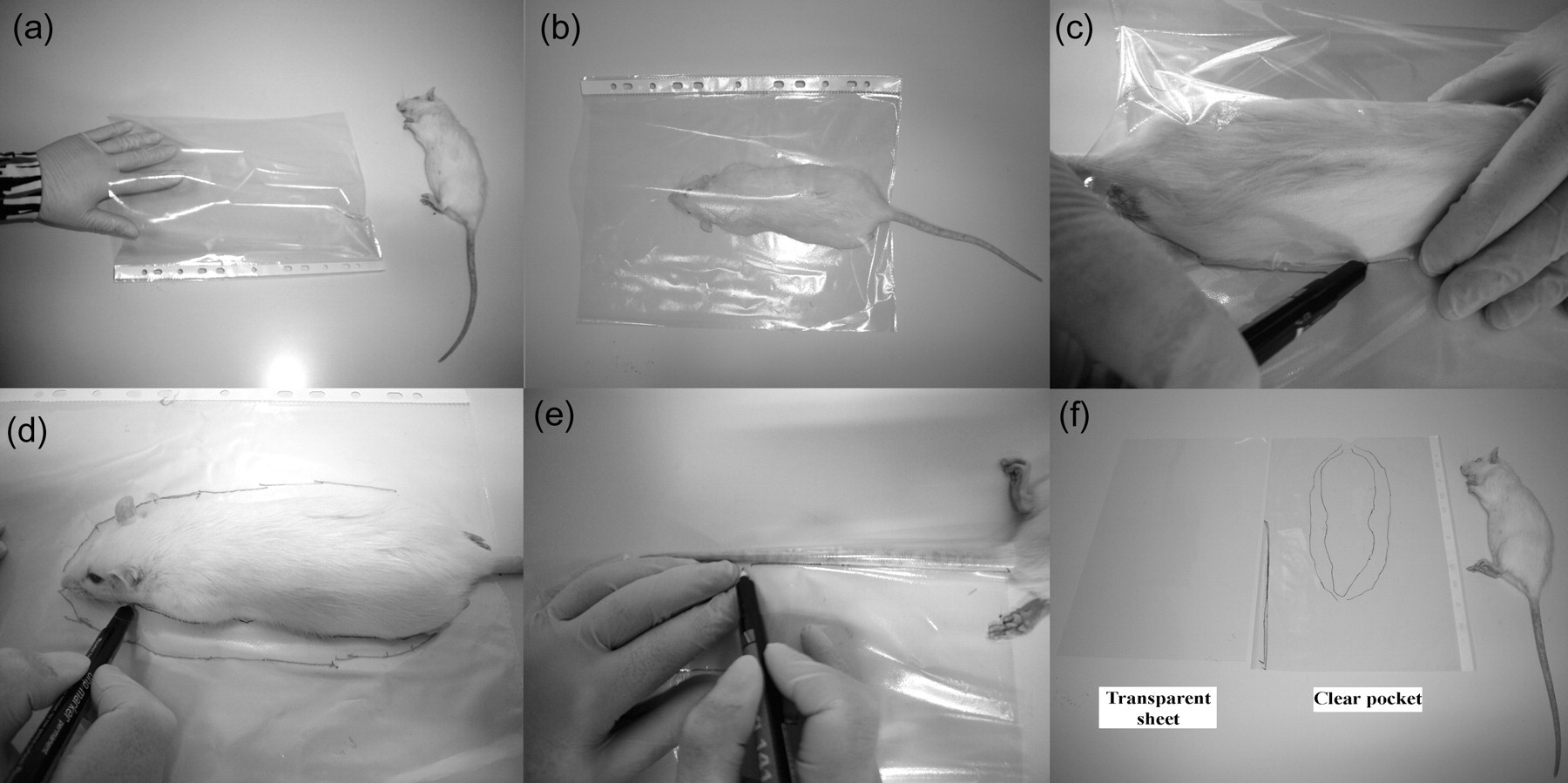
The basic steps of the suggested procedure of surface area measurement. (a) The clear pocket prior to use. (b) The rat placed into the pocket (ventral side faced down) with the tail kept out of the pocket. (c) The dorsal–lateral surface area of the animal carefully marked on the upside sheet. (d) The animal placed on the outer surface of the upside sheet of the pocket (ventral side also down), and the ventral surface of the rat marked on the upside sheet. (e) The tail of the rat placed into the pocket, and positioned close to one of its edges. The edge of the tail opposite to the edge of the pocket marked on the upside sheet. The same procedure was followed for the other side of the tail. (f) The shapes marked on the clear pocket and the pocket pieces transferred on transparent sheets
Finally, to determine the surface area of the ears, a small piece of clear pocket was folded around each ear, and the surface area was marked on the pocket piece.
The shapes marked on the clear pocket (Figure 1f) and pocket pieces were transferred onto transparent sheets (Figure 2), and the surface area of each part of the rat's body was measured using a planimeter (HAFF planimeters, model No. 313 E, Gebrueder HAFF GmbH, Pfronten, Germany). Having all these measurements recorded, the TBSA area of each rat was calculated by adding the results of the planimetry. All the measurements were taken at the same day and the same hour, and all animals survived the experiment.
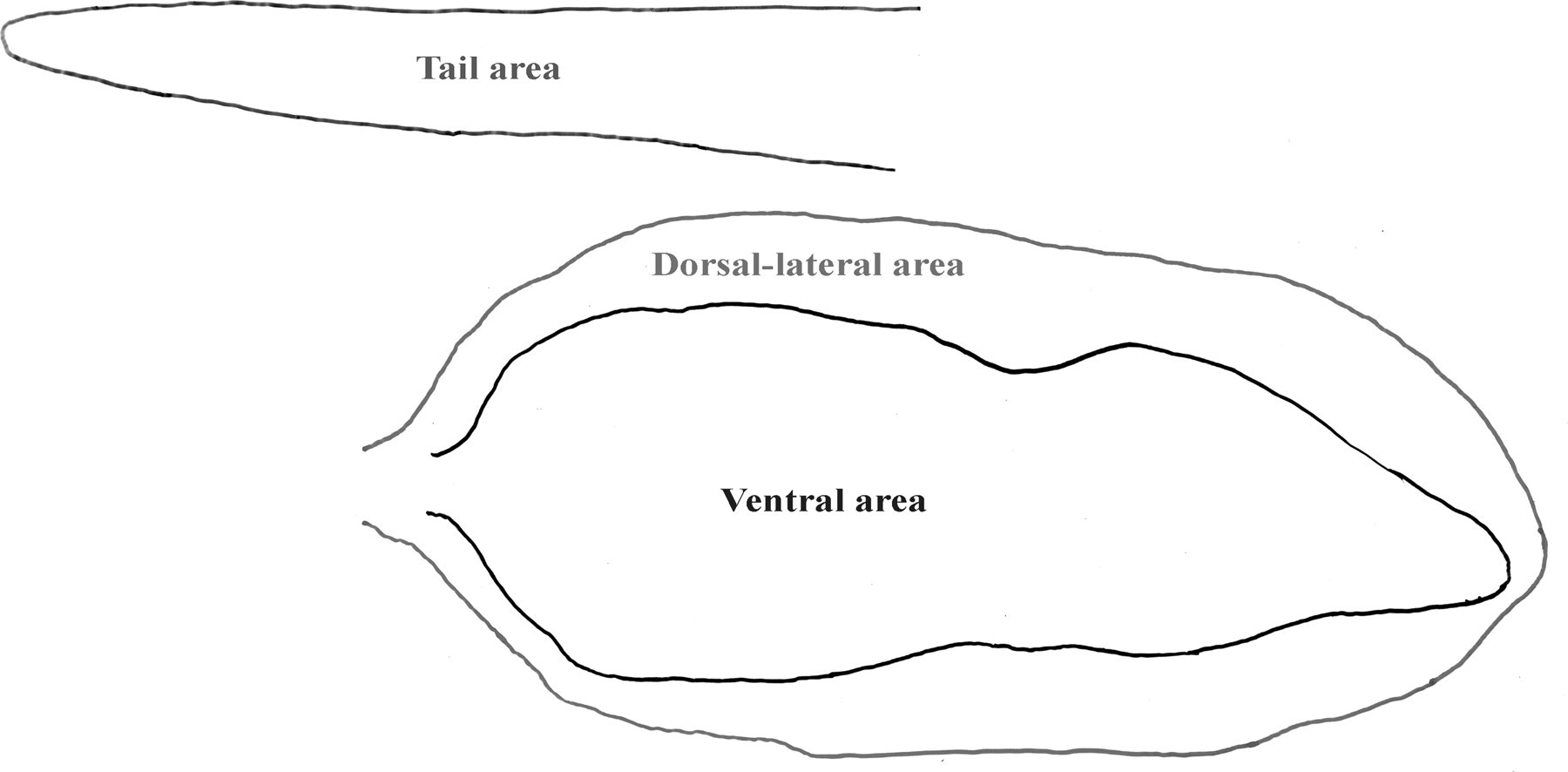
Ventral, dorsal–lateral and tail areas, as copied from the clear pocket onto the transparent sheet, ready to be measured using the planimeter
Statistical analysis
Data are expressed as means (SD). The statistical significant difference between data means was determined by using paired samples t-test. The Pearson correlation was used for TBSA and animal body weight. All statistical procedures were performed using SPSS (SPSS version 16.0, Statistical Package for the Social Sciences software, SPSS, Chicago, IL, USA). P ≤ 0.01 was considered statistically significant.
Results
The TBSA of each animal was calculated using the findings of the planimetry. The k value for each rat was then calculated using the Meeh's formula (k = TBSA/W 2/3) and an average of 9.83 was obtained (Table 1).
Individually calculated k values using planimetric findings and the resulting new mean k value
TBSA = total body surface area
The TBSA, in the range of weights for the population of rats used in this study, was calculated with the Meeh's formula using the average k value found in this study (9.83) and k values found by other investigators (Hill and Hill: 9.93, Rubner: 9.13, Carmen and Mitchell: 11.36, Quiring: 10.38 and Gilpin: 9.46). The TBSA values, calculated using the aforementioned different k values, were compared with the corresponding TBSA values measured with planimetry.
The TBSA deviation was then calculated using the following formula: (%) Deviation = ([TBSAcalculated − TBSAplano]/TBSAplano) × 100. Statistical analysis of the data revealed that the use of the k constants reported from Carmen and Mitchell, 11 Quiring, 8 Rubner 15 and Gilpin 14 resulted in significant overestimation or underestimation of the TBSA compared with the findings of planimetry (P < 0.01). Specifically, the use of k constants reported by Carmen and Mitchell 11 as well as by Quiring 8 resulted in significant overestimation of TBSA (deviation: +16% and +6%, respectively), whereas the use of those reported by Rubner 15 and Gilpin 14 resulted in significant underestimation of TBSA (deviation: −7% and −3%, respectively). No significant difference between the calculated and measured TBSA was found using the k constant reported by Hill and Hill. 10 The findings are listed in detail in Table 2.
Comparison of the actual TBSA to that found with the Meeh's formula, using the new mean k value and k values reported in other studies
TBSA = total body surface area
The Meeh's formula was used with an exponent of 2/3 in all cases (TBSA = k W 2/3). The following k constant values were used: Present study, 9.83 (mean k value obtain from our planimetric data); Hill and Hill, 9.93; Gilpin, 9.46; Rubner, 9.13; Quiring, 10.38 and Carmen and Mitchell, 11.36. Deviation of calculated (Meeh's formula) from the actual (planimetry) TBSA: Deviation (%) = ([TBSAcalculated − TBSAplano]/TBSAplano) × 100
*Statistically significant finding (P < 0.01)
Further analysis of the deviation between the TBSA values calculated using our average k constant (9.83) and the actual TBSA values measured with planimetry showed that it was quite narrow. However, an increasing overestimation of the TBSA was noticed as the body weight of the animals increases (r = 0.954, P < 0.01) (Figure 3).
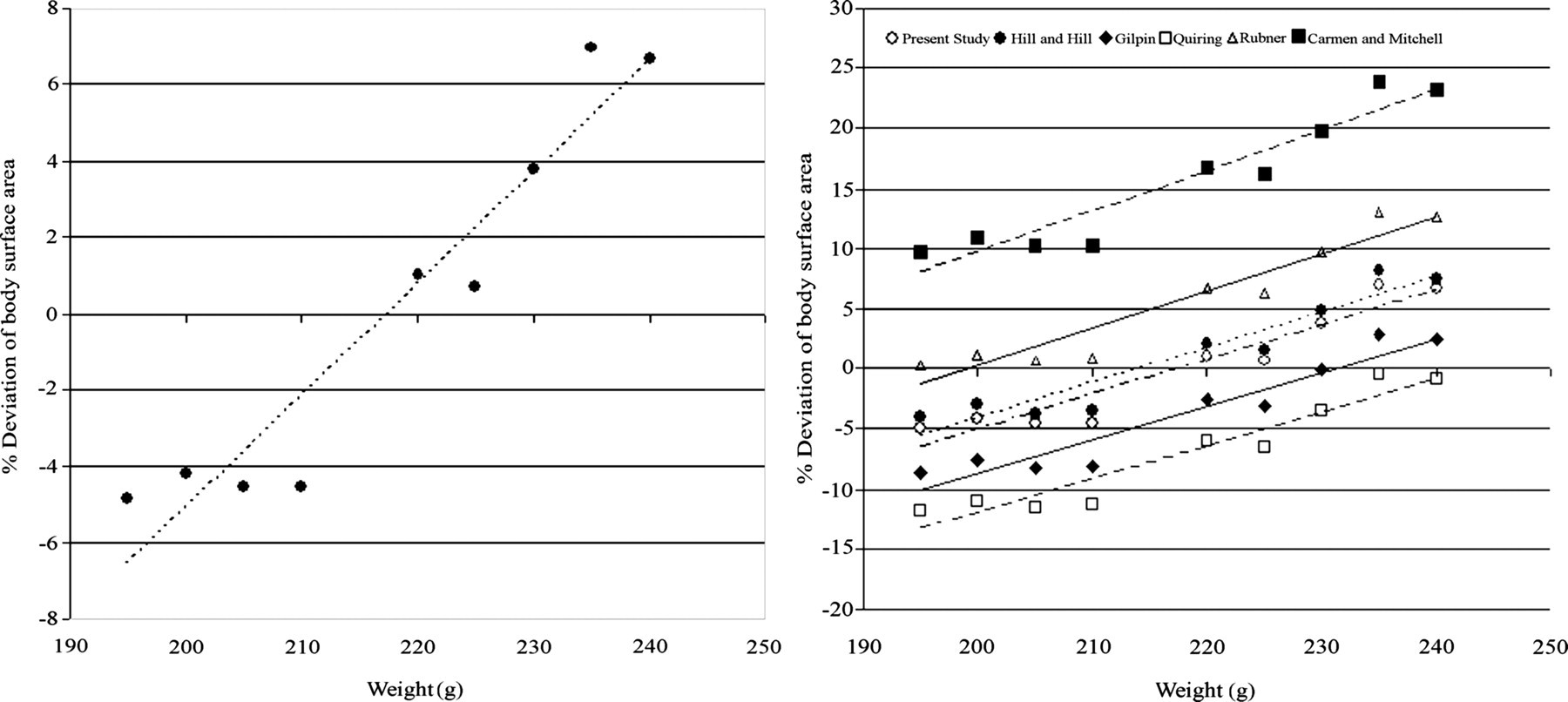
Graph demonstrating increasing overestimation of the total body surface area (TBSA) as the body weight of the animals increases. The deviation was calculated as the % deviation of the actual TBSA and the mean TBSA calculated by the different k values of the rats grouped according to their weight (9 groups, ranging from 195 to 240 g)
Discussion
It is well documented that precise estimation of TBSA or P-MSA is often crucial in medical decision-making. TBSA measurements are also of great interest in many biomedical applications, such as the study of burn injuries, the calculation of drug dosage, the treatment of obesity, haemodialysis and wound healing, etc. 1–4,16–18
TBSA measurement can be performed using direct methods, indirect methods and predictive formulae. Direct methods fall into four categories: coating, surface integration, triangulation and three-dimensional whole-body scanning. Indirect estimation methods can be classified as linear geometric and photographic. Finally, predictive formulae are constructed through population studies using direct measurement methods. 16,19–24
In reviewing the aforementioned methods, direct measurement methods, although accurate, are usually cumbersome, time-consuming and impractical in both the experimental and clinical setting. Indirect methods, although relatively easy to perform, have a low degree of accuracy. Predictive formulae have been widely used, since they are simple and straightforward methods of TBSA calculation. However, their accuracy and applicability have been frequently questioned as a reflection of the diversity of species, 8 strains 14 and weight. 22
The use of animal models is critical in biomedical research. Precise estimation of the TBSA of live laboratory animals has been the subject of many studies for a long time. To date, the most commonly used method is the well-accepted Meeh-Rubner formula (TBSA = k W 2/3), where W stands for weight, 2/3 is an exponent and k is a constant. As in all predictive formulae, its precision depends on the animal series and the direct measurement method used. Moreover, it is well documented that the accuracy of k constant depends on the animal species and strain, as well as the spectrum of weights over which it is applied. Therefore, within a species, the narrower the weight range over which it is applied, the greater the accuracy of the formula. Laser technology is often used to estimate the TBSA of humans and large animals and also bone fossils but to our knowledge they are not used in the estimation of TBSA of small animals and rodents. This technology presents weaknesses in recording very small body parts such as fingers and toes, or body parts that are very thickly covered in hair (e.g. use of latex caps to cover hair). 24 Furthermore, this method includes an investment in an expensive scanner, data may be missing because of shading (e.g. the armpits and crotch areas are often shaded) and also requires the subject to remain motionless and hold its breath for 10 seconds. 24,25
Several investigators, having in mind the aforementioned parameters, have attempted to determine the accurate value of k constant in the rat, which is one of the species most commonly used in laboratory practice because of the small size, low cost, ease of handling and fast reproduction rate. A common method of calculating the TBSA in rats is after killing and skinning them. Carmen and Mitchel 11 skinned the rats, pinned the stretched pelt on a board, and measured the surface area planometrically. However, since the skin is an elastic organ, the surface area will vary widely according to the tension placed upon the skin. In an effort to overcome this problem various methods have been reported, but all of them are time-consuming and cumbersome. Lee 13 dipped the rat carcass into varnish before skinning, since the dry and firm varnish covering did not allow stretching of the pelt during the surface area measurement procedure. Diack 5 dipped the rats in a collodion mixture, so that when dried a film was created, which was peeled off and measured. In another study by Gilpin 14 adhesive tape was applied to the skin of the animal prior to skinning and pegging the pelt for surface area measurement. Nevertheless, various k values were reported, as a reflection of the different strains, weight ranges, and methods of skinning and stretching the pelt of the animals used.
In an effort to overcome the aforementioned drawbacks, in this study, the Wistar rat was used, which is the first rat strain developed to serve as a model organism, and one of the most popular rat strains used for laboratory research, currently. Moreover, since it is quite sure that only animals of similar parameters should be used to generate empirical value, we have included in our study a large number of rats of the same gender, as well as of the most commonly used weight range for experimentation (195–240 g). 8,14,22
A simple direct procedure of TBSA measurement on live animals was applied, using a clear pocket and a planimeter. As a result, no sacrifice of any animal was required. Moreover, the use of the plastic transparent sheet, which cannot be stretched, eliminated the adverse effect of stretching the pelt of skinned animals on the accurate measurement of TBSA. On the basis of the measurements performed, a new accurate value of k constant was determined. Most importantly, accurate measurement of a premarked area with the suggested procedure, as well as precise determination of the TBSA, using the new k value in the Meeh's formula, can be performed at the same time.
In conclusion, the suggested procedure of surface area measurement is easy, cheap, accurate, does not require animal sacrifice, and avoids lengthy and tedious skinning procedures. Therefore, it can be easily used for direct measurement of P-MSAs in small animals. Also, a new accurate k constant of Meeh's equation was determined for precise calculation of TBSA in a certain weight range of a commonly used rat strain.