






Abstract
Gastrointestinal transit times (Gltts) were compared in separate litters of 10- and 15-day-old Sprague Dawley rats using barium sulphate. By tracking the leading front of the bolus on radiographs, the gastrocaecal transit times in pups were estimated. To measure the total Gltt, the duration from orogastric gavage until an observable defecation of barium sulphate was recorded. The gastrocaecal times for 10-day-old pups maintained with their dam (n = 5) ranged from 4–5 h and those removed from the dam ranged from 2.5–5 h. For 15-day-old pups with their dam (n = 6) and without dam (n = 5), gastrocaecal times ranged from 4–6 h and 3.5–5 h, respectively. Ten-day-old pups that remained with the dam had a Gltt of 13.8 ± 0.9 h and those kept in the absence of the dam had a time of 9.3 ± 0.7 h. This decrease (P < 0.05) in Gltt in the absence of the dam was age-dependent in 10-day-old pups, and was not observed (P > 0.05) in 15-day-old pups. The results provide a basis, for the design of future studies involving neonate rat metabolism, to include maternal presence.
Maternal separation and social isolation experiments using rhesus monkeys demonstrated concomitant changes in the physical and behavioural development of the infants. 1 Infant monkeys demonstrated a measurable increase in aggression and stress. 2 In Wistar rats, psychological stress influenced the gastrointestinal transit time (Gltt) by observable increases in stomach emptying. 3 This present study compares the influence of maternal separation (substitution model) versus maternal presence (maintenance model) on Gltt in young rats for future experimental design. 4
Gltt is the time required for ingested material to transit and be excreted from the GI tract. There is considerable interest in understanding the transit time of experimental animals for nutritional research, design of inflammatory bowel disease animal models 5 and pharmacokinetic studies. 6 This depends on measurement of transit time where the stage of gut development is largely age-dependent.7,8 Maternal presence may be an additional factor influencing Gltt in young rats since the dam's presence provides nutritional requirements, thermal regulation and tactile stimulation. 9
This study aims to investigate the acute effect of maternal separation on Gltt in neonatal rat pups by a non-surgical method without the need of anaesthetics. Therefore, 10-and 15-day-old Sprague Dawley rats in the presence or absence of their mother were gavage fed barium sulphate and its passage was monitored non-invasively using X-ray radiography. Rats were selected for experimental ease as they are larger at 10 days than mice.
Studies were conducted in accordance with the University of Ottawa's Animal Care Committee under protocol BMI-77. One litter of 10-day-old (n = 10) and one separate litter of 15-day-old (n = 11) Sprague Dawley rat pups (Charles River, Canada) weighing 19–28 g (10-day-old rats, 21.51 ± 1.61 g; 15-day-old rats, 27.40 ± 1.00 g; P < 0.05) were housed in polycarbonate rat cages and placed into an empty Ohio Medical Products Armstrong Isolation Servo-Care Incubator Model 190ASC (Ohmeda Inc, Liberty Corner, NJ, USA) at 37°C and fasted for 2 h to empty the stomach cavity. 7 Cages provided ample space for pup activity and were outfitted with a food and water source for the dam.
Rats were individually identified and divided into two groups: maintained with their mother or placed in an incubator without the mother. All pups were gavage fed 250 μL of barium sulphate (Liquid Polibar Plus, 53%w/v) (EZEM Corp, Montreal Quebec, Canada) that was suspended in ddH20 (1:1, v/v). For X-ray radiography, animals were placed into a holding grid to ensure serial tracking of bolus movement. X-ray radiographs (Hitachi DGC-1010, 34 kV, 2 mA) (Hitachi Co, Tokyo, Japan) were taken at 10, 20 and 30 min, followed by subsequent exposures every 30 min thereafter. At 4 h, images were captured every hour for the duration of the experiment. All aged pups separated from their mother were handled at hourly intervals by weighing and feeding 0.25 mL of Enfamil A + infant formula (Mead Johnson Nutritionals, Evansville, IN, USA). In addition, saline solution (Baxter, Deerfield, IL, USA) was injected subcutaneously to hydrate pups in the absence of their mother.
For the present investigation, gastrocaecal and GItt were defined as the duration for the leading edge of the barium sulphate to enter the caecum and exit the anus, respectively. X-ray radiographic images were analysed to determine these time points. Gastrocaecal times were reported as a range. GItts were reported as the mean ± the standard error of the mean. A Student's t-test was performed where P < 0.05 was considered statistically significant.
Gastrocaecal time for 10-day-old pups with their dam and without their dam was 4–5 and 2.5–5 h, respectively (Table 1). For 15-day-old rats, the gastrocaecal times with and without the dam was 4–6 and 3.5–5 h, respectively. In the older Sprague Dawley pups, the GItt increased in both the maintenance (P < 0.05) and separation groups (P < 0.05) in comparison with those for their 10-day-old counterparts (Figure 1). Observable developmental changes in 15-day-old rats in comparison to their 10-day-old counterparts included additional body fur and increased palpebral Assuring. The effect of maternal presence/absence was observed in 10-day-old pups that demonstrated a significant difference in their GItt (P < 0.001).
Gastrointestinal transit time in 10- and 15-day-old rats in the presence (M+) or absence (M-) of their mother. The total transit time was calculaient as (timebarium sulphate observed in faeces – timebarium sulphate ingested). Data were analysed with Student's t-test for significance (n = 5–6 animals). *Denotes a significant difference between the M+ and M- groups (P < 0.001). †,‡Denote a significant difference between age groups (P < 0.05)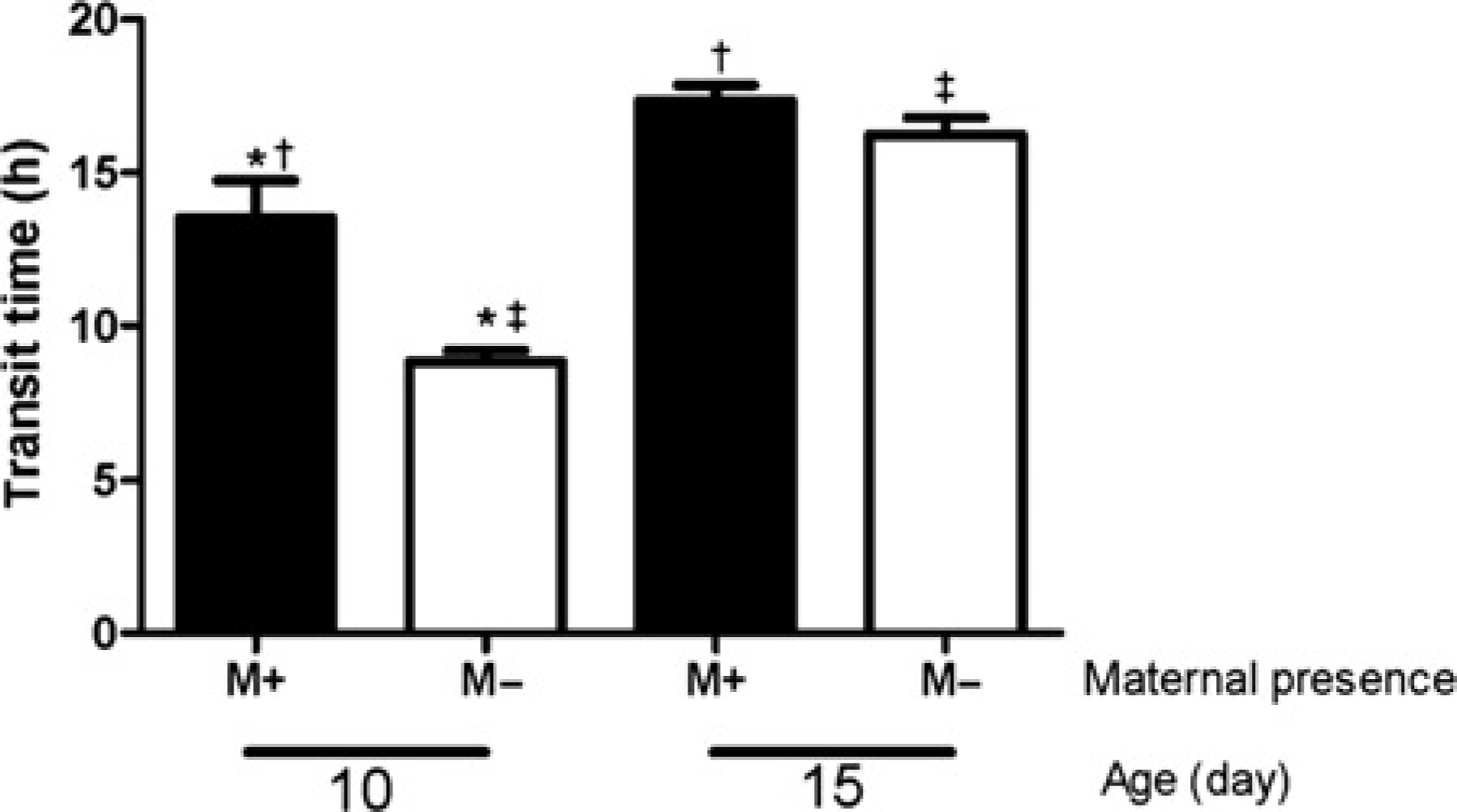
Gastrocaecal and gastrointestinal transit time (GItt) in 10-and 15-day-old rats
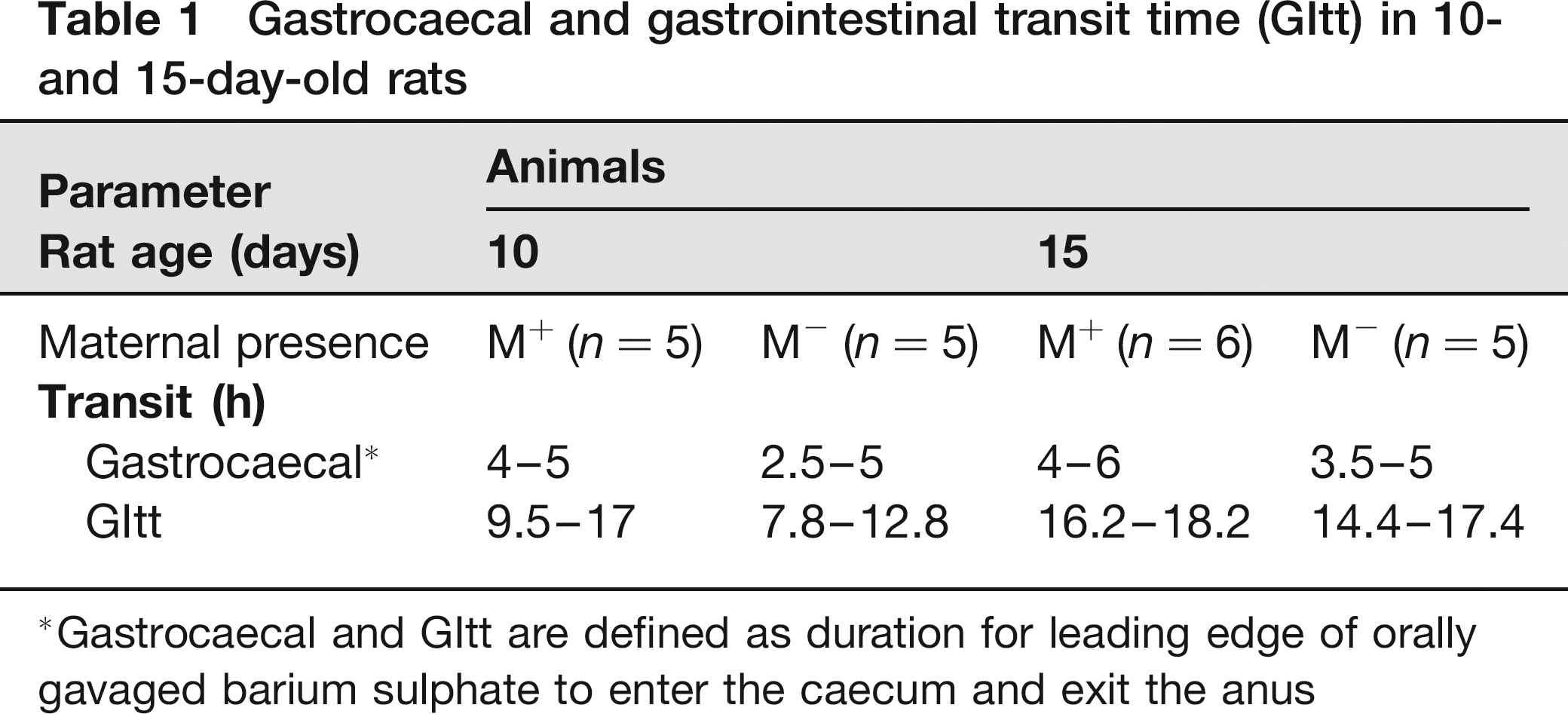
Gastrocaecal and GItt are defined as duration for leading edge of orally gavaged barium sulphate to enter the caecum and exit the anus
Due to limitations of the study, the frequency of radiographs and animal feeding times could not be performed simultaneously on all 21 animals. For this reason, the gastrocaecal data were expressed as ranges (Table 1). However, statistical analysis could be performed with GItt, since it was possible to measure barium sulphate defecation using several stopwatches.
Maternal separation may alter the response to stressors and therefore GItt in rat pups through factors such as a lack of maternal stimuli, new diet and physical stress. The mother provided on-demand feeding for the pups and performed anogenital licking, which is thought to stimulate urine and faeces elimination. 9 The effect of infant formula and stress induced from subcutaneous saline injections must also be considered when examining GItt differences. Considering that rats wean at 20–22 days, pups may start tolerating maternal absence as early as 15 days of age. Whereas, age-related differences in GItt may be considered in light of recent data. Older rats have lengthened colons, increased colonic mucosa, increased spontaneous contractile activity and show development of cholinergic neuromuscular transmission. 8
Knowing that maternal separation induces stress in neonate rats 10 and that stress influences GItt in the Wistar strains, 3 one may infer that decreased GItt was a result of stress caused by maternal separation. The present data suggest that future experiments monitoring absorption, digestion, metabolism and excretion or pharmacokinetic studies using neonatal rats may be performed while maintaining them in the presence of their mothers. This may benefit the experimental outcome by reducing variation in transit time and lessening the impact on digestion and metabolism.
Footnotes
Acknowledegements
This study was funded by the Canadian Institutes of Health Research Grant #82816. We are grateful to Kim Yates at the University of Ottawa's Animal Care and Veterinary Services for excellent assistance.