






Abstract
Environmental enrichment, besides having a great impact on animal welfare, can also be a potential variable in experimental research. Thus, we investigated whether enrichment of cages with paper tissues or plastic tunnels affects scientific outcome in the well-described mouse model of allergic asthma. BALB/cJ mice were introduced to paper tissues as nesting material, transparent plastic tunnels serving as shelters or kept in non-enriched cages. Afterwards, mice were sensitized to chicken egg ovalbumin (OVA) precipitated in aluminium sulphate and then intranasally challenged with OVA to induce allergic lung inflammation. Mice housed in cages enriched with paper tissues, but not with plastic tunnels, had increased total cell number, eosinophil number and IL-13 concentration in bronchoalveolar lavage fluid in comparison with the non-enriched control group. These results indicate that the effect of environmental enrichment on mice asthma models depends on the type of enrichment used. Therefore, it is important to consider the potential effects of any environmental enrichment on animal welfare and more importantly, on research results in order to standardize and obtain more accurate data from rodent studies.
Mouse models of allergic asthma have become invaluable in research of the factors influencing the pathophysiological responses during the initiation and perpetuation of allergic asthma, as well as for the investigation of new treatments for this disease. 1 The time course of mice asthma models are usually measured in weeks to months, and therefore prolonged maintenance of laboratory animals in the facility is required. 2 An understanding of animal behaviour and ethical principles in laboratory animal science imply the use of environmental enrichment in everyday housing of all laboratory animals, including rodents. This enrichment includes elements that may stimulate normal behaviour and, additionally, help to avoid adverse phenomena like aggression in group-housed male mice. For this purpose, bedding, shelters, nesting and gnawing materials and other forms of relevant enrichment have been frequently introduced to laboratory rodents. 3
In addition to the impact on animal welfare, environmental enrichment can clearly become a potential variable with possible effect on research results. The environmental enrichment has been shown to decrease the specific parameters of the immune system in healthy mice, such as absolute percentages of CD8+ cells, as well as ratios of IFN-y/IL-10 and IL-2/IL-10. 4 These results suggest that environmental enrichment could have an impact on immune response in animals involved in disease models as well. However, there is a lack of scientific reports about the influence of environmental enrichment on rodent immune responses in the animal models extensively used to study inflammatory disorders, including allergic asthma. Therefore, we have investigated the effect of paper tissue enrichment on mouse immune response in the allergic asthma model.
Specific pathogen-free BALB/cByJ male mice (5 weeks old, Charles River, Lyon, France) were, after the quarantine, divided into four groups. Each group of six to eight animals were housed in type III polycarbonate cages (Tecniplast, Buguggiate, Italy) on wire mesh with a layer of corn cob bedding underneath (Scobis Due, Mucedola, Italy) in order to reduce the possible influence of bedding on the target organ, the lungs. Animals were provided with bottled tap water and pelleted food (4R21, Mucedola, Italy) ad libitum. The quarantine and holding rooms had a controlled photoperiod (12:12 L:D), temperature 23–24°C, relative humidity (60 ± 5%) and ventilation (15 air changes/h). Regular health monitoring assured that mice were not exposed to any pathogens throughout the experiments. Two groups were housed without enrichment, the third group received paper tissue enrichment (Kleenex, Kimberly-Clark Europe Ltd, London, UK) and the fourth group received red or amber-tinted transparent plastic tunnels (Lillico Biotechnology, Hookwood, Surrey, UK). The experiment was repeated thrice, using the same setting. Standard cleaning procedure was performed twice a week. All procedures on animals were approved by the Ethic Committee of GlaxoSmithKline Research Centre Zagreb Limited, and performed in accordance with (a) guidelines outlined by the NIH Guide for the Care and Use of Laboratory Animals; and (b) regional legislative equivalent, Animal Protection Law, published 13 December 2006 in the Official Gazette No. 135. Allergic airway inflammation in mice was done as described earlier.
5
Briefly, BALB/cByJ mice were sensitized by intraperitoneal application of 10 µg of ovalbumin (OVA, grade VI; Sigma, St Louis, MO, USA) dissolved in 2% Alu-Gel-S (SERVA Electrophoresis GmbH, Heidelberg, Germany) in a total volume of 0.2 mL/mouse with OVA (grade VI, Sigma) on experimental days 0 and 14. On experimental day 20, mice, under anaesthesia (combination of ketamine hydrochloride and xylazine hydrochloride, 10 mg/kg), were intranasally instilled with 25 µg of OVA dissolved in saline in a total volume of 50 µL. On experimental day 22, mice were euthanized by an intraperitoneal overdose of thiopental (Nycomed, Konstanz, Germany). Tracheotomy was performed and the lungs were washed thrice with phosphate-buffered saline in a total volume of 1 mL. The bronchoalveolar lavage samples were centrifuged for 5 min at 2000
Experimental protocol for the asthma model requires that mice are housed for at least three weeks. During that time mice were exposed to either paper tissues or plastic tunnels, or kept without enrichment as a control. The effect of housing with environmental enrichment was evaluated through inflammatory cell response in BALF at its peak, 48 h after challenge with OVA (experimental day 22). As expected, all mice challenged with OVA had increased total cell and eosinophil numbers in BALF in comparison with saline-challenged mice (Figure 1). Housing of mice with paper tissues as enrichment significantly increased total number of cells in BALF after OVA challenge in comparison with non-enriched OVA-challenged controls (Figure 1a). This increase of total cell number was associated with the significant increase of eosinophils (Figure 1b) and to a lesser extent increase of macrophages and IL-13 concentration (Figures 1c and d). Moreover, the variability within the mice of the group housed with paper tissues was greatly increased, as can be seen by the height of the error bars on the graphs. In contrast to paper tissues, the number of inflammatory cells or IL-13 concentration in BALF of mice enriched with plastic tunnels was not significantly different from that of non-enriched mice (Figure 1).
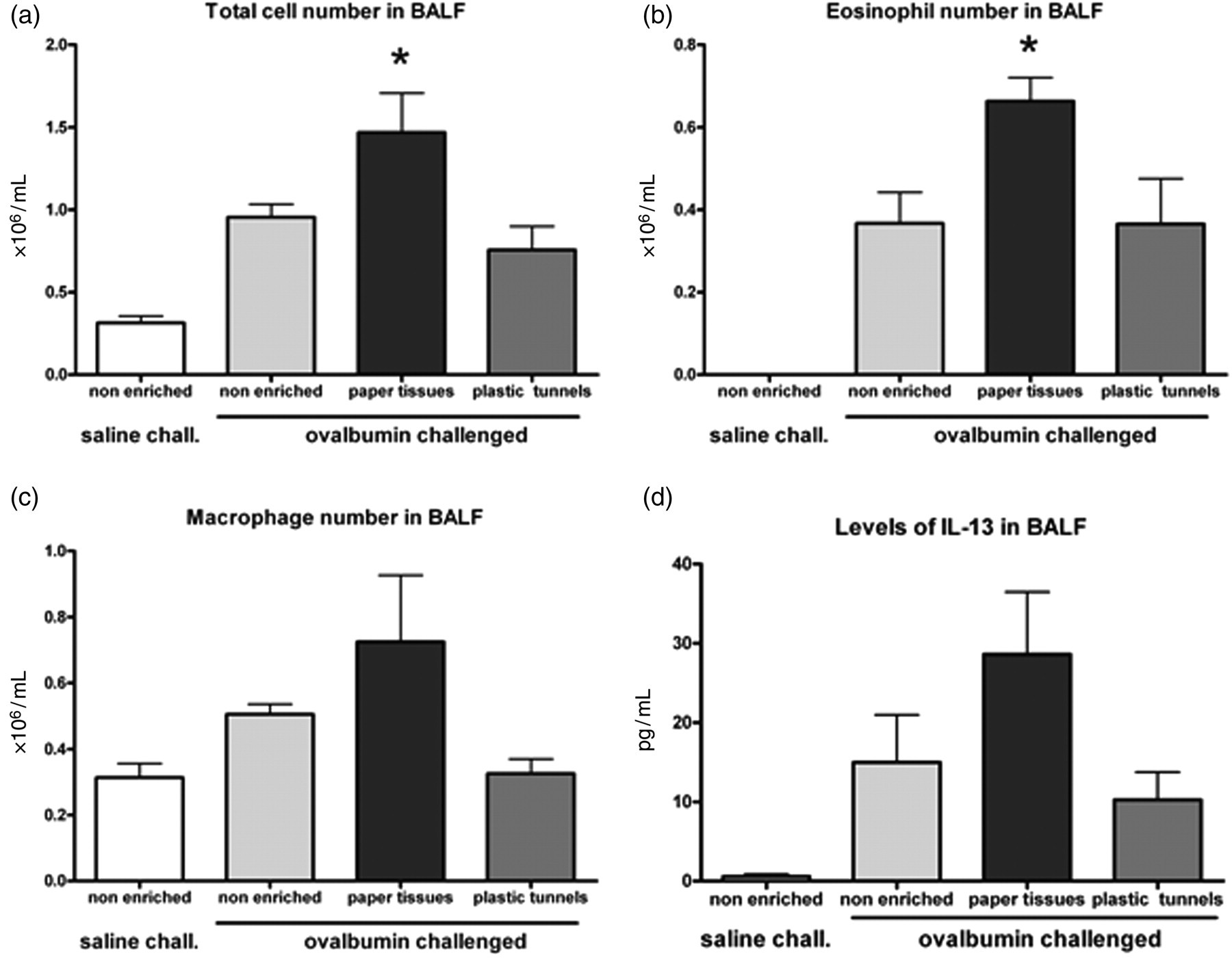
Effects of enrichment with paper tissues on the accumulation of inflammatory cells in bronchoalveolar lavage fluid (BALF). Total number of cells (a), number of eosinophils (b), macrophages (c) and levels of IL-13 (d) in BALF 48 h after challenge are presented as mean ± SEM pooled from three individual experiments (n = 6–8 mice per group). Significant differences (P < 0.05) versus positive control group (non-enriched ovalbumin challenged mice) are marked with an asterisk (*)
Our results indicate that enrichment with paper tissues significantly elevated allergic inflammation and increased in-group variability in this mouse model of asthma, whereas housing of mice with plastic tunnels did not affect any of the measured inflammatory markers in BALF. Possible explanation for enhanced allergic reaction could be a consequence of inhaled cellulose fibre particles of which Kleenex tissues are made of. Mice shred tissues in an attempt to make a nest and during this process unavoidably inhale cellulose particles. According to the literature, cellulose fibres may provoke specific inflammatory reactions in several animal species characterized by the accumulation of eosinophiles, basophiles and mast cells in lung tissue. 6,7 Therefore, inhaled cellulose fibres and simultaneous exposure to OVA allergen could be the possible reason behind enhanced allergic reaction of animals whose home cage was enriched with paper tissues. Previous studies have clearly shown that paper tissue enrichments strongly enhance species-specific nesting behaviour, reduce aggression between male mice and are highly preferred by mice compared with other kinds of nesting material. 8,9 However, since they interfered with the experimental results they are not the optimal choice of enrichment in this model.
Thus, the provision of enrichment should be evaluated not only in the context of the welfare of the animal, but also in the objectiveness of research goals. It would be advisable to carefully test various environmental enrichment schemes in the particular experimental model before it is routinely introduced into an animal cage for housing purposes. Ultimately, the decision to include a particular type of enrichment should be done on a case-by-case basis, including parameters such as whether the enrichment has a demonstrable beneficial effect on the animal, and whether the potential effects of the enrichment are experimentally relevant. 10 Awareness of the possible effects of enriched environments will allow scientists to monitor affected parameters and determine appropriate baselines to account for such influences. Moreover, this would permit the inclusion of appropriate control groups to ensure that interpretation of the study data was not compromised by uncontrolled variables. 3