






Abstract
The future laboratory animal technician in Europe will be provided with three different levels of education. All candidates have to start with an introductory course to reach level A0. At this level (A0) they will be able to assist in the laboratory animal facility by undertaking limited specific duties under supervision. Most A0 assistants will continue their education and training for at least one year while in full-time employment. This process will include continual assessment with the option of a final examination to become qualified at level A1. A1 represents a comprehensively educated laboratory animal technician with theoretical background knowledge and practical skills. Some of the A1 laboratory animal technicians may continue specific education for at least another year of full-time employment. They will develop knowledge and expertise as well as supervisory and basic managerial skills in order to obtain level A2.
Appropriate education and training of all those engaged in the use of live vertebrate animals for scientific purposes is required by both the Council of Europe and the European Union.1-4 The Federation of European Laboratory Animal Science Associations (FELASA) had published recommendations for the education and training of persons working with laboratory animals for Categories A and C. 5 For Category A an education was described on four levels, from basic laboratory animal care (level 1) to higher management or specialization (level 4).
The FELASA Working Group for the revision of Category A has looked over the 1995 recommendations critically and is now delivering a revised and simplified educational concept for Category A that will completely replace the FELASA recommendations of 1995. The proposal describes the recommended education of future Laboratory Animal Technicians. It does not consider existing staff members, who already work as laboratory animal technicians, but do not have the respective education. However, such staff may undertake this new course of study if they so wish. It does not consider other assisting personnel who have no direct animal-oriented tasks or duties.
The situation in the countries of the FELASA member associations is multifarious and recommendations for the education of laboratory animal technicians have to consider that. The recommendations must be kept more general in several respects, not least to provide a better opportunity for countries to adapt their current educational systems to the FELASA recommended concept in a step-by-step manner.
In general, the Working Group proposes Category A education on a binary basis, i.e. students are trained in two different institutions. These are the educating institution (employer, e.g. university, pharmaceutical firm) and the vocational school or provider of special courses, e.g. distance/online learning.
The future European laboratory animal technician (Table 1) may enter the education with an introductory course of 30 h, including theoretical and practical training by achieving level A0. At this level, which is only an introductory level, the staff will be able to assist in the laboratory animal facility by undertaking limited specific duties under supervision.
Proposed education and training timelines for different levels of FELASA Category A technician
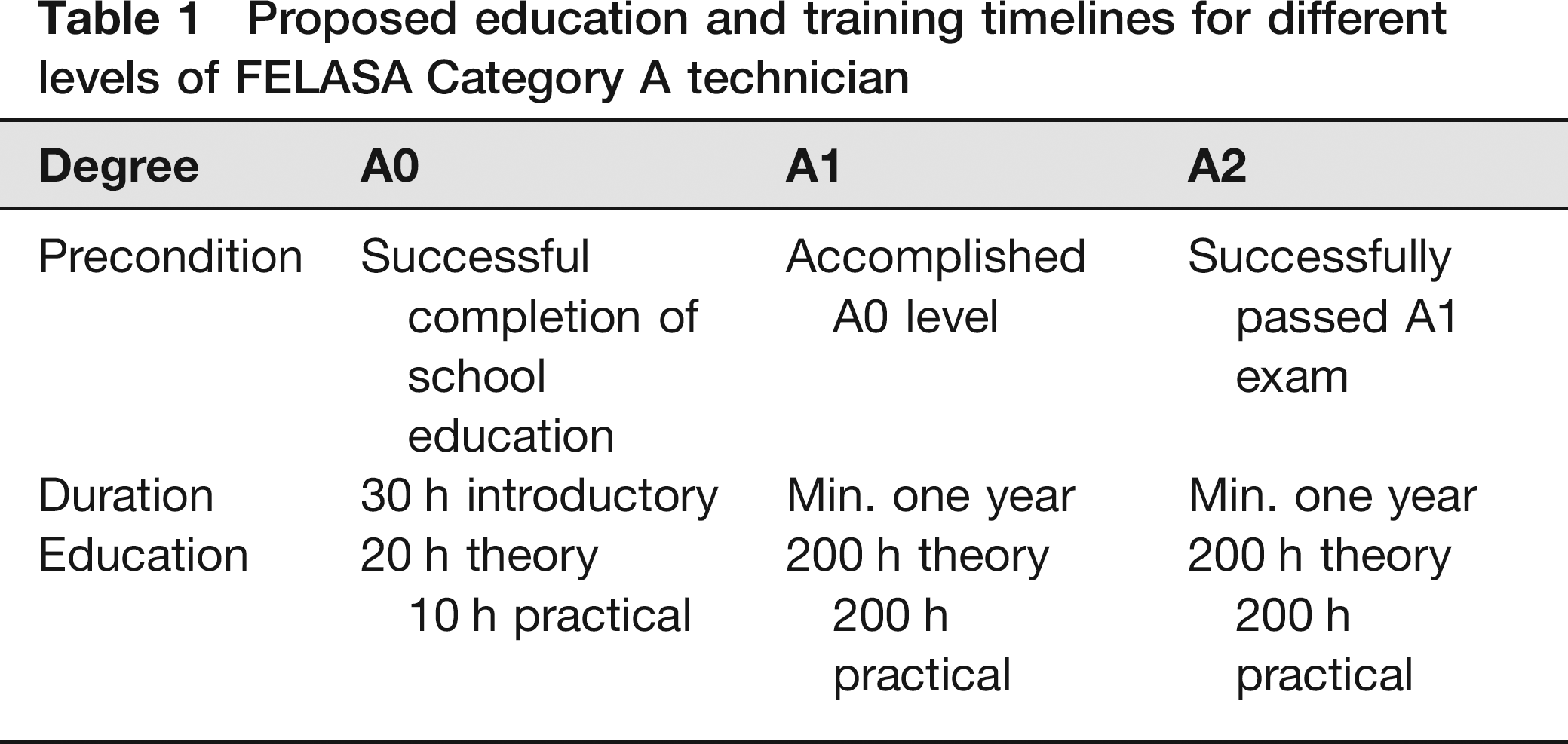
It is recommended that the A0 course is followed by further formal practical and theoretical training, while students complete a minimum of one year full-time equivalent of work experience. During this time, regular assessments of competency and understanding should take place along with a final evaluation of the students’ ability; successful students would then be at level A1.
After at least another year practical experience and successful completion of the A2 syllabus, the Laboratory Animal Technician should have achieved additional experimental and supervisory skills and thus can obtain level A2.
Progress from one level to the next is not automatic. Indeed, considering the staffing structure of an animal facility, it is obvious that not all those persons succeeding at one level will seek or be able to enter the next.
It is foreseeable that conditions in the field of biomedical research will change in the future. New techniques may be developed and other species may be required for laboratory use. Under these circumstances, the education of laboratory animal technicians must not end with the final exam, it has to continue throughout their entire professional life. The concept of continuing professional development must therefore be recognized in order to ensure the well-trained professional laboratory animal technician of the future.
Recognition of previous educational achievement
Where students are able to provide formal evidence of successful educational and/or training achievement in relevant subject areas (at a level equal to or greater than the category of education and training being undertaken), then exemptions from appropriate sections of the course may be granted on a ‘case-by-case’ basis. Importantly, such exemption should be limited to educational/training achieved within the last eight years.
FELASA Category A0 (A zero)
General: Personnel may enter this level from a variety of working backgrounds, age groups and educational abilities, but evidence of the successful completion of school education is required. Candidates have to be literate, numerate and with some understanding of basic secondary school level science. Interest in animals and the acceptance of the need to carry out routine tasks associated with proper maintenance and care of the animals is an essential prerequisite.
Activities and responsibilities
Competent handling of relevant species.
Competent transfer of animals between housing units, e.g. cage, pen or tank.
Feeding and watering of animals.
Cleaning of animal rooms.
Disposal of waste.
Recording room temperature and relative humidity and report.
Autoclaving maintenance equipment.
Transportation of animals within the facility.
Cage washing and filling with bedding.
Cage transportation.
Store keeping.
Replenishment of consumable items.
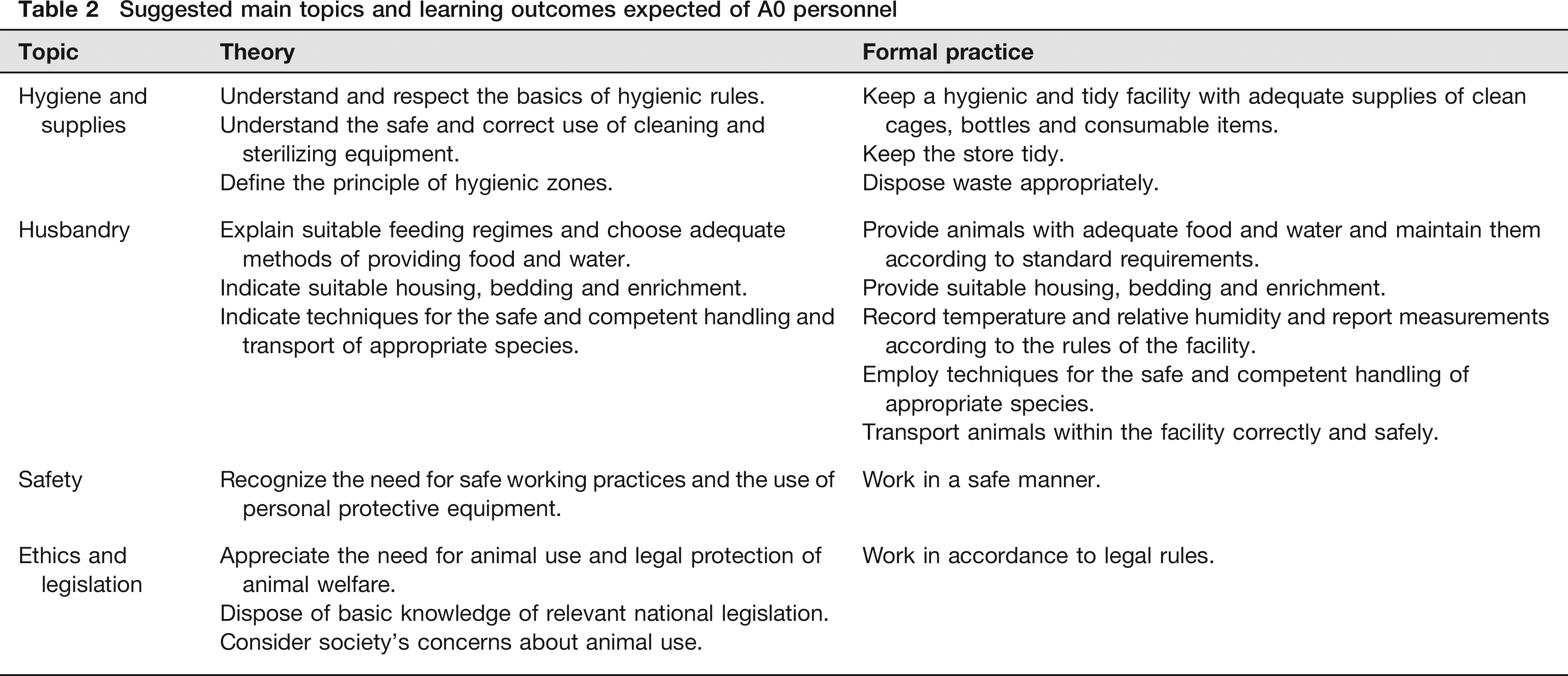
Teaching syllabi for Category A0
Suggested main topics and learning outcomes expected of A0 personnel
FELASA Category A1
General: While undertaking level Al, students will either demonstrate or acquire basic knowledge in biology, general science (physics, chemistry, history of laboratory animal science, concepts of experimental testing), mathematics, information technology (computer use) and communication (i.e. competent in both oral and written expression). It is recognized that at this level students should receive credits for prior learning where qualifications of a similar or higher standard are held. Precondition for starting education for level A1 is the FELASA Category A0 degree.
Depth in which topics need to be dealt with: Modules completed in level Al will result in successful students achieving a general understanding of the husbandry and welfare practices found within a laboratory animal facility. This will be underpinned by theoretical background knowledge and the ability to demonstrate competency in the practical skills required by laboratory animal technicians in their day-to-day work.
Hours of theory and practical: A total of 200 h theory and 200 h formal practical training and one year working under supervision in the workplace or approved educational establishment is required to build up experience. This may be undertaken while in full-time employment during which time students are supervised on a day-to-day basis. After graduation they should be competent to perform animal care routines and procedures following instructions, standard operating procedures and protocols.
Examination requirements: A process of continual assessment with the option of a final examination. Declarations of practical competency may be awarded at any time during the training period. Once practical competency is achieved, individuals may then work without immediate supervision for that specific training activity.
Teacher requirements: A combination of specialist teaching staff is recommended, each to be competent in their subject area. These may include individuals who have successfully completed Categories A2, B, C and D.
Activities and responsibilities
These are applicable to vertebrate animals housed within conventional, specified pathogen-free and barriered areas and/or aquatic systems. These may also include isolators, individually ventilated cages, quarantine units and other containment/isolation systems.
Competent handling, restraint and sexing (including age determination based on physical characteristics) of the common, most frequently used laboratory animal species.
Daily maintenance of conventional and/or genetically altered animals to include: establishing breeding groups/lines under direct supervision; recognition of mating and pregnancy signs; weaning; maintenance of computer and/or paper breeding records; and preparation of breeding performance data.
Receipt, checking and housing of incoming animals (in-house/commercial sources); issuing; and maintenance of defined paperwork and recording systems.
Acclimatization, socialization and training of animals.
Identifying animals by appropriate marking systems suitable for the animal species.
Cleaning, feeding and watering of experimental, breeding and other animals. Daily observation and inspection of animals for general condition (including noting food/ water intake). Reporting any variance of experimental animals to the investigator.
General maintenance of animal housing equipment and room(s): cleaning, disinfecting; replenishment of consumable items, etc. Involvement in general microbiological monitoring procedures, e.g. sampling, effective functioning of washing and sterilization equipment.
Recording animal room environment (temperature, humidity, light, etc.) and room procedures (daily activities in the room). Reporting any variance outside specified limits.
Conduct of minor procedures, e.g. blood sampling, drug administration and biopsy of tissues for genotyping (it is recognized that additional legal requirements in some countries may preclude all laboratory animal technicians from undertaking the minor procedures detailed above).
Postoperative care of experimental animals; assistance to researchers with animal handling and restraint; and maintenance of animals on specific experimental projects including recording of observations, e.g. body weight.
Recognition of wellbeing, discomfort, distress and pain.
Perform competently an appropriate method of euthanasia on relevant species in compliance with established procedures and/or legal requirements. Participation in necropsies, e.g. experimental purposes, animal health surveillance programmes.
Teaching syllabi for Category A1
Main topics and learning outcomes to be undertaken and demonstrated by A1 personnel
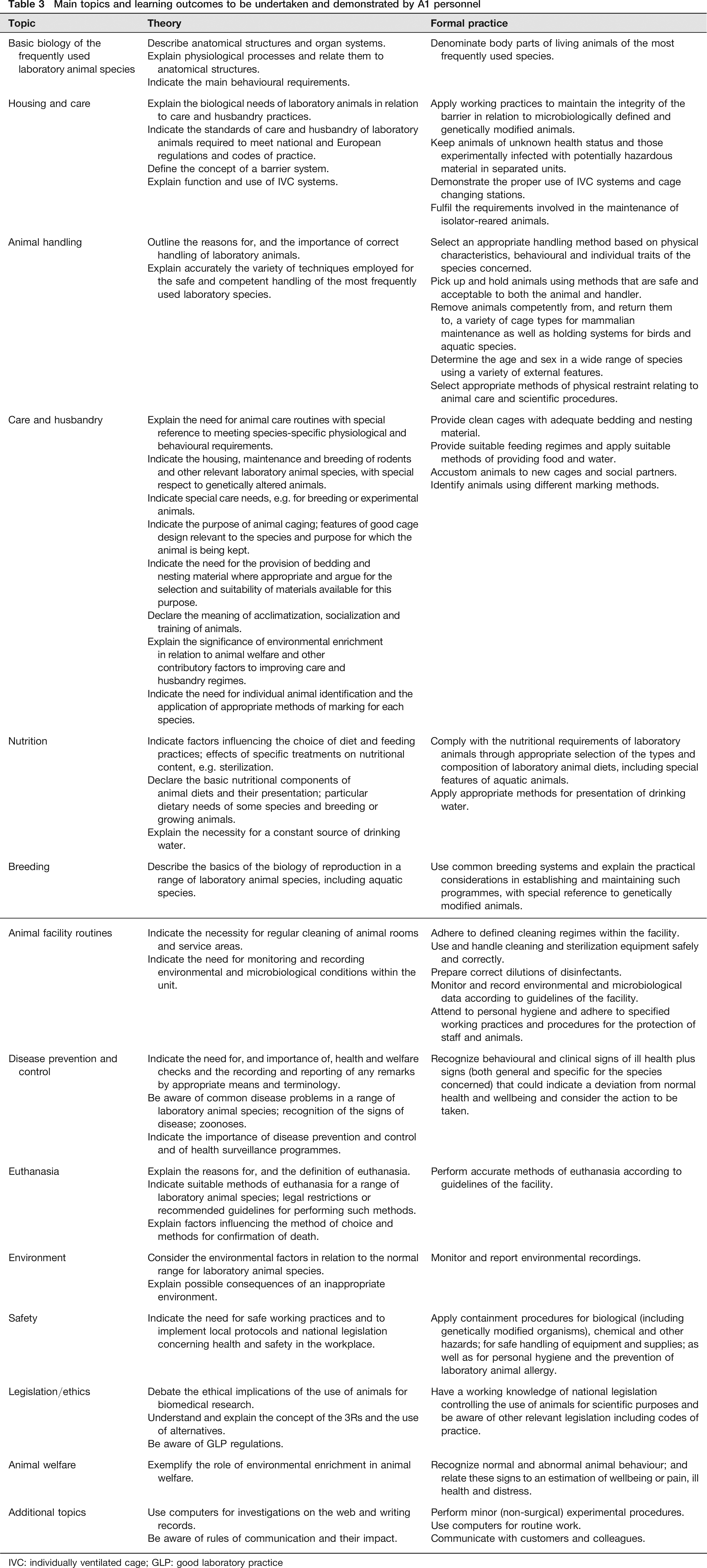
IVC: individually ventilated cage; GLP: good laboratory practice
FELASA Category A2
Entry qualification: The continuing development of knowledge and expertise plus the acquisition of supervisory and managerial skills would form the basis of duties undertaken at this level. Personnel obtaining level A2 would be expected to have successfully completed level Al or equivalent qualification and experience. It is recognized that even at level A2, as recommended for level Al, students should receive credits for prior learning where qualifications of a similar or higher standard are held.
Depth in which topics need to be dealt with: Successful completion of level A2 modules will enable career-oriented, professional laboratory animal technicians to demonstrate and apply theoretical knowledge to key specialized and/ or supervisory roles. It is recognized that successful completion of level A2 training will enable laboratory animal technicians to undertake a range of experimental procedures, thereby increasing the expertise available for in vivo research programmes.
Hours of theory and practical: Full A1 education plus 200 h theory plus 200 h of formal practical training plus one additional year of practical experience.
Examination requirements: A process of continual assessment with the option of a final examination. Declarations of practical competency may be awarded at any time during the training period.
Teacher requirements: See Teacher requirements for FELASA Category A1.
Activities and responsibilities
Organization and supervision of the animal care and husbandry routines.
Planning of daily work routines and staff rotas.
Coordination of resources to meet demands.
Participation in management of departmental budgets.
Main topics and learning outcomes to be undertaken and demonstrated by A2 personnel
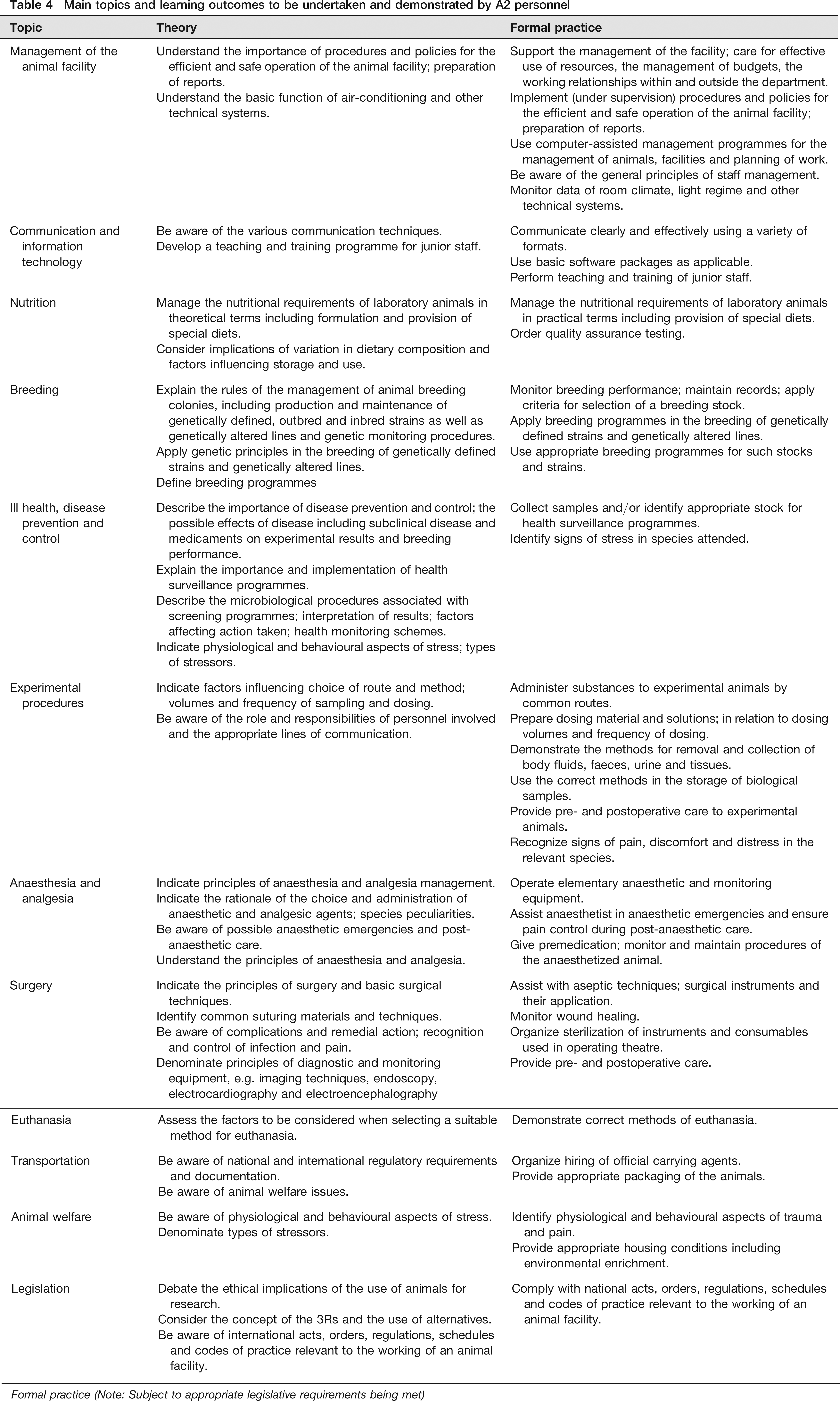
Formal practice (Note: Subject to appropriate legislative requirements being met)
Ordering of animals, equipment and supplies. Management of animal breeding colonies, including re-derivation programmes. Arranging despatch, transportation and receipt of animals. Knowledge of welfare and national and international regulatory requirements. Assistance in research projects and involvement in experimental protocols. Providing advice regarding compliance with relevant legislation. Implementation of environmental and microbiological monitoring procedures including health surveillance programmes. Participation in the training and development of staff. Contribution to aspects of animal welfare (e.g. refinement of techniques). Preparation of reports, etc. which may require some knowledge of data management and statistics. To guide and assist new trainee animal care personnel to achieve routine care procedures to the expected standard.
Teaching syllabi for Category A2
Suggested main topics and learning outcomes (Table 4)
Definition of terms and role of people:
Laboratory animal assistant (A0): Persons assisting the laboratory animal technicians by undertaking basic routine, hygiene and animal care tasks.
Laboratory animal technician (A1): Persons mostly involved in the breeding and care of laboratory animals, whereas some of whom give routine help with experiments.
Laboratory animal technician (A2): Persons responsible for the breeding and care of laboratory animals and also help routinely with experiments and/or supervise and train junior staff. It is recommended that A2 laboratory animal technicians adhere a supplementary education to qualify as Category B persons too. In some countries this is a legal requirement for people involved in experimental settings with live animals.
FELASA Category B: Persons carrying out or assisting in animal experiments.
Relevant websites
Candidates should be aware of the relevant national and international websites relating to laboratory animal science and welfare.