





Abstract
Christine Tomkins is the Chief Executive of the Medical Defence Union (
Please outline your typical working day
I cycle to work from my home in south London to our offices near Blackfriars Bridge. It only takes about 20 minutes and it sets me up for the day. The weather is good surprisingly often and my route hugs the river, with beautiful views at every turn and none of the hassles of other forms of transport.
That is about as typical as my day gets, though. Once at my desk, my diary is generally filled with meetings that focus on the company's strategy, innovation and financial management. The one constant in my working day is that everything I do is focused on the interests of our members.
We are the only medical defence organization (MDO) to provide members (over 50% of the UK's doctors in hospital and primary care) with insurance for their clinical negligence claims. That brings with it an interesting and varied workload.
I am responsible for over 350 people and work closely with the Executive team of Finance, Professional Services and Marketing Directors, and our Board of Management which includes clinicians and other professionals with a wide range of business experience. Our aim is to ensure members' funds are secure and that their medicolegal needs are met.
Christine Tomkins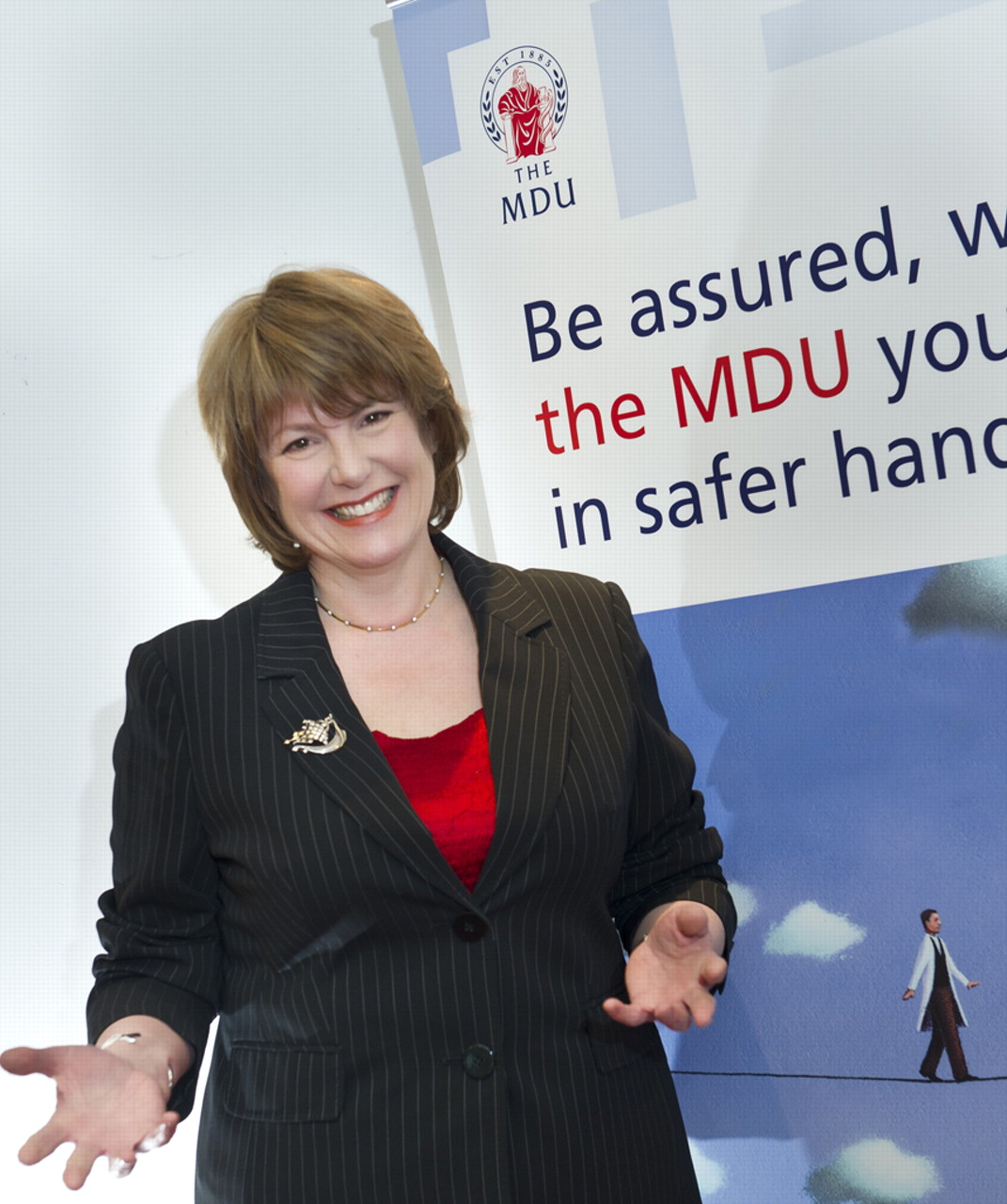
There are regular meetings with the Board, Executive and other specialist colleagues and advisers in order to define and refine the MDU's commercial strategy. Currently, members' claims are backed by two of the world's largest reinsurers – SCOR and Hannover Re. Liaising with these companies forms a significant part of my work.
Managing the business side of the MDU may seem a long way from my original training as an ophthalmic surgeon, but the careful preparation, dedicated teamwork and focus on the best result for patients that clinicians apply all the time are equally important in my work on behalf of members. I spend a great deal of time analysing data, consulting with experts, and thinking about and implementing long-term strategies. The company has to operate as efficiently as possible and meet our members' needs and, I hope, exceed their expectations – and continue to do so far into the future.
Innovation is as important in this role as it is in clinical practice. My colleagues and I spend a lot of the time ‘horizon scanning’ and bouncing ideas off each other to make sure we stay ahead.
One aspect of work you most look forward to each day
Working with people who are far more expert than I am in areas I never imagined I would be considering when I embarked on my medical training. They are at the top of their fields in finance, actuarial, legal, clinical and regulatory and government work, so I learn something every day.
One aspect of work you least look forward to each day
Tackling my in-tray. There are days when I know I won't have time to deal with everything. I'm not too keen on travelling either, because when I do there is inevitably ‘down time’ which is annoying when there is so much to be done.
A person who has inspired you most at work (past or present)
Donald Longson, a consultant physician at Manchester Royal Infirmary and the dean of clinical studies at Manchester Medical School. I did my pre-registration medical house job with him at Manchester Royal Infirmary and was lucky enough to have him as a friend and mentor until his death in 2002. He was wonderfully clever and perceptive, as well as funny and kind. His patients loved him, as did his colleagues and friends. He was the perfect example of an exceptional doctor and an exceptional human being.
The most significant achievement of your career
I am most proud of being appointed Chief Executive of the MDU, the head of a company run by doctors for doctors. I am the first woman in the role and the only doctor leading a mutual defence organization.
List your reasons for choosing this career
I got into it by sheer chance. In 1984 I was leafing through the job vacancies in the BMJ and an advert for an MDU medicolegal adviser caught my eye. I came along for a chat and was really interested. I thought I would try it for six months but once I started, I was hooked. It's a dynamic, constantly changing environment.
Alternative career (in another lifetime)
It would have to be something to do with horses. My passion is carriage driving so I'd probably have liked to compete professionally.
Non-medical book(s) you are currently reading
The House of Special Purpose by John Boyne, author of The Boy in the Striped Pyjamas. Set in 20th-century Russia, it spans a 70-year history and tells of places and times far from anything I know about or have experienced.
Song(s)/piece(s) of music you are currently listening to
Ludovico Einaudi. My son introduced me to his music. He's a fantastic pianist and composer (Einaudi, that is, not my son).
How do you wind down at the end of the working day?
Dinner, theatre or opera with friends and family are my favourite ways to wind down. I think it's important to switch off from work and enjoy the occasion. It makes me fresher the next day. And then, of course, I have the bike ride back along the river to home.
This is a series on the working lives of medical professionals. Please email any suggestions or comments to