





Abstract
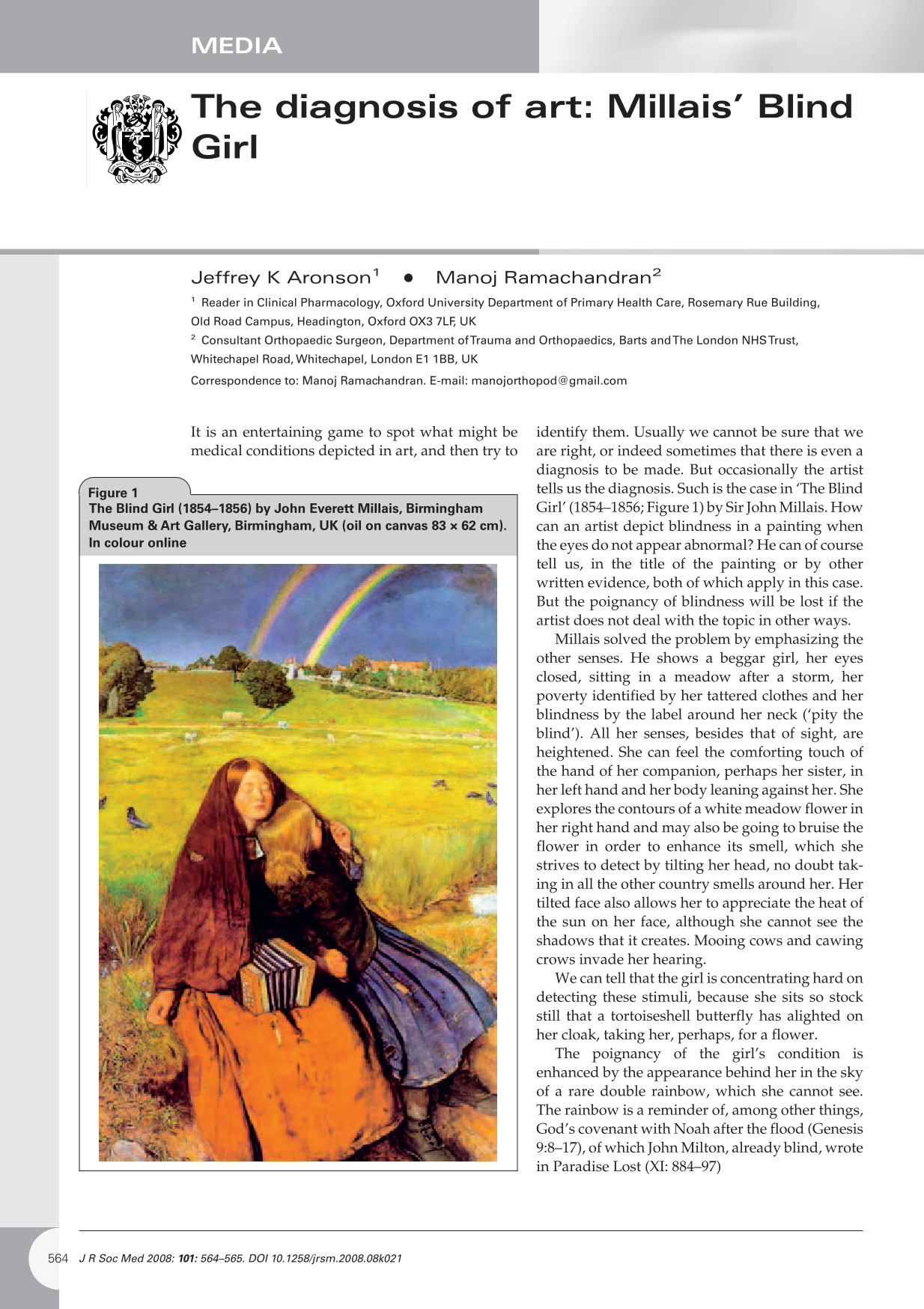
It is an The Blind Girl (1854–1856) by John Everett Millais, Birmingham Museum & Art
Gallery, Birmingham, UK (oil on canvas 83 × 62 cm). In colour online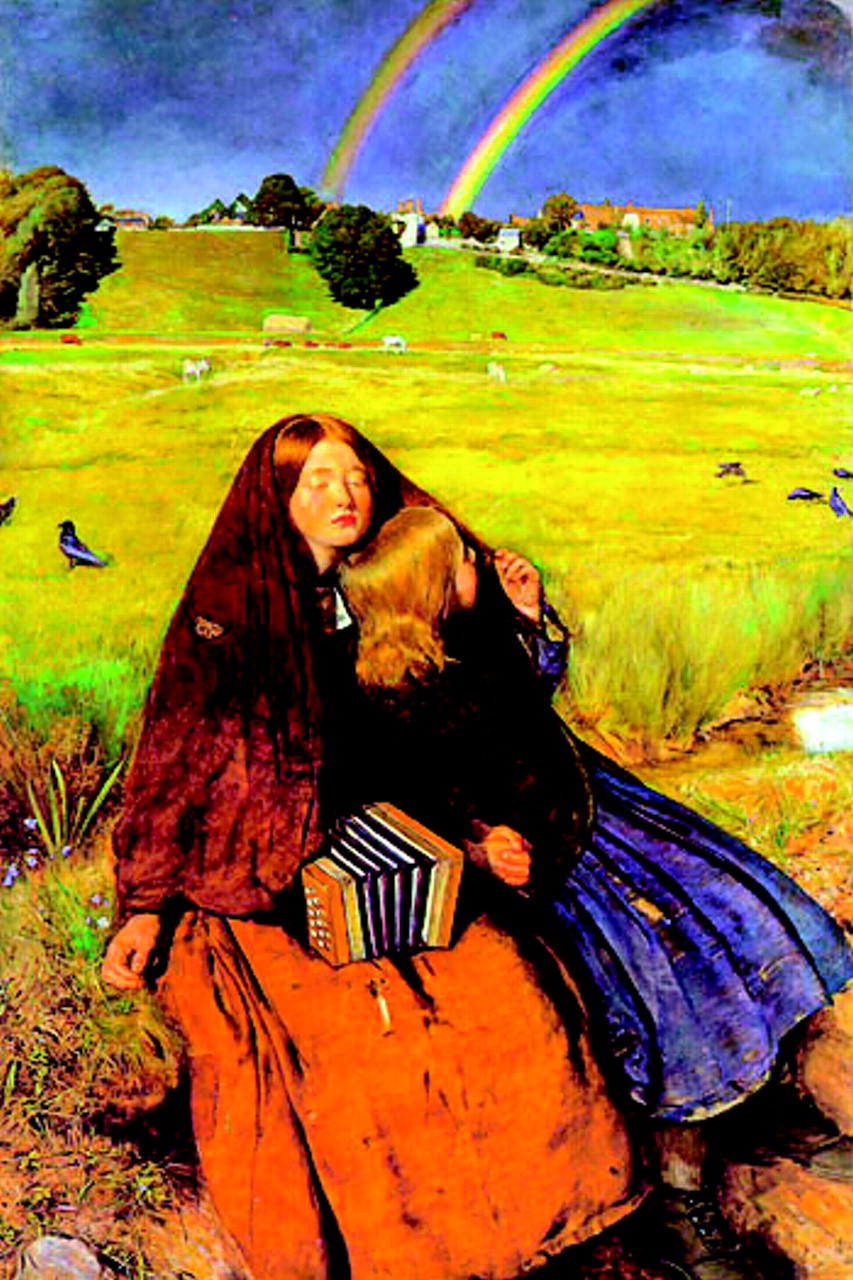
Millais solved the problem by emphasizing the other senses. He shows a beggar girl, her eyes closed, sitting in a meadow after a storm, her poverty identified by her tattered clothes and her blindness by the label around her neck (‘pity the blind’). All her senses, besides that of sight, are heightened. She can feel the comforting touch of the hand of her companion, perhaps her sister, in her left hand and her body leaning against her. She explores the contours of a white meadow flower in her right hand and may also be going to bruise the flower in order to enhance its smell, which she strives to detect by tilting her head, no doubt taking in all the other country smells around her. Her tilted face also allows her to appreciate the heat of the sun on her face, although she cannot see the shadows that it creates. Mooing cows and cawing crows invade her hearing.
We can tell that the girl is concentrating hard on detecting these stimuli, because she sits so stock still that a tortoiseshell butterfly has alighted on her cloak, taking her, perhaps, for a flower.
The poignancy of the girl's condition is enhanced by the appearance behind her in the sky of a rare double rainbow, which she cannot see. The rainbow is a reminder of, among other things, God's covenant with Noah after the flood (Genesis 9:8–17), of which John Milton, already blind, wrote in Paradise Lost (XI: 884–97)
The two girls cannot hope to find the legendary pot of gold at the rainbow's end, apparently situated in the town of Winchelsea, seen in the background. But they may be on their way there, to try to earn a penny from entertaining the townsfolk with the accordion that rests in the blind girl's lap. The double rainbow may also be a sign of redemption, like the ones that Robert Browning mentioned in his verse drama ‘Pippa Passes’ (1841) and described in his twin poems ‘Christmas-Eve and Easter-Day’:
‘Christmas-Eve’, which describes a visionary religious experience, was published in 1850, just a few years before Millais produced his painting of the blind girl. Could Browning's double rainbow have influenced him?