





Abstract

We mostly associate Henri de Toulouse-Lautrec with paintings of the demi-monde of Paris night-life. 1 However, his oeuvre stretches much further than that. Figure 1 shows one of his paintings of the famous Paris surgeon, Dr Jules-Emile Péan (1830–98). The patient has his mouth wide open and his nose is covered with a pad, presumably soaked in ether or chloroform. An assistant stands on the other side (we see his left shoulder, his head, and his right hand), restraining the patient and holding a scalpel in readiness. And at the centre of focus we see the surgeon probing the patient's mouth with an instrument–perhaps the haemostatic compression forceps that Péan controversially claimed to have invented in 1868. 2 , 3 , 4
In The Story of San Michele (1929), a book that is perhaps best described
as fictionalized memoirs, the Swedish physician Axel Munthe
5
described Péan: “I tremble at the thought of what would have happened to me had I fallen into the
hands of one of the other leading surgeons in Paris in those days. … The famous
Professor Péan, the terrible butcher of Hôpital St. Louis, would have chopped off
both my legs on the spot and thrown them on the top of some stumps of arms and legs,
half-a-dozen ovaries and uteruses and various tumours, all in a heap on the floor of
his amphitheatre besmeared with blood like a slaughter-house. Then, his enormous
hands still red with my blood, he would have plunged his knife with the dexterity of
a conjurer into his next victim, half conscious under insufficient anaesthesia, while
half-a-dozen others, screaming with terror on their brancards, were awaiting their
turn of torture. The massacre en masse at an end, Péan would wipe the sweat from his
forehead, rub a few spots of blood and pus from his white waistcoat and dresscoat–he
always operated in evening dress–and with a: ‘Voilà pour aujourd'hui,
Messieurs!’ he would rush out of the amphitheatre to his pompous landau
and drive full speed to his private clinic in Rue de la Santé to cut open the
abdomens of half-a-dozen women driven there by a gigantic réclame like helpless sheep
to the slaughterhouse of La Villette.”
It should be added, however, that Munthe's descriptions are not to be relied upon. 6
Dr Péan Operating, 1891–1892. Oil on cardboard, 74 × 50 cm. Sterling and Francis
Clark Art Institute, Williamstown, Massachusetts, USA. In colour online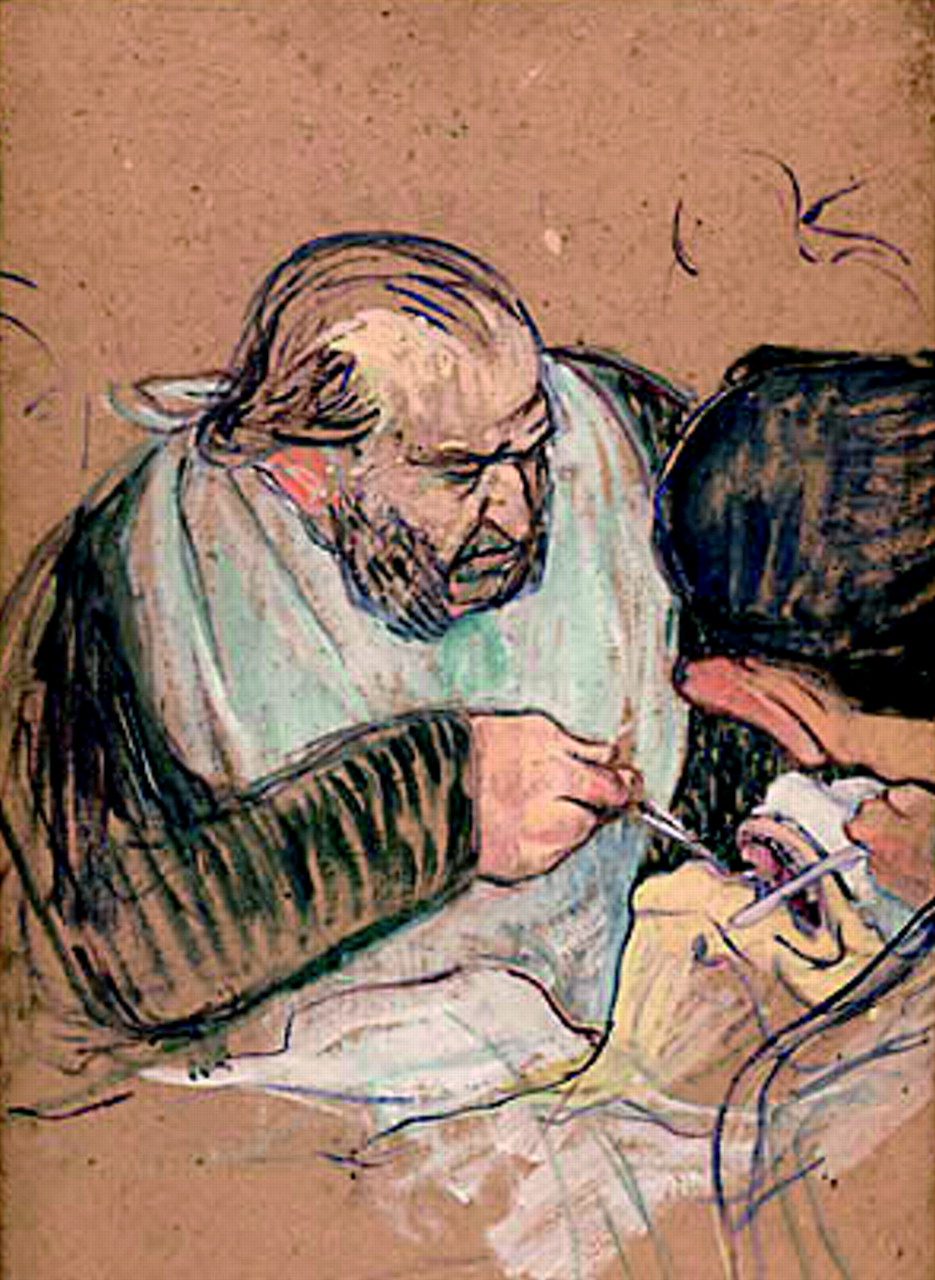
We do not know the identity of Péan's assistant in the painting. Could it have been Tapié de Céleyran? One of Lautrec's friends, Paul Leclerq, wrote that he had “black hair, gleaming with pomade”, but Leclerq also says that the hair was “parted down the back and carefully brushed upwards at each side”. Furthermore, Lautrec painted his cousin in 1894 and showed him with steeply sloping shoulders, in contrast to the assistant.
And the diagnosis? As so often, only wild speculation is possible. The painting has been called “Une Opération de Trachéotomie”, although that is not what it looks like at first glance, for Péan's forceps are in the patient's mouth. But perhaps the patient's swollen neck is the bull neck of diphtheria and Péan is inspecting the pharynx before performing a tracheotomy, which Pierre Bretonneau introduced in 1825 for diphtheria, the name of which he also coined. 7 Then again, in addition to the swollen neck the lips are prominent; perhaps the patient has laryngeal obstruction due to angio-oedema, which Quincke had described in 1882. 8 Tracheotomy was also a common treatment for tuberculosis and cancer of the larynx in the late nineteenth century. 9 Or perhaps the surgeon is about to incise an abscess or to excise a tumour or ulcerated tonsils. The nub of flesh just under the teeth could be the tongue displaced to the right; in which case, perhaps he is removing a salivary calculus.
Whatever the reason for the operation, with a few expert strokes, some shading, and apart from black and white using little more colour than that of the cardboard for contrast, Toulouse-Lautrec has given us a vivid picture of a late nineteenth century surgeon at work.
Footnotes
DECLARATIONS
Footnotes
Acknowledgements
Not applicable