





Abstract
This is the tenth in a series of articles on making evidence-based medicine work for you. The series is based on the book ‘Attenti Alle Bufale’ by Tom Jefferson (www.attentiallebufale.it).
Quick instrument
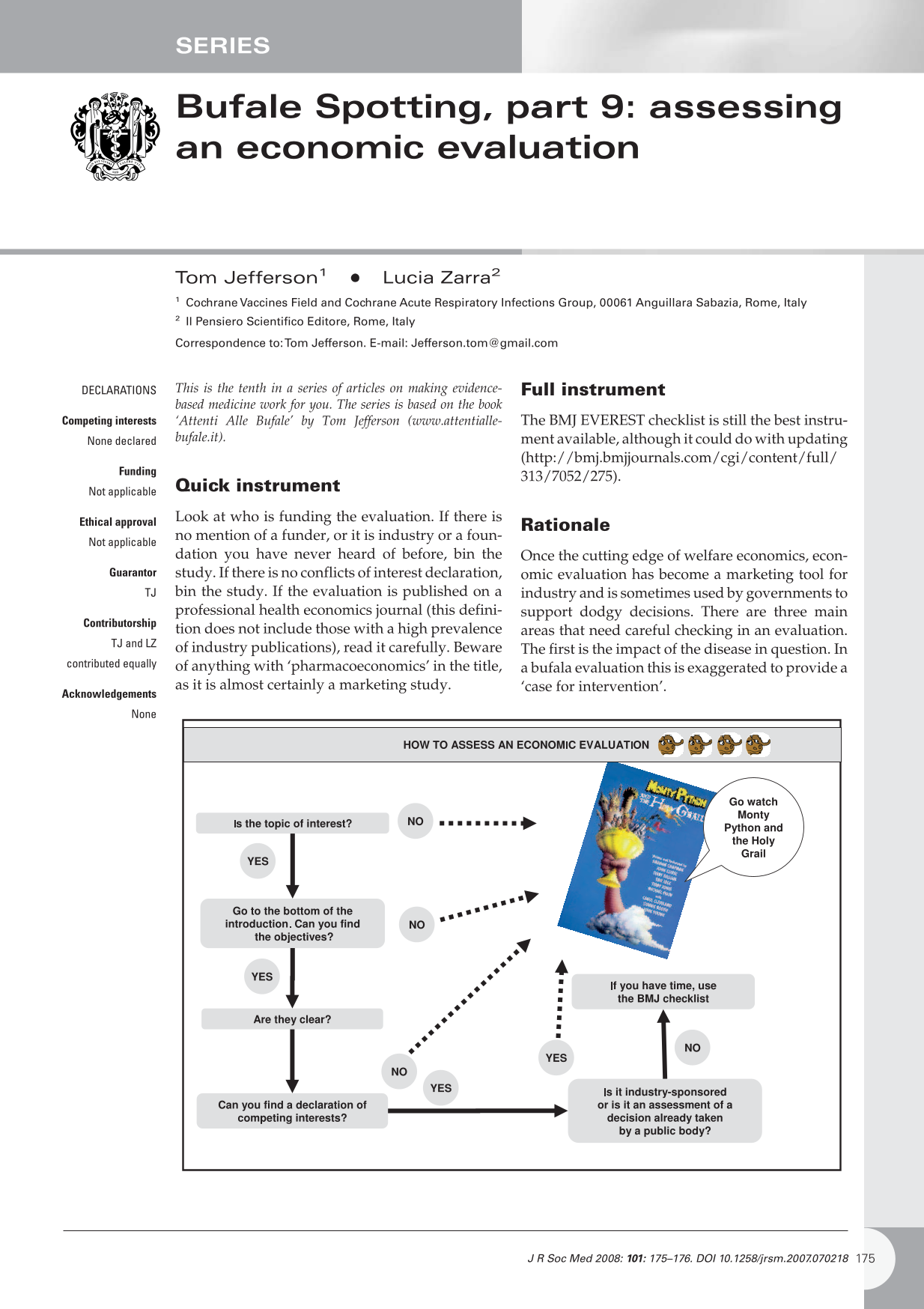
Look at who is funding the evaluation. If there is
Full instrument
The BMJ EVEREST checklist is still the best instrument available, although it could do with updating (http://bmj.bmjjournals.com/cgi/content/full/313/7052/275).
Rationale
Once the cutting edge of welfare economics, economic evaluation has become a marketing tool for industry and is sometimes used by governments to support dodgy decisions. There are three main areas that need careful checking in an evaluation. The first is the impact of the disease in question. In a bufala evaluation this is exaggerated to provide a ‘case for intervention’.
The second are the estimates of effectiveness (i.e. real world impact) of the intervention(s) to deal with the problem. Bufala researchers sometimes pretend that efficacy (which invariably yields higher estimates) and effectiveness are the same thing. The third are the methods used to estimate the impact of the intervention. The oldest trick in the book is to pretend that average costs are the same as marginal ones. For example, that if you prevent a few cases of disease X by intervening you accrue a 100% saving as hospital beds will not be filled and their operating costs will be saved. In reality the beds will be filled by cases of something else and the saving will be slight, if any.
Footnotes
DECLARATIONS
Footnotes
Acknowledgements
None