






Abstract
Objective
To assess the impact of media coverage of the UK Flexible Sigmoidoscopy Trial on colorectal screening uptake in England.
Setting
In April 2010, publication of the UK Flexible Sigmoidoscopy (FS) Trial results generated considerable media interest in both FS and colorectal cancer (CRC) generally.
Methods
We used routinely collected data from the south of England (excluding London) to analyse return of faecal occult blood test (FOBt) kits within 28 days of the invitation (early uptake) among 60–69 year olds, before (T1, n = 31,229), around the time of (T2, n = 39,571), and one month after (T3, n = 33,430) the FS publicity.
Results
FOBt uptake over the whole period was 58.2%, with 38.4% of the kits returned within 28 days (early uptake). Across the three time periods, early uptake was 35.8% at T1, 39.4% at T2, and 39.7% at T3. Multivariate regression controlling for age, gender and socioeconomic status confirmed that uptake was higher if people received the FOBt kit around the time of the media coverage (T2: odds ratio [OR] = 1.17, 95% CI = 1.13–1.20), or one month after (T3: OR = 1.18, 95% CI = 1.15–1.22) than before (T1). Sub-group analyses demonstrated that the impact was stronger among previous non-responders than among first-time invitees or previous responders (P < 0.001).
Conclusion
Media coverage of the FS Trial appeared to have a small but positive impact on FOBt screening uptake, especially among people who had previously abstained from screening.
Introduction
Mass Media And Cancer Screening
Mass media can be an important vehicle for informing the public about health issues, with planned media campaigns and involvement of well-known public figures having positive effects on cancer screening uptake.12–15 Mammography appointments in four Australian states increased by 40% during two weeks of coverage of singer Kylie Minogue's breast cancer diagnosis, with a doubling of appointments made by previously unscreened eligible women. 16 In the UK, the TV celebrity Jade Goody's cervical cancer diagnosis and death heightened public interest in cervical cancer, 17 , 18 triggering an increase in cervical screening. 17 American media coverage of Katie Couric's colonoscopy as part of a CRC awareness campaign was associated with higher colonoscopy screening rates for nine months after the media coverage ceased. 19
Less is known about the potential impact of media coverage of scientific advances in cancer screening and prevention. There have been some studies20–23 of media content itself and its likely impact on knowledge about cancer prevention (e.g. the relationship between HPV and cervical cancer 24 ). However, we are not aware of any studies examining the impact of media coverage of scientific developments on screening uptake.
A possible limitation of mass media publicity is that its credibility, and thus influence, could depend on the compatibility of its content and source with the audience's identity or prior attitudes. 25 For instance, in the Kylie Minogue case mammography rates rose mainly among women closer to the age of the singer. 16 In the context of cancer-related scientific advances, people with more positive attitudes towards cancer screening and prevention may attend more closely to such media coverage. Thus, it might serve as an environmental cue for individuals who are already positively inclined towards screening to act, but have limited effect on those who are not inclined (e.g. most who have not responded to previous invitations). 26 Alternatively, the mass media might allow individuals who would not usually take notice of health communications to receive information about disease prevention.
Uk Flexible Sigmoidoscopy Trial Press Coverage
In April 2010, the Lancet published the results of the UK Flexible Sigmoidoscopy (FS) Trial showing dramatic reductions in CRC mortality and incidence. 27 This important publication stimulated considerable attention in print and TV media. Although FS screening was not at that time included in the English CRC screening programme, the media content raised the profile of CRC and early detection. The present study investigated the impact of FS Trial media coverage on participation in the NHS FOBt-based CRC screening programme in the areas of England served by the Southern Programme Hub. We predicted higher return rates for FOBt kits sent out around the time of intensive media coverage than in the month before. Among people who had been previously invited, we also investigated whether the media impact was stronger in previous non-responders or those who had previously completed a test.
Methods
Media Coverage of Colorectal Cancer
To document the media coverage relating to the release of the UK FS Trial results, we used the UK Nexis® database to locate national newspaper articles about CRC published in England between 1 March and 30 June 2010. Search items were ‘cancer’ AND [‘bowel’ OR ‘colon’ OR ‘colonic’ OR ‘colorectal’ OR ‘colorectum’]. Regional newspaper articles were excluded from the search because they had a limited coverage of the total geographic area within which we examined effects on uptake. The search query yielded a total of 306 ‘hits’. We used the following set of hierarchically-applied exclusion criteria: i) duplicates (n = 8), ii) not published in England (n = 24), iii) CRC not mentioned in the article or not the main topic of the article (n = 248). This left 26 national newspaper articles to be included in a content analysis to determine the extent to which they discussed FS or FOBt, and whether the article was supportive of FS or FOBt.
Colorectal Cancer Screening Uptake
The present analyses were based on anonymized, routinely recorded data from one of the screening hubs responsible for the delivery of the English CRC screening programme. For this study we included only 60–69 year olds because the age extension to 74 had not been fully implemented. We analysed uptake for eligible individuals who had received a FOBt kit in three time periods each covering a 15- to 16-day timespan: 14–30 March (T1), 28 April-14 May (T2), and 5–21 June (T3). Thus, T1 invitees received their kit at least 28 days before the press release, T2 invitees received the kit within 16 days of the press release, and T3 invitees received the kit at least 38 days after the press release.
The present analyses focused primarily on ‘early uptake’; defined for the purposes of this study as the FOBt kit being returned within 28 days. This avoided any effect from invitation reminder letters that were mailed 28 days after the initial invitation. Kits returned by T1 invitees would therefore have been completed before the media attention associated with the FS Trial results. Early uptake is also important for the programme because it avoids the cost of sending reminders. However, we also analysed data on total uptake to ensure that any media impact went beyond simply prompting earlier test kit return with no influence on overall uptake.
Data came from the screening programme's Southern Hub, which serves a total population of approximately 14.4 million people (of whom about 1.3 million are aged 60–74 years), and covers an area that extends between Buckinghamshire and Kent to Cornwall (excluding London). The date when each individual was sent an invitation to participate in the screening programme and the return date of a completed kit were recorded. The date that invitees received the kit was estimated as 10 days after the invitation date (kits are sent 8 days after the invitation and take on average 2 days to be delivered by second class mail). Other data included the individual's CRC screening history, categorized into: i) ‘first-time invitees’ who were being sent their first invitation to participate in the CRC screening programme (n = 86,533), ii) ‘previous responders’ who were being invited for the second time and had returned a kit in the previous screening round (n = 12,937), and iii) ‘previous non-responders’ who were being invited for the second time but had not returned a kit in the previous round (n = 4,760).
The dataset also included age, gender and level of socioeconomic deprivation for each individual's residential postcode sector, derived using the 2007 Index of Multiple Deprivation for England (IMD). The IMD uses census-derived indicators of income, education, employment, environment, health, and housing at small-area level to generate a scale from 0 (least deprived) to 80 (most deprived). 28
We tested whether there had been an increase in FOBt kits returned in T2 and T3 compared with T1 in the total sample, and included known demographic predictors of uptake, namely age-group (60–64, 65–69 years), gender, and SES (IMD score: 0–80) in the analysis. To test whether the impact of media coverage differed by CRC screening history group, we calculated odds ratios for each group and used bootstrapping with 999 re-samplings to obtain bias-corrected confidence intervals (CIs) to test differences between odds ratios. 29 Analyses were performed using STATA 11. 30
Results
Media coverage of colorectal cancer
The 26 national newspaper articles that covered CRC were in titles directed towards a wide range of readerships including tabloids (e.g. The Sun, The Mirror), middle-market newspapers (e.g. Daily Mail, Daily Express), and broadsheets (e.g. The Times, The Telegraph, The Guardian, The Independent). The length of the articles ranged from 42 to 1330 words, with a median of 195 words (mean = 360; SD = 388 words). Of the 26 articles, 12 reported primarily the results of the FS Trial and were published within two days of the Lancet publication (28/29 April 2010). As illustrated in Figure 1, this was by far the largest number of articles published on a single specific CRC-related news item during the period of interest and accounted for the densest media coverage, with nearly half the articles published on two days of the four-month period. Without exception, the articles presented FS as a ‘breakthrough’ in CRC screening and prevention, and were also extremely positive about CRC screening in general and often made mention of CRC as a common cancer. However, very few (n = 3) made direct reference to FOBt or the current English screening programme, and only one explained that FOBt could be valuable for detecting cancers in parts of the colon that FS is unable to reach.
Number of included CRC-related publications by date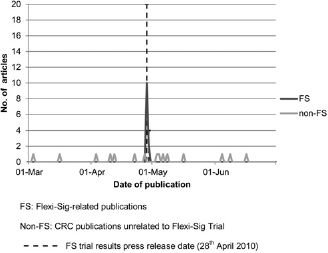
Colorectal Cancer Screening Uptake
In total, 104,230 FOBt kits were sent out by the Southern Hub across the three time periods examined. Overall uptake across the three time periods was 58.2% (i.e. any kits returned up until 31 December 2010), with 38.4% of the kits returned within 28 days (early uptake).
Early uptake was 35.8% in T1, 39.4% in T2, and 39.7% in T3. Table 1 presents results of multivariate logistic regression analyses of early uptake for all invitees and each screening history sub-group, controlling for age-group, gender and SES. Test kits were significantly more likely to have been returned if they were sent around the time of the press release (T2: OR = 1.167, 95% CI: 1.132–1.204), or a month after (T3: OR = 1.185, 95% CI: 1.147–1.223), than before (T1).
Multivariate logistic regression models of early uptake
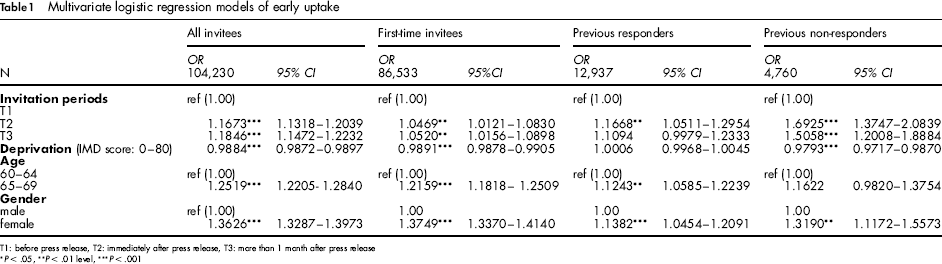
T1: before press release, T2: immediately after press release, T3: more than 1 month after press release
*P < .05
P < .01 level
P < .001
As expected, respondents who were female, older, and living in an area associated with higher SES, were more likely to return the FOBt kit within 28 days. However, there were no significant interactions between age, gender or SES and time period, so interaction terms were not included in the regression models presented in Table 1.
Figure 2 shows uptake in each time period for the whole group, and for each screening history sub-group. Sub-group analyses showed that the media impact at T2 (vs. T1) was stronger among previous non-responders (OR = 1.693, CI: 1.375–2.084) than previous responders (OR = 1.167, CI: 1.051–1.295) or first-time invitees (OR = 1.047, CI: 1.012–1.083) (see Table 1). Bootstrapping confirmed the significance of differences between coefficients for previous non-responders versus previous responders (0.372, CI: 0.134–0.571), and previous non-responders versus first time invitees (0.480, CI: 0.314–0.680).
Early uptake rates: total sample and by screening history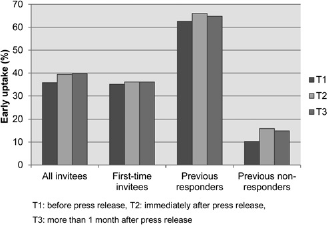
Finally, we examined whether the pattern observed for early uptake was seen for overall uptake even though the ‘baseline’ overall uptake value (T1) would have included some media exposure for those who were late returners; diluting the observed impact of media coverage. Multivariate logistic regression showed a pattern that was similar to early uptake, but as predicted, the difference between time periods was smaller. Overall uptake was higher for kits sent in T2 (OR = 1.120, CI: 1.087–1.154) and T3 (OR= 1.117, CI: 1.083-1.153) than T1, controlling for age, gender and SES.
Discussion
Media coverage of the FS Trial appeared to have a modest positive impact on screening uptake, which lasted for at least a month after the exposure, supporting previous findings of media effects on cancer screening.12,14,15,19 This is despite the fact that FS-related media coverage rarely mentioned either the current English screening programme or FOBt testing. Especially among first-time invitees, it is likely that the increase in FOBt uptake in the current screening programme was due to heightened awareness that CRC is a common cancer and that screening is available.
Among people who had previously been invited for CRC screening, our findings suggest that media attention did more than providing an environmental cue to act for those who are already inclined to screen. In fact, the impact was stronger among those who had not responded in a previous screening round. Consistent with this view, uptake did not decrease (T3) to levels lower than baseline (T1) after an initial increase in uptake during and shortly following the media coverage (T2), which could have been the case if the publicity merely brought forward an intended screening action. Nor has there been a general upward trend in uptake since the launch of the NHS Bowel Cancer Screening Programme in 2006, which implies it is unlikely that the observed increase in uptake in our study would have occurred independently of specific events. 31 However, this study did not support a previous finding that mass media campaigns help lessen SES differences in screening rates. 15 This may be because of the strong science context of the news story.
There has been considerable interest in identifying effective strategies to promote awareness and uptake of CRC screening.32–35 The media plays a part, particularly through the portrayal of personal cancer stories such as storylines in TV programmes and cancer stories of well-known public figures, both of which have been shown to produce strong, albeit short-lived, effects. 34 The present study showed that while the effects may be smaller, media coverage of scientific progress can also increase participation. Interestingly, these effects reached people who had not previously engaged with the invitations sent by the screening programme, as was also the case for coverage of celebrity cancer diagnoses. 16 , 17
To our knowledge, this is the first study to document differences in screening uptake as a response to media attention generated from the publication of a randomized controlled trial. Another strength was the use of objective indicators of uptake in a large population-based sample, as well as having information on individual characteristics of invitees. This enabled us not only to investigate the impact of the media coverage on the total volume of responses to screening invitations, but also to look more closely at differences between sub-groups known to be more or less likely to respond, and to analyse the impact of media coverage in the context of a number of established predictors of uptake such as SES, gender and age.
A constraint of the study design was that we were restricted to analysing uptake within 28 days of receiving the test kit in order to avoid time contamination. We did not compare uptake figures for the same dates the previous year because there were too few individuals in their second round of screening in 2009 to make a valid evaluation, and therefore we have examined the media effects over a relatively short time span. Furthermore, while we documented relevant newspaper coverage around the time of the FS press release, we could not control for media exposure at an individual level. Some sub-groups of the population may have had more exposure than others. In this respect it was reassuring that we did not find significant differences in media impact by SES because the science content of the news story could have resonated better with high SES audiences. It should also be noted that actual coverage was probably wider than our media analysis suggests. Apart from coverage in national print media, people could also have been exposed to the news through other media (e.g. TV, radio, local newspapers). Finally, the conclusions from this study may not be generalizable to other types of cancer-related media coverage for three reasons. Firstly, not all news stories on cancer screening are positive; for example, the recent media coverage of the controversy surrounding the effectiveness of the breast screening programme. 36 , 37 Research to date has exclusively tested the impact of positive media campaigns on screening, but it is equally important to test the impact of negative stories. Secondly, the strength of media effects may vary. This study reported the impact of a news story which made only passing reference to the current screening programme; media coverage corresponding more closely with screening practice may have a stronger impact. Thirdly, the impact of media campaigns might be limited to those whose screening invitation coincided with the campaign, but there are a number of important indirect routes through which changes in screening behaviour might be achieved. 12 Most promising in this respect would be campaigns that successfully increase awareness of CRC screening and increase the frequency of interpersonal discussions about CRC-related issues. The fact that the largest potential for change in uptake remains with low SES groups should be reflected in the messages conveyed in such a campaign.
Conclusion
This is the first study to use objective data on colorectal cancer screening uptake to evaluate the impact of media coverage of a CRC-related scientific development. The results suggest that such media attention can have a small but positive impact on participation in CRC screening programmes. The finding that the impact was strongest among previous non-attenders was of particular interest and suggests that portraying scientific advances in the media extends beyond ‘merely preaching to the converted’ and has the potential to reach those who have previously not engaged with the programme.
Footnotes
This work was supported by a Cancer Research UK programme grant to Jane Wardle (C1417/A7976). We would like to acknowledge David Boniface at the Department of Epidemiology and Public Health, UCL who provided guidance on a draft of the manuscript.