






Abstract
Objectives
To determine the impact of media reporting of cervical cancer in a UK celebrity on cervical screening uptake, response time and colposcopy referral and attendance.
Setting
Population-based national cervical screening programme for women in Wales, UK.
Methods
A time series regression analysis of the Welsh national cervical screening and colposcopy databases was used to examine the number of smear tests carried out between 2000 and 2010, stratified by age group and deprivation indicators. Logistic regression was used to analyse colposcopy attendance.
Results
Over 33,000 more cervical screening tests than expected were carried out in the year of media reporting (2008/9), 11,539 (35%) of which were in the month of Jade Goody's death. The largest increase was evident in women aged 35–39 years (475 additional tests per month, 95% CI 331–619). Impacts were similar across deprivation quintiles. Colposcopy referrals increased by 18% during the year of media reporting. Increases were observed for all smear test results in 2008/9, particularly among younger women, and further rises were evident in 2009/10 for smear tests showing borderline changes and mild dyskaryosis. The proportion of women attending colposcopy appointments rose in the year of media reporting (χ 2 = 45.8, P < 0.001).
Conclusions
Mass media reporting of cervical cancer in a UK celebrity was associated with a significant, but transient, increase in screening uptake and colposcopy referral and attendance. Mass media reporting can play a role in enhanced detection of abnormalities, but public health messages must be communicated effectively to minimize anxiety whilst maximizing case-finding and uptake among non-responders.
Introduction
Mass media communication can increase uptake of cancer screening5–10 and communication interventions to promote breast or cervical screening are estimated to change behaviour in approximately 4% of women. 11 Mass media reporting of experiences or treatment of cancer in celebrities has been associated with significant increases in screening uptake and information-seeking behaviour across all age groups and socio-economic groups over defined time periods.5,9,12–16,25 However, the effects of past media campaigns and reports have been somewhat short-lived.5,6,9,25
In 2008/9, cervical screening coverage in England and Wales increased for the first time since 2002, and further increases in coverage were evident in younger women in 2009/10.3,4,17 This was attributed, in part, to the extensive media reporting of the diagnosis and death of a UK celebrity, Jade Goody, from cervical cancer. Jade Goody was diagnosed with cervical cancer in August 2008 at the age of 27 years; she died in March 2009, and her funeral was held in April 2009.
Whilst the broad impact of the media reporting on cervical screening coverage has been examined, no studies have assessed specific characteristic such as impact on responsiveness to screening invitations or colposcopy referrals, and few have examined the socio-demographic groups that were most affected. In this paper we describe the impact of media reporting of Jade Goody's diagnosis of and death from cervical cancer on the number of smear tests carried out, screening coverage, response times to screening invitations, colposcopy referrals and colposcopy attendance in different age and socio-economic groups.
Methodology
Cervical screening policy in Wales permits the screening (with cytology) of women aged 20–64 years every three years using a call-recall system with a comprehensive quality assurance system. Wales has a total population of almost three million and over 200,000 women are screened each year. 17 The Cervical Screening Wales (CSW) programme database contains records of all women who attended for cervical screening in Wales from the late 1980s onwards. The database contains demographic information, NHS number, dates of cervical smears, cervical smear cytology results, and for April 2001 onwards: data on colposcopy referrals and details on colposcopy interventions. For screening uptake analysis, we included data on women who attended the screening programme between 2000 and 2010 to enable incorporation of seasonal effects on screening uptake. Response time and colposcopy analysis included data between 2007 and 2010 to include the year prior to media reporting (July 2007/June 2008); the year of media reporting (July 2008/June 2009); and the year following peak media reporting (July 2009/June 2010).
Outcome variables were: the total number of cervical screening tests carried out; cervical screening coverage (the number of women screened in the last 5 years as a proportion of eligible women); response time (the time interval [expressed in months] between the date of screening invitation and the date of screening test for women on routine recall); colposcopy referral (the number of women referred to colposcopy analysed by referral smear result for women of different age and socio-economic groups); and attendance at colposcopy (the number of eligible women that were recorded as having attended or not attended appointments as a proportion of all appointments assigned in the same year).
Women were grouped into five-year age bands. We used the Welsh Index of Multiple Deprivation 2005 (based on postcode of residence for each woman) as an area level measure for social deprivation.
Statistical Methods
Time Series Regression Analysis
To allow for fluctuations in smear uptake with time, a time series regression analysis incorporating seasonal effects was carried out on 10 years of cervical screening data, using SARIMA (Seasonal Autogressive Integrated Moving Average). The analysis was also performed by age group and deprivation quintile. Autoregressive and moving average terms were included in the models, as appropriate. A dummy variable was included for the year of media reporting (July 2008 to June 2009). Analysis was carried out using STATA version 10.
In addition, using data from September 2000 onwards, the obtained time series model was run on data prior to July 2008 and predictions made for the following 12 months. This was to enable a month-by-month comparison of the observed number of smears, with the number that would have been expected in the absence of Jade Goody's experience of cervical cancer.
Cervical Screening Coverage
Cervical screening coverage (the proportion of eligible women aged 20–64 years screened within the last 5 years) was compared for eligible women between the time periods July 2007-June 2008 and July 2008-June 2009; and between July 2007-June 2008 and July 2009-June 2010. SPSS 16.0 was used to obtain 95% confidence intervals for proportions or differences in proportions.
Response Time
The proportion of eligible women issued with a cervical screening invitation that responded to a cervical screening invitation either before receiving an invitation, within the same month of receiving an invitation, or within the month following receipt, was analysed for each time period: 2007/8, 2008/9 and 2009/10.
Colposcopy Referrals And Attendance
The number of colposcopy referrals was examined for all women in Wales between July 2007 and June 2010. SPSS version 16.0 was used to obtain 95% confidence intervals for proportions or differences in proportions referred to colposcopy and attending colposcopy appointments. Binary logistic regression was used to analyse the odds of attending or not attending appointments in 2008/9 or 2009/10 compared with 2007/8. Data were adjusted for age group, deprivation quintile and year of appointment.
Results
Cervical Screening Uptake
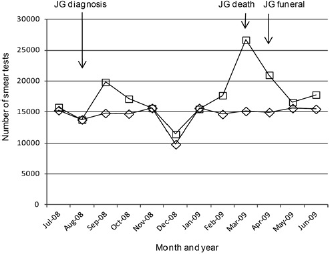
Figure 1 indicates the number of smear tests carried out per month between September 2000 and September 2010, and shows a clear increase in the number of smear tests carried out in 2008/9. A smaller peak was also evident following the introduction of a storyline on the television soap opera Coronation Street in April 2001, in which one of the characters developed cervical cancer and died six weeks thereafter (June 2001). The time series regression model included a seasonal differencing term and a seasonal moving average component (lag 12). The time series analysed, therefore, was the change in monthly smears from its value in the same month, one year ago. Analysis demonstrated there were, on average, 2,502 extra smear tests per month (95% CI 1,643–3,361) during the year of media reporting (2008/9), equivalent to over 33,000 tests during the course of the year. Figure 2 illustrates that there was a clear peak in the difference between the observed number of screening tests in the month of Jade Goody's death (n = 26,658) and the number that would have been expected in the absence of Jade Goody's experience of cervical cancer (n = 15,119; difference 11,539 tests).
Time series plot indicating the number of cervical screening tests carried out for all women in Wales between 2000 and 2010. Events associated with increased uptake of cervical screening are marked by arrows, including the introduction of a storyline on Coronation Street (April 2001) and death of the character (June 2001); and the months of Jade Goody (JG)'s diagnosis (August 2008), death (March 2009), and funeral (April 2009) Comparison of the difference between the observed number of cervical screening tests carried out (open squares) and the number of tests expected in the absence of media reporting (open diamonds) during 2008/9, the year of media reporting of Jade Goody. Arrows mark the months of Jade Goody's cervical cancer diagnosis, death and funeral (August 2008; March 2009; and April 2009, respectively)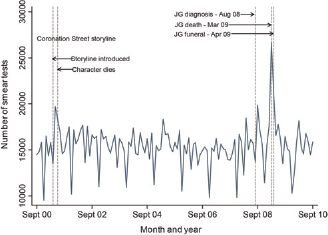
The absolute increase in the number of screening tests undertaken per month during 2008/9 was greatest in women aged 25–44 years, in whom the average number of additional smear tests over that expected ranged between 376 and 475 per month. Approximately 500 additional screening tests were undertaken, on average, per month within each deprivation quintile. The relative increase in coverage (the proportion of eligible women aged 20–64 years screened within the last 5 years) during 2008/9 compared with 2007/8was modest and similar across age groups (e.g. 20–24 yrs: difference 0.3%, 95% CI 0.3–0.4%; 25–29 yrs, 45–49 yrs and 60–64 yrs: difference 0.2%, 95% CI 0.2–0.3%).
Response Time to Cervical Screening Invitation
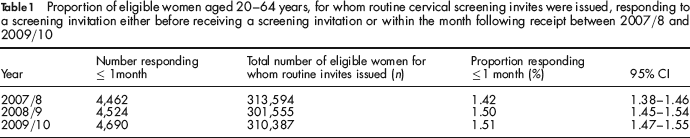
The proportion of women attending screening before receiving an invitation or in the month following receipt was slightly higher in 2008/9 and 2009/10 compared with 2007/8 (Table 1). The proportion of women accessing screening before invitations were received rose from 0.004% (n = 14) in 2007/8to 0.02% (n = 61) in 2008/9 and 0.01% (n = 45) in 2009/10 and analysis by quarter showed that this number was greatest in the quarter of Jade Goody's funeral (April–June 2009, n = 42). However, numbers were very low overall.
Proportion of eligible women aged 20–64 years, for whom routine cervical screening invites were issued, responding to a screening invitation either before receiving a screening invitation or within the month following receipt between 2007/8 and 2009/10
Referrals to Colposcopy
Figure 3a shows the overall increase in the number of referrals to colposcopy for women between 2007 and 2010 (n [2007/8] 8,474; n [2008/9] 10,292; n [2009/10] 10,649), peaking between the period of Jade Goody's death and funeral. The number of referrals increased for all referral smear test results between 2007/8 and 2008/9. However, only those from smear tests showing borderline changes and mild dyskaryosis continued to rise in 2009/10 following the media reporting of Jade Goody (Figure 3b). The proportion of referrals for borderline tests was significantly higher in 2009/10 compared with 2007/8 (difference in proportion 3.7%, 95% CI 2.5–4.9%).
Number of referrals to colposcopy between 2007 and 2010 (a) and number of referrals to colposcopy by smear test result (b). The number of referrals to colposcopy by referral smear test result are shown in the year before media reporting, 2007/8 (white bars), the year of media reporting 2008/9 (grey bars) and the year following media reporting 2009/10 (black bars)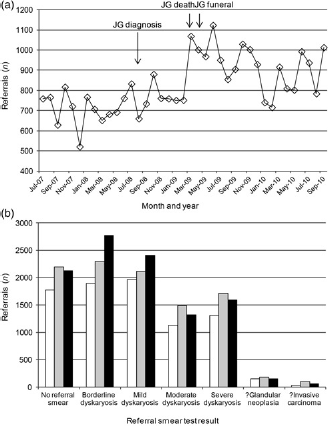
The number of referrals increased in all age groups in 2008/9 compared with 2007/8, the greatest increase being evident for women aged 20–24 years, 25–29 years and 30–34 years. Among women aged 20–24 years and 25–29 years, the largest increases were evident for smear tests coded as borderline, moderate dyskaryosis or severe dyskaryosis (additional referrals [n] 2008/9 versus 2007/8 20–24 yrs: 104, 156, 178; 25–29 years: 92, 71, 108, respectively). For women aged 30–34 years the largest increase was evident for those coded as moderate dyskaryosis, severe dyskaryosis or no referral smear result (additional referrals [n] 2008/9 versus 2007/8: 46, 66, 72, respectively). During 2008/9, referrals from smears coded as invasive carcinoma also increased but numbers of referrals were small (< 25 referrals) in each age group.
Attendance At Colposcopy
The number of colposcopy appointments booked rose steadily from 37,736 in 2007/8to 47,499in 2009/10. The proportion of appointments attended by all women (rather than cancelled, changed by patient or hospital, or not attended) rose from 56.2% in 2007/8 to 58.6% in 2008/9(χ 2 = 45.8, P < 0.001); whilst the proportion of appointments not attended decreased from 10.8% to 8.4% (χ 2 = 136.6, P < 0.001). The odds of attending appointments were slightly higher in both 2008/9 and 2009/10 compared with 2007/8 (AOR 1.10, 95% CI 1.04–1.17; P = 0.002; AOR 1.14, 95% CI 1.08–1.21; P < 0.001, respectively). The odds of an appointment being categorized as ‘did not attend’ significantly decreased in 2008/9 compared with 2007/8 (AOR 0.74, 95% CI 0.67–0.82; P < 0.001) but to a lesser extent in 2009/10 compared with 2007/8 (AOR 0.88, 95% CI 0.80–0.96; P = 0.006).
Discussion
Mass media reporting of the experiences of a UK celebrity with cervical cancer was associated with a significant (but transient) rise in cervical screening uptake, particularly amongst women aged 25–44 years, and an increase in referrals to, and attendance at, colposcopy. Colposcopy referrals increased for all smear test result types, with the greatest increase in referrals evident in younger women and a continued rise evident from smear tests showing borderline changes and mild dyskaryosis in the year following the media reporting. In contrast, the proportion of women responding to a screening invitation either before receipt or within the month following receipt increased only marginally.
Our finding regarding the increase in smear tests carried out supports findings of previous studies and systematic reviews highlighting that mass media interventions can be an effective means of influencing public health and increasing screening uptake5,6,8,9,18,19 but that the duration of effect may be somewhat short-lived.5,6,9,12,13,20,21 Previous studies have reported that media coverage of celebrities with cancer, and mass media campaigns of between four and nine weeks duration, have been associated with sharp but transient impacts on screening and information-seeking behaviour,5,6,9,13–16,22,23,25 with 27%, 21%, 18% and 15% increases reported in the number of screening tests conducted and impacts evident for between two and 19 weeks following the end of the intervention.5,6,9,24,25 Our study demonstrated a 19% increase in screening tests performed and an 18% rise in colposcopy referrals during the year of Jade Goody's illness with marked effects seen when Jade Goody died, the period of peak media reporting. 26
The effect of media reporting particularly amongst younger women is encouraging in light of evidence demonstrating consistently lower cervical screening coverage amongst younger women.3,27 Previous studies have reported that those most affected by media reporting of cancer tend to be similar to the celebrity in terms of age group12,23,28,29 and our study provides further evidence to suggest that widely-recognized or relevant role models could play a role in enhancing uptake amongst target age groups in future media campaigns.
In contrast, we found limited evidence of an effect of media reporting of Jade Goody on the number of cervical screening tests carried out among women in different socio-economic groups, consistent with the results of an evaluation of a mass media intervention on cervical screening uptake in Australia. 5 Nevertheless, approximately half of women that responded to a cervical screening invitation in the month of receipt of an invitation were in the two least deprived quintiles, indicating a greater propensity of women from higher socio-economic groups to respond quickly to screening invitations, and suggesting a need to target messages more appropriately across socio-economic groups.
Our finding of a short-lived impact on screening uptake, and the lack of evidence for a marked sustained impact on the proportion of women responding quickly to cervical screening invitations, is of interest in light of a meta-analysis demonstrating that media campaigns with greater reach and exposure have a stronger effect on behaviour. 11 Reports of Jade Goody's experiences were found in print, visual and electronic media over a prolonged time period and frequently emphasized the more personal, emotive and painful aspects of her illness.26,30
However, content analysis of media reports of Jade Goody's experiences demonstrated that less than 5% of newspaper reports mentioned risk factors for cervical cancer, with just 8.2% of articles mentioning screening, but 41% mentioning the terminal nature of her illness and 36% reporting on her treatment.14,26 Consistent with studies demonstrating a lack of preventive information in media reports of cancer or cancer screening,31–34 the comparative lack of mobilizing information regarding screening and prevention may have precluded longer-term impacts on behaviour.
In contrast to cervical screening uptake, colposcopy referrals continued to increase in the two years following the start of media reporting of Jade Goody, reflecting the sustained impact of the increase in smear tests carried out. The increase in referrals for moderate dyskaryosis, severe dyskaryosis and invasive carcinoma in younger women suggests a possible impact of the media reporting on the identification, monitoring or treatment of cellular abnormalities and raises the possibility that women at higher risk may have been encouraged to attend screening. Cervical screening of women aged 20–24 years, however, has been found to have little or no impact on rates of invasive cervical cancer in women aged under 30 years35,36 and taken together with the concurrent increase in referrals from smear tests showing borderline changes, mild or moderate dyskaryosis in the year following media reporting, the data suggest that a number of younger women may have been subjected to further testing and anxiety for abnormalities that might not have progressed to cervical cancer.
Two thirds of the additional referrals for borderline changes in 2009/10 were made for women aged 20–34 years, which may have raised anxiety levels among younger women, and no rise was evident in the proportion of referrals from inadequate, borderline, mild, moderate or severe dyskaryosis smear test results that led to the identification of cervical cancer during 2007/8or2008/9. Similarly, no rise in the proportion of referrals with an outcome of histologically diagnosed high-grade cervical intraepithelial neoplasia (CIN2) was evident in 2008/9 compared with 2007/8.17,37
Overall, this study has demonstrated that widespread and sustained media reporting of a well known celebrity is associated with enhanced, but transient, cervical screening uptake and referrals and attendance at colposcopy. The preferential impact of the media reporting amongst younger women suggests that media campaigns could play a role in enhancing uptake in this group. However, there is a need for proactive interaction between public health practitioners, screening professionals, and the media during such mass media events, to ensure that preventive information is provided in a clear and accessible format for target audiences. Careful design and targeting of public health messages is required to limit anxiety whilst sustaining impacts and ensuring that beneficial impacts are maximized in target groups.