






Abstract
The EUROCAT website www.eurocat-network.eu publishes prenatal detection rates for major congenital anomalies using data from European population-based congenital anomaly registers, covering 28% of the EU population as well as non-EU countries. Data are updated annually. This information can be useful for comparative purposes to clinicians and public health service managers involved in the antenatal care of pregnant women as well as those interested in perinatal epidemiology.
EUROCAT is a European Network for Surveillance of Congenital Anomalies. 1 The network started back in 1980 and now includes over 40 registries in 20 countries and covers 28% of all births in the European Union as well as other European countries. The registries use multiple sources of information to ascertain cases such as hospital records, birth and death certificates, post mortem examination reports, and include information about livebirths (LB), fetal deaths (FD) with gestational age ≥20 weeks and terminations of pregnancy (TOPFA) after prenatal diagnosis of malformations. All major structural malformations, syndromes and chromosomal anomalies are included in the database. Cases are classified in specified subgroups according to the malformation codes given at local level. Prevalence data on individual malformations by type of birth can be found on the website at http://www.eurocat-network.eu/ACCESSPREVALENCEDATA/PrevalenceTables. For all full member registries 2003-2007 the prevalence of all major anomalies was 2.37% and for non-chromosomal major anomalies overall prevalence was 2.01% (Website January 2010). Of the 76,216 cases with congenital anomalies reported in 2003-2007 13,410 (17.6%) were TOPFA.
Prenatal diagnosis of 7 selected major congenital anomalies in 17 EUROCAT registries 2003-2007
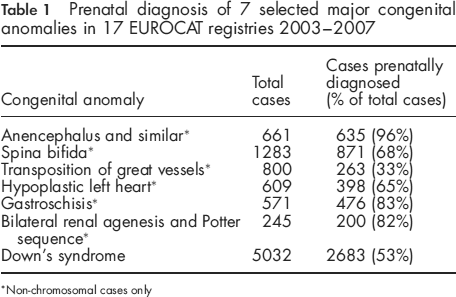
Non-chromosomal cases only
The prenatal detection rate is related to the policy of prenatal screening in the actual region or country. 2 Reports of the prenatal screening policies and the laws on TOPFA in 13 European countries for 2005 and 2009 are available at the EUROCAT website (http://www.eurocat-network.eu/PRENATALSCREENINGAndDIAGNOSIS/GeneralInformation/PublicationsonPrenatalDiagnosis) as well as a list of collaborative publications relating to prenatal screening and specific congenital anomalies.
Footnotes
Acknowledgements
EUROCAT is co-funded by the Public Health Programme of the European Commission Public Health Directorate.
For Oxford: This paper reports an independent study part funded by the Healthcare Quality Improvement Partnership (Department of Health, UK). The views expressed are not necessarily those of the Department.