






Abstract
The widespread use of prostate-specific antigen (PSA) testing has dramatically changed the epidemiology of prostate cancer. Growing incidence rates have been documented in almost all western countries following the increased usage of PSA screening. In the United States after a period of huge increase in incidence, rates have decreased to values lower than those of the pre-PSA era. Similar changes have been documented also in the area of the Tuscany Cancer Registry, central Italy, where prostate cancer incidence rates doubled from the early 1990s to 2003 and afterwards decreased. This is the first evidence, to our knowledge, of a decline in prostate cancer incidence in Italy following the screening-related increase.
We believe it might be relevant to note that a similar figure has been observed in central Italy in the area of the Tuscany Cancer Registry where prostate cancer incidence rates almost doubled from the early 1990s to 2000. 3 This occurred as a consequence of widespread PSA use in Tuscany, showing values as high as 30% at age 55–69, or 40% at age 70–74 during 2004 and 2005, 4 in spite of estimated low compliance to biopsy prompted by elevated PSA.
Figure 1 shows standardized (European population) incidence rates from the Tuscany Cancer Registry from 1985 to 2005, for the age 50+ years. An increasing trend of incidence was observed since the early 1990s. A join-point analysis carried out to detect changes in linear trend documented a sharp increase in incidence from 1985 to 2003 (the annual percent change of rates, APC, was +4.9, 95% CI +4.3; + 5.4). Afterwards rates started to decrease (APC = –3.9; 95% CI –15.3; +8.9).
Tuscany Cancer Registry. Prostate cancer incidence, age 50+ years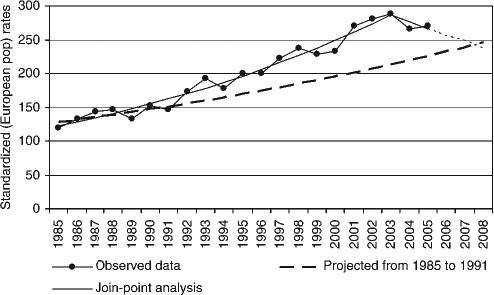
The decline in incidence rate observed in Tuscany since 2003 may suggest that the spontaneous screening prevalence round effect is starting to subside. If this decreasing trend continues, it is possible to forecast that in 2008 we will reach the same incidence levels expected according to the pre-PSA (1985–1991) increasing rate (APC = +2.9).
This is the first evidence, to our knowledge, of a decline of prostate cancer incidence in Italy, following the screening-related increase.