






Abstract
Objectives
To analyse the effect of an organized, nationwide breast cancer screening programme on non-organized mammography activities in Hungary.
Setting
The nationwide dataset of the Hungarian National Health Insurance Fund Administration covering the years 2000-2005.
Methods
Data derived from the nationwide database of the Hungarian National Health Insurance Fund Administration. The study includes all women undergoing mammography before (2000-2001) and after (2002-2003/2004-2005) the introduction of organized screening.
Results
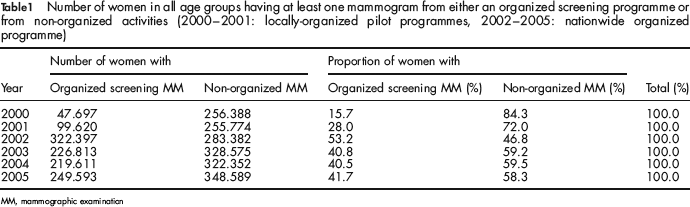
The number of women having non-organized (opportunistic/diagnostic) mammograms was around 250,000 in 2000-2001, but increased to 350,000 in 2005. In the age group 45-64 years in 2000-2001, only 27.4% of all women undergoing mammography were examined within locally-organized programmes. After the introduction of the nationwide programme, this percentage increased to 61.0% in 2002-2003, and 56.3% in 2004-2005. After the introduction of the nationwide organized programme (2002-2003), the proportion of organized screening mammographics remained among the highest in county Hajdú-Bihar (78.4%) and Zala (88.3%) and increased significantly in county Vas (87.7%).
Conclusion
The introduction of an organized nationwide screening programme in Hungary resulted in increases in the number of screening mammographics, and also of non-organized mammographics. Although the ratio of organized screening versus non-organized mammography changed in favour of screening mammographics, there are large within-country differences between counties.
Introduction
In the mid-1990s a breast cancer screening pilot programme, partly financed from a World Bank loan, 8 was introduced in five Hungarian counties. Following evaluation of its results, a nationwide organized breast cancer screening programme was launched in January 2002. 9
Little information is reported in the international literature on non-organized screening and diagnostic mammographics, or on the effect of organized screening on non-organized mammographics.10,11 Even the current European guidelines for quality assurance in breast screening do not contain indicators on non-organized mammographics. 12
We aimed to analyse the effect of the organized, nationwide breast cancer screening programme on non-organized mammography activities in Hungary.
Patients and methods
The Hungarian nationwide breast cancer screening programme
Eligible women between the ages of 45 and 65 are invited to mammographic screening by personal letter. A two-year screening interval is applied, and two-view mammograms (the mediolateral oblique and a craniocaudal views) and double readings are standard. Women within this age group are eligible for organized screening if they have not undergone mammography in the previous 2 years, and have not undergone surgical treatment (mastectomy) for breast cancer. A detailed description of the Hungarian organized nationwide breast cancer screening programme can be found elsewhere. 13
Data and methods of this study
Data are derived from the nationwide database of the National Health Insurance Fund Administration, which contains routinely collected financial data reported by the healthcare providers. Our study includes all women in Hungary undergoing mammographic examination (MM) before (2000-2001) and after (2002-2003/2004-2005) the introduction of nationwide organized screening.
Women undergoing mammography were assigned to two groups according to type of MM: women having MM within local or nationwide organized breast cancer screening programmes (organized screening MM), and those undergoing MM outside of the organized programmes, regardless of whether this was a result of a complaint or general practitioner's referral, or if they just wanted to have an alternative MM (non-organized MM).
Results
Number of women in all age groups having at least one mammogram from either an organized screening programme or from non-organized activities (2000-2001: locally-organized pilot programmes, 2002-2005: nationwide organized programme)
MM, mammographic examination
The proportion of women aged between 45 and 64 having MM within the organized screening programme or as a result of non-organized activity before (2000-2001), and after (2002-2003,/2004-2005) the introduction of the nationwide breast screening programme is shown on Figure 1. In 2000-2001, only 27.4% of women aged between 45 and 64 having MM fell within the framework of local organized programmes. After the introduction of the nationwide programme this percentage increased to 61.0% in 2002-2003 and 56.3% in 2004-2005.
Proportion of women aged 45-64 years undergoing mammographic examination (MM) within the organized screening programme or as a result of non-organized activities before (2000-2001) and after (2002-2003, 2004-2005) the introduction of nationwide breast screening programme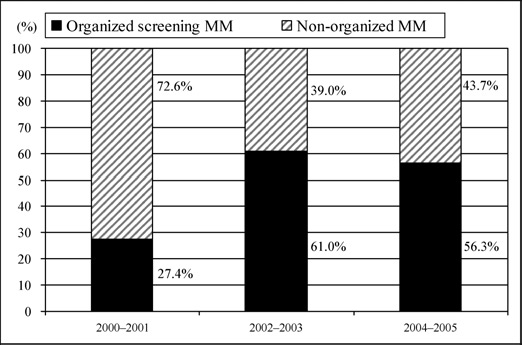
Figure 2 shows the proportion of women aged between 45 and 64 undergoing organized screening and non-organized mammography, according to counties, before and after the introduction of nationwide screening programme (2000-2001 versus 2002-2003). We found the highest rate of screening mammographics in counties running a local organized pilot screening programme: counties Hajdú-Bihar (56.6%), Jász-Nagykun-Szolnok (60.2%), Tolna (52.1%) and Zala (62.8%). After the introduction of the nationwide organized programme in 2002-2003, the proportion of organized screening mammographics remained among the highest in counties Hajdú-Bihar (78.4%) and Zala (88.3%), and increased significantly in county Vas (87.7%). The lowest proportion of organized screening mammographics was in 2002-2003 in counties Komárom-Esztergom (47.2%), Békés (42.5%), Budapest (47.2%) and Pest (48.1%).
Proportion of women aged 45-64 undergoing organized screening mammography and with non-organized mammography according to counties before and after the introduction of nationwide screening programme (2000-2001 versus 2002-2003)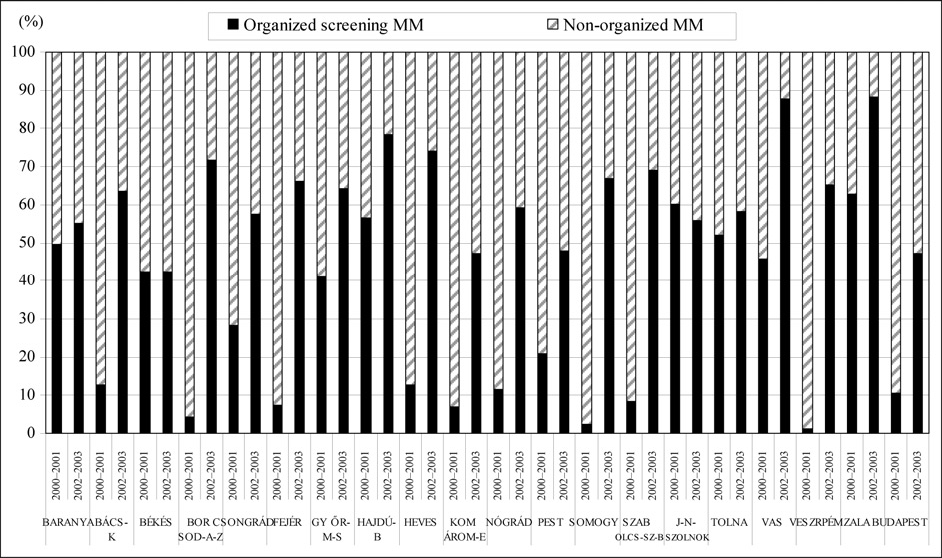
Discussion and conclusions
The introduction of the nationwide organized breast cancer screening programme resulted in an increase in both the number of organized screening and non-organized mammographics.
In the target age group, the proportion of women having organized screening instead of non-organized (opportunistic/diagnostic) mammographics increased, showing that women invited for organized screening did not seek non-organized screening. However, women aged 45-65 but not eligible to take part in organized screening programme (because they had had non-organized MM in the previous 2 years) sought mammography elsewhere. We should revise our current screening strategy in order to attract women who undergo non-organized mammography into the organized screening programme.
In Denmark, organized mammographic screening for women aged 50-69 did not encourage non-organized (opportunistic) screening in women aged 30-49 years, as only 2% of women in Fyn and 3% in Copenhagen used diagnostic mammography in 2000. 14 Beemsterboer et al. 15 reported that Dutch data showed an immediate increase in requests for non-organized mammography in all age groups after the start of an organized mammographic screening programme, but this levelled-off after only two years. Approximately, 20% of the women aged 50-69 in the Vaud canton, Switzerland, had a diagnostic mammography every year, and about 25% of women aged 50-65 in Barcelona, Spain, periodically had non-organized mammography.16,17
We found a high proportion of non-organized (opportunistic/diagnostic) mammographics in the counties of Békés, Komárom-Esztergom, Budapest and Pest. In counties Békés and Komárom-Esztergom, there were no mammographic screening units, so women invited for screening should have gone to neighbouring counties.
The introduction of the organized nationwide screening programme in Hungary resulted in an increase both in the number of screening mammographics, and of non-organized (opportunistic/diagnostic) mammographics. Although the ratio of screening versus non-organized mammography changed in favour of screening mammographics, there are large within-country differences between counties.
Funding
No.
Conflict of interest
No.