






Abstract
The purpose of this randomized controlled trial was to examine if an adjunct research project to a breast cancer screening programme would affect the high programme attendance. Women residing in the municipality of Tromsø aged 55 years or older, scheduled to receive an invitation letter to their first screening round in the Norwegian Breast Cancer Screening Programme during our 15-week recruitment period, were eligible. We randomly selected up to 25 invitees per screening day to receive a mailed request to participate in the research project named the Tromsø Mammography and Breast Cancer study. These women constituted the study arm, while the remaining eligible invitees served as the control arm. The attendance rate to the screening programme was 80.1% among the 253 women in the study arm and 74.8% among the 397 women in the control arm (P = 0.09). Our trial finds no effect on the high attendance to the breast cancer screening programme indicating that cancer screening programmes might be suitable settings for adjunct research projects.
Introduction
If epidemiological studies can successfully recruit participants from population-based cancer screening programmes with high attendance, these programmes would be the ideal setting for cancer research. A large number of eligible subjects could be reached, and the research project should be less prone to selection bias. Participants in epidemiological studies are frequently requested to donate biological specimens. Thus, those responsible for the screening programme may decline adjunct research projects to take place because they fear that the attendance rate to the screening programme may be detrimentally influenced. To our knowledge, only a couple of studies have investigated this issue.5,6
The purpose of this randomized controlled trial (RCT) was to examine if an adjunct research project to a breast cancer screening programme would affect the high programme attendance.
Subjects and methods
The present study is based on data from women invited to the Norwegian Breast Cancer Screening Programme (NBCSP) 7 at the University Hospital of North Norway, Center for Breast Imaging, Department of Radiology located in Tromsø. In 2001, an average of 80 invitees received a personal addressed letter from the Cancer Registry of Norway stating the place and time for the screening examination and a phone number if the woman wanted to change the appointment. 7
Women were eligible if they were: residing in the municipality of Tromsø, aged 55 years or older and scheduled to be invited to their first screening round during our 15-week recruitment period.
We randomly selected up to 25 invitees for each screening day to receive a letter from the University of Tromsø, Norway (UiT) thereby constituting the study arm. They were given the following information: the Tromsø Mammography and Breast Cancer (TMBC) study was designed and conducted at UiT with the main objectives to utilize mammographic densities in breast cancer research, participation in the TMBC study would include a short interview, measurements of body height, weight, waist and hip circumferences, a blood sample and a four-page questionnaire to be filled in at home and to be returned in a prepaid envelope.
Furthermore, the letter assured the women that their decision about participating in the research project or not would not influence their status in the screening programme, that they could withdraw at any time, that the Regional Committee for Medical Research Ethics and the National Data Inspection Board had approved the study and finally requested a written informed consent. The remaining eligible invitees served as the control arm. A research assistant requested attendees from the control arm to participate in the TMBC study at the screening facility.
We estimated the attendance rate to the screening programme and the intention-to-treat efficacy as the ratio between attendees and participants in the TMBC study, respectively, and eligible invitees in the same period. 8 Likewise, we calculated the participation rate to the TMBC study among the screening attendees and among those screening attendees who were requested either by letter or in person. The analyses were done overall and by study arm. We used the χ2-statistics to test for differences between the comparison groups. Results were considered statistically significant if the P value was <0.05. All P values were two-sided.
Results
Table 1 shows that the attendance rate to the screening programme was 80.1% among the 253 women in the study arm when compared with 74.8% among the 397 women in the control arm (P = 0.09). During our recruitment period, 58.9% (n = 383) of all screening invitees who were eligible for the TMBC study participated. There was no difference regarding the intention-to-treat efficacy between the study (60.9%) and control (57.7%) arm (P = 0.4).
Attendance rates * to the norwegian breast cancer screening programme (NBCSP) among screening invitees in the controlled trial and subsequent participation rates to the tromsø mammography and breast cancer (TMBC) study overall and by study arm
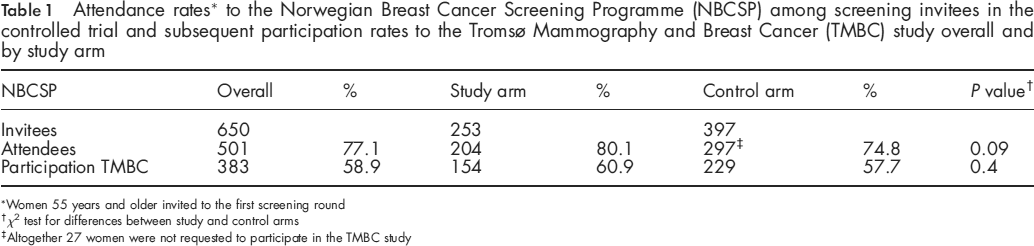
Women 55 years and older invited to the first screening round
χ2 test for differences between study and control arms
Altogether 27 women were not requested to participate in the TMBC study
Twenty-seven attendees from the control arm were not requested to participate in the TMBC study owing to lack of manpower. Among the screening attendees, overall 76.4% and of those requested 80.8% participated in the TMBC study. In the latter group, 84.8% of the attendees requested in person compared with 75.5% of those requested by mail in advance (P < 0.001).
Discussion
Our RCT found that recruitment letters to an adjunct research project did not affect the high attendance to the breast cancer screening programme. Furthermore, the majority, but not all, of the eligible screening invitees participated in the research project even if this also included donation of a blood sample. The intention-to-treat efficacy was the same for the two study arms.
A previous study from the Netherlands found that 53% of the women attended the breast cancer screening whether they were requested to participate in research projects or not. 5 We find it reassuring that this also seems to be the case in breast cancer screening programmes with high attendance.
Our research project also achieved a relatively high participation rate. The population in Tromsø has regularly been requested to participate in research projects, which could make it familiar; but could also have the opposite effect because the women would be tired of contributing to research. Our results from the Norwegian Women and Cancer Study has previously shown that women from North Norway had a higher response rate to a postal questionnaire when compared with women nationwide indicating that these women have a positive attitude to the regional University. 9 Our finding that women were more likely to participate after an in-person request is in accordance with a meta-analysis assessing the overall effect of direct-contact recruitment on mammography participation. 10
Some major strengths of our study are the strict invitation and follow-up procedures to the screening programme and the close collaboration with the Center for Breast Imaging. Two limitations are that we were unable to request as many women as we had planned and that some women who missed their first screening appointment were rescheduled after our recruitment period.
In summary, our randomized trial finds no effect on the high attendance to the breast cancer screening programme indicating that cancer screening programmes might be suitable settings for adjunct research projects.
Footnotes
Acknowledgements
The study was performed in cooperation with the Departments of Clinical Research and Radiology, Center for Breast Imaging, University Hospital of North Norway, the Norwegian Women and Cancer Study, University of Tromsø, and the Cancer Registry of Norway. We especially want to acknowledge Dr Nils Bjurstam at the Center for Breast Imaging, for his support. We want to thank the women who participated in the study. The Norwegian Cancer Society, the Aakre Foundation and The Norwegian Women's Public Health Association gave financial support for the study.