






Abstract
We read with interest an article on the interference caused by Patent Blue V® dye in the serum sample interference indices on the Roche modular (F Hoffmann-La Roche, Basel, Switzerland), 1 after noticing the same dye caused a similar effect on these indices on the Abbott Architect (Abbott Laboratories, Chicago, IL, USA). Patent Blue V® is a dye that is used in certain surgical procedures, in particular to guide sentinel lymph node biopsy. 2 Its use carries the potentially fatal side-effect of anaphylatic reaction. 3,4 The dye has also been shown to cause interference in pulse oximetry and co-oximetry. 5
We noticed that administration of Patent Blue V® dye for a surgical procedure caused a patient's serum sample to take on a green appearance, which was most apparent in the sample taken immediately postsurgery. The green colour was still present, but less intense, in a sample taken five hours after surgery, but had returned to a normal yellow appearance in a sample taken the following day (20 h postsurgery).
We found negative changes in the haemolysis and icterus indices on the Abbott Architect in the green samples, which correlated with the intensity of the colour (Figure 1). In addition, the dye caused positive interference in the lipaemia index. These findings are consistent with those of the study on the effect of Patent Blue V® on the Roche modular sample interference indices.
1
The analytical interference of Patent Blue V® dye in serum samples. The effect of Patent Blue V® dye on Abbott Architect interference indices is shown, as well as traces from spectrophotometric scanning performed on a Unicam UV/visible spectrophotometer, in serum samples taken at three time points: immediately postadministration of the dye (0 h) and at 5 h and 20 h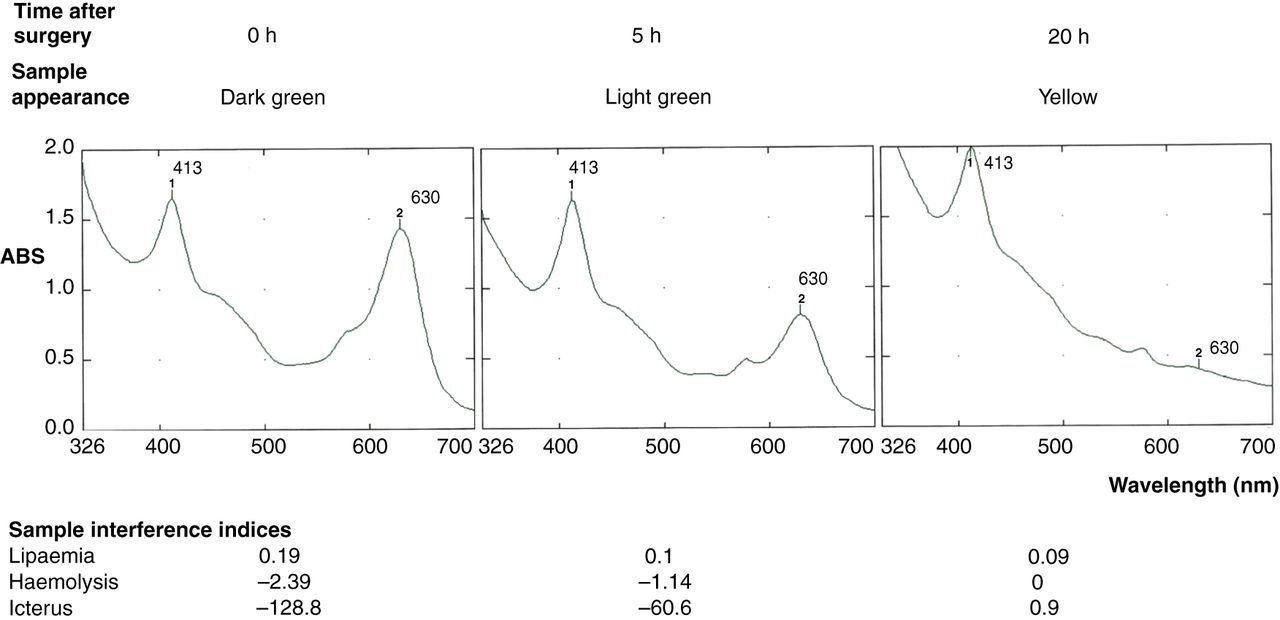
Scanning spectrophotometry (between 326 and 700 nm) using a Unicam UV/visible spectrophotometer (Unicam Analytical Systems, Madison, WI, USA) revealed a peak at 630 nm in the green samples (Figure 1), which was not present in the serum sample with a normal appearance. The presence and size of the peak at 630 nm correlated with the change in the sample interference indices. In addition, there was a peak at 413 nm in all samples, which was largest in the sample with a normal appearance.
Sample interference indices for haemolysis, lipaemia and icterus on the Abbott Architect are calculated using specific formulae following bichromatic spectrophotometric readings at 500/524 nm (A1), 572/604 nm (A2), 628/660 nm (A3) and 524/804 nm (A4). The peak at 630 nm in the green samples would be expected to affect at least the A2 and A3 readings, thus explaining the effect on the interference indices.
The dye did not appear to affect routine biochemical measurements (data not shown), consistent with the findings of the study on the Roche modular. 1 However, the interference caused by Patent Blue V® has the potential to mask the presence of haemolysis or icterus, and exaggerate the presence of lipaemia. Therefore, in theory, a spurious result could be issued in such samples, e.g. a falsely elevated potassium concentration. We recommend interpreting biochemical results with caution in serum samples affected by Patent Blue V® and considering possible hidden haemolysis or icterus when these indices are apparently ‘normal’.
DECLARATIONS