






Abstract
Point-of-care blood glucose meters based on glucose dehydrogenase (GDH) and pyrroloquinoline quinone (PQQ)-coupled reaction are subject to interference by non-glucose sugars 1 and icodextrin metabolites, chiefly maltose. 2
Reports of treatment of spurious hyperglycaemia, arising from the interference, with insulin leading to life-threatening/fatal hypoglycaemia caused the Food and Drug Administration and others 3–6 to issue safety notices to alert health professionals of the dangers of using GDH-PQQ-based glucose monitoring systems.
Roche Accu-Chek Advantage/Sensor Comfort glucose test strip (Roche Diagnostics, Basle, Switzerland) is based on GDH-PQQ reaction and is subject to positive interference by the non-glucose sugars mentioned in the safety notices.
Roche has now launched a successor glucose test strip called Accu-Chek Performa. Although the latter is still based on GDH-PQQ reaction, it is claimed that maltose interference has been eliminated and that blood glucose results are not significantly influenced by patients' haematocrit within the range of 10–65%.
We evaluated the Performa glucose test strips for interference from non-glucose sugars (fructose, galactose, lactose, maltose, mannose and xylose) and for the effect of blood haematocrit on blood glucose measurements. Throughout this study, glucose metabolism in heparinized whole venous blood was inhibited by adding
For the interference study, heparinized venous blood containing 10 mmol/L
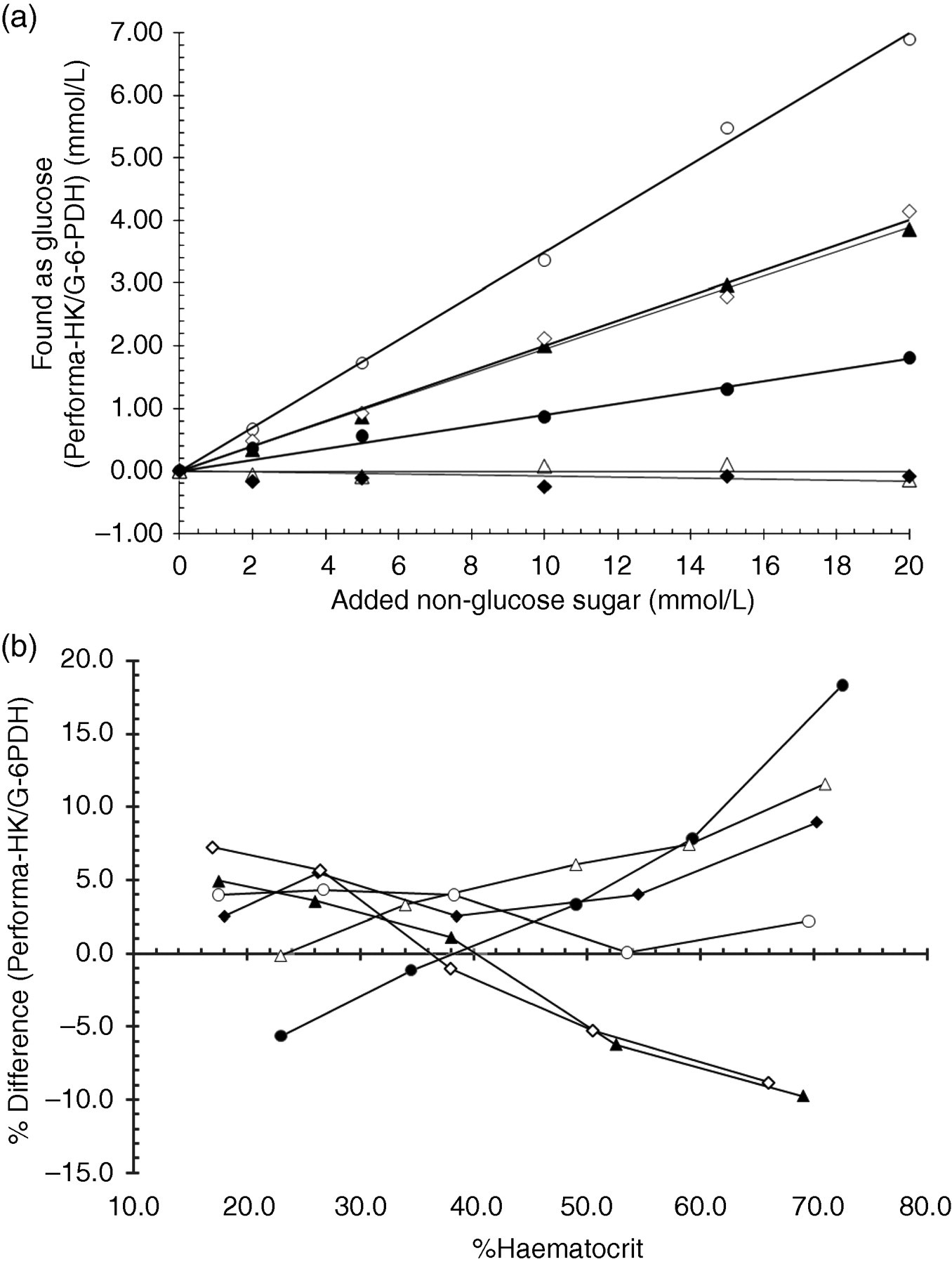
(a) Interference of non-glucose sugars with glucose measurement using Performa Glucose strip on Roche Accu-Chek Inform II. ○, galactose; ▴, lactose; ◊, mannose; •, maltose; Δ, fructose; and ♦, xylose. Basal blood glucose concentration was 5.17 mmol/L. (b) Effect of haematocrit on measurements of different levels of blood glucose compared with HK/G-6-PDH reference method. •, 1.85 mmol/L glucose; Δ, 4.03 mmol/L glucose; ♦, 5.6 mmol/L glucose; ○, 7.82 mmol/L glucose; ◊, 12.45 mmol/L glucose; and ▴, 18.14 mmol/L glucose
Fructose and xylose showed no interference (Figure 1a). However, the presence of 1 mmol/L of maltose, mannose, lactose and galactose raised the glucose concentration by 0.09, 0.19, 0.19 and 0.34 mmol/L, respectively. Although the magnitude of interference by maltose with the Performa strip is considerably less than with its predecessor, 9% positive interference is still significant.
In order to study the effect of haematocrit, cellular and plasma proportions of the heparinized venous blood were adjusted to obtain haematocrits of 17.5–23.0%, 26.0–34.5%, 38.0–49.0%, 51.0–59.0% and 66.0–72.5%. Haematocrits were measured by capillary centrifugation in Hettich Haematoktrit Centrifuge (NV Qlab SA, Vilvoorde, Belgium). Each haematocrit level was tested at mean blood glucose concentration of 1.9, 4.0, 5.6, 7.8, 12.5 and 18.1 mmol/L. While the low blood glucose concentration (1.9 mmol/L) was achieved by allowing the heparinized whole blood, without
Figure 1b shows the percentage differences of glucose measurements with the Performa glucose strip compared with the HK/G-6-PDH method at different levels of haematocrit and blood glucose concentrations. The Performa results showed some degree of mutual dependency of haematocrit and glucose concentration. At all glucose concentrations and haematocrits of 17–59%, the Performa results were within ±7% of the reference method. When glucose concentration was 1.9 mmol/L and haematocrits were 23.0% and 34.5%, Performa gave 5.6% and 1.1% lower results, respectively, compared with the reference method. Thereafter, the Performa results were higher than the reference method (Figure 1b). At glucose concentrations of 12.5 and 18.1 mmol/L, the Performa results decreased with increasing haematocrit.
In summary, for haematocrits ranging from 17% to 59% and at all glucose concentrations tested, the Performa results were within ±7% of the reference method. Of the non-glucose sugars tested for interference, fructose and xylose showed no interference; maltose caused significant (9%); lactose and mannose substantial (both being 19%); and galactose severe (34%) positive interference.
DECLARATIONS